Market Insights
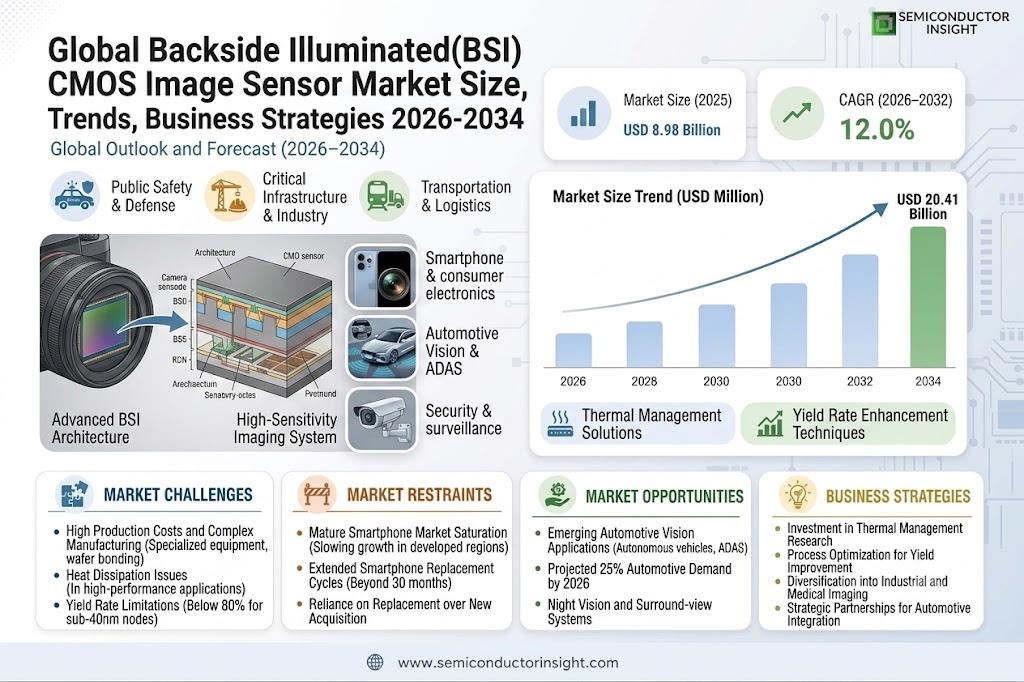
Global Backside Illuminated(BSI) CMOS Image Sensor Market size was valued at USD 8.98 billion in 2025. The market is projected to grow from USD 10.12 billion in 2026 to USD 20.41 billion by 2032, exhibiting a CAGR of 12.0% during the forecast period.
Backside Illuminated(BSI) CMOS Image Sensor Market is an advanced imaging technology that enhances light sensitivity by repositioning the photodiode layer behind the wiring layer, minimizing light obstruction compared to traditional front-side illuminated sensors. This architecture significantly improves low-light performance and image quality, making it ideal for applications in smartphones, automotive systems, and industrial imaging.
The market growth is driven by increasing demand for high-resolution cameras in mobile devices and the rapid adoption of ADAS (Advanced Driver Assistance Systems) in vehicles. Additionally, advancements in stacked BSI-CMOS sensors and rising investments in AI-powered imaging solutions are accelerating industry expansion. Key players such as Sony Semiconductor Solutions, Samsung Electronics, and OmniVision Technologies continue to innovate with higher pixel densities and improved dynamic range capabilities.
MARKET DRIVERS
Growing Demand for High-Resolution Imaging
Backside Illuminated(BSI) CMOS Image Sensor Market is experiencing significant growth due to increasing demand for high-resolution imaging in smartphones, automotive cameras, and surveillance systems. Manufacturers are investing heavily in BSI technology to enhance low-light performance and pixel sensitivity, with shipments expected to grow by 12% annually.
Advancements in Semiconductor Fabrication
Technological advancements in semiconductor fabrication processes have enabled manufacturers to produce BSI CMOS image sensors with smaller pixel sizes while maintaining light sensitivity. This innovation drives adoption across medical imaging and industrial applications, where precision is critical.
The integration of AI-powered image processing with BSI CMOS sensors is creating new growth avenues, particularly in computational photography and machine vision applications.
MARKET CHALLENGES
High Production Costs and Complex Manufacturing
Backside Illuminated(BSI) CMOS Image Sensor Market faces challenges from the complex manufacturing processes required for BSI technology. The need for specialized equipment and wafer bonding techniques increases production costs by approximately 20-25% compared to traditional sensors.
Other Challenges
Heat Dissipation Issues
BSI CMOS image sensors in high-performance applications generate significant heat, requiring additional thermal management solutions that increase device complexity.
Yield Rate Limitations
Current yield rates for advanced BSI sensors remain below 80% for nodes below 40nm, presenting production scalability challenges for mass-market adoption.
MARKET RESTRAINTS
Mature Smartphone Market Saturation
With smartphone markets reaching maturity in developed regions, growth opportunities for BSI CMOS image sensors in this segment are slowing. Manufacturers must increasingly rely on replacement cycles rather than new customer acquisition, with replacement periods extending beyond 30 months in major markets.
MARKET OPPORTUNITIES
Emerging Automotive Vision Applications
Backside Illuminated(BSI) CMOS Image Sensor Market is poised for growth in automotive applications, particularly for advanced driver-assistance systems (ADAS) and autonomous vehicles. The automotive sector is projected to account for 25% of BSI sensor demand by 2026, with night vision and surround-view systems driving adoption.
Medical and Scientific Imaging Expansion
BSI CMOS image sensors are gaining traction in medical endoscopy and scientific instrumentation due to their superior quantum efficiency. The global market for medical imaging sensors is expected to reach USD 1.2 billion by 2025, with BSI technology capturing an increasing share.
Backside Illuminated(BSI) CMOS Image Sensor Market Trends
Advancements in BSI CMOS Architecture Driving Market Growth
Backside Illuminated(BSI) CMOS Image Sensor Market continues to evolve with significant architectural improvements. These sensors now offer 30% better light sensitivity compared to front-side illuminated designs, enabling superior low-light performance. Leading manufacturers have transitioned to stacked BSI designs, which integrate signal processing circuits directly beneath the photodiode layer.
Other Trends
Automotive Applications Emerging as Key Growth Segment
The automotive sector now accounts for nearly 25% of BSI CMOS Image Sensor demand, driven by ADAS requirements and in-cabin monitoring systems. These applications demand sensors with high dynamic range (HDR) above 120dB and automotive-grade reliability. Tesla and other automakers are deploying up to 16 BSI sensors per vehicle.
Consumer Electronics Transition to Higher Resolutions
While smartphone markets are saturating, the push for 100MP+ cameras in flagship devices continues. BSI technology enables smaller pixel pitches below 0.7μm while maintaining image quality. Manufacturers are also developing advanced pixel isolation techniques to minimize crosstalk in high-density arrays. The consumer segment remains the largest application, though growth rates are slowing to single digits.
Industrial and Medical Applications Gaining Traction
Professional applications now represent the fastest growing sector for BSI CMOS Image Sensors, with medical imaging and machine vision demanding specialized features. Global shutter BSI sensors have seen particular adoption for industrial inspection systems, offering high-speed capture without motion artifacts. Endoscopic applications benefit from the improved signal-to-noise ratios of BSI architectures.
Manufacturing Technology Developments
The industry is transitioning to more advanced 28nm and 22nm process nodes for BSI CMOS production, enabling higher integration and better power efficiency. TSMC and Sony lead in developing specialized CIS processes, while packaging innovations like wafer-level chip-scale packaging help reduce module sizes. These manufacturing improvements are critical for meeting automotive and industrial temperature requirements.
COMPETITIVE LANDSCAPE
Key Industry Players
BSI CMOS Image Sensor Market Dominated by Specialized Semiconductor Giants
Sony Semiconductor Solutions maintains undisputed leadership in Backside Illuminated(BSI) CMOS Image Sensor Market with 40% global share, leveraging its proprietary stacked sensor technology. The Japanese conglomerate supplies high-performance sensors for premium smartphones and automotive applications. Samsung Electronics follows with 20% market presence, capitalizing on its vertical integration from semiconductor fabrication to consumer device manufacturing. OmniVision (acquired by Will Semiconductor) holds 12% share through innovative pixel designs for mid-range mobile devices.
Emerging Chinese players like GalaxyCore and Smartsens Technology are gaining traction in security and industrial segments with cost-competitive solutions. STMicroelectronics leads in automotive BSI sensors for advanced driver assistance systems (ADAS), while ON Semiconductor dominates medical imaging applications. Japanese firms Panasonic and Canon maintain strong positions in industrial machine vision with specialized global shutter BSI sensors. South Korea’s SK Hynix and China’s SOI Semiconductor are expanding capacity to challenge the incumbents.
List of Key BSI CMOS Image Sensor Companies Profiled
- Sony Semiconductor Solutions
- Samsung Electronics
- OmniVision Technologies
- STMicroelectronics
- ON Semiconductor
- GalaxyCore Inc.
- Panasonic Corporation
- Smartsens Technology
- Canon Inc.
- SK Hynix
- SOI Semiconductor
- Toshiba Electronic Devices
- Himax Technologies
- PixArt Imaging
- Silicon Optronics
Segment Analysis:
| Segment Category | Sub-Segments | Key Insights |
| By Type |
|
More than 10 Megapixels dominates Backside Illuminated(BSI) CMOS Image Sensor Market due to:
|
| By Application |
|
Automotive is the fastest growing application segment due to:
|
| By End User |
|
OEMs represent the dominant end user segment because:
|
| By Architecture |
|
Stacked BSI CIS is gaining market share due to:
|
| By Shutter Type |
|
Global Shutter technology is becoming increasingly important for:
|
Regional Analysis: Global Backside Illuminated (BSI) CMOS Image Sensor Market
Asia-Pacific
Asia-Pacific hosts the world’s most concentrated BSI CMOS production network, with foundries and OSAT facilities clustered in key locations. This ecosystem enables rapid prototyping and cost-effective high-volume production, giving regional players competitive advantages in time-to-market and manufacturing scalability for next-generation image sensors.
The region’s massive smartphone market drives continuous innovation in BSI CMOS technology. Manufacturers compete to develop sensors with smaller pixel sizes, improved quantum efficiency, and enhanced durability to meet the requirements of flagship mobile devices from local and global brands.
Asian semiconductor firms lead in developing stacked BSI CMOS architectures and advanced pixel technologies. Research institutions collaborate with manufacturers to push the boundaries of sensor performance, particularly in low-light conditions and high-speed capture scenarios.
The region boasts fully integrated supply chains for BSI CMOS production, from wafer fabrication to module assembly. This vertical integration allows for tighter quality control and faster adaptation to changing market demands compared to regions with fragmented supply networks.
North America
North America remains a key innovation hub for Backside Illuminated CMOS Image Sensor technologies, particularly in specialized applications. The region’s strength lies in high-performance imaging for defense, medical diagnostics, and automotive LiDAR systems. American semiconductor companies focus on developing customized BSI solutions with enhanced spectral response and advanced packaging techniques. The market benefits from strong collaboration between tech giants, academic institutions, and startups, fostering breakthroughs in quantum efficiency and 3D stacking architectures for next-generation image sensors.
Europe
European manufacturers specialize in high-end industrial and automotive BSI CMOS sensors, emphasizing reliability and precision. The region leads in developing sensors for machine vision applications in manufacturing automation and quality control systems. Strict EU regulations regarding imaging performance standards drive innovation in sensor calibration and consistency. Automotive manufacturers particularly value European-developed BSI sensors for advanced driver assistance systems, where superior low-light performance and thermal stability are critical requirements.
South America
The South American BSI CMOS Image Sensor market focuses primarily on consumer electronics imports and automotive applications. While local manufacturing remains limited, the region shows growing demand for smartphone cameras and security surveillance systems. Governments are implementing policies to attract sensor component manufacturing, particularly focusing on packaging and testing facilities. The market’s potential is recognized, though infrastructure challenges and semiconductor ecosystem development remain key hurdles for regional growth in this sector.
Middle East & Africa
This emerging region sees increasing adoption of BSI CMOS sensors primarily in security and surveillance applications. Governments invest in smart city projects that require high-performance imaging solutions with low-light capabilities. The market shows potential for growth in consumer electronics as smartphone penetration increases, though most sensors are imported from established manufacturing regions. Local companies explore opportunities in specialized applications such as desert environment imaging and oil/gas industry inspection systems.
Report Scope
This market research report provides a comprehensive analysis of the Backside Illuminated(BSI) CMOS Image Sensor Market, covering the forecast period 2025–2032. It offers detailed insights into market dynamics, technological advancements, competitive landscape, and key trends shaping the industry.
Key focus areas of the report include:
- Market Overview: The report begins with an overview outlining its current market scenario, key growth indicators, and industry transformation drivers. It discusses macroeconomic factors, demand–supply balance, regulatory landscape, and the strategic role of semiconductors in powering advancements across industries such as automotive, telecommunications, consumer electronics, and industrial automation.
- Market Size & Forecast: Historical data and future projections for revenue, unit shipments, and market value across major regions and segments.
- Segmentation Analysis: Detailed breakdown by product type, technology, application, and end-user industry to identify high-growth segments and investment opportunities.
- Regional Insights: Insights into market performance across North America, Europe, Asia-Pacific, Latin America, and the Middle East & Africa, including country-level analysis where relevant.
- Competitive Landscape: Profiles of leading market participants, including their product offerings, R&D focus, manufacturing capacity, pricing strategies, and recent developments such as mergers, acquisitions, and partnerships.
- Technology Trends & Innovation: Assessment of emerging technologies, integration of AI/IoT, semiconductor design trends, fabrication techniques, and evolving industry standards.
- Market Drivers & Restraints: Evaluation of factors driving market growth along with challenges, supply chain constraints, regulatory issues, and market-entry barriers.
- Stakeholder Insights: Insights for component suppliers, OEMs, system integrators, investors, and policymakers regarding the evolving ecosystem and strategic opportunities.
Primary and secondary research methods are employed, including interviews with industry experts, data from verified sources, and real-time market intelligence to ensure the accuracy and reliability of the insights presented.
FREQUENTLY ASKED QUESTIONS:
What is the current market size of Backside Illuminated(BSI) CMOS Image Sensor Market?
-> Backside Illuminated(BSI) CMOS Image Sensor Market size was valued at USD 8.98 billion in 2025. The market is projected to grow from USD 10.12 billion in 2026 to USD 20.41 billion by 2032, exhibiting a CAGR of 12.0% during the forecast period.
What is the production volume of Backside Illuminated(BSI) CMOS Image Sensors?
-> In 2025, global Backside Illuminated(BSI) CMOS Image Sensor production reached approximately 3.46 billion Units, with an average global market price of around USD 2.84 per unit.
Which key companies operate in Backside Illuminated(BSI) CMOS Image Sensor Market?
-> Key players include SONY, Samsung, OmniVision, STMicroelectronics, On Semi, GalaxyCore, Panasonic, Smartsens Technology, Canon, and SOI, among others.
What are the key growth drivers?
-> Key growth drivers include increasing demand for high-resolution imaging in smartphones, expansion of automotive ADAS systems, and growing adoption in industrial and medical applications.
Which region dominates the market?
-> Asia is the dominant market, with strong presence in China, Japan, and South Korea, while North America and Europe remain significant markets for advanced applications.
What are the emerging trends?
-> Emerging trends include stacked BSI CIS architectures, global shutter technology, and integration of AI-powered imaging solutions.

Get Sample Report PDF for Exclusive Insights
Report Sample Includes
- Table of Contents
- List of Tables & Figures
- Charts, Research Methodology, and more...
 Download Sample Report PDF