Aviation Sensors Market, Trends, Business Strategies 2026-2034

Aviation Sensors Market was valued at USD 465 million in 2025 and is expected to reach USD 676 million by 2032 at a CAGR of 5.6%

PDF Icon Download Sample Report PDF
  • Quick Dispatch

    All Orders

  • Secure Payment

    100% Secure Payment

Price range: $1,500.00 through $4,250.00

Clear

Aviation Sensors Market Insights

Global Aviation Sensors market size was valued at USD 465 million in 2025. The market is projected to reach USD 676 million by 2032, exhibiting a CAGR of 5.6% during the forecast period.

Aviation sensors are specialized measuring instruments crucial for ensuring aircraft stability and safety during flight. These sensors monitor environmental changes around the aircraft, facilitating real-time data for navigation, control, and performance optimization. They represent one of the most vital components of avionics equipment on an aircraft. Key types include Temperature Sensors, Humidity Sensors, Oxygen Sensors, Pressure Sensors, Flow Sensors, Speed Sensors, and Position Sensors.

The market is experiencing steady growth driven by factors such as rising global air traffic, stringent safety regulations from bodies like the FAA and EASA, and advancements in smart sensor technologies. Furthermore, the surge in unmanned aerial vehicle (UAV) deployments and commercial fleet expansions are accelerating demand. Key players are bolstering innovation through strategic initiatives. Honeywell International Inc., Raytheon Company, GE Aviation, United Technologies Corp, Thales, Meggitt PLC, Safran SA, and TE Connectivity Ltd. dominate with comprehensive portfolios, holding significant revenue shares among the top manufacturers.
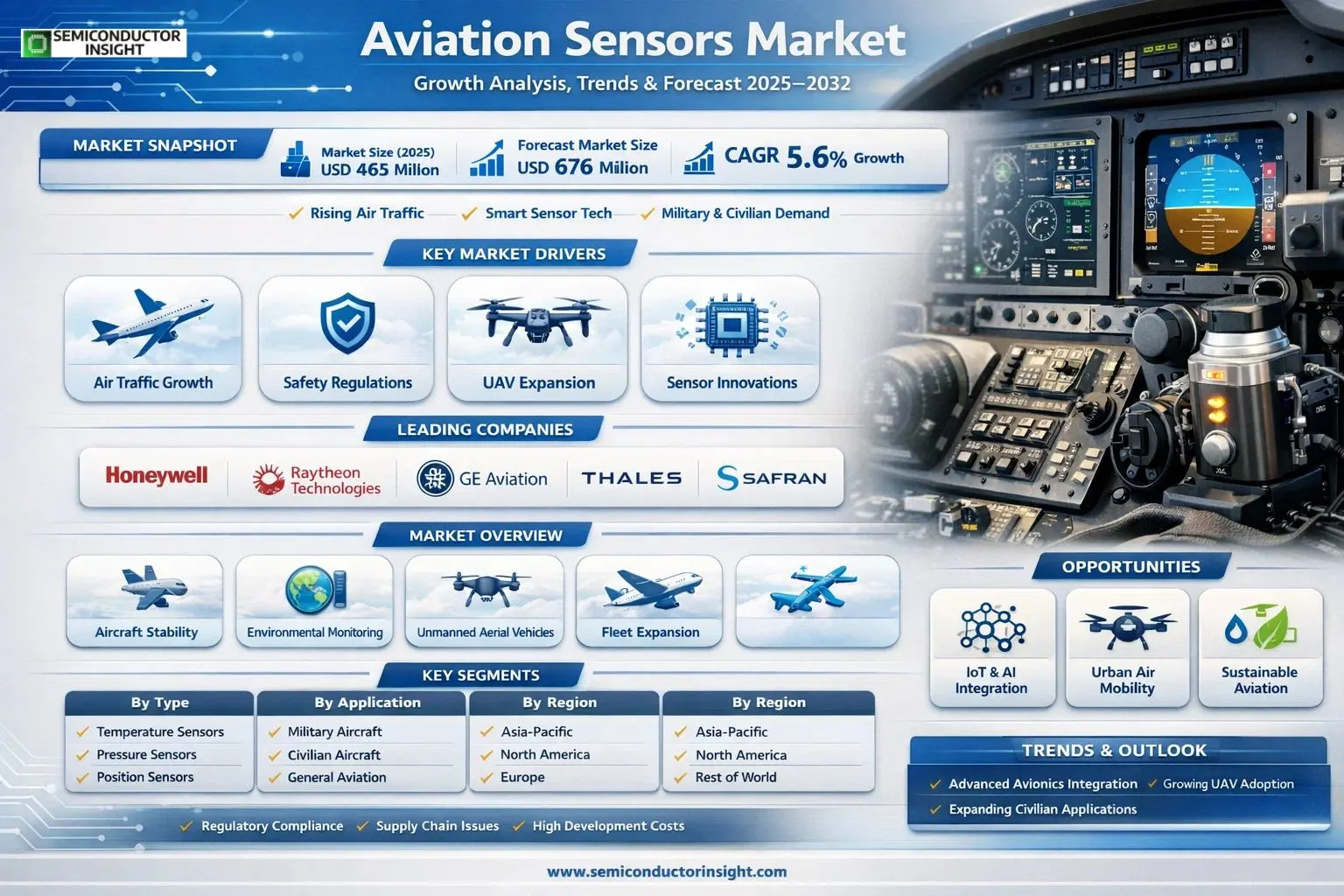
Aviation Sensors Market

MARKET DRIVERS

Technological Advancements

Aviation Sensors Market is propelled by rapid innovations in micro-electro-mechanical systems (MEMS) and fiber optic sensors, enabling lighter, more precise measurements for flight controls and engine monitoring. These technologies enhance aircraft performance and fuel efficiency, aligning with global sustainability goals. With the integration of smart sensors in modern airframes, manufacturers are achieving real-time data analytics that reduce operational downtimes.

Surging Air Traffic Demand

Global air passenger traffic is projected to reach 4.7 billion by 2025, driving demand for advanced sensors in commercial aviation fleets. Airlines are retrofitting older aircraft with next-generation inertial and pressure sensors to meet heightened safety standards. This expansion supports Aviation Sensors Market’s growth trajectory at a CAGR of approximately 7.2% through 2030.

Key growth factor: UAV proliferation, with over 1 million commercial drones expected by 2030, necessitating compact, rugged sensors for navigation and obstacle avoidance.

Furthermore, the push for autonomous flight systems amplifies the need for reliable environmental and vibration sensors, fostering market expansion across military and civil sectors.

MARKET CHALLENGES

Regulatory Compliance Hurdles

Navigating stringent certifications from FAA and EASA poses significant challenges in Aviation Sensors Market, often extending development timelines by 18-24 months. Compliance testing for harsh environmental conditions, such as extreme temperatures and vibrations, requires extensive validation, increasing project costs by up to 30%.

Other Challenges

Supply Chain Disruptions

Post-pandemic shortages of rare earth materials critical for sensor manufacturing have delayed production, impacting 25% of OEM deliveries. Geopolitical tensions exacerbate this, forcing diversification strategies.Integration complexities with legacy avionics systems further complicate upgrades, demanding custom interfaces that elevate engineering expenses and slow market penetration in regional aviation.

MARKET RESTRAINTS

High Development Costs

Elevated R&D investments, averaging $50-100 million per sensor platform, restrain smaller players in Aviation Sensors Market. The need for redundancy and fail-safe designs multiplies expenses, limiting innovation to major incumbents like Honeywell and Safran.Volatile raw material prices, influenced by semiconductor shortages, add financial pressure, with costs rising 15% in recent years. This hampers scalability for emerging applications in electric vertical takeoff vehicles.Cybersecurity vulnerabilities in connected sensor networks introduce risks, prompting cautious adoption amid evolving threats. Airlines prioritize proven technologies, curbing rapid market shifts.Economic uncertainties, including fluctuating fuel prices and reduced fleet investments during downturns, further constrain growth in commercial aviation segments.

MARKET OPPORTUNITIES

IoT and AI Integration

Aviation Sensors Market stands to benefit from IoT-enabled predictive maintenance, potentially saving airlines $4-5 billion annually in downtime costs. AI algorithms processing sensor data for anomaly detection will drive adoption in next-gen aircraft.Urban air mobility initiatives, with eVTOL deliveries forecasted at 25,000 units by 2030, create demand for lightweight, high-accuracy sensors in propulsion and battery management systems.Sustainable aviation fuels and hybrid-electric propulsion open avenues for advanced temperature and flow sensors, supporting net-zero emission targets by 2050.Aftermarket services, including sensor retrofits for aging fleets, represent a $2 billion opportunity, bolstered by digital twin technologies for enhanced lifecycle management.
Aviation Sensors Market Trends

Integration of Advanced Sensors in Avionics for Enhanced Safety

Aviation sensors play a critical role in monitoring environmental changes to ensure aircraft stability and safety during flight. In Aviation Sensors Market, there is a strong push toward integrating advanced sensors within avionics systems. These instruments detect variations in pressure, temperature, humidity, oxygen levels, flow, speed, and position, enabling real-time data for pilots and automated systems. Manufacturers are focusing on precision and reliability to meet stringent regulatory standards from bodies like the FAA and EASA. This trend is driven by the need for superior situational awareness, particularly in complex flight conditions.

Other Trends

Diversification Across Sensor Types

Aviation Sensors Market shows diversification in product types, with pressure sensors, position sensors, and speed sensors gaining prominence alongside traditional temperature and humidity sensors. This expansion addresses varied aircraft requirements, from engine monitoring to flight control surfaces. Industry surveys highlight that suppliers are innovating to combine multiple sensing capabilities into compact modules, reducing weight and improving efficiency in modern aircraft designs.

Growth in Military and Civilian Applications

Applications in both military and civilian sectors are shaping Aviation Sensors Market. Military uses demand rugged sensors for high-stress environments, while civilian aviation emphasizes cost-effective, lightweight solutions for commercial fleets. Key players like Honeywell International Inc., Raytheon Company, and GE Aviation are leading developments tailored to these segments. Recent advancements include enhanced oxygen and flow sensors for life support systems in fighters and passenger jets alike. Regional dynamics show North America maintaining leadership due to established manufacturers, while Asia, particularly China and Japan, is emerging with increased production to support growing fleets.

Competitive landscapes reveal top firms holding significant shares through mergers and R&D investments. Challenges include supply chain disruptions and cybersecurity risks for connected sensors, prompting a shift toward resilient designs. Overall, Aviation Sensors Market is evolving with emphasis on smart, interconnected technologies that support next-generation aircraft autonomy and sustainability goals.

COMPETITIVE LANDSCAPE

Key Industry Players

Aviation Sensors Market Leaders and Strategic Positioning

Aviation Sensors Market exhibits an oligopolistic structure dominated by established aerospace giants, with Honeywell International Inc. leading as a primary innovator in avionics sensing technologies. Honeywell’s extensive portfolio, encompassing pressure, temperature, and position sensors critical for flight stability and safety, positions it at the forefront, supported by its robust R&D investments and integration with major aircraft OEMs. Raytheon Company, GE Aviation, United Technologies Corp (now part of RTX), and Thales collectively command a substantial revenue share, leveraging synergies in military and civilian applications. This concentration among top players fosters innovation in sensor precision and reliability, amid a market projected to grow from $465 million in 2025 to $676 million by 2032 at a 5.6% CAGR, driven by rising air traffic and stringent safety regulations.

Beyond the frontrunners, niche players like Meggitt PLC, Safran SA, and Esterline Technologies Corporation carve out specialized roles, focusing on advanced humidity, flow, and oxygen sensors for extreme aviation environments. Companies such as Eaton Corporation and TE Connectivity Ltd. excel in connectivity-integrated sensors, addressing emerging needs in smart avionics and unmanned systems. Additional significant contributors including Ametek, Crane Co., Stellar Technology, Curtiss-Wright Corporation, and CETC provide tailored solutions for regional markets, particularly in Asia-Pacific defense sectors. This diverse competitive ecosystem encourages mergers, acquisitions, and technological collaborations, enhancing market resilience against supply chain challenges and regulatory hurdles while spurring advancements in sensor miniaturization and data analytics for predictive maintenance.

List of Key Aviation Sensors Companies Profiled

Segment Analysis:

Segment Category Sub-Segments Key Insights
By Type
  • Temperature Sensor
  • Humidity Sensor
  • Oxygen Sensor
  • Pressure Sensor
  • Flow Sensor
  • Speed Sensor
  • Position Sensor
Leading Segment: Pressure Sensor

  • Essential for altitude determination and cabin pressurization systems, directly impacting flight safety and comfort.
  • Provides real-time data for autopilot and flight management systems, enabling precise navigation in varying atmospheric conditions.
  • High demand stems from rigorous certification requirements and the need for robust performance in extreme temperatures and vibrations.
  • Integrates seamlessly with avionics suites from major manufacturers, fostering widespread adoption across aircraft fleets.
By Application
  • Military Aircraft
  • Civilian Aircraft
  • General Aviation
  • Others
Leading Segment: Civilian Aircraft

  • Dominates due to expansive commercial fleets requiring continuous monitoring for operational efficiency and regulatory compliance.
  • Supports advanced engine health management and environmental control systems in passenger and cargo operations.
  • Growing integration with predictive maintenance technologies enhances reliability and reduces downtime for airlines.
  • Key enabler for fuel-efficient routing and optimized flight paths in high-traffic airspace environments.
By End User
  • Commercial Airlines
  • Defense Organizations
  • MRO Providers
  • OEMs
Leading Segment: OEMs

  • Primary integrators during aircraft manufacturing, ensuring sensors meet exact design specifications from inception.
  • Facilitate seamless incorporation into new-generation aircraft with enhanced avionics architectures.
  • Drive innovation through collaborations with tier-one suppliers for customized sensor solutions.
  • Benefit from long-term fleet support contracts, embedding sensors as core components of airframe systems.
By Platform
  • Fixed-Wing Aircraft
  • Rotary-Wing Aircraft
  • UAVs
Leading Segment: Fixed-Wing Aircraft

  • Core to both commercial and military fleets, demanding high-precision sensors for long-haul and high-speed operations.
  • Critical for aerodynamic control, structural integrity monitoring, and propulsion system feedback.
  • Adapts to diverse missions from transcontinental flights to tactical insertions, requiring versatile sensor capabilities.
  • Benefits from mature supply chains and standardized interfaces across major airframe manufacturers.
By Technology
  • MEMS Sensors
  • Fiber Optic Sensors
  • Traditional Analog Sensors
Leading Segment: MEMS Sensors

  • Offer compact size, low power consumption, and superior accuracy ideal for modern avionics miniaturization trends.
  • Enable integration into smart systems for real-time data processing and fault detection.
  • Resilient to electromagnetic interference, crucial for electronic-intensive aircraft environments.
  • Support shift towards lighter-weight designs, improving overall aircraft performance and efficiency.

Regional Analysis: Aviation Sensors Market

North America

North America leads Aviation Sensors Market through its robust aerospace ecosystem, where innovation drives sensor integration for enhanced flight safety and efficiency. Major manufacturers pioneer advanced technologies like inertial navigation and pressure sensors, tailored for commercial and military aircraft. The region’s stringent regulatory frameworks from bodies like the FAA ensure high reliability standards, fostering trust among operators. Collaborative R&D between OEMs and suppliers accelerates adoption of smart sensors for predictive maintenance and real-time monitoring. Growing demand for next-generation aircraft, including sustainable aviation initiatives, propels sensor diversification into environmental and health monitoring systems. Supply chain maturity and proximity to key assembly hubs minimize integration challenges, positioning North America as the benchmark for aviation sensors market excellence. This dominance stems from decades of investment in aerospace infrastructure, enabling seamless scalability and customization for diverse applications from drones to wide-body jets.

North America Key Drivers
Strong aerospace heritage fuels demand for precision aviation sensors market solutions. Fleet modernization initiatives prioritize sensors for fuel efficiency and safety. Government contracts bolster military sensor deployments, while urban air mobility concepts spur lightweight, compact designs.
North America Major Players
Industry giants like Honeywell and Collins Aerospace dominate, offering integrated sensor suites. Their extensive portfolios cover flight control and engine health monitoring, supported by robust service networks. Strategic partnerships enhance market penetration.
North America Tech Advancements
Focus on IoT-enabled sensors enables data analytics for proactive maintenance. Fiber optic and MEMS technologies improve accuracy in harsh environments. R&D investments drive AI integration for autonomous flight systems.
North America Regulations
FAA certifications streamline approvals for sensor innovations. Emphasis on cybersecurity and data integrity shapes compliance. Harmonized standards with EASA facilitate exports, strengthening aviation sensors market leadership.

Europe
Europe’s aviation sensors market thrives on a collaborative ecosystem centered around Airbus and suppliers like Safran. Emphasis on sustainable aviation fuels and noise reduction drives demand for advanced environmental sensors. The EASA’s rigorous certification processes ensure seamless integration across multinational fleets. Regional focus on digitalization introduces next-generation sensors for connected aircraft, enhancing operational resilience. Defense sector growth, particularly in unmanned systems, expands applications for ruggedized navigation sensors. Supply chain diversification post-disruptions strengthens resilience, while EU-funded projects accelerate innovations in health monitoring and vibration analysis for extended aircraft lifespans.

Asia-Pacific
Asia-Pacific emerges as a dynamic hub in Aviation Sensors Market, propelled by rapid fleet expansion from airlines in China and India. Local manufacturing ramps up to meet booming air travel, with sensors vital for cost-effective maintenance. Government initiatives promote indigenous aerospace capabilities, fostering sensor localization. Urban air mobility and drone regulations spur lightweight sensor development. Regional collaborations with global players transfer technology, boosting precision in flight control systems. Supply chain integration with Southeast Asian hubs enhances efficiency, positioning the region for sustained growth in commercial and cargo aviation.

South America
South America’s aviation sensors market gains momentum from increasing air connectivity in Brazil and neighboring countries. Emphasis on regional manufacturing supports domestic fleets with reliable engine and structural health sensors. Infrastructure upgrades prioritize safety enhancements amid challenging terrains, driving adoption of weather-resilient systems. Partnerships with North American firms introduce advanced diagnostics for aging aircraft. Growing cargo operations demand robust logistics sensors, while biofuel experiments integrate environmental monitoring. Regulatory alignment with international standards facilitates technology imports, nurturing a maturing aviation sensors market landscape.

Middle East & Africa
The Middle East & Africa aviation sensors market benefits from ambitious airline expansions and hub developments. Premium carriers invest in luxury cabin sensors for passenger comfort and safety. Harsh climate adaptations favor durable, high-precision systems for navigation and fuel management. Defense modernization introduces military-grade sensors, while African initiatives focus on affordable solutions for regional connectivity. Cross-continental collaborations enhance supply chains, promoting sensor innovations for long-haul operations. Sustainable aviation goals integrate low-emission monitoring, solidifying the region’s strategic role in global aviation sensors market dynamics.

Report Scope

This market research report provides a comprehensive analysis of Aviation Sensors Market, covering the forecast period 2025–2032. It offers detailed insights into market dynamics, technological advancements, competitive landscape, and key trends shaping the industry.

Key focus areas of the report include:

  • Market Overview: The report begins with an overview outlining its current market scenario, key growth indicators, and industry transformation drivers. It discusses macroeconomic factors, demand–supply balance, regulatory landscape, and the strategic role of aviation sensors in powering advancements across industries such as commercial aviation, military aircraft, unmanned systems, and general aviation.
  • Market Size & Forecast: Historical data and future projections for revenue, unit shipments, and market value across major regions and segments.
  • Segmentation Analysis: Detailed breakdown by product type, technology, application, and end-user industry to identify high-growth segments and investment opportunities.
  • Regional Insights: Insights into market performance across North America, Europe, Asia-Pacific, Latin America, and the Middle East & Africa, including country-level analysis where relevant.
  • Competitive Landscape: Profiles of leading market participants, including their product offerings, R&D focus, manufacturing capacity, pricing strategies, and recent developments such as mergers, acquisitions, and partnerships.
  • Technology Trends & Innovation: Assessment of emerging technologies, integration of AI/IoT, semiconductor design trends, fabrication techniques, and evolving industry standards.
  • Market Drivers & Restraints: Evaluation of factors driving market growth along with challenges, supply chain constraints, regulatory issues, and market-entry barriers.
  • Stakeholder Insights: Insights for component suppliers, OEMs, system integrators, investors, and policymakers regarding the evolving ecosystem and strategic opportunities.

Primary and secondary research methods are employed, including interviews with industry experts, data from verified sources, and real-time market intelligence to ensure the accuracy and reliability of the insights presented.

FREQUENTLY ASKED QUESTIONS:

What is the current market size of Aviation Sensors Market?

-> Aviation Sensors Market was valued at USD 465 million in 2025 and is expected to reach USD 676 million by 2032 at a CAGR of 5.6%.

Which key companies operate in Aviation Sensors Market?

-> Key players include Honeywell International Inc., Raytheon Company, GE Aviation, United Technologies Corp, Thales, Meggitt PLC, Safran SA, Esterline Technologies Corporation, Eaton Corporation, TE Connectivity Ltd., among others.

What are the key growth drivers?

-> Key growth drivers include demand for aircraft stability and safety monitoring, expansion in military and civilian aviation, and advancements in avionics equipment.

Which region dominates the market?

-> North America is a key market with significant U.S. presence, while Asia shows strong potential in China and other countries.

What are the emerging trends?

-> Emerging trends include growth in segments like Temperature Sensor, Pressure Sensor, Position Sensor, and focus on military and civilian applications.


Aviation Sensors Market, Trends, Business Strategies 2026-2034

Get Sample Report PDF for Exclusive Insights

Report Sample Includes

  • Table of Contents
  • List of Tables & Figures
  • Charts, Research Methodology, and more...

PDF Icon Download Sample Report PDF
SKU: 07eddfc74d70
Category:
License Type

Corporate License, Excel License, PDF and Excel Databook License

Download Sample Report

Table of Content

1 Introduction to Research & Analysis Reports
1.1 Aviation Sensors Market Definition
1.2 Market Segments
1.2.1 Segment by Type
1.2.2 Segment by Application
1.3 Global Aviation Sensors Market Overview
1.4 Features & Benefits of This Report
1.5 Methodology & Sources of Information
1.5.1 Research Methodology
1.5.2 Research Process
1.5.3 Base Year
1.5.4 Report Assumptions & Caveats
2 Global Aviation Sensors Overall Market Size
2.1 Global Aviation Sensors Market Size: 2025 VS 2032
2.2 Global Aviation Sensors Market Size, Prospects & Forecasts: 2021-2032
2.3 Global Aviation Sensors Sales: 2021-2032
3 Company Landscape
3.1 Top Aviation Sensors Players in Global Market
3.2 Top Global Aviation Sensors Companies Ranked by Revenue
3.3 Global Aviation Sensors Revenue by Companies
3.4 Global Aviation Sensors Sales by Companies
3.5 Global Aviation Sensors Price by Manufacturer (2021-2026)
3.6 Top 3 and Top 5 Aviation Sensors Companies in Global Market, by Revenue in 2025
3.7 Global Manufacturers Aviation Sensors Product Type
3.8 Tier 1, Tier 2, and Tier 3 Aviation Sensors Players in Global Market
3.8.1 List of Global Tier 1 Aviation Sensors Companies
3.8.2 List of Global Tier 2 and Tier 3 Aviation Sensors Companies
4 Sights by Type
4.1 Overview
4.1.1 Segment by Type – Global Aviation Sensors Market Size Markets, 2025 & 2032
4.1.2 Temperature Sensor?
4.1.3 ?Humidity Sensor?
4.1.4 ?Oxygen Sensor?
4.1.5 ?Pressure Sensor?
4.1.6 ?Flow Sensor?
4.1.7 Speed ?Ssensor?
4.1.8 Position Sensor?
4.2 Segment by Type – Global Aviation Sensors Revenue & Forecasts
4.2.1 Segment by Type – Global Aviation Sensors Revenue, 2021-2026
4.2.2 Segment by Type – Global Aviation Sensors Revenue, 2027-2032
4.2.3 Segment by Type – Global Aviation Sensors Revenue Market Share, 2021-2032
4.3 Segment by Type – Global Aviation Sensors Sales & Forecasts
4.3.1 Segment by Type – Global Aviation Sensors Sales, 2021-2026
4.3.2 Segment by Type – Global Aviation Sensors Sales, 2027-2032
4.3.3 Segment by Type – Global Aviation Sensors Sales Market Share, 2021-2032
4.4 Segment by Type – Global Aviation Sensors Price (Manufacturers Selling Prices), 2021-2032
5 Sights by Application
5.1 Overview
5.1.1 Segment by Application – Global Aviation Sensors Market Size, 2025 & 2032
5.1.2 Military
5.1.3 Civilian
5.2 Segment by Application – Global Aviation Sensors Revenue & Forecasts
5.2.1 Segment by Application – Global Aviation Sensors Revenue, 2021-2026
5.2.2 Segment by Application – Global Aviation Sensors Revenue, 2027-2032
5.2.3 Segment by Application – Global Aviation Sensors Revenue Market Share, 2021-2032
5.3 Segment by Application – Global Aviation Sensors Sales & Forecasts
5.3.1 Segment by Application – Global Aviation Sensors Sales, 2021-2026
5.3.2 Segment by Application – Global Aviation Sensors Sales, 2027-2032
5.3.3 Segment by Application – Global Aviation Sensors Sales Market Share, 2021-2032
5.4 Segment by Application – Global Aviation Sensors Price (Manufacturers Selling Prices), 2021-2032
6 Sights Region
6.1 By Region – Global Aviation Sensors Market Size, 2025 & 2032
6.2 By Region – Global Aviation Sensors Revenue & Forecasts
6.2.1 By Region – Global Aviation Sensors Revenue, 2021-2026
6.2.2 By Region – Global Aviation Sensors Revenue, 2027-2032
6.2.3 By Region – Global Aviation Sensors Revenue Market Share, 2021-2032
6.3 By Region – Global Aviation Sensors Sales & Forecasts
6.3.1 By Region – Global Aviation Sensors Sales, 2021-2026
6.3.2 By Region – Global Aviation Sensors Sales, 2027-2032
6.3.3 By Region – Global Aviation Sensors Sales Market Share, 2021-2032
6.4 North America
6.4.1 By Country – North America Aviation Sensors Revenue, 2021-2032
6.4.2 By Country – North America Aviation Sensors Sales, 2021-2032
6.4.3 United States Aviation Sensors Market Size, 2021-2032
6.4.4 Canada Aviation Sensors Market Size, 2021-2032
6.4.5 Mexico Aviation Sensors Market Size, 2021-2032
6.5 Europe
6.5.1 By Country – Europe Aviation Sensors Revenue, 2021-2032
6.5.2 By Country – Europe Aviation Sensors Sales, 2021-2032
6.5.3 Germany Aviation Sensors Market Size, 2021-2032
6.5.4 France Aviation Sensors Market Size, 2021-2032
6.5.5 U.K. Aviation Sensors Market Size, 2021-2032
6.5.6 Italy Aviation Sensors Market Size, 2021-2032
6.5.7 Russia Aviation Sensors Market Size, 2021-2032
6.5.8 Nordic Countries Aviation Sensors Market Size, 2021-2032
6.5.9 Benelux Aviation Sensors Market Size, 2021-2032
6.6 Asia
6.6.1 By Region – Asia Aviation Sensors Revenue, 2021-2032
6.6.2 By Region – Asia Aviation Sensors Sales, 2021-2032
6.6.3 China Aviation Sensors Market Size, 2021-2032
6.6.4 Japan Aviation Sensors Market Size, 2021-2032
6.6.5 South Korea Aviation Sensors Market Size, 2021-2032
6.6.6 Southeast Asia Aviation Sensors Market Size, 2021-2032
6.6.7 India Aviation Sensors Market Size, 2021-2032
6.7 South America
6.7.1 By Country – South America Aviation Sensors Revenue, 2021-2032
6.7.2 By Country – South America Aviation Sensors Sales, 2021-2032
6.7.3 Brazil Aviation Sensors Market Size, 2021-2032
6.7.4 Argentina Aviation Sensors Market Size, 2021-2032
6.8 Middle East & Africa
6.8.1 By Country – Middle East & Africa Aviation Sensors Revenue, 2021-2032
6.8.2 By Country – Middle East & Africa Aviation Sensors Sales, 2021-2032
6.8.3 Turkey Aviation Sensors Market Size, 2021-2032
6.8.4 Israel Aviation Sensors Market Size, 2021-2032
6.8.5 Saudi Arabia Aviation Sensors Market Size, 2021-2032
6.8.6 UAE Aviation Sensors Market Size, 2021-2032
7 Manufacturers & Brands Profiles
7.1 Honeywell International Inc.
7.1.1 Honeywell International Inc. Company Summary
7.1.2 Honeywell International Inc. Business Overview
7.1.3 Honeywell International Inc. Aviation Sensors Major Product Offerings
7.1.4 Honeywell International Inc. Aviation Sensors Sales and Revenue in Global (2021-2026)
7.1.5 Honeywell International Inc. Key News & Latest Developments
7.2 Raytheon Company
7.2.1 Raytheon Company Company Summary
7.2.2 Raytheon Company Business Overview
7.2.3 Raytheon Company Aviation Sensors Major Product Offerings
7.2.4 Raytheon Company Aviation Sensors Sales and Revenue in Global (2021-2026)
7.2.5 Raytheon Company Key News & Latest Developments
7.3 GE Aviation
7.3.1 GE Aviation Company Summary
7.3.2 GE Aviation Business Overview
7.3.3 GE Aviation Aviation Sensors Major Product Offerings
7.3.4 GE Aviation Aviation Sensors Sales and Revenue in Global (2021-2026)
7.3.5 GE Aviation Key News & Latest Developments
7.4 United Technologies Corp
7.4.1 United Technologies Corp Company Summary
7.4.2 United Technologies Corp Business Overview
7.4.3 United Technologies Corp Aviation Sensors Major Product Offerings
7.4.4 United Technologies Corp Aviation Sensors Sales and Revenue in Global (2021-2026)
7.4.5 United Technologies Corp Key News & Latest Developments
7.5 Thales
7.5.1 Thales Company Summary
7.5.2 Thales Business Overview
7.5.3 Thales Aviation Sensors Major Product Offerings
7.5.4 Thales Aviation Sensors Sales and Revenue in Global (2021-2026)
7.5.5 Thales Key News & Latest Developments
7.6 Meggitt PLC
7.6.1 Meggitt PLC Company Summary
7.6.2 Meggitt PLC Business Overview
7.6.3 Meggitt PLC Aviation Sensors Major Product Offerings
7.6.4 Meggitt PLC Aviation Sensors Sales and Revenue in Global (2021-2026)
7.6.5 Meggitt PLC Key News & Latest Developments
7.7 Safran SA
7.7.1 Safran SA Company Summary
7.7.2 Safran SA Business Overview
7.7.3 Safran SA Aviation Sensors Major Product Offerings
7.7.4 Safran SA Aviation Sensors Sales and Revenue in Global (2021-2026)
7.7.5 Safran SA Key News & Latest Developments
7.8 Esterline Technologies Corporation
7.8.1 Esterline Technologies Corporation Company Summary
7.8.2 Esterline Technologies Corporation Business Overview
7.8.3 Esterline Technologies Corporation Aviation Sensors Major Product Offerings
7.8.4 Esterline Technologies Corporation Aviation Sensors Sales and Revenue in Global (2021-2026)
7.8.5 Esterline Technologies Corporation Key News & Latest Developments
7.9 Eaton Corporation
7.9.1 Eaton Corporation Company Summary
7.9.2 Eaton Corporation Business Overview
7.9.3 Eaton Corporation Aviation Sensors Major Product Offerings
7.9.4 Eaton Corporation Aviation Sensors Sales and Revenue in Global (2021-2026)
7.9.5 Eaton Corporation Key News & Latest Developments
7.10 TE Connectivity Ltd.
7.10.1 TE Connectivity Ltd. Company Summary
7.10.2 TE Connectivity Ltd. Business Overview
7.10.3 TE Connectivity Ltd. Aviation Sensors Major Product Offerings
7.10.4 TE Connectivity Ltd. Aviation Sensors Sales and Revenue in Global (2021-2026)
7.10.5 TE Connectivity Ltd. Key News & Latest Developments
7.11 Ametek
7.11.1 Ametek Company Summary
7.11.2 Ametek Business Overview
7.11.3 Ametek Aviation Sensors Major Product Offerings
7.11.4 Ametek Aviation Sensors Sales and Revenue in Global (2021-2026)
7.11.5 Ametek Key News & Latest Developments
7.12 Crane Co.
7.12.1 Crane Co. Company Summary
7.12.2 Crane Co. Business Overview
7.12.3 Crane Co. Aviation Sensors Major Product Offerings
7.12.4 Crane Co. Aviation Sensors Sales and Revenue in Global (2021-2026)
7.12.5 Crane Co. Key News & Latest Developments
7.13 Stellar Technology
7.13.1 Stellar Technology Company Summary
7.13.2 Stellar Technology Business Overview
7.13.3 Stellar Technology Aviation Sensors Major Product Offerings
7.13.4 Stellar Technology Aviation Sensors Sales and Revenue in Global (2021-2026)
7.13.5 Stellar Technology Key News & Latest Developments
7.14 Curtiss Wright Corporation
7.14.1 Curtiss Wright Corporation Company Summary
7.14.2 Curtiss Wright Corporation Business Overview
7.14.3 Curtiss Wright Corporation Aviation Sensors Major Product Offerings
7.14.4 Curtiss Wright Corporation Aviation Sensors Sales and Revenue in Global (2021-2026)
7.14.5 Curtiss Wright Corporation Key News & Latest Developments
7.15 CETC
7.15.1 CETC Company Summary
7.15.2 CETC Business Overview
7.15.3 CETC Aviation Sensors Major Product Offerings
7.15.4 CETC Aviation Sensors Sales and Revenue in Global (2021-2026)
7.15.5 CETC Key News & Latest Developments
8 Global Aviation Sensors Production Capacity, Analysis
8.1 Global Aviation Sensors Production Capacity, 2021-2032
8.2 Aviation Sensors Production Capacity of Key Manufacturers in Global Market
8.3 Global Aviation Sensors Production by Region
9 Key Market Trends, Opportunity, Drivers and Restraints
9.1 Market Opportunities & Trends
9.2 Market Drivers
9.3 Market Restraints
10 Aviation Sensors Supply Chain Analysis
10.1 Aviation Sensors Industry Value Chain
10.2 Aviation Sensors Upstream Market
10.3 Aviation Sensors Downstream and Clients
10.4 Marketing Channels Analysis
10.4.1 Marketing Channels
10.4.2 Aviation Sensors Distributors and Sales Agents in Global
11 Conclusion
12 Appendix
12.1 Note
12.2 Examples of Clients
12.3 DisclaimerList of Tables
Table 1. Key Players of Aviation Sensors in Global Market
Table 2. Top Aviation Sensors Players in Global Market, Ranking by Revenue (2025)
Table 3. Global Aviation Sensors Revenue by Companies, (US$, Mn), 2021-2026
Table 4. Global Aviation Sensors Revenue Share by Companies, 2021-2026
Table 5. Global Aviation Sensors Sales by Companies, (K Units), 2021-2026
Table 6. Global Aviation Sensors Sales Share by Companies, 2021-2026
Table 7. Key Manufacturers Aviation Sensors Price (2021-2026) & (US$/Unit)
Table 8. Global Manufacturers Aviation Sensors Product Type
Table 9. List of Global Tier 1 Aviation Sensors Companies, Revenue (US$, Mn) in 2025 and Market Share
Table 10. List of Global Tier 2 and Tier 3 Aviation Sensors Companies, Revenue (US$, Mn) in 2025 and Market Share
Table 11. Segment by Type – Global Aviation Sensors Revenue, (US$, Mn), 2025 & 2032
Table 12. Segment by Type – Global Aviation Sensors Revenue (US$, Mn), 2021-2026
Table 13. Segment by Type – Global Aviation Sensors Revenue (US$, Mn), 2027-2032
Table 14. Segment by Type – Global Aviation Sensors Sales (K Units), 2021-2026
Table 15. Segment by Type – Global Aviation Sensors Sales (K Units), 2027-2032
Table 16. Segment by Application – Global Aviation Sensors Revenue, (US$, Mn), 2025 & 2032
Table 17. Segment by Application – Global Aviation Sensors Revenue, (US$, Mn), 2021-2026
Table 18. Segment by Application – Global Aviation Sensors Revenue, (US$, Mn), 2027-2032
Table 19. Segment by Application – Global Aviation Sensors Sales, (K Units), 2021-2026
Table 20. Segment by Application – Global Aviation Sensors Sales, (K Units), 2027-2032
Table 21. By Region – Global Aviation Sensors Revenue, (US$, Mn), 2025 & 2032
Table 22. By Region – Global Aviation Sensors Revenue, (US$, Mn), 2021-2026
Table 23. By Region – Global Aviation Sensors Revenue, (US$, Mn), 2027-2032
Table 24. By Region – Global Aviation Sensors Sales, (K Units), 2021-2026
Table 25. By Region – Global Aviation Sensors Sales, (K Units), 2027-2032
Table 26. By Country – North America Aviation Sensors Revenue, (US$, Mn), 2021-2026
Table 27. By Country – North America Aviation Sensors Revenue, (US$, Mn), 2027-2032
Table 28. By Country – North America Aviation Sensors Sales, (K Units), 2021-2026
Table 29. By Country – North America Aviation Sensors Sales, (K Units), 2027-2032
Table 30. By Country – Europe Aviation Sensors Revenue, (US$, Mn), 2021-2026
Table 31. By Country – Europe Aviation Sensors Revenue, (US$, Mn), 2027-2032
Table 32. By Country – Europe Aviation Sensors Sales, (K Units), 2021-2026
Table 33. By Country – Europe Aviation Sensors Sales, (K Units), 2027-2032
Table 34. By Region – Asia Aviation Sensors Revenue, (US$, Mn), 2021-2026
Table 35. By Region – Asia Aviation Sensors Revenue, (US$, Mn), 2027-2032
Table 36. By Region – Asia Aviation Sensors Sales, (K Units), 2021-2026
Table 37. By Region – Asia Aviation Sensors Sales, (K Units), 2027-2032
Table 38. By Country – South America Aviation Sensors Revenue, (US$, Mn), 2021-2026
Table 39. By Country – South America Aviation Sensors Revenue, (US$, Mn), 2027-2032
Table 40. By Country – South America Aviation Sensors Sales, (K Units), 2021-2026
Table 41. By Country – South America Aviation Sensors Sales, (K Units), 2027-2032
Table 42. By Country – Middle East & Africa Aviation Sensors Revenue, (US$, Mn), 2021-2026
Table 43. By Country – Middle East & Africa Aviation Sensors Revenue, (US$, Mn), 2027-2032
Table 44. By Country – Middle East & Africa Aviation Sensors Sales, (K Units), 2021-2026
Table 45. By Country – Middle East & Africa Aviation Sensors Sales, (K Units), 2027-2032
Table 46. Honeywell International Inc. Company Summary
Table 47. Honeywell International Inc. Aviation Sensors Product Offerings
Table 48. Honeywell International Inc. Aviation Sensors Sales (K Units), Revenue (US$, Mn) and Average Price (US$/Unit) & (2021-2026)
Table 49. Honeywell International Inc. Key News & Latest Developments
Table 50. Raytheon Company Company Summary
Table 51. Raytheon Company Aviation Sensors Product Offerings
Table 52. Raytheon Company Aviation Sensors Sales (K Units), Revenue (US$, Mn) and Average Price (US$/Unit) & (2021-2026)
Table 53. Raytheon Company Key News & Latest Developments
Table 54. GE Aviation Company Summary
Table 55. GE Aviation Aviation Sensors Product Offerings
Table 56. GE Aviation Aviation Sensors Sales (K Units), Revenue (US$, Mn) and Average Price (US$/Unit) & (2021-2026)
Table 57. GE Aviation Key News & Latest Developments
Table 58. United Technologies Corp Company Summary
Table 59. United Technologies Corp Aviation Sensors Product Offerings
Table 60. United Technologies Corp Aviation Sensors Sales (K Units), Revenue (US$, Mn) and Average Price (US$/Unit) & (2021-2026)
Table 61. United Technologies Corp Key News & Latest Developments
Table 62. Thales Company Summary
Table 63. Thales Aviation Sensors Product Offerings
Table 64. Thales Aviation Sensors Sales (K Units), Revenue (US$, Mn) and Average Price (US$/Unit) & (2021-2026)
Table 65. Thales Key News & Latest Developments
Table 66. Meggitt PLC Company Summary
Table 67. Meggitt PLC Aviation Sensors Product Offerings
Table 68. Meggitt PLC Aviation Sensors Sales (K Units), Revenue (US$, Mn) and Average Price (US$/Unit) & (2021-2026)
Table 69. Meggitt PLC Key News & Latest Developments
Table 70. Safran SA Company Summary
Table 71. Safran SA Aviation Sensors Product Offerings
Table 72. Safran SA Aviation Sensors Sales (K Units), Revenue (US$, Mn) and Average Price (US$/Unit) & (2021-2026)
Table 73. Safran SA Key News & Latest Developments
Table 74. Esterline Technologies Corporation Company Summary
Table 75. Esterline Technologies Corporation Aviation Sensors Product Offerings
Table 76. Esterline Technologies Corporation Aviation Sensors Sales (K Units), Revenue (US$, Mn) and Average Price (US$/Unit) & (2021-2026)
Table 77. Esterline Technologies Corporation Key News & Latest Developments
Table 78. Eaton Corporation Company Summary
Table 79. Eaton Corporation Aviation Sensors Product Offerings
Table 80. Eaton Corporation Aviation Sensors Sales (K Units), Revenue (US$, Mn) and Average Price (US$/Unit) & (2021-2026)
Table 81. Eaton Corporation Key News & Latest Developments
Table 82. TE Connectivity Ltd. Company Summary
Table 83. TE Connectivity Ltd. Aviation Sensors Product Offerings
Table 84. TE Connectivity Ltd. Aviation Sensors Sales (K Units), Revenue (US$, Mn) and Average Price (US$/Unit) & (2021-2026)
Table 85. TE Connectivity Ltd. Key News & Latest Developments
Table 86. Ametek Company Summary
Table 87. Ametek Aviation Sensors Product Offerings
Table 88. Ametek Aviation Sensors Sales (K Units), Revenue (US$, Mn) and Average Price (US$/Unit) & (2021-2026)
Table 89. Ametek Key News & Latest Developments
Table 90. Crane Co. Company Summary
Table 91. Crane Co. Aviation Sensors Product Offerings
Table 92. Crane Co. Aviation Sensors Sales (K Units), Revenue (US$, Mn) and Average Price (US$/Unit) & (2021-2026)
Table 93. Crane Co. Key News & Latest Developments
Table 94. Stellar Technology Company Summary
Table 95. Stellar Technology Aviation Sensors Product Offerings
Table 96. Stellar Technology Aviation Sensors Sales (K Units), Revenue (US$, Mn) and Average Price (US$/Unit) & (2021-2026)
Table 97. Stellar Technology Key News & Latest Developments
Table 98. Curtiss Wright Corporation Company Summary
Table 99. Curtiss Wright Corporation Aviation Sensors Product Offerings
Table 100. Curtiss Wright Corporation Aviation Sensors Sales (K Units), Revenue (US$, Mn) and Average Price (US$/Unit) & (2021-2026)
Table 101. Curtiss Wright Corporation Key News & Latest Developments
Table 102. CETC Company Summary
Table 103. CETC Aviation Sensors Product Offerings
Table 104. CETC Aviation Sensors Sales (K Units), Revenue (US$, Mn) and Average Price (US$/Unit) & (2021-2026)
Table 105. CETC Key News & Latest Developments
Table 106. Aviation Sensors Capacity of Key Manufacturers in Global Market, 2024-2026 (K Units)
Table 107. Global Aviation Sensors Capacity Market Share of Key Manufacturers, 2024-2026
Table 108. Global Aviation Sensors Production by Region, 2021-2026 (K Units)
Table 109. Global Aviation Sensors Production by Region, 2027-2032 (K Units)
Table 110. Aviation Sensors Market Opportunities & Trends in Global Market
Table 111. Aviation Sensors Market Drivers in Global Market
Table 112. Aviation Sensors Market Restraints in Global Market
Table 113. Aviation Sensors Raw Materials
Table 114. Aviation Sensors Raw Materials Suppliers in Global Market
Table 115. Typical Aviation Sensors Downstream
Table 116. Aviation Sensors Downstream Clients in Global Market
Table 117. Aviation Sensors Distributors and Sales Agents in Global Market

List of Figures
Figure 1. Aviation Sensors Product Picture
Figure 2. Aviation Sensors Segment by Type in 2025
Figure 3. Aviation Sensors Segment by Application in 2025
Figure 4. Global Aviation Sensors Market Overview: 2025
Figure 5. Key Caveats
Figure 6. Global Aviation Sensors Market Size: 2025 VS 2032 (US$, Mn)
Figure 7. Global Aviation Sensors Revenue: 2021-2032 (US$, Mn)
Figure 8. Aviation Sensors Sales in Global Market: 2021-2032 (K Units)
Figure 9. The Top 3 and 5 Players Market Share by Aviation Sensors Revenue in 2025
Figure 10. Segment by Type – Global Aviation Sensors Revenue, (US$, Mn), 2025 & 2032
Figure 11. Segment by Type – Global Aviation Sensors Revenue Market Share, 2021-2032
Figure 12. Segment by Type – Global Aviation Sensors Sales Market Share, 2021-2032
Figure 13. Segment by Type – Global Aviation Sensors Price (US$/Unit), 2021-2032
Figure 14. Segment by Application – Global Aviation Sensors Revenue, (US$, Mn), 2025 & 2032
Figure 15. Segment by Application – Global Aviation Sensors Revenue Market Share, 2021-2032
Figure 16. Segment by Application – Global Aviation Sensors Sales Market Share, 2021-2032
Figure 17. Segment by Application -Global Aviation Sensors Price (US$/Unit), 2021-2032
Figure 18. By Region – Global Aviation Sensors Revenue, (US$, Mn), 2025 & 2032
Figure 19. By Region – Global Aviation Sensors Revenue Market Share, 2021 VS 2025 VS 2032
Figure 20. By Region – Global Aviation Sensors Revenue Market Share, 2021-2032
Figure 21. By Region – Global Aviation Sensors Sales Market Share, 2021-2032
Figure 22. By Country – North America Aviation Sensors Revenue Market Share, 2021-2032
Figure 23. By Country – North America Aviation Sensors Sales Market Share, 2021-2032
Figure 24. United States Aviation Sensors Revenue, (US$, Mn), 2021-2032
Figure 25. Canada Aviation Sensors Revenue, (US$, Mn), 2021-2032
Figure 26. Mexico Aviation Sensors Revenue, (US$, Mn), 2021-2032
Figure 27. By Country – Europe Aviation Sensors Revenue Market Share, 2021-2032
Figure 28. By Country – Europe Aviation Sensors Sales Market Share, 2021-2032
Figure 29. Germany Aviation Sensors Revenue, (US$, Mn), 2021-2032
Figure 30. France Aviation Sensors Revenue, (US$, Mn), 2021-2032
Figure 31. U.K. Aviation Sensors Revenue, (US$, Mn), 2021-2032
Figure 32. Italy Aviation Sensors Revenue, (US$, Mn), 2021-2032
Figure 33. Russia Aviation Sensors Revenue, (US$, Mn), 2021-2032
Figure 34. Nordic Countries Aviation Sensors Revenue, (US$, Mn), 2021-2032
Figure 35. Benelux Aviation Sensors Revenue, (US$, Mn), 2021-2032
Figure 36. By Region – Asia Aviation Sensors Revenue Market Share, 2021-2032
Figure 37. By Region – Asia Aviation Sensors Sales Market Share, 2021-2032
Figure 38. China Aviation Sensors Revenue, (US$, Mn), 2021-2032
Figure 39. Japan Aviation Sensors Revenue, (US$, Mn), 2021-2032
Figure 40. South Korea Aviation Sensors Revenue, (US$, Mn), 2021-2032
Figure 41. Southeast Asia Aviation Sensors Revenue, (US$, Mn), 2021-2032
Figure 42. India Aviation Sensors Revenue, (US$, Mn), 2021-2032
Figure 43. By Country – South America Aviation Sensors Revenue Market Share, 2021-2032
Figure 44. By Country – South America Aviation Sensors Sales, Market Share, 2021-2032
Figure 45. Brazil Aviation Sensors Revenue, (US$, Mn), 2021-2032
Figure 46. Argentina Aviation Sensors Revenue, (US$, Mn), 2021-2032
Figure 47. By Country – Middle East & Africa Aviation Sensors Revenue, Market Share, 2021-2032
Figure 48. By Country – Middle East & Africa Aviation Sensors Sales, Market Share, 2021-2032
Figure 49. Turkey Aviation Sensors Revenue, (US$, Mn), 2021-2032
Figure 50. Israel Aviation Sensors Revenue, (US$, Mn), 2021-2032
Figure 51. Saudi Arabia Aviation Sensors Revenue, (US$, Mn), 2021-2032
Figure 52. UAE Aviation Sensors Revenue, (US$, Mn), 2021-2032
Figure 53. Global Aviation Sensors Production Capacity (K Units), 2021-2032
Figure 54. The Percentage of Production Aviation Sensors by Region, 2025 VS 2032
Figure 55. Aviation Sensors Industry Value Chain
Figure 56. Marketing Channels