
MARKET INSIGHTS
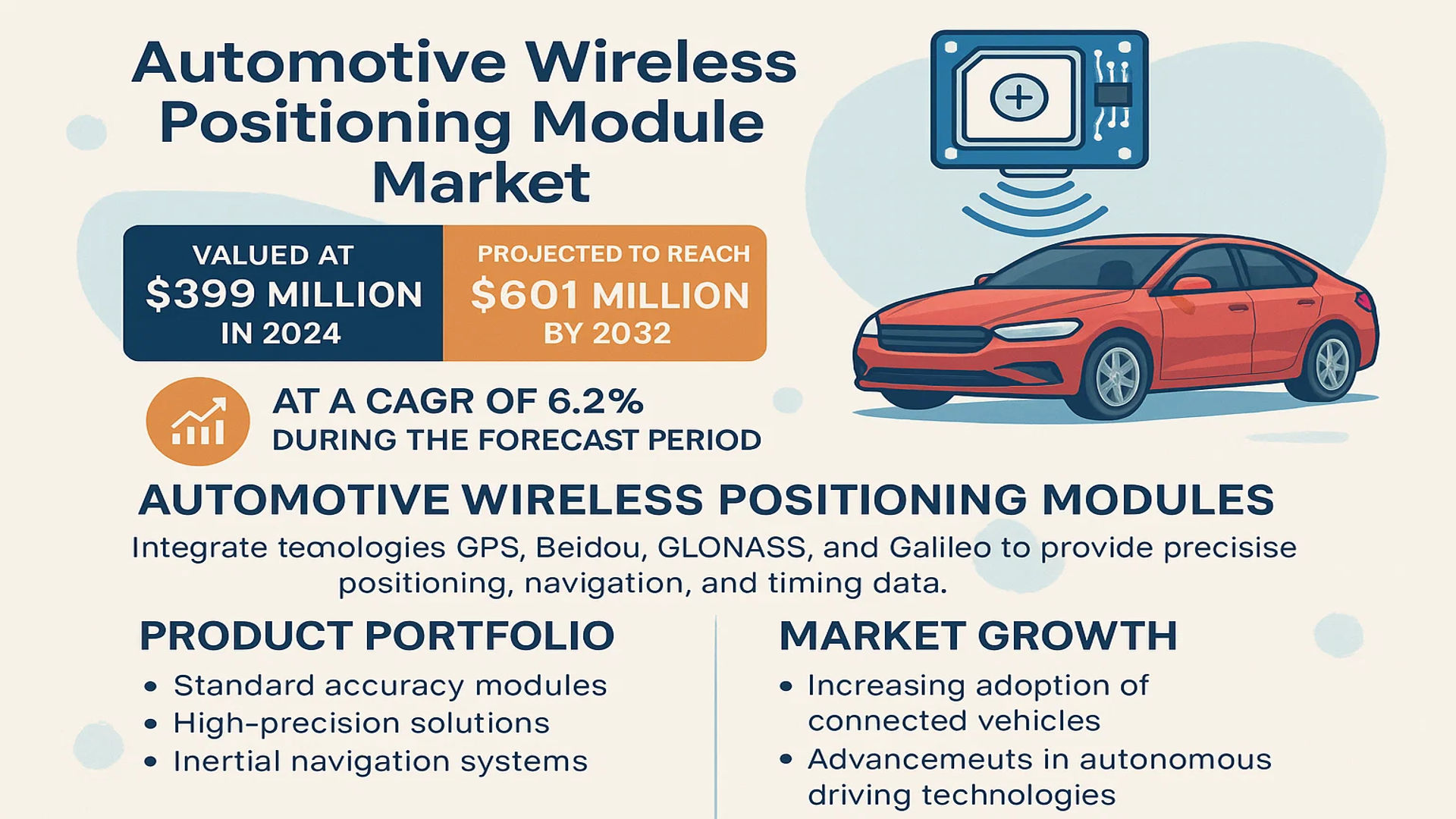
The global Automotive Wireless Positioning Module market was valued at 399 million in 2024 and is projected to reach US$ 601 million by 2032, at a CAGR of 6.2% during the forecast period.
Automotive wireless positioning modules are critical components that enable real-time, accurate location tracking for vehicles. These modules integrate technologies such as GPS, Beidou, GLONASS, and Galileo to provide precise positioning, navigation, and timing data. The product portfolio includes standard accuracy modules, high-precision solutions, and inertial navigation systems tailored for diverse automotive applications.
The market growth is primarily driven by the increasing adoption of connected vehicles and advancements in autonomous driving technologies. According to industry data, Asia dominates automotive production, accounting for 56% of global output, followed by Europe (20%) and North America (16%). Key players like Sierra Wireless, Quectel, and U-blox are expanding their product offerings to cater to the growing demand for smart mobility solutions, while the integration of 5G networks is expected to further accelerate market expansion in coming years.
MARKET DYNAMICS
MARKET DRIVERS
Rising Demand for Advanced Telematics Systems to Accelerate Market Growth
The global automotive industry is witnessing a rapid transformation with increasing adoption of advanced telematics and navigation systems. Wireless positioning modules have become critical components enabling real-time vehicle tracking, fleet management, and location-based services. With the growing integration of IoT in automotive applications, these modules now serve as essential connectivity hubs, facilitating V2X (vehicle-to-everything) communication. The increasing penetration of autonomous vehicles and smart mobility solutions is further propelling demand, as high-precision positioning becomes paramount for safe navigation and traffic management.
Government Mandates for Vehicle Tracking to Boost Market Expansion
Stringent government regulations mandating vehicle tracking systems across commercial fleets are significantly driving market growth. Many countries have implemented policies requiring GPS-based tracking for public transportation, logistics vehicles, and emergency services to enhance safety and operational efficiency. The European Union’s eCall emergency response system, which became mandatory for all new vehicles in 2018, demonstrates how regulatory frameworks are accelerating adoption. Similar initiatives in emerging markets are creating substantial opportunities as governments prioritize road safety and fleet optimization.
➤ The eCall system has demonstrated 40-50% faster emergency response times in accident scenarios, showcasing the life-saving potential of positioning technology.
Furthermore, the growing emphasis on stolen vehicle recovery systems and usage-based insurance models is creating additional demand. Insurance providers increasingly offer premium discounts for vehicles equipped with tracking capabilities, creating a compelling value proposition for consumers.
MARKET RESTRAINTS
Technological Complexity and Integration Challenges to Hinder Adoption
While wireless positioning modules offer significant benefits, their integration into modern vehicle architectures presents substantial challenges. The automotive industry’s transition to domain-based E/E architectures requires positioning modules to interface with multiple vehicle systems, including infotainment, ADAS, and telematics. This complexity increases development costs and complicates implementation, particularly for entry-level vehicle segments. The need for specialized expertise in RF design and satellite signal processing further exacerbates these challenges.
Additionally, maintaining positioning accuracy in urban canyons and multipath environments remains a persistent technical hurdle that affects reliability. These factors collectively restrain market expansion, particularly in cost-sensitive emerging markets where price sensitivity often outweighs feature prioritization.
MARKET CHALLENGES
Cybersecurity Vulnerabilities Pose Significant Operational Risks
The increasing connectivity of positioning modules creates substantial cybersecurity risks that challenge market growth. As these modules become integrated into critical vehicle systems, they represent potential attack vectors that could compromise vehicle safety and user privacy. The automotive industry has witnessed a 300% increase in cybersecurity incidents related to connected vehicle components, with positioning systems being particularly vulnerable to spoofing and jamming attacks.
Other Challenges
Regulatory Compliance Complexity
Differing regional standards for wireless spectrum usage and positioning accuracy requirements create compliance burdens for manufacturers. The lack of global harmonization forces companies to develop multiple product variants, increasing R&D costs and time-to-market.
Supply Chain Disruptions
The semiconductor shortages that impacted the automotive industry highlighted the vulnerability of positioning module supply chains. Dependence on specialized ICs from limited suppliers continues to pose inventory management challenges.
MARKET OPPORTUNITIES
Emergence of Multi-Constellation GNSS Solutions to Create New Growth Avenues
The development of multi-constellation GNSS receivers supporting GPS, GLONASS, Galileo, and BeiDou systems presents significant market opportunities. These advanced solutions offer improved accuracy and reliability by leveraging multiple satellite systems simultaneously. The automotive industry is increasingly adopting these technologies to enhance navigation performance, particularly for autonomous driving applications where positioning accuracy below 10 cm is required.
The integration of inertial measurement units (IMUs) with wireless positioning modules is creating hybrid solutions that maintain accuracy even in GNSS-denied environments. This technological advancement is particularly valuable for urban mobility applications and last-mile delivery services where uninterrupted positioning is critical. The market is poised for substantial growth as these solutions become more affordable and widely adopted across vehicle segments.
AUTOMOTIVE WIRELESS POSITIONING MODULE MARKET TRENDS
Integration of Advanced Navigation Technologies to Drive Market Growth
The global automotive wireless positioning module market is witnessing significant advancements due to the increasing adoption of precise navigation technologies in modern vehicles. GPS and Beidou modules dominate the segment, contributing to over 65% of market revenue in 2024, with anticipated growth due to the rising demand for real-time tracking and autonomous driving solutions. Additionally, the integration of inertial navigation systems (INS) with wireless positioning modules ensures uninterrupted location accuracy even in GPS-denied environments, further boosting adoption. Automakers are leveraging these innovations to enhance driver assistance systems (ADAS) and comply with stringent safety regulations, which is expected to propel market expansion at a CAGR of 6.2% through 2032.
Other Trends
Rise in Electric and Autonomous Vehicle Production
The proliferation of electric vehicles (EVs) and autonomous vehicles (AVs) is accelerating the demand for high-precision positioning modules. With global EV sales surpassing 10 million units in 2022 and a projected 30 million units by 2030, automakers are prioritizing seamless connectivity and navigation functionalities. Wireless positioning modules are critical for autonomous fleets, enabling vehicle-to-everything (V2X) communication and geofencing. China, the U.S., and Europe lead this trend, accounting for nearly 85% of the global EV market, which directly correlates with heightened module adoption. Furthermore, partnerships between automakers and tech firms to develop 5G-enabled positioning solutions are reshaping the competitive landscape.
Expansion of Commercial Vehicle Telematics
The commercial vehicle sector is increasingly adopting wireless positioning modules to streamline logistics and fleet management. Market data indicates that telematics-equipped trucks and buses grew by 18% year-over-year in 2023, driven by the need for fuel efficiency and regulatory compliance. Positioning modules with low-power wide-area network (LPWAN) capabilities are gaining traction, as they offer extended battery life and cost-effective tracking. Regions like North America and Europe dominate this segment, owing to strict mandates such as the EU’s Electronic Logging Device (ELD) regulation. Emerging economies in Asia-Pacific are also witnessing rapid adoption, particularly in last-mile delivery and ride-hailing services, further diversifying market opportunities.
COMPETITIVE LANDSCAPE
Key Industry Players
Innovation and Strategic Partnerships Drive Market Leadership in Automotive Wireless Positioning
The global Automotive Wireless Positioning Module market remains highly competitive, with key players competing on technological advancements, precision, and regional market penetration. U-blox emerges as a dominant force, leveraging its robust portfolio of GNSS modules and strong alliances with automotive OEMs. The company’s foothold in Europe and North America provides a strategic advantage, especially as demand for high-accuracy positioning surges in electric and autonomous vehicles.
Meanwhile, Sierra Wireless and Quectel are reinforcing their market positions through continuous R&D investments, particularly in multi-constellation GNSS solutions that integrate GPS, GLONASS, and BeiDou. Both companies reported growth in automotive sector revenues in 2023, driven by increasing adoption in connected vehicles. According to industry data, Quectel captured approximately 18% of the global automotive module shipments last year, while Sierra Wireless secured 12%.
Chinese players like Sunsea Group and Fibocom Wireless Inc. are rapidly expanding, capitalizing on Asia’s 56% share of global automobile production. Their cost-competitive modules are increasingly favored by domestic manufacturers, though export markets remain a challenge due to stringent certification requirements. For instance, Fibocom’s 2023 partnership with Great Wall Motors highlights this localized growth strategy.
Notably, Renesas Electronics and Skylab are differentiating themselves through integrated solutions combining positioning with V2X (vehicle-to-everything) communication capabilities. Renesas’ recent collaboration with Toyota underscores the industry’s shift toward holistic telematics platforms.
List of Key Automotive Wireless Positioning Module Companies Profiled
- U-blox (Switzerland)
- Sierra Wireless (Canada)
- Quectel (China)
- Sunsea Group (China)
- Fibocom Wireless Inc. (China)
- Neoway (China)
- Renesas Electronics (Japan)
- Skylab (China)
Segment Analysis:
By Type
GPS Module Segment Dominates Due to Widespread Adoption in Navigation and Telematics Systems
The market is segmented based on type into:
- GPS Module
- Beidou Module
- GLONASS Module
- Galileo Module
- Others (Dual-frequency modules, Dead Reckoning modules)
By Application
Passenger Car Segment Leads Owing to Increased Demand for Connected Vehicle Technologies
The market is segmented based on application into:
- Passenger Cars
- Compact cars
- Sedans
- SUVs
- Luxury vehicles
- Commercial Vehicles
- Light commercial vehicles
- Heavy trucks
- Buses
- Electric Vehicles
- Autonomous Vehicles
By Frequency Band
L1 Band Remains Most Prevalent Due to Compatibility with Existing Navigation Systems
The market is segmented based on frequency band into:
- L1 Band
- L5 Band
- Dual-band (L1+L5)
- Multi-band
By Vehicle Connectivity
V2X-Enabled Modules Gain Traction for Smart Mobility Applications
The market is segmented based on vehicle connectivity into:
- Standalone Positioning Modules
- V2X Integrated Modules
- Telematics Control Units
- Integrated Infotainment Systems
Regional Analysis: Automotive Wireless Positioning Module Market
Asia-Pacific
Asia-Pacific dominates the global automotive wireless positioning module market, accounting for over 56% of worldwide automobile production as of 2022. China leads regional adoption, with its automotive industry representing approximately 32% of global output. The combination of massive vehicle production volumes (over 26 million units annually) and rapid technological adoption creates strong demand for positioning modules across passenger and commercial vehicles. Japan, the world’s largest car exporter, integrates high-precision positioning systems in export models to meet global standards. Regional growth is further propelled by government mandates for connected vehicle technologies across China, India, and ASEAN nations, though price sensitivity drives preference for cost-effective GPS solutions over premium alternatives.
North America
Stringent automotive safety regulations and advanced telematics adoption fuel North America’s position as the second-largest market. The U.S. accounts for 16% of global auto production, with premium vehicle segments demonstrating particularly strong uptake of high-accuracy positioning modules. Federal Motor Vehicle Safety Standards (FMVSS) increasingly incorporate positioning data requirements for emergency response systems, while commercial fleet operators utilize real-time tracking for logistics optimization. The region shows accelerating demand for dual-band GNSS solutions that maintain accuracy in urban environments, though adoption faces temporary headwinds from semiconductor supply chain constraints affecting automotive electronics production.
Europe
Europe’s automotive positioning module market benefits from concentrated premium vehicle production and strict eCall emergency system mandates. Germany’s automotive sector (representing 20% of regional vehicle production) drives innovation in high-precision modules for autonomous driving applications. The EU’s Galileo satellite system integration provides alternative positioning infrastructure, reducing reliance on foreign GNSS networks. However, the transition to next-generation modules progresses slower than Asia due to complex automotive certification processes and labor-intensive retrofitting requirements in legacy vehicle fleets. Sustainability concerns are prompting development of low-power positioning solutions aligned with Europe’s green mobility initiatives.
South America
South America shows emerging potential with Brazil and Argentina as key growth markets, though economic volatility limits short-term expansion. Local automotive producers primarily incorporate basic GPS modules for entry-level vehicles, while imported luxury models drive limited demand for advanced systems. Infrastructure limitations, including inconsistent cellular network coverage for assisted-GNSS services, constrain positioning accuracy in rural areas. However, increasing investments in Brasil’s automotive sector (projected to reach 3 million annual vehicle production by 2025) indicate future opportunities for module suppliers eyeing long-term regional growth.
Middle East & Africa
The MEA automotive positioning module market remains nascent but exhibits growth potential through premium vehicle imports and developing commercial telematics sectors. Gulf Cooperation Council (GCC) countries lead adoption due to high luxury vehicle penetration and smart city initiatives requiring precise location services. Africa’s market develops more slowly, with basic GPS modules dominating the small new vehicle market (under 1 million annual sales continent-wide). Regional challenges include limited aftermarket integration capabilities and minimal local vehicle production, though expanding automotive finance options may accelerate technology adoption in coming years.
Report Scope
This market research report provides a comprehensive analysis of the Global Automotive Wireless Positioning Module Market, covering the forecast period 2024–2032. It offers detailed insights into market dynamics, technological advancements, competitive landscape, and key trends shaping the industry.
Key focus areas of the report include:
- Market Size & Forecast: Historical data and future projections for revenue, unit shipments, and market value across major regions and segments. The global market was valued at USD 399 million in 2024 and is projected to reach USD 601 million by 2032, growing at a CAGR of 6.2%.
- Segmentation Analysis: Detailed breakdown by product type (GPS Module, Beidou Module, Others), application (Passenger Car, Commercial Car), and end-user industry to identify high-growth segments.
- Regional Outlook: Insights into market performance across North America, Europe, Asia-Pacific, Latin America, and Middle East & Africa, with country-level analysis of key automotive markets like China, US, Japan, Germany, and India.
- Competitive Landscape: Profiles of leading players including Sierra Wireless, Quectel, U-blox, and Renesas Electronics, covering their product portfolios, market share, R&D focus, and recent strategic developments.
- Technology Trends & Innovation: Assessment of emerging positioning technologies, integration with vehicle connectivity systems, and advancements in navigation accuracy.
- Market Drivers & Restraints: Analysis of factors such as increasing vehicle production (global output of 81.6 million units in 2022), demand for connected vehicles, and challenges like supply chain constraints.
- Stakeholder Analysis: Strategic insights for automotive OEMs, tier-1 suppliers, module manufacturers, and investors regarding market opportunities and competitive positioning.
The research methodology combines primary interviews with industry experts and analysis of verified secondary data sources to ensure accuracy and reliability of market intelligence.
FREQUENTLY ASKED QUESTIONS:
What is the current market size of Global Automotive Wireless Positioning Module Market?
-> Automotive Wireless Positioning Module market was valued at 399 million in 2024 and is projected to reach US$ 601 million by 2032, at a CAGR of 6.2% during the forecast period.
Which key companies operate in this market?
-> Major players include Sierra Wireless, Quectel, U-blox, Fibocom Wireless, and Renesas Electronics.
What are the key growth drivers?
-> Growth is driven by increasing vehicle production (81.6 million units in 2022), demand for connected car technologies, and government mandates for vehicle tracking systems.
Which region dominates the market?
-> Asia-Pacific leads the market (56% of global vehicle production), with China accounting for 32% of worldwide automobile manufacturing.
What are the emerging trends?
-> Emerging trends include integration with V2X systems, multi-GNSS modules, and high-precision positioning for autonomous vehicles.

Get Sample Report PDF for Exclusive Insights
Report Sample Includes
- Table of Contents
- List of Tables & Figures
- Charts, Research Methodology, and more...
 Download Sample Report PDF



