Market Insights
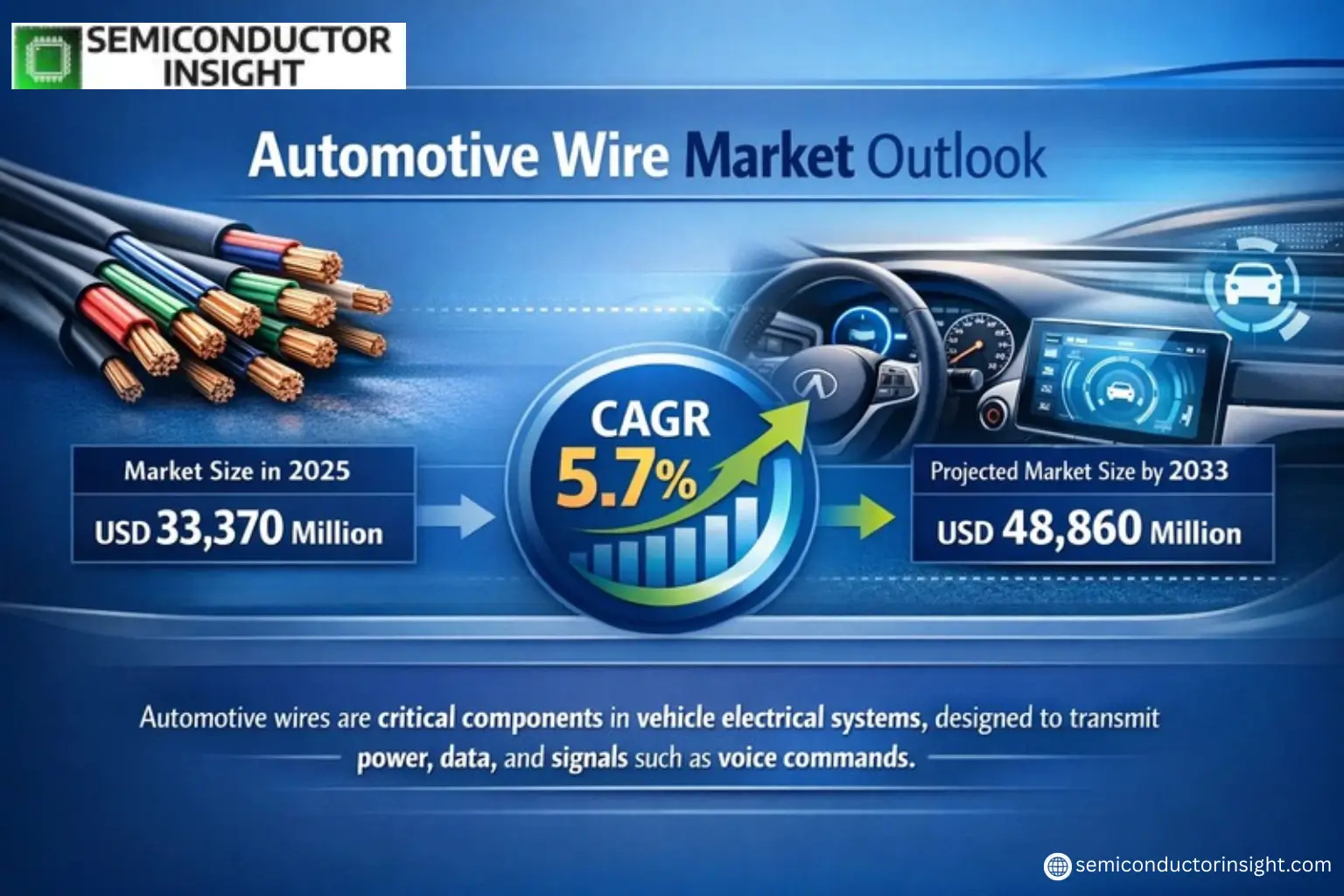
Global Automotive Wire Market was valued at USD 33,370 million in 2025 and is projected to reach USD 48,860 million by 2033, exhibiting a CAGR of 5.7% during the forecast period.
Automotive wires are critical components in vehicle electrical systems, designed to transmit power, data, and signals such as voice commands. These wires are engineered to withstand harsh conditions, including high temperatures and vibrations. They are typically bonded, twisted, or braided into assemblies that form circuits within vehicles.
The market growth is driven by increasing vehicle electrification, rising demand for advanced safety features, and stringent emission regulations necessitating efficient wiring solutions. China dominates the market with a 30% share due to its robust automotive manufacturing sector. The copper core segment leads product categories with a 35% share, while body applications account for the largest end-use segment. Key players like Yazaki and Sumitomo Electric collectively hold around 70% of the global market.
MARKET DRIVERS
Increasing Automotive Production and Electrification
Global Automotive Wire Market is experiencing growth due to rising vehicle production and the shift toward electrification. With over 90 million vehicles produced annually, demand for high-quality automotive wiring remains strong. The increasing adoption of electric vehicles (EVs) further amplifies this demand, as EVs require 30% more wiring than conventional vehicles.
Technological Advancements in Wiring Solutions
Innovations in lightweight materials and high-temperature-resistant wires are driving market expansion. Automakers are increasingly adopting automotive wire harnesses with enhanced durability to support advanced vehicle features like ADAS (Advanced Driver Assistance Systems) and infotainment systems.
Additionally, stringent emission norms are pushing automakers to integrate more efficient wiring systems, boosting market growth.
MARKET CHALLENGES
High Cost of Raw Materials
Fluctuating prices of copper and aluminum, the primary materials for automotive wires, pose a significant challenge. Volatility in metal prices increases manufacturing costs, impacting profit margins for wire suppliers and automakers.
Other Challenges
Complexity in Wire Harness Design
Modern vehicles require intricate wiring configurations, increasing installation time and potential failure risks. Poorly designed harnesses can lead to electrical malfunctions and higher warranty costs.
MARKET RESTRAINTS
Supply Chain Disruptions
Global supply chain bottlenecks, including semiconductor shortages and transportation delays, hinder the timely delivery of automotive wires. These disruptions slow down vehicle production, indirectly affecting wiring demand.
MARKET OPPORTUNITIES
Rising Demand for High-Performance Electric Vehicles
The EV revolution presents substantial growth potential for the Automotive Wire Market. Premium and performance EVs demand specialized high-voltage wiring systems, creating opportunities for manufacturers to expand their product portfolios.
Adoption of Smart and Autonomous Vehicles
Autonomous driving technology requires robust wiring infrastructure for sensors and communication modules. Investments in self-driving cars are expected to boost the need for reliable automotive wires in the coming decade.
Automotive Wire Market Trends
Steady Growth in Automotive Wire Demand
Global Automotive Wire Market recorded a valuation of USD 33.37 billion in 2025 and is projected to reach USD 48.86 billion by 2033, growing at a CAGR of 5.7%. This growth is driven by increasing vehicle electrification and the rising adoption of advanced automotive electronics requiring specialized wiring solutions.
Other Trends
Material Innovations
Copper core wires dominate the Automotive Wire Market with 35% share due to superior conductivity. Aluminum core wires are gaining traction in cost-sensitive applications while maintaining performance standards. Manufacturers are investing in high-temperature resistant materials for electric vehicle applications.
Regional Market Developments
China leads the Automotive Wire Market with 30% global share, followed by Europe and North America collectively holding 35%. Emerging Asian markets are witnessing accelerated growth due to expanding automotive production capacities and localization of wire harness manufacturing.
Application-Specific Expansion
Body applications account for the largest segment in the Automotive Wire Market, with chassis and engine applications following closely. The growing integration of ADAS systems and in-vehicle connectivity is driving demand for specialized wiring in sensors and infotainment systems.
Competitive Landscape
Yazaki, Sumitomo Electric, and Delphi collectively hold over 50% of the global Automotive Wire Market. These leaders are expanding production capacities in emerging markets through joint ventures and technology partnerships to meet growing regional demand.
Technology Transition Challenges
The shift towards high-voltage systems in electric vehicles presents both opportunities and manufacturing challenges for Automotive Wire suppliers. Companies are developing new insulation materials and modular wiring systems to address evolving industry requirements while maintaining cost competitiveness.
COMPETITIVE LANDSCAPE
Key Industry Players
A concentrated market dominated by Japanese and European suppliers
Global Automotive Wire Market exhibits a consolidated structure with Yazaki, Sumitomo Electric, and Delphi collectively holding over 50% market share. These tier-1 suppliers maintain dominance through extensive OEM relationships and vertical integration capabilities. Japanese suppliers like Yazaki and Sumitomo have particularly strong positioning in Asian markets, while European players like LEONI and Delphi lead in premium vehicle segments with advanced wiring harness solutions.
Niche players like Furukawa Electric and Kyungshin specialize in high-temperature-resistant wires for electric vehicles, while Chinese manufacturers such as Beijing Force and Shanghai Shenglong are gaining traction through cost-competitive solutions for domestic automakers. The market sees increasing competition in aluminum core wiring as lightweighting becomes crucial for EV manufacturers.
List of Key Automotive Wire Companies Profiled
- Yazaki Corporation
- Sumitomo Electric Industries
- Aptiv (formerly Delphi)
- LEONI AG
- Lear Corporation
- Yura Corporation
- Furukawa Electric Co., Ltd.
- Coficab Group
- PKC Group
- Kyungshin Corporation
- Beijing Force
- Fujikura Ltd.
- Coroplast Fritz Müller GmbH
- Nexans (General Cable)
- Shanghai Shenglong
Segment Analysis:
| Segment Category | Sub-Segments | Key Insights |
| By Type |
|
Copper Core dominates the market due to superior conductivity and durability:
|
| By Application |
|
Body applications represent the largest consumption area:
|
| By End User |
|
Passenger Vehicles account for majority of demand:
|
| By Vehicle System |
|
Power Transmission systems drive core demand:
|
| By Technology |
|
High-Temperature Wires showing strong growth potential:
|
Regional Analysis: Global Automotive Wire Market
China’s automotive wire manufacturers benefit from complete vertical integration, producing everything from copper conductors to specialized insulation materials domestically. This gives Chinese suppliers decisive cost advantages in the global Automotive Wire Market while meeting stringent OEM requirements.
Japanese firms lead in developing high-performance automotive wires with superior durability and thermal resistance. Their focus on miniaturization and weight reduction addresses modern vehicle design challenges while maintaining extreme reliability standards demanded by premium automakers.
India emerges as a key automotive wire production base with competitive labor costs and improving technical capabilities. Domestic manufacturers are scaling up capacity to support both conventional vehicles and emerging EV segments through technology partnerships with global wiring specialists.
Thailand, Indonesia, and Vietnam are developing localized automotive wire supply chains to support regional vehicle assembly plants. Governments offer incentives for wire production facilities that serve both domestic and export markets in the automotive sector.
North America
The North American Automotive Wire Market emphasizes advanced materials and automated production techniques. U.S. manufacturers focus on specialized high-temperature and abrasion-resistant wiring for trucks and SUVs while developing shielded cables for autonomous driving systems. Strict flammability standards push innovation in insulating materials. Regional trade agreements facilitate cross-border supply chains with Mexico’s growing wire processing capabilities. Detroit-area suppliers work closely with OEM engineering teams to develop application-specific wiring solutions.
Europe
European automotive wire manufacturers lead in developing environmentally sustainable solutions including halogen-free insulation and recyclable materials. German engineering drives precision in high-voltage cabling for premium EVs while Italian specialists focus on lightweight conductor designs. The region’s emphasis on circular economy principles influences material selection and end-of-life recycling processes for automotive wiring systems across all vehicle classes.
South America
Brazil’s established automotive industry maintains steady demand for conventional wiring systems while Argentina shows growing capabilities in specialty cables. Regional economic fluctuations impact investment in next-generation wire technologies, though local manufacturers continue upgrading facilities to meet evolving OEM specifications for South America’s unique operating conditions and fuel mixtures.
Middle East & Africa
The Middle East focuses on heat-resistant automotive wiring for extreme climate operation while developing localized production to reduce import dependency. African markets show potential as wire manufacturing hubs serving both domestic vehicle assembly and aftermarket needs, particularly for commercial vehicles operating in challenging terrain conditions across the continent.
Report Scope
This market research report provides a comprehensive analysis of the Automotive Wire Market , covering the forecast period 2025–2033. It offers detailed insights into market dynamics, technological advancements, competitive landscape, and key trends shaping the industry.
Key focus areas of the report include:
- Market Overview: The report begins with an overview outlining its current market scenario, key growth indicators, and industry transformation drivers. It discusses macroeconomic factors, demand–supply balance, regulatory landscape, and the strategic role of semiconductors in powering advancements across industries such as automotive, telecommunications, consumer electronics, and industrial automation.
- Market Size & Forecast: Historical data and future projections for revenue, unit shipments, and market value across major regions and segments.
- Segmentation Analysis: Detailed breakdown by product type, technology, application, and end-user industry to identify high-growth segments and investment opportunities.
- Regional Insights: Insights into market performance across North America, Europe, Asia-Pacific, Latin America, and the Middle East & Africa, including country-level analysis where relevant.
- Competitive Landscape: Profiles of leading market participants, including their product offerings, R&D focus, manufacturing capacity, pricing strategies, and recent developments such as mergers, acquisitions, and partnerships.
- Technology Trends & Innovation: Assessment of emerging technologies, integration of AI/IoT, semiconductor design trends, fabrication techniques, and evolving industry standards.
- Market Drivers & Restraints: Evaluation of factors driving market growth along with challenges, supply chain constraints, regulatory issues, and market-entry barriers.
- Stakeholder Insights: Insights for component suppliers, OEMs, system integrators, investors, and policymakers regarding the evolving ecosystem and strategic opportunities.
Primary and secondary research methods are employed, including interviews with industry experts, data from verified sources, and real-time market intelligence to ensure the accuracy and reliability of the insights presented.
FREQUENTLY ASKED QUESTIONS:
What is the current market size of Automotive Wire Market?
-> Automotive Wire Market was valued at USD 33,370 million in 2025 and is projected to reach USD 48,860 million by 2033, exhibiting a CAGR of 5.7% during the forecast period.
What is the growth rate of Automotive Wire Market?
-> The market is expected to grow at a CAGR of 5.7% during the forecast period from 2025 to 2033.
Which key companies operate in Automotive Wire Market?
-> Key players include Yazaki, Sumitomo Electric, Delphi, LEONI, Lear, Yura, Furukawa Electric, among others. The top five players account for approximately 70% of the global market share.
What are the key market segments by type?
-> Cooper Core dominates with about 35% share, followed by Aluminum Core and other segments.
Which region dominates the Automotive Wire Market?
-> China is the largest market with about 30% share, followed by Europe and North America with combined 35% market share.
What are the key applications of Automotive Wire?
-> The largest application segment is Body, followed by Chassis, Engine, HVAC, and Speed Sensors.

Get Sample Report PDF for Exclusive Insights
Report Sample Includes
- Table of Contents
- List of Tables & Figures
- Charts, Research Methodology, and more...
 Download Sample Report PDF