MARKET INSIGHTS
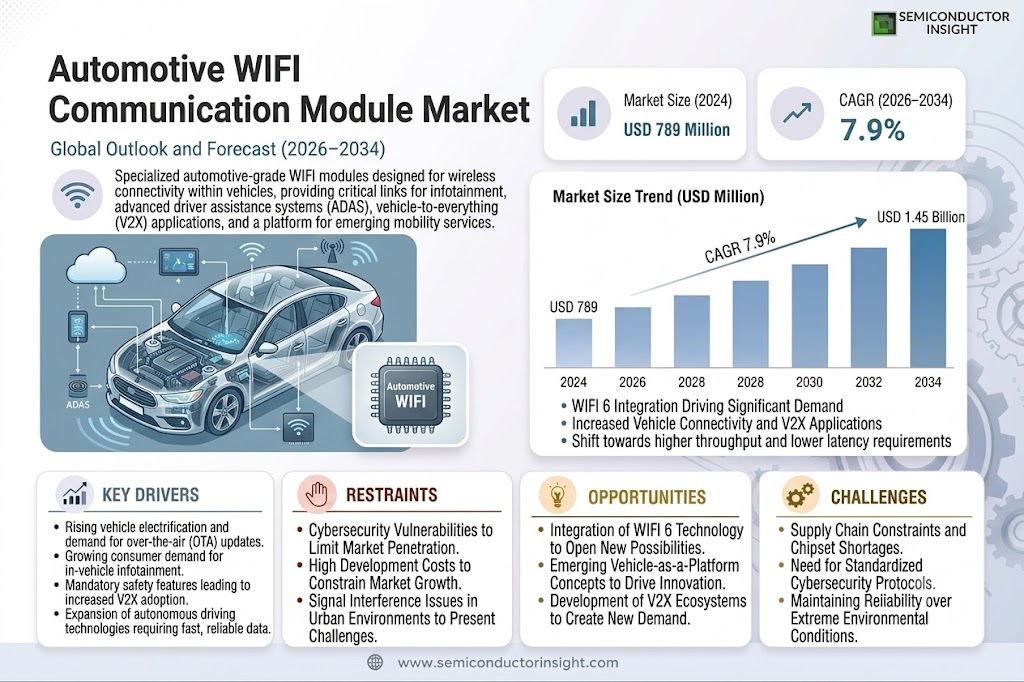
The global Automotive WIFI Communication Module Market size was valued at US$ 789 million in 2024 and is projected to reach US$ 1.45 billion by 2032, at a CAGR of 7.9% during the forecast period 2025-2032.
An automotive WIFI communication module is an embedded hardware component that enables high-speed wireless connectivity in vehicles through IEEE 802.11 standards. These modules facilitate V2X (vehicle-to-everything) communication, supporting applications ranging from telematics and over-the-air updates to in-vehicle infotainment systems. Key variants include WiFi 6 (802.11ax) and WiFi 5 (802.11ac) modules, with growing adoption of 5GHz band solutions for reduced interference.
The market growth is primarily driven by increasing demand for connected vehicle technologies, with global connected car penetration expected to reach 30% by 2025. Furthermore, regulatory mandates for vehicle safety features in regions like Europe and North America are accelerating adoption. Leading manufacturers such as Qualcomm and NXP Semiconductors are investing heavily in automotive-grade chipsets, with the WiFi 6 segment projected to capture 45% market share by 2027 due to its superior bandwidth and low latency characteristics.
MARKET DYNAMICS
MARKET DRIVERS
Rising Demand for Connected Vehicles to Accelerate Market Growth
The global automotive industry is witnessing rapid digital transformation, with connected vehicles emerging as a key growth sector. Automotive WIFI communication modules serve as critical enablers for vehicle-to-vehicle (V2V) and vehicle-to-infrastructure (V2I) communication systems. The number of connected cars on roads globally has surpassed 250 million units as of 2024, with projections indicating this figure could exceed 400 million by 2030. This exponential growth is directly driving demand for reliable, high-speed WIFI modules that can handle increasing data traffic while maintaining low latency.
Advancements in Autonomous Driving Technologies to Boost Adoption
Automotive WIFI modules are becoming indispensable components in autonomous vehicle ecosystems. These modules facilitate critical functions including real-time data exchange between vehicles, cloud-based navigation updates, and over-the-air (OTA) software upgrades. Level 3 autonomous vehicles, which are now entering mainstream production, require multiple WIFI modules for redundancy and fail-safe operation. The average autonomous vehicle currently incorporates three to five WIFI communication modules, significantly higher than traditional vehicles. As automakers progress toward Level 4 and Level 5 autonomy, this demand is expected to grow substantially.
Government Mandates for Vehicle Connectivity to Stimulate Market Expansion
Government regulations worldwide are increasingly mandating certain connectivity features in new vehicles for safety and traffic management purposes. Countries in Europe and North America have introduced regulations requiring emergency call (eCall) systems, vehicle-to-infrastructure communication, and other connected features that rely on WIFI technology. These regulatory developments are creating sustained demand for automotive-grade WIFI modules across all vehicle segments.
MARKET RESTRAINTS
Cybersecurity Vulnerabilities to Limit Market Penetration
As vehicles become more connected, they also become vulnerable to cyber threats. Automotive WIFI modules can potentially serve as entry points for hackers seeking to compromise vehicle systems. Several high-profile incidents of connected vehicle hacking have made automakers cautious about expanding WIFI connectivity features. The industry currently lacks standardized cybersecurity protocols for automotive WIFI modules, creating uncertainty among OEMs about large-scale deployment.
High Development Costs to Constrain Market Growth
Developing automotive-grade WIFI modules that meet stringent industry standards involves significant investment. These modules must operate reliably across extreme temperature ranges (-40°C to 85°C) while maintaining consistent performance. Certification processes for automotive applications add additional costs and development time. The total cost of developing and qualifying a new automotive WIFI module can exceed $5 million, creating barriers for smaller manufacturers.
Signal Interference Issues in Urban Environments to Present Challenges
Dense urban environments with numerous WIFI networks create signal congestion that can degrade automotive WIFI performance. The 2.4GHz spectrum used by many automotive WIFI modules is particularly prone to interference from other devices. While newer modules utilize less congested 5GHz bands, implementation costs remain high. Urban areas can experience packet loss rates as high as 15-20% for automotive WIFI signals, potentially compromising safety-critical applications.
MARKET OPPORTUNITIES
Integration of WIFI 6 Technology to Open New Possibilities
The transition to WIFI 6 (802.11ax) standards presents significant opportunities for the automotive sector. WIFI 6 modules offer improved throughput (up to 9.6 Gbps), lower latency, and better performance in congested environments compared to previous generations. Automotive OEMs are increasingly specifying WIFI 6 for next-generation vehicle platforms, creating a wave of upgrade opportunities. The WIFI 6 segment is projected to grow at a compound annual growth rate of over 30% in the automotive sector through 2032.
Emerging Vehicle-as-a-Platform Concepts to Drive Innovation
Automakers are exploring new business models where vehicles serve as platforms for third-party services and applications. These concepts rely heavily on robust WIFI connectivity to enable in-vehicle commerce, advertising, and subscription services. The average connected vehicle is expected to generate over $100 annually in connectivity-related revenue by 2027, creating strong incentives for automakers to upgrade their WIFI communication capabilities.
Development of V2X Ecosystems to Create New Demand
Vehicle-to-everything (V2X) communication systems are evolving beyond basic safety applications to enable smarter traffic management and optimized routing. Cities worldwide are investing in intelligent transportation infrastructure that requires compatible WIFI modules in vehicles. Pilot projects in several regions have demonstrated 15-20% improvements in traffic flow through V2X implementations, paving the way for broader adoption.
MARKET CHALLENGES
Supply Chain Constraints to Impact Market Stability
The automotive WIFI module market continues to face supply chain disruptions affecting semiconductor availability. Specialty chipsets required for automotive WIFI modules have experienced lead times extending beyond 52 weeks in some cases. These constraints are particularly challenging given the automotive industry’s just-in-time manufacturing model, potentially delaying vehicle production schedules and module deployments.
Integration Complexities with Vehicle Architectures to Slow Adoption
Modern vehicle electrical architectures are evolving toward domain-based and zonal designs, requiring WIFI modules to interface with multiple electronic control units. These architectural changes introduce integration challenges that can extend development cycles by 6-12 months. The average vehicle development program now allocates 15-20% of its electronics integration budget to connectivity solutions, including WIFI modules.
Competition from Alternative Connectivity Technologies to Intensify
While WIFI dominates in-vehicle connectivity, alternative technologies including 5G cellular-V2X (C-V2X) and dedicated short-range communications (DSRC) are gaining traction for certain applications. The coexistence of multiple connectivity standards creates complexity for automakers and may fragment the market. Some jurisdictions are mandating specific technologies for safety applications, potentially limiting WIFI module adoption in those use cases.
AUTOMOTIVE WIFI COMMUNICATION MODULE MARKET TRENDS
5G Integration and Advanced Connectivity Solutions Driving Market Expansion
The automotive WIFI communication module market is experiencing a significant shift as 5G technology gains traction in the connected vehicle ecosystem. With automakers prioritizing high-speed, low-latency data transmission, the adoption of 5G-compatible modules is projected to grow at a CAGR of over 24% through 2032. These modules enable real-time vehicle-to-everything (V2X) communication, enhancing safety features like collision avoidance and traffic management. Additionally, over 45% of new passenger vehicles shipped globally in 2024 incorporated embedded WIFI modules, reflecting the rising demand for seamless onboard connectivity. This trend is further amplified by the integration of WiFi 6 modules, which offer superior bandwidth efficiency and reduced interference in dense urban environments.
Other Trends
Electrification and Smart Mobility Initiatives
As the automotive industry accelerates toward electrification, WIFI modules are becoming critical for over-the-air (OTA) updates and battery management system communications. Governments worldwide are implementing regulations mandating connected vehicle technologies, with regions like the European Union allocating €3.4 billion toward smart mobility infrastructure. This has spurred partnerships between semiconductor giants and automakers to develop application-specific modules. For instance, commercial vehicles are increasingly embedding dual-band WIFI modules to support fleet telematics, with the segment expected to account for 38% of market revenue by 2027.
Consolidation of Supply Chains and Regional Market Dynamics
Recent supply chain disruptions have prompted a strategic realignment, with key players like Qualcomm and NXP Semiconductors establishing regional production hubs in Asia and North America. China’s domestic manufacturers now supply 60% of the Asia-Pacific market, leveraging cost advantages and localized R&D. Meanwhile, the North American market benefits from strong R&D investments in V2X technologies, contributing to 32% of global patent filings in automotive WIFI modules. However, material shortages and geopolitical trade tensions remain persistent challenges, necessitating diversified sourcing strategies for critical components like RF chipsets and antennas.
COMPETITIVE LANDSCAPE
Key Industry Players
Automotive WIFI Module Market Driven by Technological Advancements and Strategic Collaborations
The global Automotive WIFI Communication Module market features a competitive landscape dominated by semiconductor giants and specialized connectivity solution providers. According to recent market analysis, the top five manufacturers accounted for approximately 45% of total revenue in 2024, indicating a moderately consolidated market structure. While established players maintain strong positions through technological leadership, emerging companies are gaining traction by addressing niche automotive connectivity requirements.
Qualcomm Technologies leads the market through its advanced automotive-grade WiFi 6/6E solutions and comprehensive vehicle-to-cloud platforms. The company’s Snapdragon Automotive Connectivity Platforms have become industry benchmarks, particularly for premium electric vehicles requiring high-bandwidth infotainment systems. Meanwhile, Samsung subsidiary Harman (through its acquisition of Harman International) has significantly expanded its automotive WiFi module footprint through integrated telematics solutions.
The Asia-Pacific region has seen particularly strong growth from players like Quectel and Fibocom Wireless, who have capitalized on China’s rapidly expanding new energy vehicle market. These manufacturers compete aggressively on price-performance ratios while meeting stringent automotive certification standards. Their success stems from vertical integration strategies and close partnerships with domestic automakers.
European semiconductor leaders NXP and Infineon maintain strong positions in the market through their reliable automotive-grade chipsets. These companies differentiate themselves through robust security features and functional safety certifications critical for advanced driver assistance systems (ADAS) integration. Recent partnerships between chip manufacturers and automotive OEMs are accelerating the adoption of WiFi 6 modules in next-generation vehicle architectures.
Strategic acquisitions continue to reshape the competitive landscape, evidenced by Renesas Electronics’ acquisition of Celeno Communications to strengthen its WiFi 6/6E capabilities. Similarly, Marvell Technology has expanded its automotive WiFi offerings through targeted R&D investments in automotive-optimized radio frequency solutions.
List of Key Automotive WIFI Communication Module Manufacturers
- Qualcomm Technologies (U.S.)
- Harman International (Samsung) (South Korea)
- NXP Semiconductors (Netherlands)
- Infineon Technologies (Germany)
- Marvell Technology (U.S.)
- Quectel Wireless Solutions (China)
- Fibocom Wireless (China)
- Renesas Electronics (Japan)
- Murata Manufacturing (Japan)
- LM Technologies (U.K.)
Segment Analysis:
By Type
WiFi 6 Module Segment Leads Due to Higher Bandwidth and Lower Latency for Connected Vehicles
The market is segmented based on type into:
- WiFi 6 Module
- Subtypes: Single-band, Dual-band, and others
- WiFi 5 Module
- Others
- Including legacy WiFi 4 and emerging WiFi 7 technologies
By Application
Passenger Vehicle Segment Dominates Owing to Increasing Demand for In-Vehicle Connectivity
The market is segmented based on application into:
- Commercial Vehicle
- Passenger Vehicle
By Connectivity
V2X Communication Segment Shows Rapid Growth for Improved Road Safety
The market is segmented based on connectivity into:
- Vehicle-to-Vehicle (V2V)
- Vehicle-to-Infrastructure (V2I)
- Vehicle-to-Pedestrian (V2P)
- Vehicle-to-Cloud (V2C)
- Vehicle-to-Grid (V2G)
By Vehicle Type
Electric Vehicles Segment Gains Traction with Smart Charging Solutions
The market is segmented based on vehicle type into:
- Internal Combustion Engine Vehicles
- Electric Vehicles
- Subtypes: BEV, PHEV, HEV
- Autonomous Vehicles
Regional Analysis: Automotive WIFI Communication Module Market
North America
The North American market for automotive WIFI communication modules is driven by advanced vehicle connectivity standards and high adoption rates of smart technologies. The U.S. accounts for the largest share, with increasing integration of WiFi 6 modules in passenger and commercial vehicles due to rising demand for telematics and in-car infotainment systems. Major automakers are collaborating with tech giants like Qualcomm and Intel to enhance vehicle-to-everything (V2X) connectivity. Regulatory support for autonomous driving development further accelerates market growth. However, high costs associated with advanced modules remain a challenge for mass-market adoption, particularly in budget vehicle segments.
Europe
Europe is a leader in adopting automotive WIFI communication modules, supported by stringent governmental regulations on vehicle safety and connectivity. Germany and France dominate the regional market, thanks to robust automotive manufacturing bases and investments in 5G-enabled V2X infrastructure. The EU’s General Safety Regulation (GSR) mandates advanced connectivity features, pushing OEMs to integrate high-speed, low-latency WiFi 6 and 5G hybrid modules. Key suppliers like Infineon and NXP Semiconductors are expanding production capacities to meet growing demand. The focus remains on cybersecurity and data privacy, influencing module design and deployment strategies across the region.
Asia-Pacific
Asia-Pacific is the fastest-growing market, propelled by expanding automotive production in China, Japan, and South Korea. China leads the regional demand due to government initiatives promoting smart transportation and electric vehicles (EVs), with Quectel and Fibocom Wireless as key local players. WiFi 5 modules still dominate volume sales due to cost advantages, though WiFi 6 adoption is rising in premium segments. India and Southeast Asia show slower uptake because of affordability constraints but present long-term potential with increasing digitization. Japanese automakers prioritize reliability, favoring modules from Murata Manufacturing and Renesas Electronics.
South America
South America’s automotive WIFI communication module market is nascent but growing, driven by Brazil and Argentina’s gradual shift toward connected vehicles. Economic instability limits widespread adoption, but fleet management applications in commercial vehicles create steady demand. Local automakers rely on cost-effective WiFi 5 solutions from global suppliers like Marvell and MediaTek. Infrastructure gaps and low consumer awareness of advanced connectivity features hinder faster market expansion, though partnerships with tech providers could unlock opportunities in urban centers.
Middle East & Africa
This region shows emerging demand, primarily in Gulf Cooperation Council (GCC) countries like the UAE and Saudi Arabia, where luxury vehicle sales and smart city projects drive module integration. WiFi 6 adoption is limited to high-end models, while WiFi 5 modules remain prevalent in mid-tier vehicles. South Africa and Turkey are secondary markets, with growth tied to localized vehicle production. Challenges include inconsistent internet coverage and low aftermarket penetration, though infrastructure investments and 5G rollouts are expected to boost long-term prospects.
Report Scope
This market research report provides a comprehensive analysis of the global and regional Automotive WIFI Communication Module markets, covering the forecast period 2024–2032. It offers detailed insights into market dynamics, technological advancements, competitive landscape, and key trends shaping the industry.
Key focus areas of the report include:
- Market Size & Forecast: Historical data and future projections for revenue, unit shipments, and market value across major regions and segments. The global market was valued at USD million in 2024 and is projected to reach USD million by 2032.
- Segmentation Analysis: Detailed breakdown by product type (WiFi 6 Module, WiFi 5 Module, Others), application (Commercial Vehicle, Passenger Vehicle), and end-user industry to identify high-growth segments and investment opportunities.
- Regional Outlook: Insights into market performance across North America, Europe, Asia-Pacific, Latin America, and the Middle East & Africa, including country-level analysis where relevant. The U.S. market is estimated at USD million in 2024, while China is projected to reach USD million.
- Competitive Landscape: Profiles of leading market participants including Qualcomm, Marvell, Infineon, LG Innotek, and Renesas Electronics, including their product offerings, R&D focus, and recent developments such as mergers and acquisitions.
- Technology Trends & Innovation: Assessment of emerging technologies including WiFi 6 adoption, vehicle-to-everything (V2X) communication, and integration with 5G networks.
- Market Drivers & Restraints: Evaluation of factors driving market growth including connected vehicle adoption and smart transportation systems, along with challenges such as cybersecurity concerns.
- Stakeholder Analysis: Insights for automotive OEMs, tier-1 suppliers, module manufacturers, and investors regarding the evolving ecosystem and strategic opportunities.
Primary and secondary research methods are employed, including interviews with industry experts, data from verified sources, and real-time market intelligence to ensure the accuracy and reliability of the insights presented.
FREQUENTLY ASKED QUESTIONS:
What is the current market size of Global Automotive WIFI Communication Module Market?
-> Automotive WIFI Communication Module Market size was valued at US$ 789 million in 2024 and is projected to reach US$ 1.45 billion by 2032, at a CAGR of 7.9% during the forecast period 2025-2032.
Which key companies operate in Global Automotive WIFI Communication Module Market?
-> Key players include Qualcomm, Marvell, Infineon, LG Innotek, Renesas Electronics, NXP Semiconductors, and MediaTek, among others.
What are the key growth drivers?
-> Key growth drivers include increasing demand for connected vehicles, government initiatives for smart transportation, and rising adoption of WiFi 6 technology.
Which region dominates the market?
-> Asia-Pacific is the fastest-growing region due to expanding automotive production, while North America leads in technological adoption.
What are the emerging trends?
-> Emerging trends include integration with 5G networks, vehicle-to-infrastructure communication, and advanced cybersecurity solutions for automotive WiFi.

Get Sample Report PDF for Exclusive Insights
Report Sample Includes
- Table of Contents
- List of Tables & Figures
- Charts, Research Methodology, and more...