Automotive Thermal Crystal Market Insights
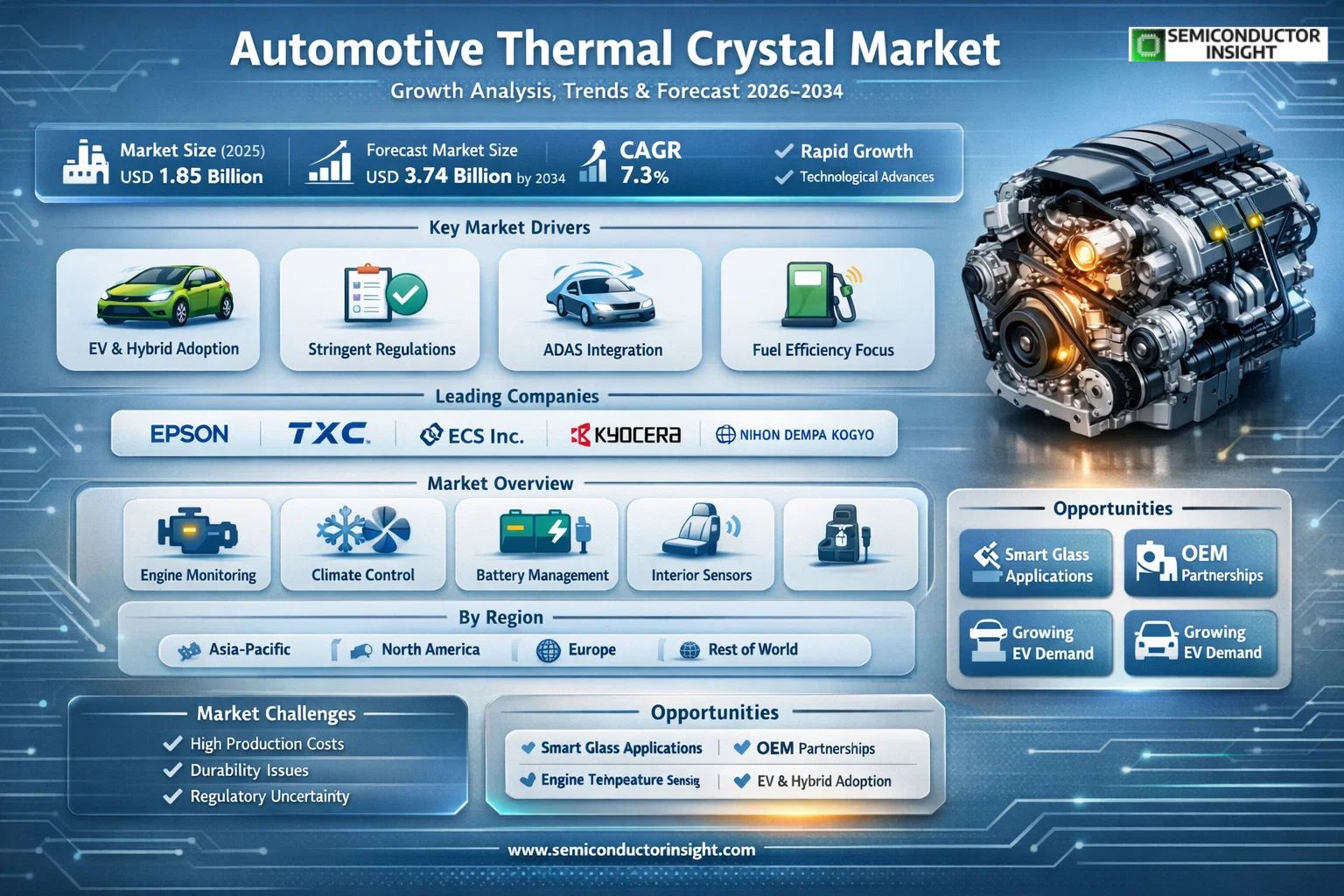
Global Automotive Thermal Crystal market size was valued at USD 1.85 billion in 2025. The market is projected to grow from USD 1.98 billion in 2026 to USD 3.74 billion by 2034, exhibiting a CAGR of 7.3% during the forecast period.
Automotive thermosensitive crystal is a specialized sensor deployed within automotive electronic systems, engineered to detect temperature variations and convert them into precise electrical signals. This category of crystal is characterized by high sensitivity and rapid response, making it indispensable across a broad range of vehicle functions. Key application areas include engine temperature monitoring, climate control and air conditioning systems, interior thermal regulation, and battery thermal management in electric and hybrid vehicles. The primary product types within this market are NTC (Negative Temperature Coefficient) Thermistors and PTC (Positive Temperature Coefficient) Thermistors, each offering distinct performance advantages depending on the operating environment and application requirements.
The market is gaining significant momentum driven by several converging factors, including the accelerating global shift toward vehicle electrification, the proliferation of advanced driver-assistance systems (ADAS), and increasingly stringent automotive safety and emission regulations worldwide. Furthermore, the growing complexity of modern vehicle architectures , particularly in electric vehicles (EVs) and hybrid electric vehicles (HEVs) , is amplifying the demand for precise, reliable thermal sensing components. Global key manufacturers of Automotive Thermal Crystal include Epson, TXC Corporation, ECS Inc., KYOCERA, NIHON DEMPA KOGYO, Harmony, KDS, Siward, Hosonic, and TKD Science and Technology, among others, who collectively maintain a competitive landscape defined by continuous product innovation and strategic capacity expansion to meet growing automotive industry requirements.
MARKET DRIVERS
Rising Demand for Advanced Thermal Management Solutions in Modern Vehicles
Automotive Thermal Crystal Market is experiencing robust growth, largely driven by the accelerating adoption of electric vehicles (EVs) and hybrid electric vehicles (HEVs) worldwide. Unlike conventional internal combustion engine vehicles, EVs require highly efficient thermal regulation systems to maintain battery performance, longevity, and passenger safety. Thermochromic and thermal crystal-based materials have emerged as a critical component in smart glazing, cabin temperature regulation, and heat-reflective coatings, making them indispensable in next-generation automotive design. As global EV sales continue to surge, demand for automotive thermal crystal technologies is set to expand proportionally across key markets including North America, Europe, and Asia-Pacific.
Stringent Fuel Efficiency and Emission Regulations Accelerating Adoption
Government mandates targeting reduced carbon emissions and improved fuel efficiency are a significant driver for Automotive Thermal Crystal Market. Regulatory frameworks such as the European Union’s CO₂ emission reduction targets and the U.S. Corporate Average Fuel Economy (CAFE) standards are compelling automakers to integrate lightweight and thermally efficient materials into vehicle architecture. Thermal crystal coatings applied to automotive glass and body panels help reduce the reliance on energy-intensive HVAC systems, thereby contributing directly to improved energy efficiency. This regulatory pressure is encouraging both OEMs and Tier-1 suppliers to invest in thermal crystal technology as a strategic differentiator in product development.
➤ Thermochromic materials used in automotive glazing can reduce interior cabin temperatures by a meaningful margin during peak solar exposure, directly lowering the energy burden on vehicle air conditioning systems and contributing to extended EV battery range.
Additionally, increasing consumer awareness about sustainable mobility and thermal comfort in vehicles is fueling demand for smart window and coating technologies embedded with automotive thermal crystal compounds. Automakers are actively collaborating with material science firms to develop next-generation thermal management solutions that balance optical clarity, durability, and dynamic heat responsiveness. This trend is particularly pronounced in premium and luxury vehicle segments, where innovation in interior climate control is seen as a key value proposition for discerning buyers.
MARKET CHALLENGES
High Production Costs and Complex Integration Processes Limiting Mass-Market Penetration
One of the foremost challenges facing Automotive Thermal Crystal Market is the elevated cost associated with the synthesis and application of thermochromic crystal materials. The production of high-performance thermal crystals requires precise chemical formulation and controlled manufacturing environments, both of which contribute to significant cost overheads. For mass-market vehicle segments, where cost sensitivity is paramount, integrating thermal crystal components into standard production lines remains a considerable hurdle. OEMs operating under tight margin constraints are often reluctant to adopt emerging material technologies unless clear cost-benefit advantages can be demonstrated at scale.
Other Challenges
Durability and Long-Term Performance Reliability
Thermal crystal materials used in automotive applications must withstand extreme temperature fluctuations, UV radiation, mechanical vibration, and chemical exposure over the vehicle’s operational lifespan. Ensuring consistent thermochromic responsiveness and optical quality over time presents a significant engineering challenge. Degradation of thermal crystal coatings under prolonged environmental stress can compromise both the functional performance and aesthetic appeal of the vehicle, raising concerns among OEMs and end consumers alike.
Limited Standardization and Regulatory Clarity
Automotive Thermal Crystal Market currently lacks unified industry standards governing the testing, performance benchmarking, and safety certification of thermochromic materials in vehicular applications. This regulatory ambiguity creates uncertainty for manufacturers and slows the pace of widespread adoption. Without clearly defined standards, automakers face difficulties in qualifying new suppliers and validating material performance across diverse climatic and operational conditions, further delaying integration timelines.
MARKET RESTRAINTS
Limited Supplier Ecosystem and Raw Material Availability Constraints
Automotive Thermal Crystal Market faces notable restraints stemming from a relatively concentrated supplier base and constrained availability of specialty raw materials required for thermal crystal synthesis. Key precursor compounds, including vanadium dioxide and certain rare-earth additives, are subject to supply chain vulnerabilities driven by geopolitical factors and limited global production capacity. This supply-side fragility can lead to procurement challenges and price volatility, particularly during periods of heightened automotive manufacturing activity, thereby restraining market scalability.
Technology Maturity and Consumer Awareness Gaps
Despite demonstrated technical potential, automotive thermal crystal technology remains in a relatively early commercial phase within the broader automotive materials landscape. A significant portion of automotive consumers and even some OEM procurement teams remain unaware of the performance benefits and long-term cost savings offered by thermal crystal-integrated solutions. This awareness gap, combined with the inherently conservative adoption cycle typical of the automotive industry, serves as a structural restraint on market growth. Manufacturers must invest substantially in education, demonstration programs, and pilot deployments to bridge this knowledge divide and build confidence among potential adopters across the automotive value chain.
MARKET OPPORTUNITIES
Expansion of Smart Glass Applications in Next-Generation Automotive Design
The rapid advancement of smart glass and electrochromic glazing technologies presents a transformative opportunity for Automotive Thermal Crystal Market. As automakers increasingly incorporate panoramic roofs, large-format windshields, and electronically controlled privacy glass into vehicle designs, the demand for thermally responsive crystal materials embedded within these surfaces is poised to grow substantially. The integration of thermal crystal compounds into smart automotive glass enables dynamic solar heat management without compromising visible light transmission, offering a compelling value proposition for both luxury and mainstream vehicle segments seeking to enhance passenger comfort and energy efficiency simultaneously.
Strategic Collaborations Between Material Innovators and Automotive OEMs
Growing interest from leading automotive OEMs in forming strategic partnerships with advanced material science companies represents a significant market opportunity within Automotive Thermal Crystal Market. Collaborative research and development initiatives are enabling faster commercialization of thermal crystal-based coatings, films, and embedded glazing systems tailored specifically for automotive use cases. Such partnerships facilitate co-investment in technology validation, regulatory compliance, and supply chain development, effectively lowering the barriers to large-scale adoption. Emerging markets in Southeast Asia, India, and Latin America, where automotive production is expanding rapidly, offer additional untapped growth avenues for thermal crystal solution providers seeking to diversify their geographic footprint and customer base.
Trends
Rising Demand for Advanced Temperature Sensing in Modern Vehicles Driving Automotive Thermal Crystal Market
Automotive Thermal Crystal Market is experiencing steady growth as vehicle manufacturers increasingly integrate sophisticated electronic systems that require precise and reliable temperature monitoring. Automotive thermosensitive crystals, which detect temperature changes and convert them into electrical signals, have become critical components across a wide range of vehicular applications. Their high sensitivity and fast response characteristics make them indispensable in engine temperature monitoring, air conditioning systems, and interior climate regulation. As automotive electronics continue to evolve, the demand for thermally responsive crystal-based sensors is gaining renewed momentum across both passenger and commercial vehicle segments.
Other Trends
Expansion of NTC Thermistor Applications Across Vehicle Platforms
Among the key product types within Automotive Thermal Crystal Market, the NTC (Negative Temperature Coefficient) Thermistor segment holds a prominent position. NTC thermistors are widely favored in automotive applications due to their superior sensitivity across a broad temperature range and their compatibility with modern vehicle electronic control units (ECUs). Their integration within engine management systems, battery thermal management in electric vehicles, and HVAC systems underscores their broad functional relevance. As electric and hybrid vehicle adoption continues to rise globally, NTC thermistors are well-positioned to see sustained demand.
Growing Adoption in Commercial and Passenger Vehicle Segments
Automotive Thermal Crystal Market is witnessing consistent uptake across both commercial and passenger vehicle categories. In passenger vehicles, thermal crystals support precision climate control and cabin comfort systems, while in commercial vehicles, they play a vital role in engine performance optimization and safety monitoring under demanding operating conditions. The diversification of applications across these vehicle types is broadening the addressable market for thermal crystal manufacturers, creating new opportunities particularly in emerging economies where vehicle production is accelerating.
Competitive Landscape and Regional Market Dynamics Shaping the Automotive Thermal Crystal Industry
The competitive environment of Automotive Thermal Crystal Market is characterized by the presence of established global players such as Epson, TXC Corporation, ECS Inc., KYOCERA, and NIHON DEMPA KOGYO, alongside several regional manufacturers including Siward, Hosonic, and Guangdong Huilun Crystal Technology. These companies are actively investing in product innovation and expanding their manufacturing capabilities to meet the rising requirements of automotive OEMs. Geographically, Asia , particularly China, Japan, and South Korea , remains a dominant production and consumption hub, while North America and Europe continue to represent significant demand centers driven by stringent automotive safety and emissions regulations. This regional diversity, combined with ongoing technological development in vehicle electrification, is expected to sustain long-term momentum across Automotive Thermal Crystal Market.
COMPETITIVE LANDSCAPE
Key Industry Players
Automotive Thermal Crystal Market – Competitive Dynamics, Strategic Positioning, and Leading Manufacturer Profiles
Global Automotive Thermal Crystal market is characterized by a moderately consolidated competitive landscape, with a handful of established electronic component manufacturers commanding a significant share of total revenue. Leading the competitive hierarchy are precision frequency and sensor component specialists such as Epson and KYOCERA, both of which leverage decades of expertise in crystal and ceramic-based sensing technologies to serve the automotive electronics sector. These companies benefit from robust R&D capabilities, vertically integrated manufacturing, and long-standing OEM supply relationships across North America, Europe, and Asia-Pacific. The top five players collectively accounted for a substantial portion of global market revenue in 2025, underscoring the influence of scale, product reliability, and technical certifications , particularly AEC-Q200 automotive-grade qualifications , in determining market positioning. As automakers increasingly integrate advanced thermal management systems for EVs, hybrid powertrains, and ADAS-enabled platforms, demand for high-sensitivity NTC and PTC thermistor-based thermal crystals continues to intensify, rewarding suppliers with proven performance across engine temperature monitoring, HVAC regulation, and battery thermal control applications.
Beyond the market leaders, a range of regionally significant and niche players contribute meaningfully to the competitive ecosystem. Companies such as TXC Corporation, NIHON DEMPA KOGYO (NDK), and ECS Inc. maintain strong footholds in Asia and North America respectively, differentiating through competitive pricing, application-specific product customization, and agile supply chain responsiveness. Chinese manufacturers including Siward, Hosonic, Guangdong Huilun Crystal Technology, and JINGSAI are rapidly expanding their automotive-grade product portfolios, capitalizing on the growing domestic Chinese vehicle market , projected to be one of the largest single-country markets for automotive thermal crystals through 2034. Emerging players such as YXC, Genuway, KDS, Harmony, and TKD Science and Technology further diversify the competitive field, particularly in the passenger vehicle and commercial vehicle segments, where cost-efficiency and localized supply continuity are critical procurement criteria for Tier-1 automotive suppliers.
List of Key Automotive Thermal Crystal Companies Profiled
- Epson
- TXC Corporation
- ECS Inc.
- KYOCERA
- NIHON DEMPA KOGYO (NDK)
- Harmony
- KDS
- Siward
- Hosonic
- TKD Science and Technology
- JINGSAI
- Guangdong Huilun Crystal Technology
- YXC
- Genuway
Segment Analysis:
| Segment Category | Sub-Segments | Key Insights |
| By Type |
|
NTC Thermistor leads Automotive Thermal Crystal Market as the dominant product type, driven by its exceptional temperature sensitivity and rapid response characteristics that make it the preferred choice across a broad range of automotive electronic systems.
|
| By Application |
|
Passenger Vehicle represents the leading application segment in Automotive Thermal Crystal Market, underpinned by the expanding global production of passenger cars and the increasing demand for advanced comfort, safety, and energy efficiency features in personal transportation.
|
| By End User |
|
Original Equipment Manufacturers (OEMs) constitute the dominant end-user segment, as automotive manufacturers increasingly embed thermosensitive crystal sensors directly into vehicle assemblies at the production stage to meet stringent safety, emissions, and performance standards.
|
| By Functionality |
|
Engine Temperature Monitoring stands as the leading functional application of automotive thermal crystals, given that precise and continuous engine thermal data is fundamental to vehicle safety, fuel efficiency optimization, and emissions regulation compliance across all vehicle categories.
|
| By Vehicle Propulsion Type |
|
Internal Combustion Engine (ICE) Vehicles currently represent the largest share of thermal crystal demand owing to the established and extensive global fleet of conventional gasoline and diesel-powered automobiles that rely heavily on thermosensitive sensors for core engine management and emissions control.
|
Regional Analysis: Automotive Thermal Crystal Market
Asia-Pacific
China’s dominance within the Asia-Pacific automotive thermal crystal market is deeply rooted in its world-leading electric vehicle manufacturing capacity. The country’s strong policy push for new energy vehicles directly fuels the integration of thermal crystal technologies in battery thermal management systems and smart glazing applications. Domestic OEMs and tier-one suppliers are actively investing in thermochromic and heat-responsive material innovation, establishing China as a critical growth engine for the regional market.
Japan and South Korea are recognized technology leaders in Automotive Thermal Crystal Market, channeling significant investment into advanced materials research and precision manufacturing. Leading automotive groups and specialty chemical companies in these nations are pioneering next-generation thermochromic crystal formulations with enhanced durability and responsiveness. Their expertise in semiconductor and display technologies provides a competitive advantage in developing thermally adaptive components suited to premium and performance vehicle segments.
India represents a compelling emerging opportunity within the Asia-Pacific automotive thermal crystal market. Rapid urbanization, a growing middle class, and expanding domestic vehicle production are creating fertile ground for thermal management innovations. As Indian automakers increasingly align with global sustainability and smart vehicle standards, the demand for thermal crystal materials in both affordable and premium segments is expected to strengthen progressively through the forecast period to 2034.
Across Asia-Pacific, government regulations and national energy efficiency mandates are powerful catalysts for Automotive Thermal Crystal Market. Emission reduction targets, green vehicle incentives, and building-integrated photovoltaic regulations indirectly influence automotive thermal material adoption. Nations throughout the region are aligning automotive manufacturing standards with international norms, incentivizing OEMs to source and integrate thermally responsive materials that meet evolving environmental and performance benchmarks.
North America
North America represents a strategically significant region within Global automotive thermal crystal market, characterized by high consumer expectations for vehicle comfort, energy efficiency, and smart technology integration. The United States leads regional demand, supported by a mature automotive industry actively transitioning toward electrification and connected mobility. Thermal crystal technologies find strong application in advanced driver assistance systems, smart windshields, and battery thermal management for electric and hybrid vehicles. Canada contributes through its growing EV adoption and government-backed clean transportation initiatives, while Mexico’s expanding automotive manufacturing base provides cost-competitive production capabilities. The region’s focus on premium vehicle experiences and stringent federal fuel economy standards creates sustained demand for innovative thermal management materials. Collaboration between material science innovators, automotive OEMs, and technology startups in the North American ecosystem fosters continuous product advancement, positioning the region as a key contributor to global automotive thermal crystal market growth through 2034.
Europe
Europe occupies a prominent position in Automotive Thermal Crystal Market, distinguished by its pioneering regulatory framework, commitment to sustainable mobility, and concentration of premium automotive manufacturers. Germany, France, the United Kingdom, and Scandinavia are at the forefront of integrating thermochromic and heat-responsive crystal materials into next-generation vehicle designs. Stringent European Union emissions directives and ambitious carbon neutrality targets are compelling automakers to adopt advanced thermal management solutions that improve energy efficiency and passenger comfort simultaneously. European OEMs , particularly in the luxury and performance segments , are leveraging automotive thermal crystal technologies to differentiate their offerings in increasingly competitive global markets. The region’s strong base of specialty chemical producers and material science research institutions further reinforces Europe’s capacity for innovation. With a rapid transition to electric mobility and growing consumer awareness of smart vehicle technologies, Europe is expected to sustain robust growth in Automotive Thermal Crystal Market throughout the forecast period.
South America
South America presents a gradually developing landscape for Automotive Thermal Crystal Market, with Brazil and Argentina serving as the primary drivers of regional activity. The automotive sector in these countries is undergoing a measured transformation, influenced by improving economic conditions, rising consumer aspirations, and incremental adoption of vehicle electrification. While the market remains in a comparatively nascent stage relative to Asia-Pacific and North America, growing awareness of energy-efficient vehicle technologies is beginning to stimulate interest in automotive thermal crystal applications. Local automotive assembly operations, often tied to global OEM partnerships, are expected to progressively incorporate thermally advanced materials as supply chains mature and cost barriers reduce. Government initiatives supporting domestic automotive modernization and environmental compliance further underpin the long-term potential of Automotive Thermal Crystal Market across the South American region toward 2034.
Middle East & Africa
The Middle East and Africa region represents an emerging frontier for Automotive Thermal Crystal Market, shaped by its unique climatic conditions, growing vehicle ownership, and an evolving focus on energy-efficient transportation. Extreme ambient temperatures across much of the region create compelling demand for advanced thermal management solutions in vehicles, making automotive thermal crystal technologies particularly relevant for maintaining cabin comfort and protecting sensitive electronic components. Gulf Cooperation Council nations, including the UAE and Saudi Arabia, are investing in smart city infrastructure and modern mobility ecosystems, which indirectly stimulate demand for thermally responsive automotive materials. Africa’s urbanizing population and increasing motorization rates are gradually expanding the market’s addressable base. Although infrastructure and supply chain development remain ongoing challenges, strategic investments in automotive modernization and regional trade partnerships are expected to open meaningful growth avenues for Automotive Thermal Crystal Market in this region through the forecast horizon.
Report Scope
This market research report provides a comprehensive analysis of Automotive Thermal Crystal Market, covering the forecast period 2026–2034. It offers detailed insights into market dynamics, technological advancements, competitive landscape, and key trends shaping the industry.
Key focus areas of the report include:
- Market Overview: The report begins with an overview outlining its current market scenario, key growth indicators, and industry transformation drivers. It discusses macroeconomic factors, demand–supply balance, regulatory landscape, and the strategic role of automotive thermal crystals in powering advancements across industries such as automotive electronics, engine temperature monitoring, air conditioning systems, and interior temperature regulation.
- Market Size & Forecast: Historical data and future projections for revenue, unit shipments, and market value across major regions and segments.
- Segmentation Analysis: Detailed breakdown by product type (NTC Thermistor, PTC Thermistor), application (Commercial Vehicle, Passenger Vehicle), and end-user industry to identify high-growth segments and investment opportunities.
- Regional Insights: Insights into market performance across North America, Europe, Asia-Pacific, Latin America, and the Middle East & Africa, including country-level analysis where relevant.
- Competitive Landscape: Profiles of leading market participants, including their product offerings, R&D focus, manufacturing capacity, pricing strategies, and recent developments such as mergers, acquisitions, and partnerships.
- Technology Trends & Innovation: Assessment of emerging technologies, integration of AI/IoT, sensor design trends, fabrication techniques, and evolving industry standards in automotive thermal sensing.
- Market Drivers & Restraints: Evaluation of factors driving market growth along with challenges, supply chain constraints, regulatory issues, and market-entry barriers.
- Stakeholder Insights: Insights for component suppliers, OEMs, system integrators, investors, and policymakers regarding the evolving ecosystem and strategic opportunities.
Primary and secondary research methods are employed, including interviews with industry experts, data from verified sources, and real-time market intelligence to ensure the accuracy and reliability of the insights presented.
FREQUENTLY ASKED QUESTIONS:
What is the current market size of Automotive Thermal Crystal Market?
-> Global Automotive Thermal Crystal Market was valued at USD 1.85 billion in 2025 and is expected to reach USD 3.74 billion by 2034, growing at a CAGR of 7.3% during the forecast period 2026–2034.
Which key companies operate in Automotive Thermal Crystal Market?
-> Key players include Epson, TXC Corporation, ECS Inc., KYOCERA, NIHON DEMPA KOGYO, Harmony, KDS, Siward, Hosonic, TKD Science and Technology, JINGSAI, Guangdong Huilun Crystal Technology, YXC, and Genuway, among others. In 2025, Global top five players held approximately % of the market in terms of revenue.
What are the key growth drivers?
-> Key growth drivers include rising demand for automotive electronic systems, growth in engine temperature monitoring applications, increasing adoption of advanced air conditioning and interior temperature regulation systems, and the expanding use of high-sensitivity thermosensitive crystals capable of converting temperature changes into electrical signals across both commercial and passenger vehicles.
Which region dominates the market?
-> Asia-Pacific is a significant and fast-growing region in Automotive Thermal Crystal Market, with China projected to reach USD million by the forecast period, while North America, led by the U.S. market estimated at USD million in 2025, remains a key contributor to global market revenues.
What are the emerging trends?
-> Emerging trends include increasing integration of NTC and PTC thermistors in smart automotive systems, growing demand for high-sensitivity and fast-response thermal sensors, expansion of electric vehicle platforms requiring advanced thermal management, and rising investments in automotive electronics innovation by leading manufacturers such as Epson, KYOCERA, and TXC Corporation.

Get Sample Report PDF for Exclusive Insights
Report Sample Includes
- Table of Contents
- List of Tables & Figures
- Charts, Research Methodology, and more...