Automotive SSD Market Insights
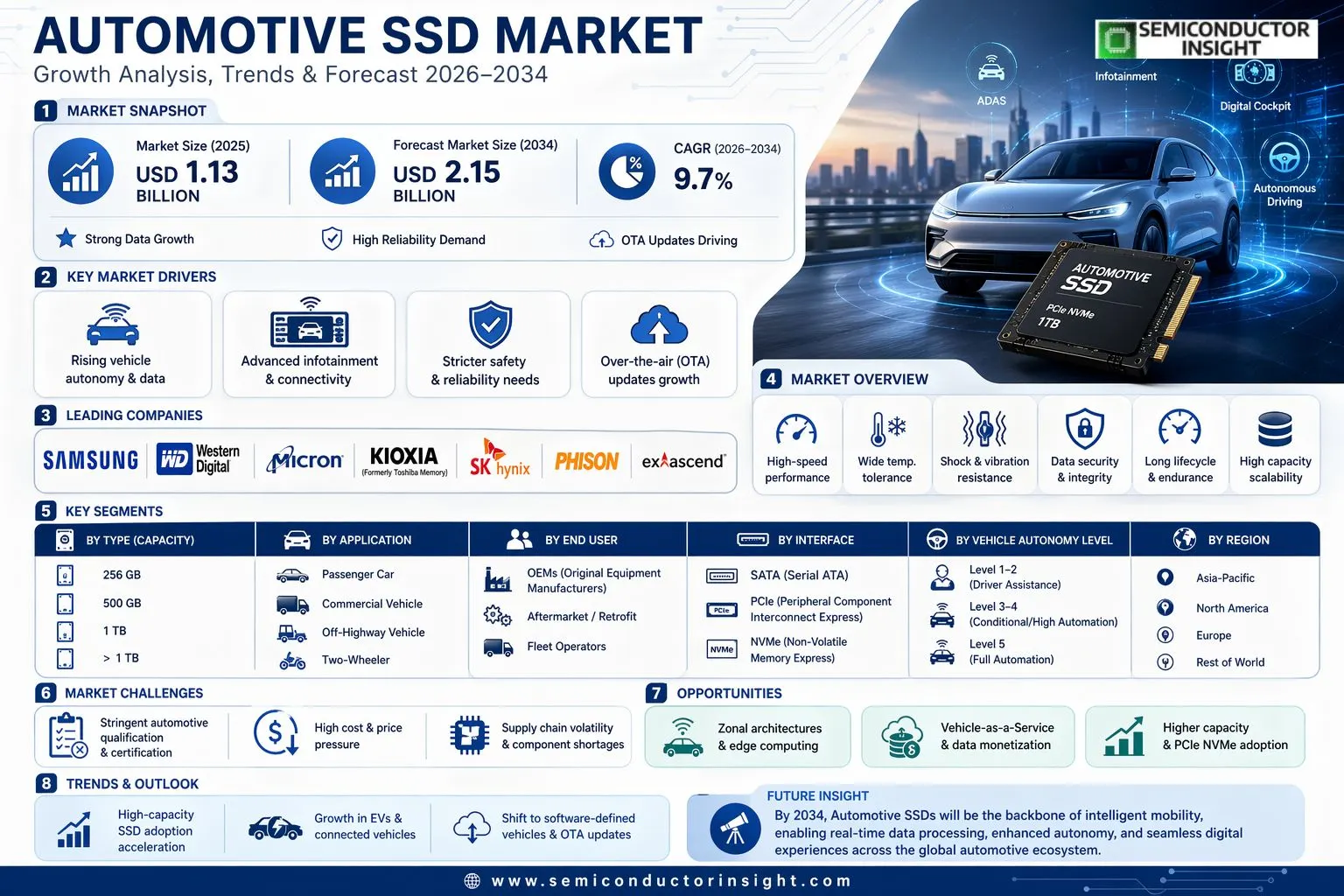
Global Automotive SSD market size was valued at USD 1.13 billion in 2025. The market is projected to grow from USD 1.24 billion in 2026 to USD 2.15 billion by 2034, exhibiting a CAGR of 9.7% during the forecast period.
Automotive Solid-State Drives (SSDs) are specialized, high-reliability storage devices designed for the demanding environment of modern vehicles. Unlike consumer-grade SSDs, these components are engineered to withstand extreme temperatures, vibrations, and extended operational lifecycles critical for automotive applications. They serve as the primary storage solution for advanced vehicle systems, including infotainment units, digital instrument clusters, advanced driver-assistance systems (ADAS), and the data-intensive requirements of autonomous driving platforms.
The market is experiencing robust growth driven by the rapid electrification and digitization of vehicles, which generates exponentially more data requiring fast, durable, and high-capacity storage. The shift towards software-defined vehicles and over-the-air (OTA) updates further necessitates reliable flash memory. However, this growth is tempered by challenges such as stringent automotive-grade certification requirements and cost pressures. Key industry players like Samsung, Western Digital, and Micron Technology are actively developing products with enhanced endurance and specialized controllers to meet automotive safety standards (ASIL). For instance, recent developments include the introduction of UFS (Universal Flash Storage) and PCIe NVMe-based SSDs specifically validated for automotive use, supporting faster boot times and real-time data processing essential for next-generation mobility.
MARKET DRIVERS
Rising Vehicle Autonomy and Data Intensity
The proliferation of Advanced Driver-Assistance Systems (ADAS) and the progression toward higher levels of autonomy are the primary forces shaping Automotive SSD Market. Modern vehicles generate and process terabytes of sensor data daily from LiDAR, radar, and cameras, demanding storage solutions with high capacity, speed, and reliability. Automotive SSD Market is directly correlated with this data explosion, as traditional storage cannot meet the performance needs for real-time data logging, black box functionality, and map updating. This transition to software-defined vehicles makes high-performance storage a critical component, not an accessory.
Transition to In-Vehicle Infotainment and Connectivity
Consumer demand for advanced, smartphone-like experiences in vehicles is accelerating the adoption of solid-state storage. Modern infotainment systems require fast boot times, smooth operation of navigation and streaming services, and support for over-the-air (OTA) updates, which are large software packages. The robust architecture of an SSD, resistant to vibration and extreme temperatures, is essential for these always-connected systems. The growth of Automotive SSD Market is therefore tightly linked to the premiumization of the digital cockpit experience across all vehicle segments.
➤ Market analysts project the segment for high-endurance SSDs designed for continuous data logging in autonomous driving systems to grow at a CAGR exceeding 30% through the decade, highlighting the sector’s strategic importance.
Finally, stringent functional safety standards such as ISO 26262 require reliable data storage for critical vehicle functions. The deterministic performance and failure predictability of automotive-grade SSDs make them the preferred choice over legacy technologies, providing a fundamental driver for market penetration and technological validation.
MARKET CHALLENGES
Stringent Automotive Qualification and Cost Pressures
Qualifying an SSD for automotive use presents a monumental hurdle. Components must endure a wide thermal operating range from -40°C to 105°C or higher, resist constant vibration, and have a lifespan often exceeding 15 years. This rigorous validation process is lengthy and expensive, creating a high barrier to entry for storage vendors. Simultaneously, Automotive SSD Market faces intense cost pressure from automakers, who must manage the bill of materials for mass-market models, creating a complex balance between performance, reliability, and affordability.
Other Challenges
Supply Chain and Technology Longevity
Automotive design cycle is long, often 3-5 years, while semiconductor technology, particularly NAND flash memory, evolves on a much faster 12-18 month cycle. This mismatch creates challenges in guaranteeing the continued supply of a specific SSD component for the entire production life of a vehicle model, potentially a decade or more.
Data Security and Integrity
As vehicles become data centers on wheels, ensuring the integrity and security of stored data,from personal user data to critical sensor logs,is paramount. Implementing robust encryption, secure boot, and protection against data corruption in harsh conditions adds layers of design complexity and cost to automotive SSDs.
MARKET RESTRAINTS
Prolonged Adoption in Entry and Mid-Level Segments
A key restraint on the overall Automotive SSD Market volume is the slow trickle-down of this technology from premium to volume vehicle segments. While high-end electric and autonomous vehicles readily adopt high-capacity SSDs, the cost-benefit analysis for mainstream internal combustion engine vehicles still often favors embedded MultiMediaCard (eMMC) storage or smaller-capacity SSDs. The significant price premium for automotive-grade SSDs over consumer-grade or industrial-grade alternatives remains a decisive factor for cost-sensitive segments, limiting total addressable market growth in the near term.
MARKET OPPORTUNITIES
Expansion of Zonal Architectures and Edge Computing
The industry’s shift from distributed Electronic Control Units (ECUs) to centralized, zonal vehicle architectures creates a significant opportunity. This consolidation requires high-performance, centralized storage hubs, elevating the role of the SSD from a component within a single system to a critical vehicle-wide data repository. For Automotive SSD Market, this means demand for higher-capacity, faster interfaces like PCIe, and enhanced reliability for managing data from multiple domains simultaneously.
Growth of Vehicle-as-a-Service and Data Monetization
The emergence of new business models, including vehicle subscription services and autonomous ride-hailing fleets, depends on reliable, high-uptime vehicles with robust data capabilities. These models will drive demand for SSDs with extreme write endurance for constant operational data recording. Furthermore, the ability to securely store and potentially pre-process valuable vehicular data for monetization,such as traffic patterns or mapping details,positions Automotive SSD as an enabling technology for future revenue streams beyond the initial vehicle sale.
Automotive SSD Market Trends
Acceleration of High-Capacity Storage Adoption
The demand for higher data storage capacities is a dominant trend in Automotive SSD Market, driven by the proliferation of advanced driver-assistance systems (ADAS), high-definition mapping, and in-vehicle infotainment systems. As vehicles generate and process increasing volumes of sensor and log data, the 1 TB and above capacity segments are witnessing accelerated development and adoption. This shift is essential for supporting over-the-air (OTA) updates and autonomous driving functionalities, necessitating robust, high-endurance storage solutions that exceed the capabilities of traditional eMMC storage.
Other Trends
Increasing Integration in Electric and Connected Vehicles
The rapid electrification of vehicle fleets and the expansion of connected car features are creating substantial new opportunities for Automotive SSD Market. Electric vehicles (EVs), with their inherently digital architectures, require sophisticated data storage for battery management systems, telematics, and user interface data. Concurrently, the growth of vehicle-to-everything (V2X) communication is increasing the need for reliable, fast storage to handle real-time data exchange, positioning SSDs as a critical component in next-generation vehicle platforms.
Supply Chain and Competitive Landscape Evolution
The competitive landscape of Automotive SSD Market is characterized by the presence of leading global memory manufacturers and specialized storage firms. Companies like Samsung, Western Digital, and Micron Technology are leveraging their technological expertise to develop automotive-grade SSDs that meet stringent requirements for temperature tolerance, data retention, and reliability. The market is also seeing increased investment in supply chain resilience and localized production strategies to mitigate component shortages and cater to specific regional demands, particularly in Asia and North America.
COMPETITIVE LANDSCAPE
Key Industry Players
A High-Growth Market Anchored by Global Semiconductor Leaders and Specialized Entrants
Global automotive SSD market is characterized by the dominance of established global memory and storage giants, with Samsung, Western Digital, and Micron Technology leading in terms of revenue share. This top tier leverages its vast R&D resources, advanced NAND flash manufacturing capabilities, and longstanding relationships with automotive Tier-1 suppliers to secure major design wins for infotainment, telematics, and advanced driver-assistance systems (ADAS). The market structure is moderately consolidated, with these top five players holding a significant collective share, driven by stringent automotive-grade certifications (AEC-Q100) and the critical need for high reliability, endurance, and performance in extreme vehicle environments. Competition centers on advancing storage density, data transfer speeds with interfaces like PCIe NVMe, and developing specialized firmware for automotive workloads.
Beyond the top-tier leaders, the competitive landscape includes several significant niche and regional players focusing on specific market segments or custom solutions. Companies like Phison and Exascend excel as key suppliers of high-performance SSD controllers and ruggedized storage modules, respectively, catering to demanding automotive applications. The market also sees strong growth from Chinese manufacturers such as Longsys, YEESTOR Microelectronics, and BIWIN Storage Technology, which are increasingly competing on cost-effective solutions for the burgeoning electric and connected vehicle markets in Asia. Other notable players like Kingston Technology, ADATA, and KIOXIA (Toshiba Memory) bring substantial storage expertise, while SK hynix and Intel (through its NAND business now part of SK hynix) represent significant competitive forces with vertically integrated supply chains.
List of Key Automotive SSD Companies Profiled
- Samsung
- Western Digital
- Micron Technology
- KIOXIA (formerly Toshiba Memory)
- SK hynix
- Phison
- Exascend
- Longsys
- YEESTOR Microelectronics
- BIWIN Storage Technology
- Kingston Technology
- ADATA Technology
- Swissbit AG
- Flexxon Pte Ltd
- Transcend Information
Segment Analysis:
| Segment Category | Sub-Segments | Key Insights |
| By Type |
|
Mid-Capacity (500 GB to 1 TB) segments are pivotal, driven by the balance between performance requirements and cost-effectiveness for most advanced vehicle applications. This range supports sophisticated infotainment systems and initial autonomous driving data logging. Higher capacities (>1 TB) are gaining strategic importance for future-proofing vehicles with over-the-air update capabilities and extensive sensor data storage from autonomous systems. |
| By Application |
|
Passenger Car application is the primary growth engine, as consumer demand for digital cockpits, high-definition mapping, and in-car entertainment escalates. The integration of SSDs is critical for enhancing user experience through faster boot times and responsive systems. Commercial vehicle adoption is rising, focused on fleet management telematics and data-intensive logistics tracking, though volume penetration is more gradual compared to passenger vehicles. |
| By End User |
|
OEMs (Original Equipment Manufacturers) constitute the definitive leading segment, as SSDs become a standard design-in component for new vehicle platforms. Collaborations between automakers and storage specialists are deepening to ensure reliability and thermal performance. The aftermarket segment shows niche potential for upgrading older premium vehicles, while fleet operators represent a specialized segment with demands for rugged, high-endurance storage for constant data recording. |
| By Interface |
|
NVMe over PCIe is emerging as the critical interface for next-generation automotive storage, offering the high throughput and low latency required for autonomous driving computations. This transition reflects a shift from legacy SATA-based architectures. The adoption is driven by the need to process real-time data from multiple cameras and LiDAR sensors without creating bottlenecks in the vehicle’s central computing platform. |
| By Vehicle Autonomy Level |
|
Level 3-4 (Conditional/High Automation) vehicles are the current focal point for advanced SSD integration, creating substantial demand for high-performance, automotive-grade storage. These autonomy levels generate enormous quantities of data that must be stored securely and accessed rapidly for decision-making. The market is actively evolving to meet the stringent reliability and endurance standards for these applications, which far exceed the requirements for traditional infotainment systems in lower autonomy vehicles. |
Regional Analysis: Global Automotive SSD Market
Asia-Pacific
The concentration of global electric vehicle manufacturing in China and South Korea directly feeds Automotive SSD Market. New EV models prioritize digital cockpits and autonomous driving features, which require the high-speed data writing and shock resistance inherent in SSDs over traditional storage.
A mature electronics supply chain for memory and controller chips is a key strategic advantage. This proximity allows for tighter collaboration between Automotive SSD suppliers and vehicle manufacturers, optimizing product design and reliability for harsh automotive environments.
Consumer demand in markets like Japan and China for immersive, feature-rich in-car experiences is a primary growth driver. Automakers are responding by installing high-capacity Automotive SSDs to support complex operating systems, over-the-air updates, and extensive media libraries.
Regional industrial policies actively promote smart mobility and automotive digitization. Initiatives focused on building intelligent transportation systems create a regulatory and infrastructural push for technologies like Automotive SSDs, which are foundational for data-intensive vehicle operations.
North America
The North American Automotive SSD Market is characterized by rapid innovation and early adoption driven by the pursuit of advanced autonomous driving technology. The presence of leading tech companies and automotive software developers in Silicon Valley adjacent to major autonomous vehicle testing grounds fosters a unique ecosystem. This dynamic accelerates the development of sophisticated data logging, sensor fusion, and artificial intelligence systems, all of which rely on the high-speed, high-reliability storage that Automotive SSDs deliver. Market penetration is further supported by strong consumer acceptance of premium vehicle features and significant private investment in next-generation mobility solutions.
Europe
Europe represents a highly sophisticated and standards-driven region within Global Automotive SSD Market. Stringent vehicle safety and data protection regulations compel automakers to utilize robust, secure storage solutions. The region’s strong focus on premium and luxury vehicle segments, where digital cockpit integration is a key differentiator, drives demand for high-performance SSDs. Furthermore, Europe’s concerted push towards the software-defined vehicle paradigm increases the necessity for reliable, updatable storage, making SSDs a critical component in future vehicle architectures designed for their long lifecycle and evolving functionality.
South America
The South American Automotive SSD Market is in an emerging growth phase, with adoption primarily concentrated in newly launched premium vehicle models from global OEMs. The regional dynamics are influenced by economic factors that affect consumer purchasing power for high-tech automotive equipment. Market growth is anticipated to align with the gradual modernization of vehicle fleets and increasing imports of vehicles equipped with advanced driver-assistance systems (ADAS) and connected features. While not a primary driver currently, the localized presence of global automakers provides a channel for future technology diffusion into the regional Automotive SSD Market landscape.
Middle East & Africa
This region exhibits a bifurcated market structure within Automotive SSD space. High-growth demand is concentrated in affluent Gulf Cooperation Council (GCC) nations where consumers purchase luxury and high-performance imported vehicles often pre-equipped with the latest storage technology. The broader regional market, however, sees slower penetration due to economic diversity and a vehicle parc dominated by older models. Key opportunities lie in the gradual upgrade of fleet vehicles for logistics and specialized applications, where the durability of Automotive SSDs in extreme temperatures and conditions becomes a significant value proposition.
Report Scope
This market research report provides a comprehensive analysis of the Automotive SSD Market , covering the forecast period 2026–2034. It offers detailed insights into market dynamics, technological advancements, competitive landscape, and key trends shaping the industry.
Key focus areas of the report include:
- Market Overview: The report begins with an overview outlining its current market scenario, key growth indicators, and industry transformation drivers. It discusses macroeconomic factors, demand–supply balance, regulatory landscape, and the strategic role of semiconductors in powering advancements across industries such as automotive, telecommunications, consumer electronics, and industrial automation.
- Market Size & Forecast: Historical data and future projections for revenue, unit shipments, and market value across major regions and segments.
- Segmentation Analysis: Detailed breakdown by product type, technology, application, and end-user industry to identify high-growth segments and investment opportunities.
- Regional Insights: Insights into market performance across North America, Europe, Asia-Pacific, Latin America, and the Middle East & Africa, including country-level analysis where relevant.
- Competitive Landscape: Profiles of leading market participants, including their product offerings, R&D focus, manufacturing capacity, pricing strategies, and recent developments such as mergers, acquisitions, and partnerships.
- Technology Trends & Innovation: Assessment of emerging technologies, integration of AI/IoT, semiconductor design trends, fabrication techniques, and evolving industry standards.
- Market Drivers & Restraints: Evaluation of factors driving market growth along with challenges, supply chain constraints, regulatory issues, and market-entry barriers.
- Stakeholder Insights: Insights for component suppliers, OEMs, system integrators, investors, and policymakers regarding the evolving ecosystem and strategic opportunities.
Primary and secondary research methods are employed, including interviews with industry experts, data from verified sources, and real-time market intelligence to ensure the accuracy and reliability of the insights presented.
FREQUENTLY ASKED QUESTIONS:
What is the current market size of Automotive SSD Market?
-> Automotive SSD Market was valued at USD 1128 million in 2025 and is projected to reach USD 2149 million by 2034, growing at a CAGR of 9.7% during the forecast period.
Which key companies operate in Automotive SSD Market?
-> Key players include Samsung, Western Digital, Micron Technology, Exascend, Phison, Longsys, YEESTOR Microelectronics, BIWIN Storage Technology, among others, with Global top five players holding a significant revenue share in 2025.
What are the key growth drivers?
-> Key growth drivers include the increasing demand for persistent and high-speed data storage in connected and autonomous vehicles, automotive infotainment advancements, and the overall digital transformation within Automotive industry.
Which region dominates the market?
-> The market spans globally, with detailed analysis for regions including North America (U.S., Canada, Mexico), Europe, Asia (China, Japan, South Korea, Southeast Asia, India), South America, and the Middle East & Africa. Both the U.S. and China are significant markets.
What are the emerging trends?
-> Emerging trends include the segmentation of SSDs by capacity (256 GB, 500 GB, 1 TB, >1 TB) catering to varied automotive applications, technological integration for enhanced reliability, and the assessment of supply chain dynamics and industry potential risks.

Get Sample Report PDF for Exclusive Insights
Report Sample Includes
- Table of Contents
- List of Tables & Figures
- Charts, Research Methodology, and more...
 Download Sample Report PDF