
Automotive Solid-state LiDAR Silicon Photonic Chip Market Insights
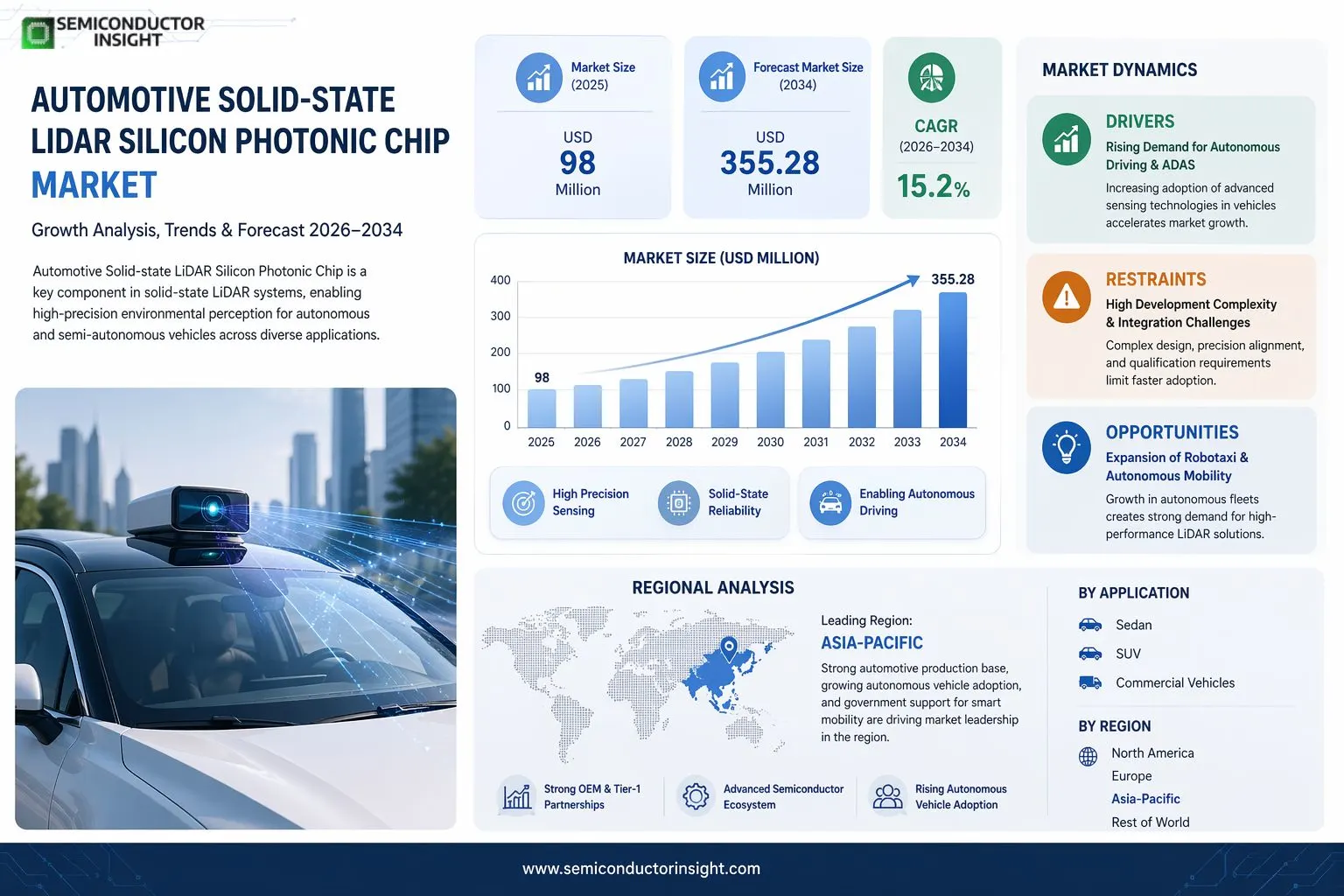
Globall Automotive Solid-state LiDAR Silicon Photonic Chip market size was valued at USD 98 million in 2025. The market is projected to grow from USD 114.37 million in 2026 to USD 355.28 million by 2034, exhibiting a CAGR of 15.2% during the forecast period.
Automotive Solid-State LiDAR Silicon Photonic Chip is a key component used in solid-state LiDAR systems and is manufactured based on silicon photonics technology. Unlike traditional mechanical LiDAR, solid-state LiDAR has no mechanical moving parts and leverages silicon photonic chips to transmit and receive laser signals, enabling high-precision environmental perception. The chip types integral to this technology include FMCW (Frequency-Modulated Continuous Wave) LiDAR chips, OPA (Optical Phased Array) LiDAR chips, and other emerging variants, each designed to support the precise sensing demands of modern autonomous and semi-autonomous vehicle platforms.
The market is witnessing robust growth driven by the accelerating global adoption of autonomous driving technologies, increasing integration of Advanced Driver Assistance Systems (ADAS), and the expanding deployment of solid-state LiDAR in both sedans and SUVs. Furthermore, favorable government regulations around vehicle safety and the strategic initiatives of key manufacturers are significantly shaping market trajectory. Key players operating in this space include Tower Semiconductor, Intel, Mobileye, Scantinel, LuminWave, Guo Ke Guang Xin (Haining) Technology, Yangzhou Qunfa, and Shanghai Xihe, among others.
MARKET DRIVERS
Accelerating Adoption of Advanced Driver Assistance Systems (ADAS) Fueling Demand
The rapid proliferation of Advanced Driver Assistance Systems across passenger vehicles and commercial fleets is a primary growth catalyst for Automotive Solid-state LiDAR Silicon Photonic Chip Market. As global automakers intensify investments in Level 2+ and Level 3 autonomous driving capabilities, the demand for reliable, compact, and high-performance sensing technologies has grown substantially. Silicon photonic chips integrated within solid-state LiDAR systems offer a compelling combination of miniaturization, thermal efficiency, and manufacturing scalability that traditional mechanical LiDAR systems cannot match, making them particularly well-suited for volume automotive production.
Regulatory Push Toward Vehicle Safety Standards Strengthening Market Momentum
Stringent vehicle safety regulations being enforced across North America, Europe, and Asia-Pacific are compelling original equipment manufacturers (OEMs) to integrate advanced sensing solutions at the platform level. Regulatory frameworks mandating automatic emergency braking, lane-keeping assistance, and pedestrian detection systems are driving automakers to evaluate solid-state LiDAR as a production-grade solution. The silicon photonic chip architecture within these LiDAR systems enables on-chip beam steering and photon detection with reduced power consumption, aligning with OEM requirements for integration into energy-efficient vehicle platforms, including battery electric vehicles (BEVs).
➤ Silicon photonics-based solid-state LiDAR solutions are increasingly recognized as a key enabling technology for next-generation automotive perception stacks, offering superior range resolution and environmental robustness compared to legacy scanning LiDAR architectures.
The convergence of semiconductor fabrication advances and photonic integration is enabling chip manufacturers to produce Automotive Solid-state LiDAR Silicon Photonic Chips at CMOS-compatible process nodes, significantly reducing unit costs and improving supply chain predictability. This technological maturity is encouraging tier-1 automotive suppliers to form strategic partnerships with silicon photonics foundries, accelerating the transition from prototype deployments to high-volume production programs across global automotive platforms.
MARKET CHALLENGES
High Development Complexity and Integration Challenges Constraining Broader Adoption
Despite promising technological fundamentals, Automotive Solid-state LiDAR Silicon Photonic Chip Market faces considerable development complexity in achieving the precise optical alignment, packaging integrity, and thermal management required for automotive-grade qualification. Silicon photonic chips must meet stringent AEC-Q100 reliability standards, including wide operating temperature ranges and resistance to mechanical vibration, which demands significant co-engineering effort between photonic chip designers and automotive system integrators. These qualification barriers extend development timelines and increase non-recurring engineering costs, particularly for smaller LiDAR startups attempting to enter the automotive supply chain.
Other Challenges
Wafer-Level Packaging and Optical Coupling Precision
Achieving low-loss optical coupling between silicon photonic waveguides and external optical components at wafer scale remains a technically demanding challenge. Variations in coupling efficiency across a production wafer can degrade LiDAR range accuracy and sensitivity, necessitating advanced packaging techniques such as flip-chip bonding and precision fiber attachment that add cost and complexity to the manufacturing process for solid-state LiDAR silicon photonic chips.
Supply Chain Concentration and Foundry Capacity Constraints
The specialized silicon photonics foundry ecosystem remains concentrated among a limited number of qualified fabs globally, creating potential supply chain vulnerabilities for automotive customers requiring long-term production commitments. Automotive OEMs and tier-1 suppliers evaluating Automotive Solid-state LiDAR Silicon Photonic Chip sourcing must carefully assess foundry capacity roadmaps and dual-sourcing strategies to mitigate risks associated with supply disruptions in this nascent but strategically critical semiconductor segment.
MARKET RESTRAINTS
Cost Competitiveness Against Established Sensing Technologies Limiting Near-Term Penetration
One of the most significant restraints facing Automotive Solid-state LiDAR Silicon Photonic Chip Market is the current cost disparity relative to established automotive camera and radar sensor technologies. While radar and vision-based systems have achieved substantial economies of scale through decades of automotive deployment, silicon photonic LiDAR chips are still progressing along the manufacturing learning curve. For cost-sensitive vehicle segments, including entry-level and mid-range passenger cars, the incremental safety performance offered by solid-state LiDAR must be weighed against the bill-of-materials impact, which continues to influence OEM sensor suite decisions in competitive vehicle programs.
Standardization Gaps and Absence of Unified Automotive LiDAR Interface Protocols
The absence of universally adopted hardware and software interface standards for solid-state LiDAR silicon photonic systems in automotive applications creates integration friction across the value chain. Unlike mature automotive sensing categories governed by established communication protocols, LiDAR data output formats, point cloud resolutions, and sensor fusion interfaces vary considerably across vendors. This fragmentation increases validation effort for automakers integrating multiple supplier solutions within a common autonomous driving or ADAS architecture, effectively slowing procurement decisions and constraining the pace at which Automotive Solid-state LiDAR Silicon Photonic Chip Market can achieve broad platform adoption across global vehicle programs.
MARKET OPPORTUNITIES
Expansion of Robotaxi and Autonomous Mobility Platforms Creating High-Value Application Segments
The accelerating commercial deployment of robotaxi fleets and autonomous mobility-as-a-service platforms presents a high-value growth opportunity for Automotive Solid-state LiDAR Silicon Photonic Chip Market. Operators of autonomous vehicle fleets demand sensing solutions combining long operational lifetimes, consistent performance across diverse environmental conditions, and compact form factors compatible with aerodynamically optimized vehicle designs. Silicon photonic solid-state LiDAR systems, with no mechanically moving parts and inherent compatibility with semiconductor batch manufacturing, are well-positioned to address these requirements, enabling fleet operators to achieve favorable total cost of ownership profiles compared to earlier-generation spinning LiDAR sensor systems.
Integration With Photonic Integrated Circuit Ecosystems Unlocking Next-Generation Sensing Architectures
Advances in photonic integrated circuit (PIC) technology are creating opportunities to embed additional optical sensing and communication functions alongside LiDAR detection capabilities within a single silicon photonic chip platform. This functional integration roadmap could allow automotive system architects to consolidate multiple perception and vehicle-to-everything (V2X) communication functions on a unified photonic chipset, reducing system complexity and enabling new sensor fusion approaches. For chip developers and automotive semiconductor vendors active in Automotive Solid-state LiDAR Silicon Photonic Chip Market, this convergence represents a strategic differentiation pathway that extends addressable revenue opportunities beyond standalone LiDAR sensor supply into broader automotive photonics platform partnerships with leading global OEMs and autonomous driving technology developers.
Trends
Rising Adoption of Silicon Photonics Technology in Automotive LiDAR Systems
Automotive Solid-state LiDAR Silicon Photonic Chip Market is witnessing a significant technological shift as automakers and Tier-1 suppliers increasingly transition from mechanical LiDAR systems to solid-state alternatives. Silicon photonic chips, which enable laser signal transmission and reception without mechanical moving parts, are becoming central to next-generation automotive perception systems. This transition is driven by the growing demand for high-precision environmental sensing in autonomous driving and advanced driver-assistance systems (ADAS). The elimination of moving components through silicon photonics integration enhances reliability, reduces form factor, and improves the durability of LiDAR modules deployed in passenger vehicles including sedans and SUVs.
Other Trends
Growth of FMCW LiDAR Chip Segment
Within Automotive Solid-state LiDAR Silicon Photonic Chip Market, the Frequency Modulated Continuous Wave (FMCW) LiDAR chip segment is emerging as a dominant product type. FMCW-based silicon photonic chips offer simultaneous velocity and distance measurement capabilities, making them highly valuable for real-time object detection in dynamic driving environments. This technical advantage over traditional Time-of-Flight approaches is accelerating their adoption across OEM platforms targeting Level 3 and above autonomous driving configurations.
Expansion of OPA LiDAR Chip Applications
Optical Phased Array (OPA) LiDAR chips represent another key segment gaining traction in Automotive Solid-state LiDAR Silicon Photonic Chip Market. OPA technology enables beam steering without any mechanical actuation, allowing for compact, chip-scale LiDAR integration. Automotive engineers are increasingly evaluating OPA-based silicon photonic solutions for integration into both sedan and SUV platforms, where spatial constraints demand highly miniaturized sensing solutions without compromising detection range or angular resolution.
Regional Dynamics and Competitive Landscape Shaping Market Trends
Automotive Solid-state LiDAR Silicon Photonic Chip Market is experiencing notable regional momentum across North America and Asia, with China and the United States emerging as key demand centers. Leading manufacturers including Tower Semiconductor, Intel, Mobileye, Scantinel, and LuminWave are actively investing in silicon photonics R&D to strengthen their competitive positioning. Chinese players such as Guo Ke Guang Xin (Haining) Technology, Yangzhou Qunfa, and Shanghai Xihe are scaling domestic production capabilities to meet rising demand from local automotive OEMs. This competitive landscape is fostering rapid innovation cycles, with companies focusing on chip miniaturization, improved power efficiency, and cost reduction strategies to accelerate mass-market deployment of solid-state LiDAR silicon photonic chips across global vehicle platforms.
COMPETITIVE LANDSCAPE
Key Industry Players
Automotive Solid-State LiDAR Silicon Photonic Chip Market: Competitive Dynamics and Leading Innovators Shaping the Future of Autonomous Sensing
Globall Automotive Solid-State LiDAR Silicon Photonic Chip market, valued at approximately USD 98 million in 2025 and projected to reach USD 281 million by 2032 at a CAGR of 16.7%, is characterized by intense innovation-driven competition among a select group of semiconductor and photonics specialists. The competitive landscape is shaped by companies with deep expertise in silicon photonics fabrication, FMCW (Frequency Modulated Continuous Wave) chip architecture, and Optical Phased Array (OPA) technologies. Intel and its autonomous driving subsidiary Mobileye together represent some of the most formidable integrated capabilities in this space, leveraging established silicon photonics foundry processes and large-scale automotive partnerships to maintain a leading revenue share. Tower Semiconductor, a leading specialty foundry, provides critical manufacturing infrastructure for silicon photonic chip designs and plays a pivotal role in enabling multiple players across the value chain to bring high-performance LiDAR chips to automotive-grade production volumes. The top five global players collectively accounted for a significant share of total market revenue in 2025, underscoring the relatively consolidated nature of this emerging but rapidly scaling segment.
Beyond the dominant integrated players, a growing cohort of specialized firms is carving out significant positions across FMCW and OPA LiDAR chip sub-segments. Germany-based Scantinel Photonics is recognized for its FMCW LiDAR chip innovation targeting solid-state automotive perception systems, while LuminWave has gained traction with its silicon photonics-based LiDAR transceiver solutions. In the Chinese market — anticipated to be one of the fastest-growing regional segments — domestic players such as Guo Ke Guang Xin (Haining) Technology, Yangzhou Qunfa, and Shanghai Xihe are advancing localized silicon photonic chip development to serve the booming domestic autonomous and smart vehicle industry. These Asia-Pacific players benefit from strong government support for semiconductor self-sufficiency and close integration with leading Chinese automotive OEMs. Competitive differentiation across Globall market is increasingly defined by chip integration density, power efficiency, long-range detection accuracy, and the ability to meet stringent AEC-Q100 automotive reliability standards — factors that continue to drive consolidation, strategic partnerships, and targeted mergers and acquisitions throughout the industry.
List of Key Automotive Solid-State LiDAR Silicon Photonic Chip Companies Profiled
- Tower Semiconductor
- Intel
- Mobileye
- Scantinel Photonics
- LuminWave
- Guo Ke Guang Xin (Haining) Technology
- Yangzhou Qunfa
- Shanghai Xihe
- imec
- Sicoya
- Poet Technologies
- Aeva Technologies
- SiLC Technologies
- Analog Photonics
- Voyant Photonics
Segment Analysis:
| Segment Category | Sub-Segments | Key Insights |
| By Type |
|
FMCW LiDAR Chip stands as the leading segment within Automotive Solid-state LiDAR Silicon Photonic Chip Market, driven by its superior capability in simultaneous velocity and distance measurement without mechanical components.
|
| By Application |
|
SUV emerges as the dominant application segment for Automotive Solid-state LiDAR Silicon Photonic Chips, reflecting the strong consumer preference for premium and semi-premium vehicles that increasingly integrate advanced driver assistance systems (ADAS) as standard features.
|
| By End User |
|
Original Equipment Manufacturers (OEMs) represent the most influential end-user segment, as major automotive brands increasingly mandate solid-state LiDAR silicon photonic chip integration into their next-generation vehicle architectures to meet evolving autonomous and safety standards.
|
| By Autonomy Level |
|
Level 3 (Conditional Automation) vehicles are currently the primary deployment target for Automotive Solid-state LiDAR Silicon Photonic Chips, as regulatory frameworks in key markets such as Germany, Japan, and China have begun formally approving Level 3 autonomous operations on public roads.
|
| By Integration Architecture |
|
Sensor-Fused Integrated Platform is rapidly emerging as the preferred integration architecture for silicon photonic LiDAR chips in production automotive programs, as OEMs and Tier-1 suppliers increasingly favor unified sensing domain controllers that consolidate LiDAR, radar, and camera data processing onto shared compute platforms.
|
Regional Analysis: Automotive Solid-state LiDAR Silicon Photonic Chip Market
Asia-Pacific
China’s domestic electric vehicle boom has created an unparalleled deployment environment for automotive solid-state LiDAR silicon photonic chip technology. Leading Chinese automakers are integrating multi-beam LiDAR as a standard safety feature rather than a premium add-on, driving volume-scale demand. This mass-market orientation is pushing silicon photonic chip manufacturers to optimize for cost-effective, high-throughput production while maintaining stringent automotive qualification standards.
Taiwan and South Korea host world-class semiconductor foundries with growing expertise in photonic integrated circuit fabrication. The proximity of advanced process nodes and specialized silicon photonics packaging capabilities to automotive supply chains within Asia-Pacific reduces development cycle times and enables rapid iteration of next-generation LiDAR chip architectures, giving regional players a meaningful competitive advantage over geographically dispersed Western peers.
Across Asia-Pacific, national governments have introduced forward-looking regulatory frameworks that mandate or incentivize advanced sensing systems in autonomous and connected vehicles. China’s intelligent connected vehicle roadmap, Japan’s automated driving legislation, and South Korea’s smart mobility initiatives collectively create a favorable policy environment that de-risks investment in automotive solid-state LiDAR silicon photonic chip development and commercialization at scale.
Asia-Pacific benefits from tightly integrated supply chains encompassing raw wafer production, photonic chip design, packaging, module assembly, and vehicle integration. This vertical cohesion reduces logistical friction and enables faster qualification cycles for automotive-grade silicon photonic LiDAR chips. Regional collaboration between chip designers, Tier-1 automotive suppliers, and OEMs is fostering co-development models that accelerate product readiness and reduce time-to-market considerably.
North America
North America represents one of the most strategically significant regions in Automotive Solid-state LiDAR Silicon Photonic Chip Market, driven by a robust concentration of autonomous vehicle technology pioneers, venture-backed LiDAR startups, and world-leading research universities. The United States hosts several of the most prominent solid-state LiDAR developers actively pursuing silicon photonics as the foundational chip architecture for next-generation automotive sensing. Silicon Valley’s deep-rooted culture of hardware-software co-design has accelerated the maturation of photonic integrated circuit platforms tailored to automotive requirements. Major automotive OEMs and technology conglomerates headquartered in the region are forging strategic partnerships and direct investments with silicon photonics chip developers, creating a dense ecosystem of innovation. Additionally, U.S. federal initiatives supporting domestic semiconductor manufacturing — particularly in the context of supply chain resilience — are expected to channel investment toward photonic chip fabrication capabilities with direct relevance to automotive LiDAR applications. Canada is also emerging as a node of photonics research excellence, contributing intellectual property and academic talent that feeds into commercial development pipelines across North America.
Europe
Europe occupies a notable position in Globall automotive solid-state LiDAR silicon photonic chip market, supported by the continent’s long-standing automotive engineering heritage and its rigorous approach to vehicle safety standardization. Germany, France, and the Netherlands serve as primary hubs of activity, with established automotive OEMs and Tier-1 suppliers actively evaluating silicon photonics-based LiDAR solutions for integration into next-generation passenger and commercial vehicle platforms. The European Union’s commitment to achieving Vision Zero road safety targets and its regulatory push toward mandatory advanced driver-assistance systems across vehicle categories are creating durable structural demand for solid-state LiDAR sensing technology. European research institutions and publicly funded consortia are contributing to foundational photonic integrated circuit research, strengthening the region’s capabilities in chip design and optical engineering. However, Europe’s relative dependence on external semiconductor foundry capacity for volume production remains a strategic consideration, with ongoing efforts to build regional fabrication infrastructure under initiatives designed to enhance semiconductor sovereignty and supply chain security.
United States
Within North America, the United States warrants specific examination as the most dynamic national market for automotive solid-state LiDAR silicon photonic chip development. The country is home to a disproportionately large share of the world’s active LiDAR technology companies, many of which have chosen silicon photonics as their core chip platform due to its compatibility with complementary metal-oxide-semiconductor manufacturing processes and its scalability advantages. Leading U.S.-based LiDAR developers are advancing beam-steering architectures built on photonic integrated circuits, targeting automotive-grade performance benchmarks for range, resolution, and thermal reliability. The CHIPS and Science Act has strengthened the domestic semiconductor manufacturing ecosystem, with potential downstream benefits for photonic chip production relevant to automotive LiDAR. Autonomous vehicle testing programs operating across multiple U.S. states continue to generate real-world validation data that accelerates the commercial readiness of solid-state LiDAR silicon photonic chip platforms, reinforcing the country’s role as both a technology incubator and an early adoption market of global significance.
Middle East & Africa
The Middle East and Africa region currently represents an emerging frontier in Automotive Solid-state LiDAR Silicon Photonic Chip Market, with adoption trajectories shaped primarily by smart city infrastructure investments and the gradual modernization of automotive fleets in Gulf Cooperation Council nations. The UAE and Saudi Arabia have articulated ambitious national visions for intelligent transportation systems, autonomous mobility services, and connected vehicle infrastructure, positioning them as early adopter markets for advanced automotive sensing technologies within the broader region. While domestic manufacturing capabilities for silicon photonic chips remain nascent, the region’s appetite for imported high-technology automotive systems creates commercial opportunities for international LiDAR suppliers. Africa’s market development remains at an earlier stage, constrained by infrastructure maturity and purchasing power considerations, though long-term urbanization trends and fleet modernization in key economies are expected to gradually expand the addressable market for automotive solid-state LiDAR silicon photonic chip solutions over the forecast period extending to 2034.
Report Scope
This market research report provides a comprehensive analysis of Automotive Solid-state LiDAR Silicon Photonic Chip Market, covering the forecast period 2026–2034. It offers detailed insights into market dynamics, technological advancements, competitive landscape, and key trends shaping the industry.
Key focus areas of the report include:
- Market Overview: The report begins with an overview outlining its current market scenario, key growth indicators, and industry transformation drivers. It discusses macroeconomic factors, demand–supply balance, regulatory landscape, and the strategic role of semiconductors in powering advancements across industries such as automotive, telecommunications, consumer electronics, and industrial automation.
- Market Size & Forecast: Historical data and future projections for revenue, unit shipments, and market value across major regions and segments.
- Segmentation Analysis: Detailed breakdown by product type, technology, application, and end-user industry to identify high-growth segments and investment opportunities.
- Regional Insights: Insights into market performance across North America, Europe, Asia-Pacific, Latin America, and the Middle East & Africa, including country-level analysis where relevant.
- Competitive Landscape: Profiles of leading market participants, including their product offerings, R&D focus, manufacturing capacity, pricing strategies, and recent developments such as mergers, acquisitions, and partnerships.
- Technology Trends & Innovation: Assessment of emerging technologies, integration of AI/IoT, semiconductor design trends, fabrication techniques, and evolving industry standards.
- Market Drivers & Restraints: Evaluation of factors driving market growth along with challenges, supply chain constraints, regulatory issues, and market-entry barriers.
- Stakeholder Insights: Insights for component suppliers, OEMs, system integrators, investors, and policymakers regarding the evolving ecosystem and strategic opportunities.
Primary and secondary research methods are employed, including interviews with industry experts, data from verified sources, and real-time market intelligence to ensure the accuracy and reliability of the insights presented.
FREQUENTLY ASKED QUESTIONS:
What is the current market size of Automotive Solid-state LiDAR Silicon Photonic Chip Market?
-> Global Automotive Solid-state LiDAR Silicon Photonic Chip Market was valued at USD 98 million in 2025 and is projected to reach USD 281 million by 2032, growing at a CAGR of 16.7% during the forecast period.
Which key companies operate in Automotive Solid-state LiDAR Silicon Photonic Chip Market?
-> Key players include Tower Semiconductor, Intel, Mobileye, Scantinel, LuminWave, Guo Ke Guang Xin (Haining) Technology, Yangzhou Qunfa, and Shanghai Xihe, among others.
What are the key growth drivers?
-> Key growth drivers include rising demand for autonomous driving and smart vehicle technologies, increasing adoption of solid-state LiDAR systems with no mechanical moving parts, and advancements in silicon photonics technology enabling high-precision environmental perception in automotive applications.
Which region dominates the market?
-> Asia is a significant and fast-growing region in the market, with China being a major contributor, while North America also holds a strong market presence driven by key players and autonomous vehicle development activities.
What are the emerging trends?
-> Emerging trends include growing adoption of FMCW LiDAR Chips and OPA LiDAR Chips, integration of silicon photonic chips in Sedan and SUV vehicle segments, and expanding applications in autonomous driving and advanced driver-assistance systems (ADAS).

Get Sample Report PDF for Exclusive Insights
Report Sample Includes
- Table of Contents
- List of Tables & Figures
- Charts, Research Methodology, and more...
 Download Sample Report PDF


