Automotive Power Management IC Market, Global Business Strategies 2025-2032

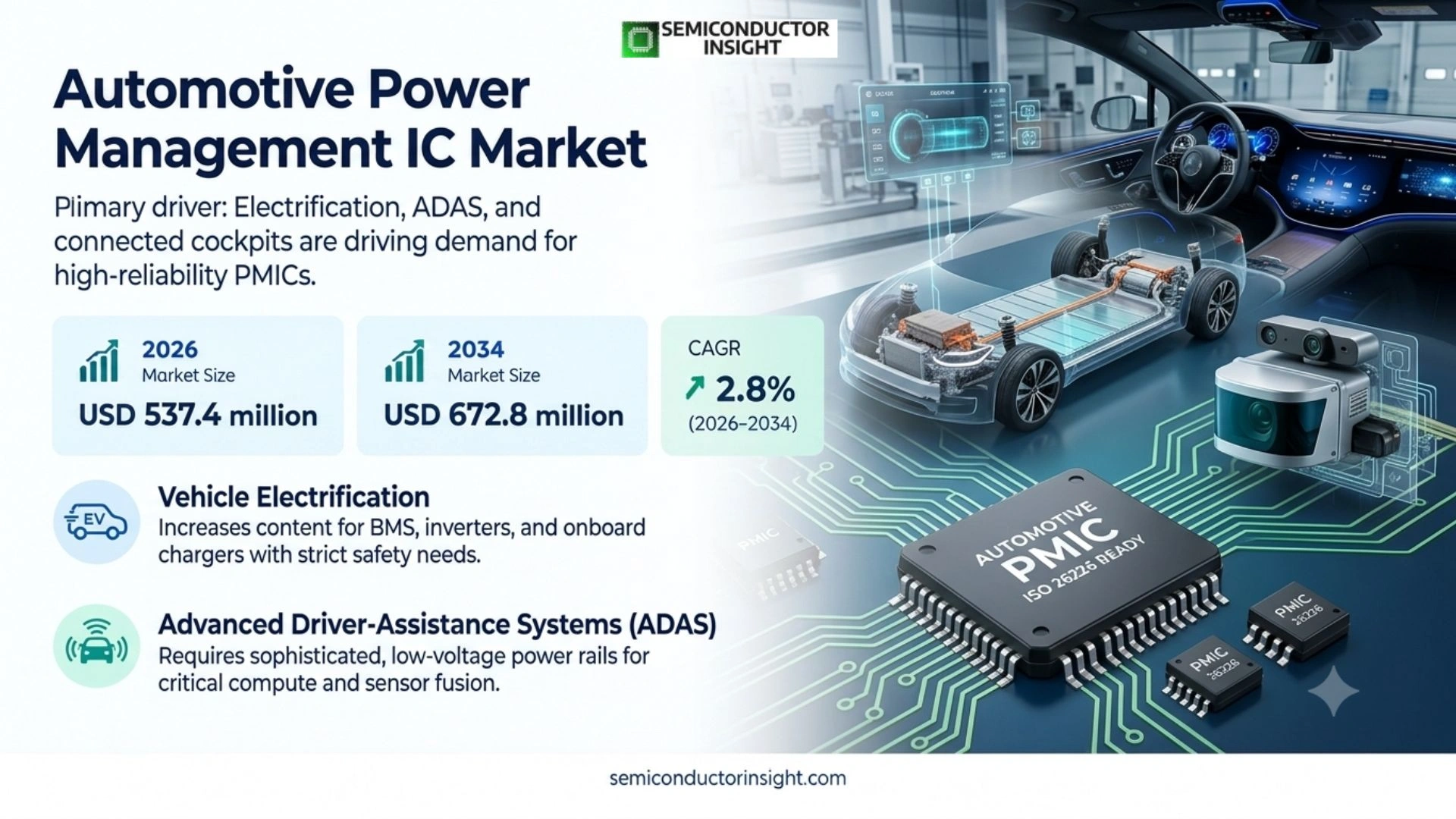
Automotive Power Management IC Market size was valued at USD 508 million in 2024 to USD 636 million by 2032, exhibiting a CAGR of 3.4% during the forecast period

PDF Icon Download Sample Report PDF
  • Quick Dispatch

    All Orders

  • Secure Payment

    100% Secure Payment

Price range: $1,500.00 through $4,250.00

Clear

MARKET INSIGHTS

Global Automotive Power Management IC Market size was valued at USD 508 million in 2024 to USD 636 million by 2032, exhibiting a CAGR of 3.4% during the forecast period.

Automotive Power Management Integrated Circuits (PMICs) are specialized semiconductor devices crucial for managing and distributing power within a vehicle’s electronic systems. These components regulate voltage, manage battery charging, control power sequencing, and optimize energy efficiency for various applications such as infotainment systems, advanced driver-assistance systems (ADAS), and lighting controls.

The market growth is primarily driven by the increasing electrification of vehicles and the rising adoption of advanced electronic features. However, the complexity of designing PMICs for harsh automotive environments and stringent safety standards presents a significant challenge. Furthermore, the expansion is fueled by the global push towards electric vehicles (EVs), which require sophisticated power management solutions for battery packs and powertrains. Key industry players are actively engaged in innovation; for instance, companies like Texas Instruments and STMicroelectronics frequently introduce new PMICs with higher efficiency and integration to meet evolving automotive demands. Texas Instruments, NXP Semiconductors, and Infineon Technologies are some of the key players that operate in the market with a wide range of portfolios.

Automotive Power Management IC Market Share
Automotive Power Management IC Market Size
Automotive Power Management IC Market Trends

MARKET DRIVERS

Accelerating Vehicle Electrification

The global push towards vehicle electrification is the primary driver for the automotive Power Management IC (PMIC) market. The proliferation of Battery Electric Vehicles (BEVs), Plug-in Hybrid Electric Vehicles (PHEVs), and Hybrid Electric Vehicles (HEVs) demands sophisticated power management to handle high-voltage battery systems, onboard chargers, and DC-DC converters. This transition requires specialized PMICs that can efficiently manage power distribution, battery charging, and system voltage regulation, significantly increasing the PMIC content per vehicle.

Proliferation of Advanced Automotive Electronics

The increasing integration of Advanced Driver-Assistance Systems (ADAS), infotainment units, digital cockpits, and connectivity modules (V2X) is drastically elevating the power requirements and complexity of vehicle electrical/electronic (E/E) architectures. Modern premium vehicles can contain over 100 PMICs to manage power for various ECUs, sensors, and displays. The trend towards domain-centralized and zonal architectures further necessitates advanced, multi-channel PMICs that can provide multiple regulated voltages with high efficiency and minimal noise.

Demand for enhanced user experience, safety, and autonomy is directly proportional to the demand for robust and intelligent power management solutions.

Furthermore, the stringent government regulations worldwide aimed at improving vehicle fuel efficiency and reducing emissions are compelling automakers to adopt more electronic systems that replace mechanical and hydraulic functions. Electrically assisted power steering, electric water pumps, and electronic turbochargers all require reliable PMICs, driving market growth.

MARKET CHALLENGES

Stringent Automotive Safety and Quality Standards

Developing PMICs for automotive applications involves navigating a labyrinth of rigorous quality and safety standards, such as AEC-Q100 qualification and ISO 26262 functional safety compliance. Achieving these certifications requires extensive design effort, rigorous testing, and long validation cycles, which increases development time and cost. Failure to meet these standards can result in significant recalls and reputational damage.

Other Challenges

Thermal Management and Reliability
As PMICs are tasked with handling higher power levels in increasingly compact spaces, effective thermal management becomes a critical challenge. Excessive heat can degrade performance and lifespan. Ensuring long-term reliability over a vehicle’s 10-15 year lifespan, especially under harsh operating conditions like extreme temperatures and voltage transients, is a major design hurdle.

Supply Chain Complexity and Cost Pressures
The global semiconductor shortage highlighted the vulnerability of the automotive supply chain. PMICs require specialized semiconductor fabrication processes. Balancing the high cost of automotive-grade components with the intense cost-pressure from automakers, who aim to keep vehicle prices competitive, presents a constant challenge for PMIC suppliers.

MARKET RESTRAINTS

High Development and Manufacturing Costs

The significant investment required for the research, design, and qualification of automotive-grade PMICs acts as a major restraint. The use of more expensive, robust semiconductor processes and packaging technologies to meet automotive reliability standards increases the bill of materials. These high costs can slow adoption, particularly in entry-level and mid-range vehicle segments where cost sensitivity is highest.

Complexity of System Integration

Integrating multiple PMICs into a vehicle’s complex E/E architecture is a significant challenge. It requires deep expertise in both power electronics and automotive systems engineering. Ensuring electromagnetic compatibility (EMC) and avoiding interference between various electronic modules adds another layer of complexity, potentially delaying time-to-market for new vehicle models and acting as a barrier to entry for less experienced players.

MARKET OPPORTUNITIES

Advent of Software-Defined Vehicles (SDVs)

The emergence of Software-Defined Vehicles presents a substantial growth opportunity. SDVs require highly flexible and programmable power management architectures that can support over-the-air (OTA) updates and dynamic power allocation for new features. This creates demand for advanced PMICs with digital control interfaces and configurability, opening new revenue streams for semiconductor companies.

Growth in Autonomous Driving and AI Processing

The progression towards higher levels of autonomy (L3 and above) necessitates powerful centralized AI computing platforms that have immense power requirements. This drives the need for highly efficient, high-current PMICs capable of powering these complex processors and their associated sensor suites (Lidar, Radar, Cameras). The market for PMICs in autonomous driving systems is expected to experience robust growth.

Expansion in Emerging Markets

Rising vehicle production and increasing adoption of electronic features in emerging economies, particularly in Asia Pacific and Latin America, present significant opportunities. As consumers in these regions demand more connected and safer vehicles, the average PMIC content per car will increase, driving market expansion beyond traditional mature markets.

Automotive Power Management IC Market Trends
Steady Market Expansion Driven by Vehicle Electrification

The global Automotive Power Management IC market is on a trajectory of consistent growth, expanding from a valuation of $508 million in 2024 to a projected $636 million by 2032, representing a compound annual growth rate (CAGR) of 3.4%. This sustained expansion is fundamentally linked to the rapid and widespread electrification of vehicles. As vehicles incorporate more sophisticated electronic control units (ECUs), advanced driver-assistance systems (ADAS), infotainment systems, and comprehensive connectivity features, the demand for efficient and reliable power management solutions intensifies. Power Management ICs (PMICs) are critical components that manage power requirements, support voltage scaling, and ensure proper power delivery sequencing, making them indispensable in modern automotive electronics.

Other Trends

Regional Market Dominance and Competitive Landscape

The market exhibits distinct regional dynamics, with North America holding the largest share at approximately 37%, followed closely by Europe with about a 31% market share. This concentration reflects the high adoption rate of advanced automotive technologies and the presence of major automotive manufacturers in these regions. The competitive landscape is characterized by a mix of established global players. Key participants include Texas Instruments, Maxim, STMicroelectronics, NXP Semiconductors, and ROHM. The top three companies collectively command a significant portion of the market, holding around 38% of the total market share, indicating a moderately concentrated yet competitive environment where technological innovation and product reliability are key differentiators.

Segmentation by Application and Component Integration

Market analysis by application reveals that PMICs are essential across both passenger and commercial vehicles, with the segmentation highlighting the broad base of demand. The trend is moving towards greater integration to meet space and efficiency constraints. The market is segmented into Discrete Type and Highly Integrated Type PMICs. There is a growing preference for Highly Integrated PMICs, which combine multiple power management functions into a single chip. This trend is driven by the automotive industry’s need for more compact, energy-efficient, and cost-effective solutions that simplify system design and improve overall reliability in increasingly complex vehicle architectures.

Future Outlook and Industry Focus

The future of the Automotive Power Management IC market is intrinsically tied to the evolution of the automotive industry towards higher levels of automation and electrification. The development of electric vehicles (EVs) and autonomous driving systems presents both a significant opportunity and a challenge, requiring PMICs that can handle higher power levels with greater efficiency and thermal performance. Manufacturers are focusing on developing next-generation PMICs with enhanced features such as higher power density, improved thermal management, and advanced diagnostic capabilities to meet the stringent requirements of future vehicle platforms and maintain a competitive edge in this evolving market.

COMPETITIVE LANDSCAPE

Key Industry Players

An Oligopolistic Market Dominated by a Few Global Semiconductor Giants

The global Automotive Power Management IC market is characterized by a high degree of consolidation, with the top three players—Texas Instruments, STMicroelectronics, and NXP Semiconductors—collectively commanding approximately 38% of the market share. This dominance is driven by their extensive portfolios, significant R&D investment, and strong, long-standing relationships with major automotive OEMs and tier-1 suppliers. Texas Instruments, as a market leader, leverages its broad analog semiconductor expertise to offer highly integrated PMIC solutions that manage complex power requirements for advanced driver-assistance systems (ADAS), infotainment, and vehicle electrification. These leading companies benefit from economies of scale and a global manufacturing footprint, which are critical for meeting the rigorous quality and supply chain demands of the automotive industry.

Beyond the dominant players, a tier of other significant companies compete effectively in specific niches or regional markets. Companies like Infineon Technologies, Renesas Electronics, and Analog Devices (which acquired Maxim Integrated) are major forces, offering specialized PMICs for powertrain, safety, and body electronics applications. ROHM Semiconductor and Toshiba Electronic Devices & Storage Corporation hold strong positions, particularly in the Asian market, with a focus on efficiency and reliability. Emerging players and specialized firms such as Richtek Technology, Allegro MicroSystems, and Monolithic Power Systems (MPS) are gaining traction by developing innovative solutions for electric vehicles, battery management systems, and high-efficiency power conversion, creating competitive pressure and fostering technological advancement within the market.

List of Key Automotive Power Management IC Companies Profiled

Segment Analysis:

Segment Category Sub-Segments Key Insights
By Type
  • Discrete Type
  • Highly Integrated Type
Highly Integrated Type is the leading segment, driven by the automotive industry’s relentless pursuit of miniaturization and efficiency. Modern vehicles require advanced power management solutions that can handle multiple power rails and complex sequencing within compact form factors. These integrated circuits offer superior design flexibility and reliability, which are critical for sophisticated electronic control units and infotainment systems. The trend toward electric vehicles and advanced driver-assistance systems further amplifies the demand for these highly integrated solutions, as they provide the necessary power conditioning and management for sensitive sensors and processors.
By Application
  • Passenger Vehicle
  • Commercial Vehicle
  • Others
Passenger Vehicle application dominates the market due to the high volume production and rapid electrification of personal transportation. The increasing integration of advanced features such as connectivity, premium audio systems, and multiple displays in passenger cars creates substantial demand for sophisticated power management. Furthermore, the global push for electric passenger vehicles necessitates highly efficient PMICs for battery management, power conversion, and motor control. The continuous consumer demand for enhanced in-cabin experiences and safety features ensures this segment remains the primary driver of market growth and innovation.
By End User
  • OEMs
  • Aftermarket
OEMs represent the most significant end-user segment, as power management ICs are fundamental components integrated during the original vehicle manufacturing process. The stringent quality, reliability, and longevity requirements of automotive OEMs create a high barrier to entry and favor established suppliers with proven track records. The shift towards electric and autonomous vehicles has intensified collaborations between PMIC manufacturers and OEMs to develop custom solutions. This deep integration at the design phase ensures optimal performance and is a key factor in securing long-term supply contracts, solidifying the dominance of the OEM channel.
By Voltage Range
  • Low Voltage
  • Medium Voltage
  • High Voltage
High Voltage PMICs are a leading and rapidly growing segment, primarily fueled by the expansion of the electric vehicle market. These components are essential for managing the high-voltage batteries and traction systems in battery electric vehicles and plug-in hybrids. They must provide robust isolation, high efficiency, and exceptional reliability under demanding conditions. The technological complexity and safety requirements for high-voltage applications create significant value and differentiation for suppliers capable of meeting these challenges, making this a critical area for innovation and competitive advantage within the automotive power management landscape.
By Vehicle Propulsion
  • Internal Combustion Engine
  • Electric Vehicle
  • Hybrid Vehicle
Electric Vehicle propulsion is the most dynamic and strategically important segment for PMIC suppliers. The transition to electromobility fundamentally increases the content and value of power management electronics per vehicle. EVs require a complex ecosystem of PMICs for the battery management system, onboard charger, DC-DC converters, and inverter control, far exceeding the requirements of traditional vehicles. This segment commands a premium due to the critical performance and safety specifications, driving intense R&D focus and shaping the long-term roadmap for leading semiconductor companies aiming to capture value in the evolving automotive landscape.

Regional Analysis: Automotive Power Management IC Market

Asia-Pacific

The Asia-Pacific region unequivocally leads the global automotive power management IC market, driven by its powerhouse automotive manufacturing sector and rapidly accelerating electric vehicle adoption. China stands as the central catalyst, with immense government support for new energy vehicles creating an unparalleled demand environment. This fuels intensive R&D and high-volume production of sophisticated PMICs for battery management, onboard charging, and voltage regulation. Major electronics manufacturing hubs in Japan, South Korea, and Taiwan provide a robust and advanced semiconductor supply chain, enabling cost-effective production and rapid innovation cycles. The sheer scale of vehicle production, coupled with aggressive electrification targets set by governments across the region, ensures a continuous and growing pipeline of demand. Furthermore, the presence of leading global automotive OEMs and a burgeoning ecosystem of domestic EV startups creates a highly competitive landscape that pushes the boundaries of power management technology, solidifying the region’s dominance for the foreseeable future.

China’s Electrification Surge
China’s dominance is propelled by strong governmental mandates and subsidies for electric vehicles, creating the world’s largest and fastest-growing market for automotive PMICs. Domestic automakers and battery giants drive demand for high-efficiency power conversion and battery management solutions, fostering a highly advanced and localized supply chain for these critical semiconductors.
Japanese & Korean Technological Prowess
Japan and South Korea contribute significantly with their world-renowned automotive and semiconductor industries. Companies here focus on developing highly reliable, high-performance PMICs for premium EVs and advanced driver-assistance systems, leveraging their expertise in quality and miniaturization to create components for the next generation of smart, connected vehicles.
Southeast Asian Manufacturing Hub
Southeast Asian nations are emerging as crucial manufacturing centers, attracting investment from global semiconductor firms seeking to diversify production. This region benefits from the broader Asia-Pacific supply chain, supporting the assembly and testing of PMICs, which are then integrated into vehicles produced both locally and for export to global markets.
Focus on Advanced Integration
The regional ecosystem is intensely focused on system-level integration, developing PMICs that combine multiple functions like DC-DC conversion, load switching, and monitoring into single, highly efficient packages. This trend is critical for meeting the space, weight, and power constraints of modern electric and autonomous vehicle architectures.

North America
North America represents a highly advanced and innovation-driven market for automotive power management ICs, characterized by stringent regulatory standards and a strong push towards vehicle electrification and autonomy. The presence of leading EV manufacturers and a mature automotive semiconductor industry fuels demand for sophisticated, high-reliability PMICs. Research focus is heavily weighted towards supporting complex autonomous driving systems and next-generation electric powertrains, requiring robust power management for high-performance computing domains and sensor suites. Collaborations between automotive OEMs and specialized semiconductor companies are common, aiming to develop custom PMIC solutions that offer superior thermal performance and efficiency.

Europe
Europe is a key market, driven by ambitious regional regulations targeting a rapid transition to electric mobility. The strong presence of premium automotive brands necessitates PMICs that meet exceptionally high standards for quality, safety, and performance. The market sees significant investment in PMICs for luxury and performance EVs, where power density, electromagnetic compatibility, and functional safety are paramount. European semiconductor suppliers are leaders in developing compliant solutions for the region’s strict automotive-grade certifications. The focus extends to supporting the continent’s growing infrastructure for connected vehicles, requiring robust power management for V2X communication modules.

South America
The South American market for automotive PMICs is nascent but growing, primarily influenced by the gradual adoption of hybrid and electric vehicles in key economies like Brazil. Market dynamics are shaped by economic factors and evolving regulatory frameworks encouraging cleaner transportation. The current demand is for cost-optimized PMIC solutions suitable for entry-level and mid-range vehicle segments. As regional manufacturing capabilities develop and consumer adoption increases, the market is expected to progressively demand more advanced power management technologies, though it currently relies significantly on imported components and designs from leading global regions.

Middle East & Africa
The Middle East & Africa region presents a developing market with potential for long-term growth. While current automotive production and EV adoption rates are relatively low compared to global leaders, there is increasing interest and initial investment in electrification, particularly in Gulf Cooperation Council countries. The market currently focuses on PMICs for conventional vehicles and the aftermarket, with demand for basic power management functions. As infrastructure develops and economic diversification policies that include automotive manufacturing gain traction, the region is poised to gradually integrate more advanced automotive electronics, creating future opportunities for PMIC suppliers.

Report Scope

This market research report provides a comprehensive analysis of the Automotive Power Management IC Market , covering the forecast period 2025–2032. It offers detailed insights into market dynamics, technological advancements, competitive landscape, and key trends shaping the industry.

Key focus areas of the report include:

  • Market Overview: The report begins with an overview outlining its current market scenario, key growth indicators, and industry transformation drivers. It discusses macroeconomic factors, demand–supply balance, regulatory landscape, and the strategic role of semiconductors in powering advancements across industries such as automotive, telecommunications, consumer electronics, and industrial automation.
  • Market Size & Forecast: Historical data and future projections for revenue, unit shipments, and market value across major regions and segments.
  • Segmentation Analysis: Detailed breakdown by product type, technology, application, and end-user industry to identify high-growth segments and investment opportunities.
  • Regional Insights: Insights into market performance across North America, Europe, Asia-Pacific, Latin America, and the Middle East & Africa, including country-level analysis where relevant.
  • Competitive Landscape: Profiles of leading market participants, including their product offerings, R&D focus, manufacturing capacity, pricing strategies, and recent developments such as mergers, acquisitions, and partnerships.
  • Technology Trends & Innovation: Assessment of emerging technologies, integration of AI/IoT, semiconductor design trends, fabrication techniques, and evolving industry standards.
  • Market Drivers & Restraints: Evaluation of factors driving market growth along with challenges, supply chain constraints, regulatory issues, and market-entry barriers.
  • Stakeholder Insights: Insights for component suppliers, OEMs, system integrators, investors, and policymakers regarding the evolving ecosystem and strategic opportunities.

Primary and secondary research methods are employed, including interviews with industry experts, data from verified sources, and real-time market intelligence to ensure the accuracy and reliability of the insights presented.

FREQUENTLY ASKED QUESTIONS:

What is the current market size of Automotive Power Management IC Market?

-> Global Automotive Power Management IC Market was valued at USD 508 million in 2024 and is projected to reach USD 636 million by 2032, exhibiting a CAGR of 3.4% during the forecast period.

Which key companies operate in Automotive Power Management IC Market?

-> Key players include Texas Instruments, Maxim, STMicroelectronics, NXP Semiconductors, Cypress, Dialog, Toshiba, ROHM, Renesas, Allegro MicroSystems, Richtek, among others. The top three companies held approximately 38% market share in 2024.

What are the key growth drivers?

-> Key growth drivers are tied to the increasing power management requirements in modern vehicles, support for advanced voltage scaling and power sequencing, and the optimization of power usage in electronic systems with power supplies or batteries.

Which region dominates the market?

-> North America is the largest market, holding about 37% share. Europe is a significant follower, accounting for approximately 31% market share.

What are the emerging trends?

-> Emerging trends include the increasing integration of PMICs in passenger and commercial vehicles, technological advancements in discrete and highly integrated product types, and the expanding application scope driven by automotive electronics.

Automotive Power Management IC Market, Global Business Strategies 2025-2032

Get Sample Report PDF for Exclusive Insights

Report Sample Includes

  • Table of Contents
  • List of Tables & Figures
  • Charts, Research Methodology, and more...

PDF Icon Download Sample Report PDF

Download Sample Report

Table of Content

1 Introduction to Research & Analysis Reports
1.1 Automotive Power Management IC Market Definition
1.2 Market Segments
1.2.1 Segment by Type
1.2.2 Segment by Application
1.3 Global Automotive Power Management IC Market Overview
1.4 Features & Benefits of This Report
1.5 Methodology & Sources of Information
1.5.1 Research Methodology
1.5.2 Research Process
1.5.3 Base Year
1.5.4 Report Assumptions & Caveats
2 Global Automotive Power Management IC Overall Market Size
2.1 Global Automotive Power Management IC Market Size: 2024 VS 2032
2.2 Global Automotive Power Management IC Market Size, Prospects & Forecasts: 2020-2032
2.3 Global Automotive Power Management IC Sales: 2020-2032
3 Company Landscape
3.1 Top Automotive Power Management IC Players in Global Market
3.2 Top Global Automotive Power Management IC Companies Ranked by Revenue
3.3 Global Automotive Power Management IC Revenue by Companies
3.4 Global Automotive Power Management IC Sales by Companies
3.5 Global Automotive Power Management IC Price by Manufacturer (2020-2025)
3.6 Top 3 and Top 5 Automotive Power Management IC Companies in Global Market, by Revenue in 2024
3.7 Global Manufacturers Automotive Power Management IC Product Type
3.8 Tier 1, Tier 2, and Tier 3 Automotive Power Management IC Players in Global Market
3.8.1 List of Global Tier 1 Automotive Power Management IC Companies
3.8.2 List of Global Tier 2 and Tier 3 Automotive Power Management IC Companies
4 Sights by Product
4.1 Overview
4.1.1 Segment by Type – Global Automotive Power Management IC Market Size Markets, 2024 & 2032
4.1.2 Discrete Type
4.1.3 Highly Integrated Type
4.2 Segment by Type – Global Automotive Power Management IC Revenue & Forecasts
4.2.1 Segment by Type – Global Automotive Power Management IC Revenue, 2020-2025
4.2.2 Segment by Type – Global Automotive Power Management IC Revenue, 2026-2032
4.2.3 Segment by Type – Global Automotive Power Management IC Revenue Market Share, 2020-2032
4.3 Segment by Type – Global Automotive Power Management IC Sales & Forecasts
4.3.1 Segment by Type – Global Automotive Power Management IC Sales, 2020-2025
4.3.2 Segment by Type – Global Automotive Power Management IC Sales, 2026-2032
4.3.3 Segment by Type – Global Automotive Power Management IC Sales Market Share, 2020-2032
4.4 Segment by Type – Global Automotive Power Management IC Price (Manufacturers Selling Prices), 2020-2032
5 Sights by Application
5.1 Overview
5.1.1 Segment by Application – Global Automotive Power Management IC Market Size, 2024 & 2032
5.1.2 Passenger Vehicle
5.1.3 Commercial Vehicle
5.2 Segment by Application – Global Automotive Power Management IC Revenue & Forecasts
5.2.1 Segment by Application – Global Automotive Power Management IC Revenue, 2020-2025
5.2.2 Segment by Application – Global Automotive Power Management IC Revenue, 2026-2032
5.2.3 Segment by Application – Global Automotive Power Management IC Revenue Market Share, 2020-2032
5.3 Segment by Application – Global Automotive Power Management IC Sales & Forecasts
5.3.1 Segment by Application – Global Automotive Power Management IC Sales, 2020-2025
5.3.2 Segment by Application – Global Automotive Power Management IC Sales, 2026-2032
5.3.3 Segment by Application – Global Automotive Power Management IC Sales Market Share, 2020-2032
5.4 Segment by Application – Global Automotive Power Management IC Price (Manufacturers Selling Prices), 2020-2032
6 Sights by Region
6.1 By Region – Global Automotive Power Management IC Market Size, 2024 & 2032
6.2 By Region – Global Automotive Power Management IC Revenue & Forecasts
6.2.1 By Region – Global Automotive Power Management IC Revenue, 2020-2025
6.2.2 By Region – Global Automotive Power Management IC Revenue, 2026-2032
6.2.3 By Region – Global Automotive Power Management IC Revenue Market Share, 2020-2032
6.3 By Region – Global Automotive Power Management IC Sales & Forecasts
6.3.1 By Region – Global Automotive Power Management IC Sales, 2020-2025
6.3.2 By Region – Global Automotive Power Management IC Sales, 2026-2032
6.3.3 By Region – Global Automotive Power Management IC Sales Market Share, 2020-2032
6.4 North America
6.4.1 By Country – North America Automotive Power Management IC Revenue, 2020-2032
6.4.2 By Country – North America Automotive Power Management IC Sales, 2020-2032
6.4.3 United States Automotive Power Management IC Market Size, 2020-2032
6.4.4 Canada Automotive Power Management IC Market Size, 2020-2032
6.4.5 Mexico Automotive Power Management IC Market Size, 2020-2032
6.5 Europe
6.5.1 By Country – Europe Automotive Power Management IC Revenue, 2020-2032
6.5.2 By Country – Europe Automotive Power Management IC Sales, 2020-2032
6.5.3 Germany Automotive Power Management IC Market Size, 2020-2032
6.5.4 France Automotive Power Management IC Market Size, 2020-2032
6.5.5 U.K. Automotive Power Management IC Market Size, 2020-2032
6.5.6 Italy Automotive Power Management IC Market Size, 2020-2032
6.5.7 Russia Automotive Power Management IC Market Size, 2020-2032
6.5.8 Nordic Countries Automotive Power Management IC Market Size, 2020-2032
6.5.9 Benelux Automotive Power Management IC Market Size, 2020-2032
6.6 Asia
6.6.1 By Region – Asia Automotive Power Management IC Revenue, 2020-2032
6.6.2 By Region – Asia Automotive Power Management IC Sales, 2020-2032
6.6.3 China Automotive Power Management IC Market Size, 2020-2032
6.6.4 Japan Automotive Power Management IC Market Size, 2020-2032
6.6.5 South Korea Automotive Power Management IC Market Size, 2020-2032
6.6.6 Southeast Asia Automotive Power Management IC Market Size, 2020-2032
6.6.7 India Automotive Power Management IC Market Size, 2020-2032
6.7 South America
6.7.1 By Country – South America Automotive Power Management IC Revenue, 2020-2032
6.7.2 By Country – South America Automotive Power Management IC Sales, 2020-2032
6.7.3 Brazil Automotive Power Management IC Market Size, 2020-2032
6.7.4 Argentina Automotive Power Management IC Market Size, 2020-2032
6.8 Middle East & Africa
6.8.1 By Country – Middle East & Africa Automotive Power Management IC Revenue, 2020-2032
6.8.2 By Country – Middle East & Africa Automotive Power Management IC Sales, 2020-2032
6.8.3 Turkey Automotive Power Management IC Market Size, 2020-2032
6.8.4 Israel Automotive Power Management IC Market Size, 2020-2032
6.8.5 Saudi Arabia Automotive Power Management IC Market Size, 2020-2032
6.8.6 UAE Automotive Power Management IC Market Size, 2020-2032
7 Manufacturers & Brands Profiles
7.1 Texas Instruments
7.1.1 Texas Instruments Company Summary
7.1.2 Texas Instruments Business Overview
7.1.3 Texas Instruments Automotive Power Management IC Major Product Offerings
7.1.4 Texas Instruments Automotive Power Management IC Sales and Revenue in Global (2020-2025)
7.1.5 Texas Instruments Key News & Latest Developments
7.2 Maxim
7.2.1 Maxim Company Summary
7.2.2 Maxim Business Overview
7.2.3 Maxim Automotive Power Management IC Major Product Offerings
7.2.4 Maxim Automotive Power Management IC Sales and Revenue in Global (2020-2025)
7.2.5 Maxim Key News & Latest Developments
7.3 STMicroelectronics
7.3.1 STMicroelectronics Company Summary
7.3.2 STMicroelectronics Business Overview
7.3.3 STMicroelectronics Automotive Power Management IC Major Product Offerings
7.3.4 STMicroelectronics Automotive Power Management IC Sales and Revenue in Global (2020-2025)
7.3.5 STMicroelectronics Key News & Latest Developments
7.4 NXP Semiconductors
7.4.1 NXP Semiconductors Company Summary
7.4.2 NXP Semiconductors Business Overview
7.4.3 NXP Semiconductors Automotive Power Management IC Major Product Offerings
7.4.4 NXP Semiconductors Automotive Power Management IC Sales and Revenue in Global (2020-2025)
7.4.5 NXP Semiconductors Key News & Latest Developments
7.5 Cypress
7.5.1 Cypress Company Summary
7.5.2 Cypress Business Overview
7.5.3 Cypress Automotive Power Management IC Major Product Offerings
7.5.4 Cypress Automotive Power Management IC Sales and Revenue in Global (2020-2025)
7.5.5 Cypress Key News & Latest Developments
7.6 Dialog
7.6.1 Dialog Company Summary
7.6.2 Dialog Business Overview
7.6.3 Dialog Automotive Power Management IC Major Product Offerings
7.6.4 Dialog Automotive Power Management IC Sales and Revenue in Global (2020-2025)
7.6.5 Dialog Key News & Latest Developments
7.7 Toshiba
7.7.1 Toshiba Company Summary
7.7.2 Toshiba Business Overview
7.7.3 Toshiba Automotive Power Management IC Major Product Offerings
7.7.4 Toshiba Automotive Power Management IC Sales and Revenue in Global (2020-2025)
7.7.5 Toshiba Key News & Latest Developments
7.8 ROHM
7.8.1 ROHM Company Summary
7.8.2 ROHM Business Overview
7.8.3 ROHM Automotive Power Management IC Major Product Offerings
7.8.4 ROHM Automotive Power Management IC Sales and Revenue in Global (2020-2025)
7.8.5 ROHM Key News & Latest Developments
7.9 Renesas
7.9.1 Renesas Company Summary
7.9.2 Renesas Business Overview
7.9.3 Renesas Automotive Power Management IC Major Product Offerings
7.9.4 Renesas Automotive Power Management IC Sales and Revenue in Global (2020-2025)
7.9.5 Renesas Key News & Latest Developments
7.10 Allegro MicroSystems
7.10.1 Allegro MicroSystems Company Summary
7.10.2 Allegro MicroSystems Business Overview
7.10.3 Allegro MicroSystems Automotive Power Management IC Major Product Offerings
7.10.4 Allegro MicroSystems Automotive Power Management IC Sales and Revenue in Global (2020-2025)
7.10.5 Allegro MicroSystems Key News & Latest Developments
7.11 Richtek
7.11.1 Richtek Company Summary
7.11.2 Richtek Business Overview
7.11.3 Richtek Automotive Power Management IC Major Product Offerings
7.11.4 Richtek Automotive Power Management IC Sales and Revenue in Global (2020-2025)
7.11.5 Richtek Key News & Latest Developments
8 Global Automotive Power Management IC Production Capacity, Analysis
8.1 Global Automotive Power Management IC Production Capacity, 2020-2032
8.2 Automotive Power Management IC Production Capacity of Key Manufacturers in Global Market
8.3 Global Automotive Power Management IC Production by Region
9 Key Market Trends, Opportunity, Drivers and Restraints
9.1 Market Opportunities & Trends
9.2 Market Drivers
9.3 Market Restraints
10 Automotive Power Management IC Supply Chain Analysis
10.1 Automotive Power Management IC Industry Value Chain
10.2 Automotive Power Management IC Upstream Market
10.3 Automotive Power Management IC Downstream and Clients
10.4 Marketing Channels Analysis
10.4.1 Marketing Channels
10.4.2 Automotive Power Management IC Distributors and Sales Agents in Global
11 Conclusion
12 Appendix
12.1 Note
12.2 Examples of Clients
12.3 DisclaimerList of Tables
Table 1. Key Players of Automotive Power Management IC in Global Market
Table 2. Top Automotive Power Management IC Players in Global Market, Ranking by Revenue (2024)
Table 3. Global Automotive Power Management IC Revenue by Companies, (US$, Mn), 2020-2025
Table 4. Global Automotive Power Management IC Revenue Share by Companies, 2020-2025
Table 5. Global Automotive Power Management IC Sales by Companies, (M Units), 2020-2025
Table 6. Global Automotive Power Management IC Sales Share by Companies, 2020-2025
Table 7. Key Manufacturers Automotive Power Management IC Price (2020-2025) & (USD/Unit)
Table 8. Global Manufacturers Automotive Power Management IC Product Type
Table 9. List of Global Tier 1 Automotive Power Management IC Companies, Revenue (US$, Mn) in 2024 and Market Share
Table 10. List of Global Tier 2 and Tier 3 Automotive Power Management IC Companies, Revenue (US$, Mn) in 2024 and Market Share
Table 11. Segment by Type – Global Automotive Power Management IC Revenue, (US$, Mn), 2024 & 2032
Table 12. Segment by Type – Global Automotive Power Management IC Revenue (US$, Mn), 2020-2025
Table 13. Segment by Type – Global Automotive Power Management IC Revenue (US$, Mn), 2026-2032
Table 14. Segment by Type – Global Automotive Power Management IC Sales (M Units), 2020-2025
Table 15. Segment by Type – Global Automotive Power Management IC Sales (M Units), 2026-2032
Table 16. Segment by Application – Global Automotive Power Management IC Revenue, (US$, Mn), 2024 & 2032
Table 17. Segment by Application – Global Automotive Power Management IC Revenue, (US$, Mn), 2020-2025
Table 18. Segment by Application – Global Automotive Power Management IC Revenue, (US$, Mn), 2026-2032
Table 19. Segment by Application – Global Automotive Power Management IC Sales, (M Units), 2020-2025
Table 20. Segment by Application – Global Automotive Power Management IC Sales, (M Units), 2026-2032
Table 21. By Region – Global Automotive Power Management IC Revenue, (US$, Mn), 2025-2032
Table 22. By Region – Global Automotive Power Management IC Revenue, (US$, Mn), 2020-2025
Table 23. By Region – Global Automotive Power Management IC Revenue, (US$, Mn), 2026-2032
Table 24. By Region – Global Automotive Power Management IC Sales, (M Units), 2020-2025
Table 25. By Region – Global Automotive Power Management IC Sales, (M Units), 2026-2032
Table 26. By Country – North America Automotive Power Management IC Revenue, (US$, Mn), 2020-2025
Table 27. By Country – North America Automotive Power Management IC Revenue, (US$, Mn), 2026-2032
Table 28. By Country – North America Automotive Power Management IC Sales, (M Units), 2020-2025
Table 29. By Country – North America Automotive Power Management IC Sales, (M Units), 2026-2032
Table 30. By Country – Europe Automotive Power Management IC Revenue, (US$, Mn), 2020-2025
Table 31. By Country – Europe Automotive Power Management IC Revenue, (US$, Mn), 2026-2032
Table 32. By Country – Europe Automotive Power Management IC Sales, (M Units), 2020-2025
Table 33. By Country – Europe Automotive Power Management IC Sales, (M Units), 2026-2032
Table 34. By Region – Asia Automotive Power Management IC Revenue, (US$, Mn), 2020-2025
Table 35. By Region – Asia Automotive Power Management IC Revenue, (US$, Mn), 2026-2032
Table 36. By Region – Asia Automotive Power Management IC Sales, (M Units), 2020-2025
Table 37. By Region – Asia Automotive Power Management IC Sales, (M Units), 2026-2032
Table 38. By Country – South America Automotive Power Management IC Revenue, (US$, Mn), 2020-2025
Table 39. By Country – South America Automotive Power Management IC Revenue, (US$, Mn), 2026-2032
Table 40. By Country – South America Automotive Power Management IC Sales, (M Units), 2020-2025
Table 41. By Country – South America Automotive Power Management IC Sales, (M Units), 2026-2032
Table 42. By Country – Middle East & Africa Automotive Power Management IC Revenue, (US$, Mn), 2020-2025
Table 43. By Country – Middle East & Africa Automotive Power Management IC Revenue, (US$, Mn), 2026-2032
Table 44. By Country – Middle East & Africa Automotive Power Management IC Sales, (M Units), 2020-2025
Table 45. By Country – Middle East & Africa Automotive Power Management IC Sales, (M Units), 2026-2032
Table 46. Texas Instruments Company Summary
Table 47. Texas Instruments Automotive Power Management IC Product Offerings
Table 48. Texas Instruments Automotive Power Management IC Sales (M Units), Revenue (US$, Mn) and Average Price (USD/Unit) & (2020-2025)
Table 49. Texas Instruments Key News & Latest Developments
Table 50. Maxim Company Summary
Table 51. Maxim Automotive Power Management IC Product Offerings
Table 52. Maxim Automotive Power Management IC Sales (M Units), Revenue (US$, Mn) and Average Price (USD/Unit) & (2020-2025)
Table 53. Maxim Key News & Latest Developments
Table 54. STMicroelectronics Company Summary
Table 55. STMicroelectronics Automotive Power Management IC Product Offerings
Table 56. STMicroelectronics Automotive Power Management IC Sales (M Units), Revenue (US$, Mn) and Average Price (USD/Unit) & (2020-2025)
Table 57. STMicroelectronics Key News & Latest Developments
Table 58. NXP Semiconductors Company Summary
Table 59. NXP Semiconductors Automotive Power Management IC Product Offerings
Table 60. NXP Semiconductors Automotive Power Management IC Sales (M Units), Revenue (US$, Mn) and Average Price (USD/Unit) & (2020-2025)
Table 61. NXP Semiconductors Key News & Latest Developments
Table 62. Cypress Company Summary
Table 63. Cypress Automotive Power Management IC Product Offerings
Table 64. Cypress Automotive Power Management IC Sales (M Units), Revenue (US$, Mn) and Average Price (USD/Unit) & (2020-2025)
Table 65. Cypress Key News & Latest Developments
Table 66. Dialog Company Summary
Table 67. Dialog Automotive Power Management IC Product Offerings
Table 68. Dialog Automotive Power Management IC Sales (M Units), Revenue (US$, Mn) and Average Price (USD/Unit) & (2020-2025)
Table 69. Dialog Key News & Latest Developments
Table 70. Toshiba Company Summary
Table 71. Toshiba Automotive Power Management IC Product Offerings
Table 72. Toshiba Automotive Power Management IC Sales (M Units), Revenue (US$, Mn) and Average Price (USD/Unit) & (2020-2025)
Table 73. Toshiba Key News & Latest Developments
Table 74. ROHM Company Summary
Table 75. ROHM Automotive Power Management IC Product Offerings
Table 76. ROHM Automotive Power Management IC Sales (M Units), Revenue (US$, Mn) and Average Price (USD/Unit) & (2020-2025)
Table 77. ROHM Key News & Latest Developments
Table 78. Renesas Company Summary
Table 79. Renesas Automotive Power Management IC Product Offerings
Table 80. Renesas Automotive Power Management IC Sales (M Units), Revenue (US$, Mn) and Average Price (USD/Unit) & (2020-2025)
Table 81. Renesas Key News & Latest Developments
Table 82. Allegro MicroSystems Company Summary
Table 83. Allegro MicroSystems Automotive Power Management IC Product Offerings
Table 84. Allegro MicroSystems Automotive Power Management IC Sales (M Units), Revenue (US$, Mn) and Average Price (USD/Unit) & (2020-2025)
Table 85. Allegro MicroSystems Key News & Latest Developments
Table 86. Richtek Company Summary
Table 87. Richtek Automotive Power Management IC Product Offerings
Table 88. Richtek Automotive Power Management IC Sales (M Units), Revenue (US$, Mn) and Average Price (USD/Unit) & (2020-2025)
Table 89. Richtek Key News & Latest Developments
Table 90. Automotive Power Management IC Capacity of Key Manufacturers in Global Market, 2023-2025 (M Units)
Table 91. Global Automotive Power Management IC Capacity Market Share of Key Manufacturers, 2023-2025
Table 92. Global Automotive Power Management IC Production by Region, 2020-2025 (M Units)
Table 93. Global Automotive Power Management IC Production by Region, 2026-2032 (M Units)
Table 94. Automotive Power Management IC Market Opportunities & Trends in Global Market
Table 95. Automotive Power Management IC Market Drivers in Global Market
Table 96. Automotive Power Management IC Market Restraints in Global Market
Table 97. Automotive Power Management IC Raw Materials
Table 98. Automotive Power Management IC Raw Materials Suppliers in Global Market
Table 99. Typical Automotive Power Management IC Downstream
Table 100. Automotive Power Management IC Downstream Clients in Global Market
Table 101. Automotive Power Management IC Distributors and Sales Agents in Global Market

List of Figures
Figure 1. Automotive Power Management IC Product Picture
Figure 2. Automotive Power Management IC Segment by Type in 2024
Figure 3. Automotive Power Management IC Segment by Application in 2024
Figure 4. Global Automotive Power Management IC Market Overview: 2024
Figure 5. Key Caveats
Figure 6. Global Automotive Power Management IC Market Size: 2024 VS 2032 (US$, Mn)
Figure 7. Global Automotive Power Management IC Revenue: 2020-2032 (US$, Mn)
Figure 8. Automotive Power Management IC Sales in Global Market: 2020-2032 (M Units)
Figure 9. The Top 3 and 5 Players Market Share by Automotive Power Management IC Revenue in 2024
Figure 10. Segment by Type – Global Automotive Power Management IC Revenue, (US$, Mn), 2024 & 2032
Figure 11. Segment by Type – Global Automotive Power Management IC Revenue Market Share, 2020-2032
Figure 12. Segment by Type – Global Automotive Power Management IC Sales Market Share, 2020-2032
Figure 13. Segment by Type – Global Automotive Power Management IC Price (USD/Unit), 2020-2032
Figure 14. Segment by Application – Global Automotive Power Management IC Revenue, (US$, Mn), 2024 & 2032
Figure 15. Segment by Application – Global Automotive Power Management IC Revenue Market Share, 2020-2032
Figure 16. Segment by Application – Global Automotive Power Management IC Sales Market Share, 2020-2032
Figure 17. Segment by Application -Global Automotive Power Management IC Price (USD/Unit), 2020-2032
Figure 18. By Region – Global Automotive Power Management IC Revenue, (US$, Mn), 2025 & 2032
Figure 19. By Region – Global Automotive Power Management IC Revenue Market Share, 2020 VS 2024 VS 2032
Figure 20. By Region – Global Automotive Power Management IC Revenue Market Share, 2020-2032
Figure 21. By Region – Global Automotive Power Management IC Sales Market Share, 2020-2032
Figure 22. By Country – North America Automotive Power Management IC Revenue Market Share, 2020-2032
Figure 23. By Country – North America Automotive Power Management IC Sales Market Share, 2020-2032
Figure 24. United States Automotive Power Management IC Revenue, (US$, Mn), 2020-2032
Figure 25. Canada Automotive Power Management IC Revenue, (US$, Mn), 2020-2032
Figure 26. Mexico Automotive Power Management IC Revenue, (US$, Mn), 2020-2032
Figure 27. By Country – Europe Automotive Power Management IC Revenue Market Share, 2020-2032
Figure 28. By Country – Europe Automotive Power Management IC Sales Market Share, 2020-2032
Figure 29. Germany Automotive Power Management IC Revenue, (US$, Mn), 2020-2032
Figure 30. France Automotive Power Management IC Revenue, (US$, Mn), 2020-2032
Figure 31. U.K. Automotive Power Management IC Revenue, (US$, Mn), 2020-2032
Figure 32. Italy Automotive Power Management IC Revenue, (US$, Mn), 2020-2032
Figure 33. Russia Automotive Power Management IC Revenue, (US$, Mn), 2020-2032
Figure 34. Nordic Countries Automotive Power Management IC Revenue, (US$, Mn), 2020-2032
Figure 35. Benelux Automotive Power Management IC Revenue, (US$, Mn), 2020-2032
Figure 36. By Region – Asia Automotive Power Management IC Revenue Market Share, 2020-2032
Figure 37. By Region – Asia Automotive Power Management IC Sales Market Share, 2020-2032
Figure 38. China Automotive Power Management IC Revenue, (US$, Mn), 2020-2032
Figure 39. Japan Automotive Power Management IC Revenue, (US$, Mn), 2020-2032
Figure 40. South Korea Automotive Power Management IC Revenue, (US$, Mn), 2020-2032
Figure 41. Southeast Asia Automotive Power Management IC Revenue, (US$, Mn), 2020-2032
Figure 42. India Automotive Power Management IC Revenue, (US$, Mn), 2020-2032
Figure 43. By Country – South America Automotive Power Management IC Revenue Market Share, 2020-2032
Figure 44. By Country – South America Automotive Power Management IC Sales, Market Share, 2020-2032
Figure 45. Brazil Automotive Power Management IC Revenue, (US$, Mn), 2020-2032
Figure 46. Argentina Automotive Power Management IC Revenue, (US$, Mn), 2020-2032
Figure 47. By Country – Middle East & Africa Automotive Power Management IC Revenue, Market Share, 2020-2032
Figure 48. By Country – Middle East & Africa Automotive Power Management IC Sales, Market Share, 2020-2032
Figure 49. Turkey Automotive Power Management IC Revenue, (US$, Mn), 2020-2032
Figure 50. Israel Automotive Power Management IC Revenue, (US$, Mn), 2020-2032
Figure 51. Saudi Arabia Automotive Power Management IC Revenue, (US$, Mn), 2020-2032
Figure 52. UAE Automotive Power Management IC Revenue, (US$, Mn), 2020-2032
Figure 53. Global Automotive Power Management IC Production Capacity (M Units), 2020-2032
Figure 54. The Percentage of Production Automotive Power Management IC by Region, 2024 VS 2032
Figure 55. Automotive Power Management IC Industry Value Chain
Figure 56. Marketing Channels