
MARKET INSIGHTS
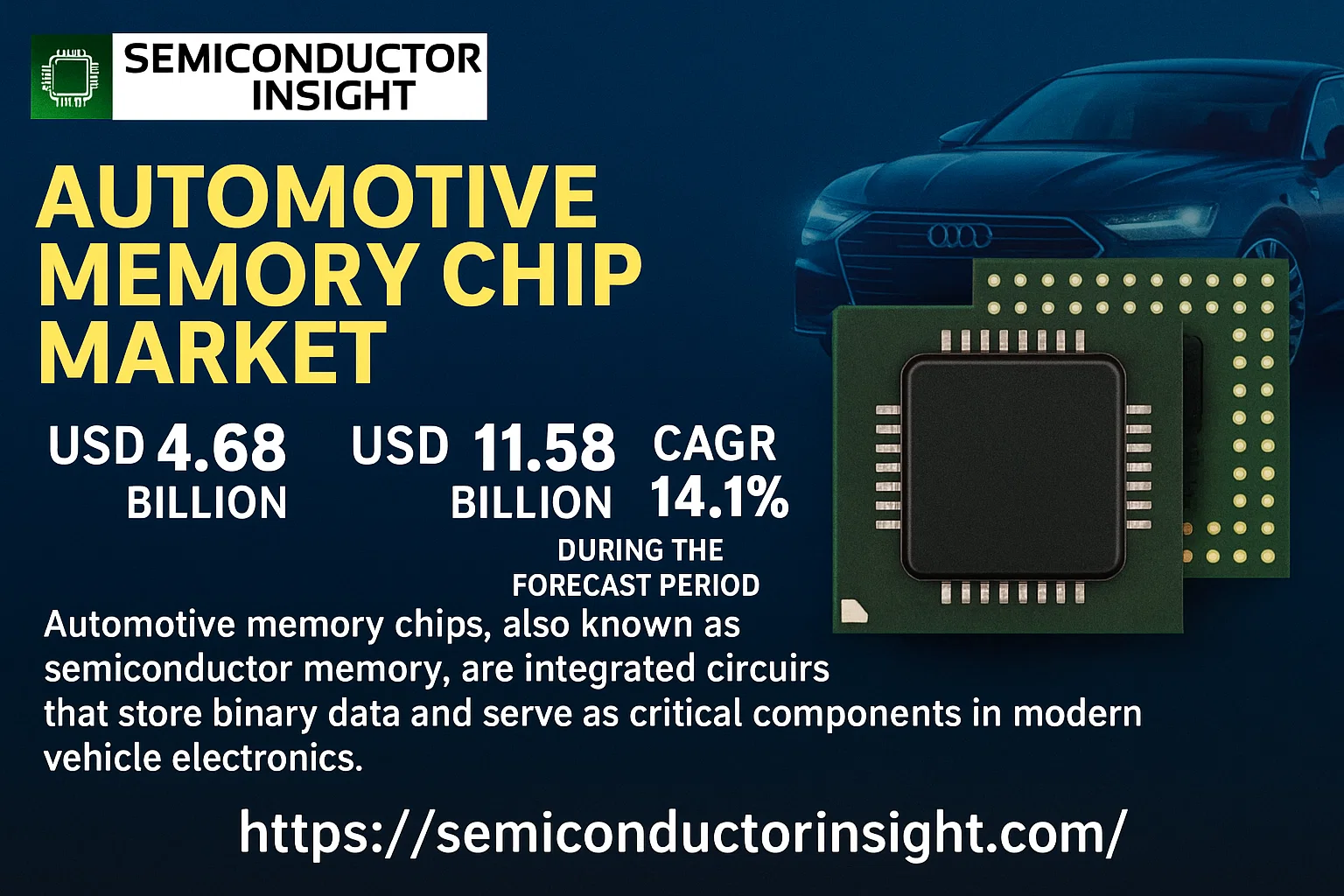
Global Automotive Memory Chip Market was valued at USD 4.68 billion in 2024 and is projected to reach USD 11.58 billion by 2032, exhibiting a Compound Annual Growth Rate (CAGR) of 14.1% during the forecast period.
Automotive memory chips, also known as semiconductor memory, are integrated circuits that store binary data and serve as critical components in modern vehicle electronics. These chips are essential for storing and processing data in applications such as Advanced Driver Assistance Systems (ADAS), infotainment systems, and telematics control units. The market is dominated by DRAM (Dynamic Random Access Memory) technology, which holds over 65% market share due to its high-speed data processing capabilities required for real-time decision-making in ADAS applications.
The market growth is primarily driven by the increasing adoption of electric and autonomous vehicles, which require significantly more memory capacity than traditional vehicles. For instance, a Level 3 autonomous vehicle requires approximately 8GB of DRAM, while Level 4 and 5 vehicles may require 12GB or more. Additionally, the rollout of 5G infrastructure is enabling more sophisticated connected car features, further driving demand for high-performance memory chips. Major manufacturers like Micron and Samsung are investing heavily in developing more efficient and temperature-resistant chips specifically designed for automotive applications, with the latest LPDDR5 (Low Power Double Data Rate 5) standard offering data rates up to 6400Mbps while operating at temperatures up to 125°C.
Regionally, China dominates the market with approximately 38% share, followed by North America (21%) and Europe (19%). This distribution reflects both manufacturing capabilities and adoption rates of advanced automotive technologies across these regions. The market faces challenges from semiconductor shortages and geopolitical tensions affecting supply chains, but is expected to maintain strong growth due to continued digitalization of vehicles and expansion of autonomous driving capabilities.
MARKET DRIVERS
Rising Demand for Advanced Driver-Assistance Systems (ADAS)
The proliferation of Advanced Driver-Assistance Systems (ADAS) is a primary driver for the automotive memory chip market. These systems, which include features like automatic emergency braking and lane-keeping assistance, require substantial data processing capabilities. High-performance memory chips, particularly DRAM and NAND flash, are essential for storing the vast amounts of sensor data and running complex algorithms in real-time, supporting the evolution towards higher levels of vehicle autonomy.
Growth of Connected Car Features and In-Vehicle Infotainment (IVI)
Consumer demand for seamless connectivity and sophisticated in-vehicle experiences is accelerating. Modern IVI systems offer navigation, streaming media, and smartphone integration, all of which rely on robust memory solutions. The transition to 5G connectivity further amplifies this need, requiring faster and higher-capacity memory chips to handle increased data throughput and support over-the-air (OTA) updates, which are becoming standard in new vehicles.
➤ The increasing electrification of vehicles is creating new memory-intensive applications, from battery management systems to sophisticated digital cockpits, fueling demand for reliable, automotive-grade memory.
Furthermore, the push towards Software-Defined Vehicles (SDVs) represents a significant driver. SDVs depend on centralized high-performance computers that consolidate functions, necessitating advanced memory architectures with high bandwidth and storage capacity to manage multiple operating systems and applications simultaneously.
MARKET CHALLENGES
Stringent Automotive-Grade Quality and Reliability Standards
Meeting the rigorous AEC-Q100 qualification standard for automotive components is a major challenge. Memory chips must operate reliably under extreme temperatures, humidity, and vibration for extended periods, often exceeding 15 years. This necessitates more robust design, extensive testing, and specialized manufacturing processes, which increase production costs and time-to-market compared to consumer-grade memory.
Other Challenges
Complex Supply Chain and Component Shortages
The automotive memory chip supply chain is complex and was severely impacted by the global chip shortage. Automotive manufacturers compete with consumer electronics giants for fab capacity, and the long lifecycle of automotive products creates challenges in securing a stable, long-term supply of specific memory chip generations.
Thermal Management and Power Consumption
As memory density and speed increase to support new automotive applications, managing power consumption and heat dissipation becomes increasingly difficult. Excess heat can degrade performance and reliability, posing a significant engineering challenge within the confined and thermally sensitive environment of a vehicle.
MARKET RESTRAINTS
High Cost of Automotive-Grade Memory Solutions
The significant price premium for automotive-grade memory chips, which can be two to three times higher than their commercial-grade counterparts, acts as a major restraint. This cost pressure is particularly acute for entry-level and mid-range vehicles, where manufacturers must carefully balance advanced features with overall vehicle affordability, potentially limiting the adoption of higher-end memory technologies.
Long Automotive Design and Validation Cycles
The lengthy development cycles in the automotive industry, typically spanning 3-5 years, restrain the rapid integration of the latest memory technologies. By the time a vehicle reaches production, the memory chips selected at the design phase may already be a generation behind the cutting-edge chips available in the consumer market, creating a technological lag.
MARKET OPPORTUNITIES
Expansion into Autonomous Vehicle Development
The progression towards Level 4 and Level 5 autonomous vehicles presents a massive opportunity. These systems will require an exponential increase in data processing and storage, driving demand for high-bandwidth memory (HBM) and large-capacity, high-endurance NAND flash memory to handle data from LiDAR, radar, and camera systems simultaneously.
Adoption of LPDDR5 and Future Memory Standards
The ongoing transition from LPDDR4 to LPDDR5 and the development of LPDDR6 offer significant growth potential. These newer standards provide higher bandwidth and improved power efficiency, which are critical for next-generation telematics, ADAS, and IVI systems. Memory suppliers that can offer robust automotive-grade versions of these advanced technologies are well-positioned for growth.
Edge Computing in Vehicles
The rise of edge computing within the vehicle creates opportunities for specialized memory solutions. Instead of sending all data to the cloud, processing occurs locally in the vehicle, requiring low-latency, high-reliability memory to support real-time decision-making for safety-critical applications, opening a new frontier for memory innovation.
Automotive Memory Chip Market Trends
Exponential Growth Driven by Vehicle Digitalization
The Automotive Memory Chip Market is undergoing a period of unprecedented expansion, valued at US$ 4,685 million in 2024 and projected to reach US$ 11,580 million by 2032, representing a robust compound annual growth rate (CAGR) of 14.1%. This surge is fundamentally linked to the escalating demand for semiconductors that power the advanced electronic systems in modern vehicles. These chips, which serve as the primary storage medium for binary data, are indispensable components for the increasing number of digital features, from infotainment to autonomous driving capabilities. The market is highly concentrated, with the top five manufacturers, including Micron and Samsung, collectively holding approximately 70% of the global market share.
Other Trends
Regional Market Dynamics
Geographically, China has emerged as the dominant market, accounting for about 38% of the global share, driven by its massive automotive production and rapid adoption of new technologies. This is followed by North America and Europe, with shares of approximately 21% and 19% respectively. These regions are at the forefront of integrating advanced driver-assistance systems (ADAS) and connected car technologies, which are primary consumers of high-performance memory chips.
Dominance of DRAM and ADAS Application
In terms of product segmentation, DRAM (Dynamic Random-Access Memory) is the undisputed leader, capturing over 65% of the market. Its high-speed performance is essential for processing the vast amounts of real-time data required by sophisticated automotive applications. The largest application segment for these chips is the Advanced Driver Assistance System (ADAS), highlighting the automotive industry’s strategic pivot towards enhanced safety and semi-autonomous driving functionalities.
Competitive Landscape and Future Outlook
The competitive environment features established semiconductor giants like SK hynix and Kioxia alongside specialized players. The market’s trajectory is shaped by the continuous evolution of vehicle architecture towards centralized computing platforms, which demand higher-density and more reliable memory solutions. While growth opportunities are vast, manufacturers face challenges related to meeting stringent automotive-grade quality standards, managing supply chain constraints, and navigating the technological complexities of next-generation vehicles, ensuring that innovation remains critical for sustained leadership.
COMPETITIVE LANDSCAPE
Key Industry Players
Market Consolidation Led by Memory Giants, Driven by High-Growth Automotive Electronics
The global automotive memory chip market is characterized by a high degree of concentration, with the top five suppliers collectively holding approximately 70% of the market share. This dominance is held by established memory semiconductor giants who have leveraged their technological expertise and manufacturing scale to secure a strong position in the automotive sector. Micron Technology and Samsung Electronics are the clear frontrunners, capitalizing on the increasing demand for high-bandwidth DRAM and high-density NAND flash memory required for advanced driver assistance systems (ADAS), which represents the largest application segment. The market structure is oligopolistic, where innovation, reliability, and stringent quality standards for automotive-grade components are critical competitive differentiators.
Beyond the top-tier leaders, a range of other significant players cater to various niches and specific memory technologies. Companies like SK hynix, Kioxia, and Western Digital offer strong alternatives in NAND and DRAM. Specialists such as Winbond, ISSI (acquired by Sino Wealth Electronic Ltd.), and Giantec-semi are key suppliers for NOR flash and SRAM, essential for low-latency code storage and processing in safety-critical systems. Firms including STMicroelectronics, Infineon (via its Cypress acquisition), Macronix, and GigaDevice provide a breadth of embedded and standalone memory solutions, often integrated with microcontrollers. Nanya Technology and On Semiconductor also hold notable positions, contributing to a diverse and competitive supplier ecosystem supporting the automotive industry’s digital transformation.
List of Key Automotive Memory Chip Companies Profiled
- Micron Technology, Inc.
- Samsung Electronics Co., Ltd.
- SK hynix Inc.
- Nanya Technology Corporation
- Kioxia Holdings Corporation
- Western Digital Corp.
- STMicroelectronics N.V.
- Infineon Technologies AG (Cypress)
- Winbond Electronics Corporation
- ISSI (Sino Wealth Electronic Ltd.)
- GigaDevice Semiconductor (Beijing) Inc.
- Giantec Semiconductor Corporation
- Macronix International Co., Ltd.
- ICMAX Technology Limited
- On Semiconductor Corporation
Segment Analysis:
| Segment Category | Sub-Segments | Key Insights |
| By Type |
|
DRAM is the dominant memory type within the automotive sector, primarily due to its high-speed data processing capabilities which are essential for real-time applications. The demand is heavily driven by the proliferation of Advanced Driver Assistance Systems (ADAS) and high-resolution infotainment displays that require large bandwidth and fast access to data. While NAND flash memory is critical for storage-intensive tasks like event data recording and complex operating systems, DRAM’s superior performance in active computation tasks secures its leading position. The market evolution towards autonomous driving is expected to further entrench DRAM’s dominance. |
| By Application |
|
Advanced Driver Assistance System (ADAS) represents the most significant application segment, fueled by the automotive industry’s rapid progression towards semi-autonomous and fully autonomous vehicles. The extensive data processing needs for functions like sensor fusion, object recognition, and real-time decision-making create immense demand for high-performance memory solutions. This application is more memory-intensive than traditional infotainment systems due to the critical nature of safety and the continuous, high-volume data flow from cameras, LiDAR, and radar systems. The ongoing regulatory push for enhanced vehicle safety features globally cements ADAS as the primary growth driver for automotive memory chips. |
| By End User |
|
Passenger Vehicles constitute the leading end-user segment, as they represent the largest volume of vehicle production globally and are at the forefront of adopting advanced electronic features. The consumer demand for enhanced in-car experiences, connectivity, and safety is strongest in this segment, driving the integration of sophisticated systems that rely on memory chips. Furthermore, the transition towards electric vehicles, which are inherently more digitized and connected, is accelerating within the passenger vehicle category, thereby increasing the average memory content per car. Commercial vehicles are also adopting more telematics and safety systems, but the volume and feature intensity in passenger vehicles ensure their leading market position. |
| By Vehicle Autonomy Level |
|
Level 0-2 (Driver Assistance) currently represents the most pervasive segment in terms of vehicle volume, as these features are becoming standard in new vehicles. However, the most significant growth in memory demand is driven by the development and gradual deployment of Level 3 and higher autonomy. Vehicles with higher levels of automation require exponentially more processing power and data storage to handle complex sensor data and make real-time driving decisions, leading to a substantial increase in the quantity and quality of memory chips required per vehicle. The progression through these autonomy levels is a critical long-term trend shaping the market’s technological requirements and growth trajectory. |
| By Memory Specification |
|
Automotive Grade memory is the leading specification, as it is specifically designed to meet the stringent reliability, longevity, and temperature requirements of the automotive environment. Unlike consumer-grade chips, automotive-grade memory must withstand extreme temperatures, constant vibration, and provide a much longer operational lifespan, often exceeding 15 years. This segment’s dominance is underpinned by stringent automotive quality standards and the critical need for failsafe operation in safety-related applications like ADAS. The demand for extended temperature grade memory is also growing for applications in harsh environments or specific under-the-hood locations, reflecting the diversifying and demanding nature of automotive electronics. |
Regional Analysis: Automotive Memory Chip Market
The region benefits from unparalleled integration between semiconductor fabrication plants and automotive assembly lines. This co-location reduces logistical complexities and time-to-market for new memory chip integrations, allowing for rapid iteration and customization based on real-time feedback from automakers, which is a critical advantage in the fast-evolving automotive sector.
Asia-Pacific is at the forefront of electric vehicle (EV) and Advanced Driver-Assistance Systems (ADAS) proliferation. These technologies are exceptionally memory-intensive, requiring robust DRAM and high-endurance NAND flash. The region’s aggressive push towards electrification and autonomy creates a premium, high-growth segment for automotive memory chips that outpaces other global markets.
Strong governmental initiatives across key countries provide significant tailwinds. Policies are designed to achieve technological self-sufficiency and global leadership in both semiconductors and smart mobility. This includes substantial funding, tax incentives, and regulatory frameworks that specifically encourage the development and use of domestically produced, advanced automotive memory chips.
The presence of massive automotive OEMs and a thriving ecosystem of electric vehicle startups generates consistent, high-volume demand. These manufacturers prioritize advanced features and connectivity, directly driving the need for more sophisticated and higher-capacity memory solutions in every vehicle segment, from economy to luxury models.
North America
The North American market is characterized by strong demand for premium and technologically advanced vehicles, particularly in the United States and Canada. Leading automotive manufacturers and technology giants are heavily invested in the development of autonomous driving systems and connected car platforms, which are major consumers of high-bandwidth memory and storage. The regulatory environment is increasingly supportive of vehicle safety and connectivity standards, pushing OEMs to integrate more advanced memory chips. Collaboration between Silicon Valley tech firms and Detroit automakers fosters innovation in areas like over-the-air updates and AI-driven features, creating a need for reliable, high-performance memory solutions that can endure harsh automotive conditions and ensure data integrity.
Europe
Europe holds a significant position as a hub for luxury and performance automotive brands, which are early adopters of cutting-edge electronic systems. Stringent European Union regulations concerning vehicle safety, emissions, and data privacy are key drivers for the adoption of sophisticated memory chips that support complex ADAS and telematics. German automakers, in particular, are deeply integrated into the semiconductor value chain, often engaging in co-development projects for bespoke memory solutions. The region’s strong focus on electric vehicle platforms from manufacturers like Volkswagen Group and BMW further accelerates demand for memory chips that manage battery systems, infotainment, and autonomous functionality, emphasizing quality, reliability, and compliance with rigorous automotive standards.
South America
The automotive memory chip market in South America is emerging, with growth largely tied to the recovery and modernization of the regional automotive industry, led by Brazil and Argentina. The market demand is currently focused on essential memory applications for entry-level and mid-range vehicles, such as basic infotainment and instrument clusters. Economic volatility can impact the pace of adoption for advanced automotive technologies. However, as global OEMs establish stronger manufacturing footprints and as consumer preference gradually shifts towards connected features, there is a slow but steady increase in the requirement for more capable memory solutions. The market potential is significant but follows a trajectory of gradual technological uptake compared to more developed regions.
Middle East & Africa
This region presents a market with diverse dynamics, ranging from the import of high-end luxury vehicles in the Gulf Cooperation Council (GCC) countries to more basic transportation needs in other areas. The demand for automotive memory chips is consequently bifurcated. In wealthier nations, there is a strong market for premium vehicles equipped with advanced infotainment and safety systems, requiring high-quality memory. In contrast, broader market growth is slower, linked to economic factors and the prevalence of older vehicle fleets. The development of local automotive manufacturing and assembly plants, along with increasing urbanization, is expected to slowly drive the long-term adoption of modern automotive electronics and their requisite memory components across the region.
Report Scope
This market research report provides a comprehensive analysis of the Automotive Memory Chip Market , covering the forecast period 2025–2032. It offers detailed insights into market dynamics, technological advancements, competitive landscape, and key trends shaping the industry.
Key focus areas of the report include:
- Market Overview: The report begins with an overview outlining its current market scenario, key growth indicators, and industry transformation drivers. It discusses macroeconomic factors, demand–supply balance, regulatory landscape, and the strategic role of semiconductors in powering advancements across industries such as automotive, telecommunications, consumer electronics, and industrial automation.
- Market Size & Forecast: Historical data and future projections for revenue, unit shipments, and market value across major regions and segments.
- Segmentation Analysis: Detailed breakdown by product type, technology, application, and end-user industry to identify high-growth segments and investment opportunities.
- Regional Insights: Insights into market performance across North America, Europe, Asia-Pacific, Latin America, and the Middle East & Africa, including country-level analysis where relevant.
- Competitive Landscape: Profiles of leading market participants, including their product offerings, R&D focus, manufacturing capacity, pricing strategies, and recent developments such as mergers, acquisitions, and partnerships.
- Technology Trends & Innovation: Assessment of emerging technologies, integration of AI/IoT, semiconductor design trends, fabrication techniques, and evolving industry standards.
- Market Drivers & Restraints: Evaluation of factors driving market growth along with challenges, supply chain constraints, regulatory issues, and market-entry barriers.
- Stakeholder Insights: Insights for component suppliers, OEMs, system integrators, investors, and policymakers regarding the evolving ecosystem and strategic opportunities.
Primary and secondary research methods are employed, including interviews with industry experts, data from verified sources, and real-time market intelligence to ensure the accuracy and reliability of the insights presented.
FREQUENTLY ASKED QUESTIONS:
What is the current market size of Automotive Memory Chip Market?
-> Global Automotive Memory Chip Market was valued at USD 4685 million in 2024 and is projected to reach USD 11580 million by 2032, growing at a CAGR of 14.1% during the forecast period.
Which key companies operate in Automotive Memory Chip Market?
-> Key players include Micron, Samsung, SK hynix, STMicroelectronics, and ISSI, among others. The top five companies hold a share of about 70%.
What are the key growth drivers?
-> Key growth drivers include increasing vehicle electrification, demand for advanced driver assistance systems (ADAS), and the proliferation of in-car infotainment systems.
Which region dominates the market?
-> China is the largest market, with a share of about 38%, followed by North America and Europe with shares of about 21% and 19%, respectively.
What are the emerging trends?
-> Emerging trends include the dominance of DRAM as the largest product segment (over 65% share) and the largest application being advanced driver assistance systems (ADAS).

Get Sample Report PDF for Exclusive Insights
Report Sample Includes
- Table of Contents
- List of Tables & Figures
- Charts, Research Methodology, and more...
 Download Sample Report PDF
