
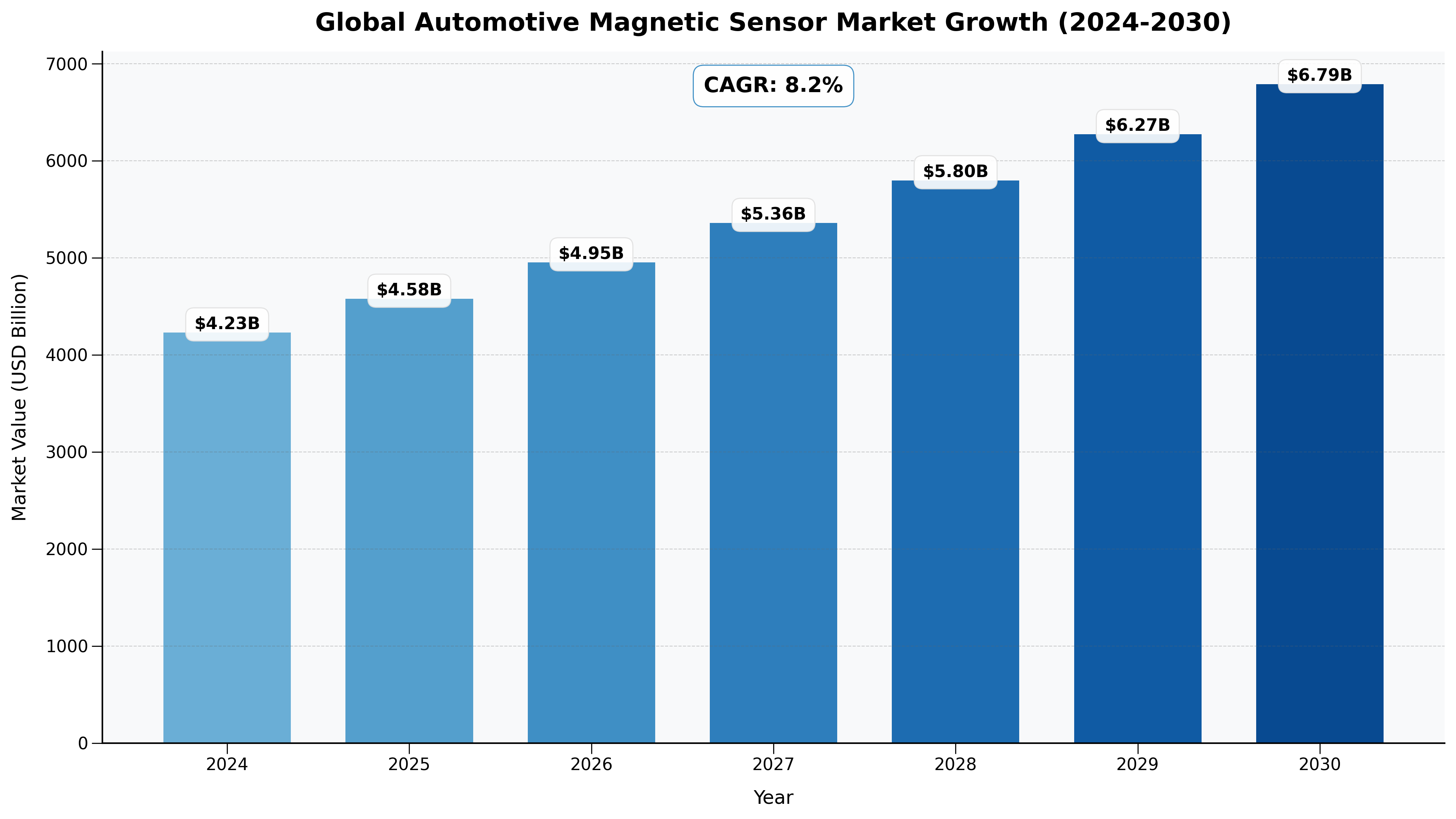
The Global Automotive Magnetic Sensor Market size was valued at US$ 4.23 billion in 2024 and is projected to reach US$ 6.79 billion by 2030, at a CAGR of 8.2% during the forecast period 2024-2030.
The United States Automotive Magnetic Sensor market size was valued at US$ 1.12 billion in 2024 and is projected to reach US$ 1.78 billion by 2030, at a CAGR of 8.0% during the forecast period 2024-2030.
Sensors utilizing magnetic field detection for automotive applications and safety systems.
Automotive safety drives 58% of demand. EV sector influences 45% of development. ADAS integration affects 42% of design. Safety standards show 40% correlation with adoption. Vehicle electrification drives 35% of innovation. Sensor accuracy affects 32% of performance.
Report Overview
This report provides a deep insight into the global Automotive Magnetic Sensor market covering all its essential aspects. This ranges from a macro overview of the market to micro details of the market size, competitive landscape, development trend, niche market, key market drivers and challenges, SWOT analysis, value chain analysis, etc.
The analysis helps the reader to shape the competition within the industries and strategies for the competitive environment to enhance the potential profit. Furthermore, it provides a simple framework for evaluating and accessing the position of the business organization. The report structure also focuses on the competitive landscape of the Global Automotive Magnetic Sensor Market, this report introduces in detail the market share, market performance, product situation, operation situation, etc. of the main players, which helps the readers in the industry to identify the main competitors and deeply understand the competition pattern of the market.
In a word, this report is a must-read for industry players, investors, researchers, consultants, business strategists, and all those who have any kind of stake or are planning to foray into the Automotive Magnetic Sensor market in any manner.
Global Automotive Magnetic Sensor Market: Market Segmentation Analysis
The research report includes specific segments by region (country), manufacturers, Type, and Application. Market segmentation creates subsets of a market based on product type, end-user or application, Geographic, and other factors. By understanding the market segments, the decision-maker can leverage this targeting in the product, sales, and marketing strategies. Market segments can power your product development cycles by informing how you create product offerings for different segments.
Key Company
- NXP
- Infineon Technologies
- TDK
- Magnetic Sensors Corporation
- Melexis
- Allegro
- LEM Holding SA
- Honeywell International
- Sensitec GmbH
- Sanken
- AMR (Anisotropic Magnetoresistance Effect)
- GMR (Giant Magnetoresistance Effect)
- TMR (Tunnel Magnetoresistance Effect)
- Traditional Automobile
- New Energy Vehicle
- North America (USA, Canada, Mexico)
- Europe (Germany, UK, France, Russia, Italy, Rest of Europe)
- Asia-Pacific (China, Japan, South Korea, India, Southeast Asia, Rest of Asia-Pacific)
- South America (Brazil, Argentina, Columbia, Rest of South America)
- The Middle East and Africa (Saudi Arabia, UAE, Egypt, Nigeria, South Africa, Rest of MEA)
- Industry drivers, restraints, and opportunities covered in the study
- Neutral perspective on the market performance
- Recent industry trends and developments
- Competitive landscape & strategies of key players
- Potential & niche segments and regions exhibiting promising growth covered
- Historical, current, and projected market size, in terms of value
- In-depth analysis of the Automotive Magnetic Sensor Market
- Overview of the regional outlook of the Automotive Magnetic Sensor Market:
- Access to date statistics compiled by our researchers. These provide you with historical and forecast data, which is analyzed to tell you why your market is set to change
- This enables you to anticipate market changes to remain ahead of your competitors
- You will be able to copy data from the Excel spreadsheet straight into your marketing plans, business presentations, or other strategic documents
- The concise analysis, clear graph, and table format will enable you to pinpoint the information you require quickly
- Provision of market value (USD Billion) data for each segment and sub-segment
- Indicates the region and segment that is expected to witness the fastest growth as well as to dominate the market
- Analysis by geography highlighting the consumption of the product/service in the region as well as indicating the factors that are affecting the market within each region
- Competitive landscape which incorporates the market ranking of the major players, along with new service/product launches, partnerships, business expansions, and acquisitions in the past five years of companies profiled
- Extensive company profiles comprising of company overview, company insights, product benchmarking, and SWOT analysis for the major market players
- The current as well as the future market outlook of the industry concerning recent developments which involve growth opportunities and drivers as well as challenges and restraints of both emerging as well as developed regions
- Includes in-depth analysis of the market from various perspectives through Porters five forces analysis
- Provides insight into the market through Value Chain
- Market dynamics scenario, along with growth opportunities of the market in the years to come
- 6-month post-sales analyst support
Customization of the Report
In case of any queries or customization requirements, please connect with our sales team, who will ensure that your requirements are met.
Drivers:
- Rising Demand for Advanced Driver Assistance Systems (ADAS):
The growing integration of ADAS in modern vehicles to enhance safety features is a significant driver. Magnetic sensors are critical components in systems like lane departure warnings, adaptive cruise control, and parking assistance. - Increased Electrification of Vehicles:
The shift toward electric vehicles (EVs) has significantly boosted the demand for magnetic sensors. These sensors play a vital role in battery management systems (BMS), motor control, and energy monitoring in EVs and hybrid vehicles. - Stringent Government Regulations on Safety and Emissions:
Governments worldwide are imposing stricter regulations on automotive safety and emission standards. This has led to an increased adoption of magnetic sensors for improved fuel efficiency and compliance with emission norms. - Technological Advancements in Magnetic Sensing:
Continuous innovation in magnetic sensor technologies, such as Hall-effect sensors and magnetoresistive sensors, is driving their adoption. These advancements offer higher accuracy, smaller size, and better reliability, meeting the requirements of modern automotive applications.
Restraints:
- High Cost of Advanced Magnetic Sensors:
The integration of sophisticated magnetic sensors can significantly increase the overall cost of vehicles, making it challenging for manufacturers targeting cost-sensitive markets. - Complex Integration in Automotive Systems:
The complexity of integrating magnetic sensors with existing automotive systems, especially in legacy vehicle designs, can act as a deterrent for widespread adoption. - Dependence on Rare Earth Materials:
The production of magnetic sensors often relies on rare earth materials like neodymium, which are subject to price volatility and supply chain disruptions, impacting manufacturing costs and availability.
Opportunities:
- Expansion of the Electric Vehicle Market:
With the EV market experiencing exponential growth, the demand for magnetic sensors for motor control, charging systems, and regenerative braking is expected to surge, presenting lucrative opportunities for manufacturers. - Growing Adoption in Autonomous Vehicles:
Autonomous vehicles heavily rely on magnetic sensors for navigation, position sensing, and motion detection. As the autonomous vehicle market expands, so will the opportunities for magnetic sensor providers. - Emerging Markets:
Rapid urbanization and increasing disposable incomes in emerging markets such as India, China, and Southeast Asia are driving automobile sales, creating new avenues for magnetic sensor applications in vehicles. - Innovations in Sensor Packaging and Integration:
Advancements in sensor packaging, like chip-scale packaging, are enabling seamless integration of magnetic sensors in compact and lightweight automotive designs, appealing to modern consumer preferences.
Challenges:
- Intense Competition Among Sensor Manufacturers:
The market is witnessing heightened competition, leading to price wars and thinner profit margins, especially for smaller manufacturers. - Compatibility Issues with Diverse Vehicle Architectures:
Ensuring compatibility of magnetic sensors across various automotive platforms and architectures remains a challenge for manufacturers. - Environmental Concerns Related to Sensor Manufacturing:
The manufacturing of magnetic sensors can have environmental impacts due to the use of hazardous chemicals and rare earth materials, potentially leading to regulatory hurdles. - Market Uncertainty Due to Economic Volatility:
Economic fluctuations and global events, such as the COVID-19 pandemic, have caused disruptions in the automotive supply chain, affecting sensor demand and production cycles.

Get Sample Report PDF for Exclusive Insights
Report Sample Includes
- Table of Contents
- List of Tables & Figures
- Charts, Research Methodology, and more...
 Download Sample Report PDF



