Automotive-grade UFS 3.1 Storage Market, Trends, Business Strategies 2026-2034

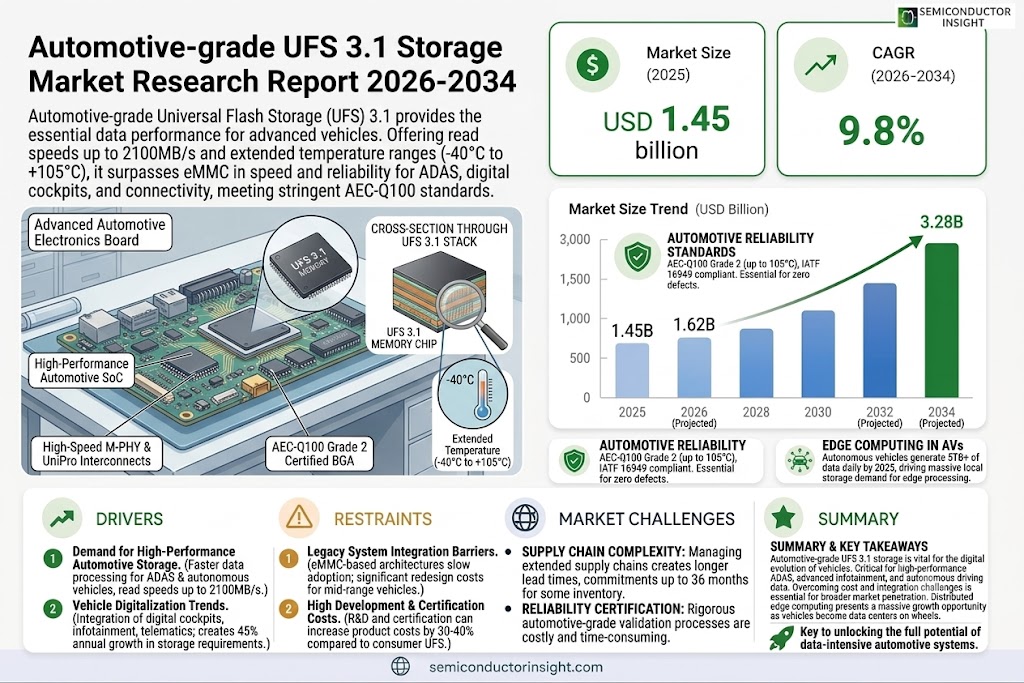
Automotive-grade UFS 3.1 Storage Market size was valued at USD 1.45 billion in 2025. The market is projected to grow from USD 1.62 billion in 2026 to USD 3.28 billion by 2034, exhibiting a CAGR of 9.8% during the forecast period

PDF Icon Download Sample Report PDF
  • Quick Dispatch

    All Orders

  • Secure Payment

    100% Secure Payment

Price range: $1,500.00 through $4,250.00

Clear

Market Insights

Global Automotive-grade UFS 3.1 Storage Market size was valued at USD 1.45 billion in 2025. The market is projected to grow from USD 1.62 billion in 2026 to USD 3.28 billion by 2034, exhibiting a CAGR of 9.8% during the forecast period.

Automotive-grade UFS (Universal Flash Storage) 3.1 is a high-performance embedded memory solution designed specifically for automotive applications requiring robust data storage under extreme conditions. Built on JEDEC’s UFS 3.1 standard, it delivers sequential read speeds up to 2100 MB/s and write speeds up to 1200 MB/s, making it ideal for advanced driver-assistance systems (ADAS), autonomous driving modules, and next-generation infotainment systems where low latency and high reliability are critical.

The market growth is driven by increasing vehicle electrification, demand for real-time data processing in autonomous vehicles, and stricter automotive safety standards necessitating fault-tolerant storage solutions. Key players like Samsung Semiconductor and Kioxia are expanding production capacities to meet rising demand, with recent developments including extended temperature range variants (-40°C to +105°C) for harsh automotive environments.
Automotive-grade UFS 3.1 Storage Market Share

MARKET DRIVERS

Rising Demand for High-Performance Automotive Storage

Automotive-grade UFS 3.1 Storage Market is driven by increasing demand for faster data processing in advanced driver assistance systems (ADAS) and autonomous vehicles. With data-intensive applications requiring read speeds up to 2100MB/s, UFS 3.1 provides the necessary performance edge over eMMC solutions.

Vehicle Digitalization Trends

Automakers are integrating more digital cockpits, infotainment systems, and telematics, creating a 45% annual growth in storage requirements per vehicle. Automotive-grade UFS 3.1 meets the extended temperature range (-40°C to +105°C) and reliability standards for these applications.

Stringent automotive safety certifications like AEC-Q100 Grade 2 are further propelling adoption of qualified UFS 3.1 solutions.

MARKET CHALLENGES

High Development and Certification Costs

Developing automotive-grade UFS 3.1 storage solutions requires substantial R&D investment to meet rigorous quality standards. The certification process alone can increase product costs by 30-40% compared to consumer-grade UFS.

Other Challenges

Supply Chain Complexity
Managing the extended supply chain for automotive components creates longer lead times, with some automakers requiring 36-month inventory commitments for storage solutions.

MARKET RESTRAINTS

Legacy System Integration Barriers

Many existing automotive architectures were designed for eMMC storage, creating integration challenges for UFS 3.1 solutions. Automakers face significant redesign costs when upgrading legacy platforms, slowing adoption in mid-range vehicle segments.

MARKET OPPORTUNITIES

Edge Computing in Autonomous Vehicles

The shift toward distributed edge computing in autonomous vehicles presents significant growth potential for high-performance UFS 3.1 storage. Each vehicle is expected to generate 5TB+ of data daily by 2025, requiring robust local storage solutions.

5G-V2X Applications

Emerging 5G vehicle-to-everything communication standards will drive demand for UFS 3.1’s low-latency performance. The technology enables real-time data processing critical for advanced safety and navigation systems.

Automotive-grade UFS 3.1 Storage Market Trends
Rising Demand for High-Speed Automotive Data Storage Solutions

Automotive-grade UFS 3.1 Storage Market is witnessing significant growth due to increasing requirements for high-speed data processing in modern vehicles. As Advanced Driver Assistance Systems (ADAS) and in-vehicle infotainment become more sophisticated, automakers are adopting UFS 3.1 solutions to handle large data volumes with faster read/write speeds compared to traditional storage options.

Other Trends

Temperature-Resistant Storage Development

Manufacturers are focusing on developing automotive-grade UFS 3.1 solutions that maintain performance across extreme temperature ranges (-40°C to 105°C), making them suitable for diverse global climates. This thermal resilience is critical for reliability in automotive applications where consistent performance is mandatory.

Regional Adoption Patterns in Automotive UFS Storage

The Asia-Pacific region, led by China, Japan and South Korea, is emerging as a major adopter of Automotive-grade UFS 3.1 Storage solutions. This growth is driven by expanding EV production and government mandates for advanced vehicle safety systems that require robust data storage capabilities. North America maintains strong demand due to premium vehicle production with sophisticated ADAS features.

Memory Capacity Expansion Trends

Market leaders are expanding product portfolios with higher capacity options to meet the growing data requirements of automated driving systems. While 32GB variants currently dominate, 64GB and 128GB Automotive-grade UFS 3.1 Storage solutions are gaining traction for future-proof vehicle architectures.

Supply Chain Developments in UFS Storage Manufacturing

Leading semiconductor companies including Kioxia, Samsung and Micron Technology are investing in dedicated production lines for automotive-grade UFS solutions. The industry is seeing increased vertical integration to ensure stable supply of these critical components amid global chip shortages.

Reliability Enhancements for Automotive Applications

Manufacturers are implementing advanced error correction technologies and extended endurance specifications in Automotive-grade UFS 3.1 Storage to meet stringent automotive quality standards, including AEC-Q100 Grade 2/3 certifications.

COMPETITIVE LANDSCAPE

Key Industry Players

Market Dominated by Storage Titans with Strong Automotive Focus

Automotive-grade UFS 3.1 Storage Market is dominated by established semiconductor and NAND flash memory giants, with Kioxia, Samsung Semiconductor, and Toshiba Corporation collectively holding significant market share. These leaders leverage their advanced 3D NAND technologies and automotive-grade certification expertise to deliver reliable high-speed storage solutions for demanding vehicle applications like ADAS and infotainment systems.

Western Digital and Micron Technology compete strongly in the 32G-128G capacity segments, while specialized players like Silicon Motion provide critical controller technology. Emerging Chinese manufacturers including Longsys are gaining traction through aggressive pricing and partnerships with domestic automakers, particularly in Asia’s growing electric vehicle market.

List of Key Automotive-grade UFS 3.1 Storage Companies Profiled

Segment Analysis:

Segment Category Sub-Segments Key Insights
By Type
  • 32G
  • 64G
  • 128G
  • Others
64G Segment demonstrates balanced performance-to-cost ratio for automotive applications:

  • Ideal capacity for most ADAS and infotainment system requirements
  • Provides sufficient storage for over-the-air updates and multimedia files
  • Offers better performance consistency compared to lower capacity variants
By Application
  • ADAS
  • T-Box
  • Dashboard
  • Infotainment Systems
  • Others
Infotainment Systems represent the most demanding application segment:

  • Requires highest sustained read/write speeds for multimedia content
  • Needs to handle multiple concurrent data streams from various sources
  • Demands superior thermal performance for automotive environments
By End User
  • OEMs
  • Tier 1 Suppliers
  • Aftermarket
OEMs dominate the demand landscape for automotive-grade storage:

  • Prefer integrated solutions for new vehicle platforms
  • Require long-term supply agreements with qualified manufacturers
  • Emphasize reliability and automotive-grade certifications
By Temperature Range
  • Standard (-25°C to 85°C)
  • Extended (-40°C to 105°C)
  • Industrial (-40°C to 125°C)
Extended Temperature Range versions show strongest adoption:

  • Meets requirements for engine bay and exterior-mounted components
  • Provides sufficient margin for extreme climate conditions
  • Balances cost with performance reliability requirements
By Certification
  • AEC-Q100
  • IATF 16949
  • ISO 26262
AEC-Q100 Certified solutions are mandatory for most automotive applications:

  • Ensures reliability across automotive temperature ranges
  • Verifies tolerance to harsh vibration and shock conditions
  • Becoming baseline requirement for all vehicle electronics

Regional Analysis: Automotive-grade UFS 3.1 Storage Market

Asia-Pacific

The Asia-Pacific region dominates the Automotive-grade UFS 3.1 Storage Market, driven by robust automotive electronics manufacturing in key countries like China, Japan and South Korea. This region benefits from strong semiconductor ecosystems, with leading memory chip producers strategically investing in UFS 3.1 technology optimized for automotive applications. Local OEMs are rapidly adopting these storage solutions for advanced driver assistance systems (ADAS) and in-vehicle infotainment, with tier-1 suppliers integrating UFS 3.1 in next-gen electric vehicles. The region’s thriving EV market and government support for automotive innovation create ideal conditions for UFS 3.1 proliferation. Japanese automakers in particular are pioneering high-performance storage architectures that leverage UFS 3.1’s reliability in extreme temperatures.

China’s Manufacturing Ecosystem
China leads in automotive UFS 3.1 adoption with concentrated semiconductor production and aggressive EV policies. Local manufacturers are developing customized UFS solutions that meet stringent automotive requirements while optimizing costs for mass production.
Japanese Quality Standards
Japanese automakers set industry benchmarks for storage reliability, driving UFS 3.1 specifications that withstand harsh operating conditions. Their rigorous qualification processes ensure Automotive-grade UFS 3.1 meets 10+ year automotive lifecycles.
Korean Innovation Hub
South Korea’s memory chip leaders are pioneering Automotive-grade UFS 3.1 with enhanced thermal management and error correction. Their vertical integration allows optimized UFS solutions for autonomous driving data loads.
EV Infrastructure Growth
Southeast Asia’s expanding EV charging networks create demand for UFS 3.1 in smart charging systems and battery management. Local collaborations between automakers and storage providers are accelerating adoption.

North America
North America represents the second-largest market for Automotive-grade UFS 3.1 Storage, driven by premium vehicle OEMs and autonomous driving development. U.S.-based automakers are integrating UFS 3.1 in next-generation digital cockpits and telematics systems, with particular focus on cybersecurity features. The region’s stringent automotive safety standards push UFS 3.1 suppliers to develop specialized firmware and controllers. Silicon Valley’s tech giants collaborating with automakers create unique implementations that leverage UFS 3.1’s high-speed performance in AI-powered vehicle systems.

Europe
Europe’s Automotive-grade UFS 3.1 Storage Market grows steadily through luxury automaker adoption and strong electronics regulation. German automotive suppliers lead in implementing UFS 3.1 for advanced digital clusters and vehicle-to-everything (V2X) communication systems. The region’s focus on functional safety and data integrity drives UFS 3.1 customization for ISO 26262 compliance. European semiconductor firms collaborate closely with automakers to optimize UFS architectures for premium infotainment and automated driving features.

South America
South America’s Automotive-grade UFS 3.1 adoption remains in early stages but shows growth potential through fleet modernization programs. Brazilian automotive electronics manufacturers are piloting UFS 3.1 in commercial vehicle telematics and fleet management systems. The region’s aftermarket upgrade sector presents opportunities for storage solutions in vehicle connectivity modules. While adoption lags behind other regions, increasing foreign automaker investments may accelerate UFS 3.1 integration in locally produced models.

Middle East & Africa
The Middle East & Africa region shows niche demand for Automotive-grade UFS 3.1 Storage in premium vehicle segments and smart city initiatives. Luxury car imports drive initial adoption, while local automotive electronics firms explore UFS solutions for extreme climate operation. The region’s developing automotive R&D centers and technology free zones create platforms for future UFS 3.1 integration in connected vehicle projects and autonomous mobility pilots.

Report Scope

This market research report provides a comprehensive analysis of the Automotive-grade UFS 3.1 Storage Market , covering the forecast period 2025–2034. It offers detailed insights into market dynamics, technological advancements, competitive landscape, and key trends shaping the industry.

Key focus areas of the report include:

  • Market Overview: The report begins with an overview outlining its current market scenario, key growth indicators, and industry transformation drivers. It discusses macroeconomic factors, demand–supply balance, regulatory landscape, and the strategic role of semiconductors in powering advancements across industries such as automotive, telecommunications, consumer electronics, and industrial automation.
  • Market Size & Forecast: Historical data and future projections for revenue, unit shipments, and market value across major regions and segments.
  • Segmentation Analysis: Detailed breakdown by product type, technology, application, and end-user industry to identify high-growth segments and investment opportunities.
  • Regional Insights: Insights into market performance across North America, Europe, Asia-Pacific, Latin America, and the Middle East & Africa, including country-level analysis where relevant.
  • Competitive Landscape: Profiles of leading market participants, including their product offerings, R&D focus, manufacturing capacity, pricing strategies, and recent developments such as mergers, acquisitions, and partnerships.
  • Technology Trends & Innovation: Assessment of emerging technologies, integration of AI/IoT, semiconductor design trends, fabrication techniques, and evolving industry standards.
  • Market Drivers & Restraints: Evaluation of factors driving market growth along with challenges, supply chain constraints, regulatory issues, and market-entry barriers.
  • Stakeholder Insights: Insights for component suppliers, OEMs, system integrators, investors, and policymakers regarding the evolving ecosystem and strategic opportunities.

Primary and secondary research methods are employed, including interviews with industry experts, data from verified sources, and real-time market intelligence to ensure the accuracy and reliability of the insights presented.

FREQUENTLY ASKED QUESTIONS:

What is the current market size of Automotive-grade UFS 3.1 Storage Market?

-> Automotive-grade UFS 3.1 Storage Market size was valued at USD 1.45 billion in 2025. The market is projected to grow from USD 1.62 billion in 2026 to USD 3.28 billion by 2034, exhibiting a CAGR of 9.8% during the forecast period

What is the projected growth rate (CAGR) of this market?

-> The market is projected to grow at a compound annual growth rate (CAGR) of % during 2025-2034.

Which key companies operate in Automotive-grade UFS 3.1 Storage Market?

-> Key players include Kioxia, Samsung Semiconductor, Toshiba Corporation, Western Digital Corporation, Synopsys, Micron Technology, Longsys, Silicon Motion, among others. The global top five players held approximately % market share in 2025.

What are the main application areas for Automotive-grade UFS 3.1 Storage?

-> Main applications include ADAS systems, T-Box units, dashboards, infotainment systems, and other automotive applications requiring high-speed data transfer.

Which region leads in market adoption?

-> The U.S. market was valued at USD million in 2025, while China is expected to reach USD million during the forecast period. Asia-Pacific shows strong growth potential.

Automotive-grade UFS 3.1 Storage Market, Trends, Business Strategies 2026-2034

Get Sample Report PDF for Exclusive Insights

Report Sample Includes

  • Table of Contents
  • List of Tables & Figures
  • Charts, Research Methodology, and more...

PDF Icon Download Sample Report PDF
SKU: 20b3ad791163
Category:
License Type

Corporate License, Excel License, PDF and Excel Databook License

Download Sample Report

Table of Content

1 Introduction to Research & Analysis Reports
1.1 Automotive-grade UFS 3.1 Storage Market Definition
1.2 Market Segments
1.2.1 Segment by Type
1.2.2 Segment by Application
1.3 Global Automotive-grade UFS 3.1 Storage Market Overview
1.4 Features & Benefits of This Report
1.5 Methodology & Sources of Information
1.5.1 Research Methodology
1.5.2 Research Process
1.5.3 Base Year
1.5.4 Report Assumptions & Caveats
2 Global Automotive-grade UFS 3.1 Storage Overall Market Size
2.1 Global Automotive-grade UFS 3.1 Storage Market Size: 2025 VS 2034
2.2 Global Automotive-grade UFS 3.1 Storage Market Size, Prospects & Forecasts: 2021-2034
2.3 Global Automotive-grade UFS 3.1 Storage Sales: 2021-2034
3 Company Landscape
3.1 Top Automotive-grade UFS 3.1 Storage Players in Global Market
3.2 Top Global Automotive-grade UFS 3.1 Storage Companies Ranked by Revenue
3.3 Global Automotive-grade UFS 3.1 Storage Revenue by Companies
3.4 Global Automotive-grade UFS 3.1 Storage Sales by Companies
3.5 Global Automotive-grade UFS 3.1 Storage Price by Manufacturer (2021-2026)
3.6 Top 3 and Top 5 Automotive-grade UFS 3.1 Storage Companies in Global Market, by Revenue in 2025
3.7 Global Manufacturers Automotive-grade UFS 3.1 Storage Product Type
3.8 Tier 1, Tier 2, and Tier 3 Automotive-grade UFS 3.1 Storage Players in Global Market
3.8.1 List of Global Tier 1 Automotive-grade UFS 3.1 Storage Companies
3.8.2 List of Global Tier 2 and Tier 3 Automotive-grade UFS 3.1 Storage Companies
4 Sights by Type
4.1 Overview
4.1.1 Segment by Type – Global Automotive-grade UFS 3.1 Storage Market Size Markets, 2025 & 2034
4.1.2 32G
4.1.3 64G
4.1.4 128G
4.1.5 Others
4.2 Segment by Type – Global Automotive-grade UFS 3.1 Storage Revenue & Forecasts
4.2.1 Segment by Type – Global Automotive-grade UFS 3.1 Storage Revenue, 2021-2026
4.2.2 Segment by Type – Global Automotive-grade UFS 3.1 Storage Revenue, 2027-2034
4.2.3 Segment by Type – Global Automotive-grade UFS 3.1 Storage Revenue Market Share, 2021-2034
4.3 Segment by Type – Global Automotive-grade UFS 3.1 Storage Sales & Forecasts
4.3.1 Segment by Type – Global Automotive-grade UFS 3.1 Storage Sales, 2021-2026
4.3.2 Segment by Type – Global Automotive-grade UFS 3.1 Storage Sales, 2027-2034
4.3.3 Segment by Type – Global Automotive-grade UFS 3.1 Storage Sales Market Share, 2021-2034
4.4 Segment by Type – Global Automotive-grade UFS 3.1 Storage Price (Manufacturers Selling Prices), 2021-2034
5 Sights by Application
5.1 Overview
5.1.1 Segment by Application – Global Automotive-grade UFS 3.1 Storage Market Size, 2025 & 2034
5.1.2 ADAS
5.1.3 T-Box
5.1.4 Dashboard
5.1.5 Infotainment Systems
5.1.6 Others
5.2 Segment by Application – Global Automotive-grade UFS 3.1 Storage Revenue & Forecasts
5.2.1 Segment by Application – Global Automotive-grade UFS 3.1 Storage Revenue, 2021-2026
5.2.2 Segment by Application – Global Automotive-grade UFS 3.1 Storage Revenue, 2027-2034
5.2.3 Segment by Application – Global Automotive-grade UFS 3.1 Storage Revenue Market Share, 2021-2034
5.3 Segment by Application – Global Automotive-grade UFS 3.1 Storage Sales & Forecasts
5.3.1 Segment by Application – Global Automotive-grade UFS 3.1 Storage Sales, 2021-2026
5.3.2 Segment by Application – Global Automotive-grade UFS 3.1 Storage Sales, 2027-2034
5.3.3 Segment by Application – Global Automotive-grade UFS 3.1 Storage Sales Market Share, 2021-2034
5.4 Segment by Application – Global Automotive-grade UFS 3.1 Storage Price (Manufacturers Selling Prices), 2021-2034
6 Sights Region
6.1 By Region – Global Automotive-grade UFS 3.1 Storage Market Size, 2025 & 2034
6.2 By Region – Global Automotive-grade UFS 3.1 Storage Revenue & Forecasts
6.2.1 By Region – Global Automotive-grade UFS 3.1 Storage Revenue, 2021-2026
6.2.2 By Region – Global Automotive-grade UFS 3.1 Storage Revenue, 2027-2034
6.2.3 By Region – Global Automotive-grade UFS 3.1 Storage Revenue Market Share, 2021-2034
6.3 By Region – Global Automotive-grade UFS 3.1 Storage Sales & Forecasts
6.3.1 By Region – Global Automotive-grade UFS 3.1 Storage Sales, 2021-2026
6.3.2 By Region – Global Automotive-grade UFS 3.1 Storage Sales, 2027-2034
6.3.3 By Region – Global Automotive-grade UFS 3.1 Storage Sales Market Share, 2021-2034
6.4 North America
6.4.1 By Country – North America Automotive-grade UFS 3.1 Storage Revenue, 2021-2034
6.4.2 By Country – North America Automotive-grade UFS 3.1 Storage Sales, 2021-2034
6.4.3 United States Automotive-grade UFS 3.1 Storage Market Size, 2021-2034
6.4.4 Canada Automotive-grade UFS 3.1 Storage Market Size, 2021-2034
6.4.5 Mexico Automotive-grade UFS 3.1 Storage Market Size, 2021-2034
6.5 Europe
6.5.1 By Country – Europe Automotive-grade UFS 3.1 Storage Revenue, 2021-2034
6.5.2 By Country – Europe Automotive-grade UFS 3.1 Storage Sales, 2021-2034
6.5.3 Germany Automotive-grade UFS 3.1 Storage Market Size, 2021-2034
6.5.4 France Automotive-grade UFS 3.1 Storage Market Size, 2021-2034
6.5.5 U.K. Automotive-grade UFS 3.1 Storage Market Size, 2021-2034
6.5.6 Italy Automotive-grade UFS 3.1 Storage Market Size, 2021-2034
6.5.7 Russia Automotive-grade UFS 3.1 Storage Market Size, 2021-2034
6.5.8 Nordic Countries Automotive-grade UFS 3.1 Storage Market Size, 2021-2034
6.5.9 Benelux Automotive-grade UFS 3.1 Storage Market Size, 2021-2034
6.6 Asia
6.6.1 By Region – Asia Automotive-grade UFS 3.1 Storage Revenue, 2021-2034
6.6.2 By Region – Asia Automotive-grade UFS 3.1 Storage Sales, 2021-2034
6.6.3 China Automotive-grade UFS 3.1 Storage Market Size, 2021-2034
6.6.4 Japan Automotive-grade UFS 3.1 Storage Market Size, 2021-2034
6.6.5 South Korea Automotive-grade UFS 3.1 Storage Market Size, 2021-2034
6.6.6 Southeast Asia Automotive-grade UFS 3.1 Storage Market Size, 2021-2034
6.6.7 India Automotive-grade UFS 3.1 Storage Market Size, 2021-2034
6.7 South America
6.7.1 By Country – South America Automotive-grade UFS 3.1 Storage Revenue, 2021-2034
6.7.2 By Country – South America Automotive-grade UFS 3.1 Storage Sales, 2021-2034
6.7.3 Brazil Automotive-grade UFS 3.1 Storage Market Size, 2021-2034
6.7.4 Argentina Automotive-grade UFS 3.1 Storage Market Size, 2021-2034
6.8 Middle East & Africa
6.8.1 By Country – Middle East & Africa Automotive-grade UFS 3.1 Storage Revenue, 2021-2034
6.8.2 By Country – Middle East & Africa Automotive-grade UFS 3.1 Storage Sales, 2021-2034
6.8.3 Turkey Automotive-grade UFS 3.1 Storage Market Size, 2021-2034
6.8.4 Israel Automotive-grade UFS 3.1 Storage Market Size, 2021-2034
6.8.5 Saudi Arabia Automotive-grade UFS 3.1 Storage Market Size, 2021-2034
6.8.6 UAE Automotive-grade UFS 3.1 Storage Market Size, 2021-2034
7 Manufacturers & Brands Profiles
7.1 Kioxia
7.1.1 Kioxia Company Summary
7.1.2 Kioxia Business Overview
7.1.3 Kioxia Automotive-grade UFS 3.1 Storage Major Product Offerings
7.1.4 Kioxia Automotive-grade UFS 3.1 Storage Sales and Revenue in Global (2021-2026)
7.1.5 Kioxia Key News & Latest Developments
7.2 Samsung Semiconductor
7.2.1 Samsung Semiconductor Company Summary
7.2.2 Samsung Semiconductor Business Overview
7.2.3 Samsung Semiconductor Automotive-grade UFS 3.1 Storage Major Product Offerings
7.2.4 Samsung Semiconductor Automotive-grade UFS 3.1 Storage Sales and Revenue in Global (2021-2026)
7.2.5 Samsung Semiconductor Key News & Latest Developments
7.3 Toshiba Corporation
7.3.1 Toshiba Corporation Company Summary
7.3.2 Toshiba Corporation Business Overview
7.3.3 Toshiba Corporation Automotive-grade UFS 3.1 Storage Major Product Offerings
7.3.4 Toshiba Corporation Automotive-grade UFS 3.1 Storage Sales and Revenue in Global (2021-2026)
7.3.5 Toshiba Corporation Key News & Latest Developments
7.4 Western Digital Corporation
7.4.1 Western Digital Corporation Company Summary
7.4.2 Western Digital Corporation Business Overview
7.4.3 Western Digital Corporation Automotive-grade UFS 3.1 Storage Major Product Offerings
7.4.4 Western Digital Corporation Automotive-grade UFS 3.1 Storage Sales and Revenue in Global (2021-2026)
7.4.5 Western Digital Corporation Key News & Latest Developments
7.5 Synopsys
7.5.1 Synopsys Company Summary
7.5.2 Synopsys Business Overview
7.5.3 Synopsys Automotive-grade UFS 3.1 Storage Major Product Offerings
7.5.4 Synopsys Automotive-grade UFS 3.1 Storage Sales and Revenue in Global (2021-2026)
7.5.5 Synopsys Key News & Latest Developments
7.6 Micron Technology
7.6.1 Micron Technology Company Summary
7.6.2 Micron Technology Business Overview
7.6.3 Micron Technology Automotive-grade UFS 3.1 Storage Major Product Offerings
7.6.4 Micron Technology Automotive-grade UFS 3.1 Storage Sales and Revenue in Global (2021-2026)
7.6.5 Micron Technology Key News & Latest Developments
7.7 Longsys
7.7.1 Longsys Company Summary
7.7.2 Longsys Business Overview
7.7.3 Longsys Automotive-grade UFS 3.1 Storage Major Product Offerings
7.7.4 Longsys Automotive-grade UFS 3.1 Storage Sales and Revenue in Global (2021-2026)
7.7.5 Longsys Key News & Latest Developments
7.8 Silicon Motion
7.8.1 Silicon Motion Company Summary
7.8.2 Silicon Motion Business Overview
7.8.3 Silicon Motion Automotive-grade UFS 3.1 Storage Major Product Offerings
7.8.4 Silicon Motion Automotive-grade UFS 3.1 Storage Sales and Revenue in Global (2021-2026)
7.8.5 Silicon Motion Key News & Latest Developments
8 Global Automotive-grade UFS 3.1 Storage Production Capacity, Analysis
8.1 Global Automotive-grade UFS 3.1 Storage Production Capacity, 2021-2034
8.2 Automotive-grade UFS 3.1 Storage Production Capacity of Key Manufacturers in Global Market
8.3 Global Automotive-grade UFS 3.1 Storage Production by Region
9 Key Market Trends, Opportunity, Drivers and Restraints
9.1 Market Opportunities & Trends
9.2 Market Drivers
9.3 Market Restraints
10 Automotive-grade UFS 3.1 Storage Supply Chain Analysis
10.1 Automotive-grade UFS 3.1 Storage Industry Value Chain
10.2 Automotive-grade UFS 3.1 Storage Upstream Market
10.3 Automotive-grade UFS 3.1 Storage Downstream and Clients
10.4 Marketing Channels Analysis
10.4.1 Marketing Channels
10.4.2 Automotive-grade UFS 3.1 Storage Distributors and Sales Agents in Global
11 Conclusion
12 Appendix
12.1 Note
12.2 Examples of Clients
12.3 DisclaimerList of Tables
Table 1. Key Players of Automotive-grade UFS 3.1 Storage in Global Market
Table 2. Top Automotive-grade UFS 3.1 Storage Players in Global Market, Ranking by Revenue (2025)
Table 3. Global Automotive-grade UFS 3.1 Storage Revenue by Companies, (US$, Mn), 2021-2026
Table 4. Global Automotive-grade UFS 3.1 Storage Revenue Share by Companies, 2021-2026
Table 5. Global Automotive-grade UFS 3.1 Storage Sales by Companies, (K Units), 2021-2026
Table 6. Global Automotive-grade UFS 3.1 Storage Sales Share by Companies, 2021-2026
Table 7. Key Manufacturers Automotive-grade UFS 3.1 Storage Price (2021-2026) & (US$/Unit)
Table 8. Global Manufacturers Automotive-grade UFS 3.1 Storage Product Type
Table 9. List of Global Tier 1 Automotive-grade UFS 3.1 Storage Companies, Revenue (US$, Mn) in 2025 and Market Share
Table 10. List of Global Tier 2 and Tier 3 Automotive-grade UFS 3.1 Storage Companies, Revenue (US$, Mn) in 2025 and Market Share
Table 11. Segment by Type – Global Automotive-grade UFS 3.1 Storage Revenue, (US$, Mn), 2025 & 2034
Table 12. Segment by Type – Global Automotive-grade UFS 3.1 Storage Revenue (US$, Mn), 2021-2026
Table 13. Segment by Type – Global Automotive-grade UFS 3.1 Storage Revenue (US$, Mn), 2027-2034
Table 14. Segment by Type – Global Automotive-grade UFS 3.1 Storage Sales (K Units), 2021-2026
Table 15. Segment by Type – Global Automotive-grade UFS 3.1 Storage Sales (K Units), 2027-2034
Table 16. Segment by Application – Global Automotive-grade UFS 3.1 Storage Revenue, (US$, Mn), 2025 & 2034
Table 17. Segment by Application – Global Automotive-grade UFS 3.1 Storage Revenue, (US$, Mn), 2021-2026
Table 18. Segment by Application – Global Automotive-grade UFS 3.1 Storage Revenue, (US$, Mn), 2027-2034
Table 19. Segment by Application – Global Automotive-grade UFS 3.1 Storage Sales, (K Units), 2021-2026
Table 20. Segment by Application – Global Automotive-grade UFS 3.1 Storage Sales, (K Units), 2027-2034
Table 21. By Region – Global Automotive-grade UFS 3.1 Storage Revenue, (US$, Mn), 2025 & 2034
Table 22. By Region – Global Automotive-grade UFS 3.1 Storage Revenue, (US$, Mn), 2021-2026
Table 23. By Region – Global Automotive-grade UFS 3.1 Storage Revenue, (US$, Mn), 2027-2034
Table 24. By Region – Global Automotive-grade UFS 3.1 Storage Sales, (K Units), 2021-2026
Table 25. By Region – Global Automotive-grade UFS 3.1 Storage Sales, (K Units), 2027-2034
Table 26. By Country – North America Automotive-grade UFS 3.1 Storage Revenue, (US$, Mn), 2021-2026
Table 27. By Country – North America Automotive-grade UFS 3.1 Storage Revenue, (US$, Mn), 2027-2034
Table 28. By Country – North America Automotive-grade UFS 3.1 Storage Sales, (K Units), 2021-2026
Table 29. By Country – North America Automotive-grade UFS 3.1 Storage Sales, (K Units), 2027-2034
Table 30. By Country – Europe Automotive-grade UFS 3.1 Storage Revenue, (US$, Mn), 2021-2026
Table 31. By Country – Europe Automotive-grade UFS 3.1 Storage Revenue, (US$, Mn), 2027-2034
Table 32. By Country – Europe Automotive-grade UFS 3.1 Storage Sales, (K Units), 2021-2026
Table 33. By Country – Europe Automotive-grade UFS 3.1 Storage Sales, (K Units), 2027-2034
Table 34. By Region – Asia Automotive-grade UFS 3.1 Storage Revenue, (US$, Mn), 2021-2026
Table 35. By Region – Asia Automotive-grade UFS 3.1 Storage Revenue, (US$, Mn), 2027-2034
Table 36. By Region – Asia Automotive-grade UFS 3.1 Storage Sales, (K Units), 2021-2026
Table 37. By Region – Asia Automotive-grade UFS 3.1 Storage Sales, (K Units), 2027-2034
Table 38. By Country – South America Automotive-grade UFS 3.1 Storage Revenue, (US$, Mn), 2021-2026
Table 39. By Country – South America Automotive-grade UFS 3.1 Storage Revenue, (US$, Mn), 2027-2034
Table 40. By Country – South America Automotive-grade UFS 3.1 Storage Sales, (K Units), 2021-2026
Table 41. By Country – South America Automotive-grade UFS 3.1 Storage Sales, (K Units), 2027-2034
Table 42. By Country – Middle East & Africa Automotive-grade UFS 3.1 Storage Revenue, (US$, Mn), 2021-2026
Table 43. By Country – Middle East & Africa Automotive-grade UFS 3.1 Storage Revenue, (US$, Mn), 2027-2034
Table 44. By Country – Middle East & Africa Automotive-grade UFS 3.1 Storage Sales, (K Units), 2021-2026
Table 45. By Country – Middle East & Africa Automotive-grade UFS 3.1 Storage Sales, (K Units), 2027-2034
Table 46. Kioxia Company Summary
Table 47. Kioxia Automotive-grade UFS 3.1 Storage Product Offerings
Table 48. Kioxia Automotive-grade UFS 3.1 Storage Sales (K Units), Revenue (US$, Mn) and Average Price (US$/Unit) & (2021-2026)
Table 49. Kioxia Key News & Latest Developments
Table 50. Samsung Semiconductor Company Summary
Table 51. Samsung Semiconductor Automotive-grade UFS 3.1 Storage Product Offerings
Table 52. Samsung Semiconductor Automotive-grade UFS 3.1 Storage Sales (K Units), Revenue (US$, Mn) and Average Price (US$/Unit) & (2021-2026)
Table 53. Samsung Semiconductor Key News & Latest Developments
Table 54. Toshiba Corporation Company Summary
Table 55. Toshiba Corporation Automotive-grade UFS 3.1 Storage Product Offerings
Table 56. Toshiba Corporation Automotive-grade UFS 3.1 Storage Sales (K Units), Revenue (US$, Mn) and Average Price (US$/Unit) & (2021-2026)
Table 57. Toshiba Corporation Key News & Latest Developments
Table 58. Western Digital Corporation Company Summary
Table 59. Western Digital Corporation Automotive-grade UFS 3.1 Storage Product Offerings
Table 60. Western Digital Corporation Automotive-grade UFS 3.1 Storage Sales (K Units), Revenue (US$, Mn) and Average Price (US$/Unit) & (2021-2026)
Table 61. Western Digital Corporation Key News & Latest Developments
Table 62. Synopsys Company Summary
Table 63. Synopsys Automotive-grade UFS 3.1 Storage Product Offerings
Table 64. Synopsys Automotive-grade UFS 3.1 Storage Sales (K Units), Revenue (US$, Mn) and Average Price (US$/Unit) & (2021-2026)
Table 65. Synopsys Key News & Latest Developments
Table 66. Micron Technology Company Summary
Table 67. Micron Technology Automotive-grade UFS 3.1 Storage Product Offerings
Table 68. Micron Technology Automotive-grade UFS 3.1 Storage Sales (K Units), Revenue (US$, Mn) and Average Price (US$/Unit) & (2021-2026)
Table 69. Micron Technology Key News & Latest Developments
Table 70. Longsys Company Summary
Table 71. Longsys Automotive-grade UFS 3.1 Storage Product Offerings
Table 72. Longsys Automotive-grade UFS 3.1 Storage Sales (K Units), Revenue (US$, Mn) and Average Price (US$/Unit) & (2021-2026)
Table 73. Longsys Key News & Latest Developments
Table 74. Silicon Motion Company Summary
Table 75. Silicon Motion Automotive-grade UFS 3.1 Storage Product Offerings
Table 76. Silicon Motion Automotive-grade UFS 3.1 Storage Sales (K Units), Revenue (US$, Mn) and Average Price (US$/Unit) & (2021-2026)
Table 77. Silicon Motion Key News & Latest Developments
Table 78. Automotive-grade UFS 3.1 Storage Capacity of Key Manufacturers in Global Market, 2024-2026 (K Units)
Table 79. Global Automotive-grade UFS 3.1 Storage Capacity Market Share of Key Manufacturers, 2024-2026
Table 80. Global Automotive-grade UFS 3.1 Storage Production by Region, 2021-2026 (K Units)
Table 81. Global Automotive-grade UFS 3.1 Storage Production by Region, 2027-2034 (K Units)
Table 82. Automotive-grade UFS 3.1 Storage Market Opportunities & Trends in Global Market
Table 83. Automotive-grade UFS 3.1 Storage Market Drivers in Global Market
Table 84. Automotive-grade UFS 3.1 Storage Market Restraints in Global Market
Table 85. Automotive-grade UFS 3.1 Storage Raw Materials
Table 86. Automotive-grade UFS 3.1 Storage Raw Materials Suppliers in Global Market
Table 87. Typical Automotive-grade UFS 3.1 Storage Downstream
Table 88. Automotive-grade UFS 3.1 Storage Downstream Clients in Global Market
Table 89. Automotive-grade UFS 3.1 Storage Distributors and Sales Agents in Global Market

List of Figures
Figure 1. Automotive-grade UFS 3.1 Storage Product Picture
Figure 2. Automotive-grade UFS 3.1 Storage Segment by Type in 2025
Figure 3. Automotive-grade UFS 3.1 Storage Segment by Application in 2025
Figure 4. Global Automotive-grade UFS 3.1 Storage Market Overview: 2025
Figure 5. Key Caveats
Figure 6. Global Automotive-grade UFS 3.1 Storage Market Size: 2025 VS 2034 (US$, Mn)
Figure 7. Global Automotive-grade UFS 3.1 Storage Revenue: 2021-2034 (US$, Mn)
Figure 8. Automotive-grade UFS 3.1 Storage Sales in Global Market: 2021-2034 (K Units)
Figure 9. The Top 3 and 5 Players Market Share by Automotive-grade UFS 3.1 Storage Revenue in 2025
Figure 10. Segment by Type – Global Automotive-grade UFS 3.1 Storage Revenue, (US$, Mn), 2025 & 2034
Figure 11. Segment by Type – Global Automotive-grade UFS 3.1 Storage Revenue Market Share, 2021-2034
Figure 12. Segment by Type – Global Automotive-grade UFS 3.1 Storage Sales Market Share, 2021-2034
Figure 13. Segment by Type – Global Automotive-grade UFS 3.1 Storage Price (US$/Unit), 2021-2034
Figure 14. Segment by Application – Global Automotive-grade UFS 3.1 Storage Revenue, (US$, Mn), 2025 & 2034
Figure 15. Segment by Application – Global Automotive-grade UFS 3.1 Storage Revenue Market Share, 2021-2034
Figure 16. Segment by Application – Global Automotive-grade UFS 3.1 Storage Sales Market Share, 2021-2034
Figure 17. Segment by Application -Global Automotive-grade UFS 3.1 Storage Price (US$/Unit), 2021-2034
Figure 18. By Region – Global Automotive-grade UFS 3.1 Storage Revenue, (US$, Mn), 2025 & 2034
Figure 19. By Region – Global Automotive-grade UFS 3.1 Storage Revenue Market Share, 2021 VS 2025 VS 2034
Figure 20. By Region – Global Automotive-grade UFS 3.1 Storage Revenue Market Share, 2021-2034
Figure 21. By Region – Global Automotive-grade UFS 3.1 Storage Sales Market Share, 2021-2034
Figure 22. By Country – North America Automotive-grade UFS 3.1 Storage Revenue Market Share, 2021-2034
Figure 23. By Country – North America Automotive-grade UFS 3.1 Storage Sales Market Share, 2021-2034
Figure 24. United States Automotive-grade UFS 3.1 Storage Revenue, (US$, Mn), 2021-2034
Figure 25. Canada Automotive-grade UFS 3.1 Storage Revenue, (US$, Mn), 2021-2034
Figure 26. Mexico Automotive-grade UFS 3.1 Storage Revenue, (US$, Mn), 2021-2034
Figure 27. By Country – Europe Automotive-grade UFS 3.1 Storage Revenue Market Share, 2021-2034
Figure 28. By Country – Europe Automotive-grade UFS 3.1 Storage Sales Market Share, 2021-2034
Figure 29. Germany Automotive-grade UFS 3.1 Storage Revenue, (US$, Mn), 2021-2034
Figure 30. France Automotive-grade UFS 3.1 Storage Revenue, (US$, Mn), 2021-2034
Figure 31. U.K. Automotive-grade UFS 3.1 Storage Revenue, (US$, Mn), 2021-2034
Figure 32. Italy Automotive-grade UFS 3.1 Storage Revenue, (US$, Mn), 2021-2034
Figure 33. Russia Automotive-grade UFS 3.1 Storage Revenue, (US$, Mn), 2021-2034
Figure 34. Nordic Countries Automotive-grade UFS 3.1 Storage Revenue, (US$, Mn), 2021-2034
Figure 35. Benelux Automotive-grade UFS 3.1 Storage Revenue, (US$, Mn), 2021-2034
Figure 36. By Region – Asia Automotive-grade UFS 3.1 Storage Revenue Market Share, 2021-2034
Figure 37. By Region – Asia Automotive-grade UFS 3.1 Storage Sales Market Share, 2021-2034
Figure 38. China Automotive-grade UFS 3.1 Storage Revenue, (US$, Mn), 2021-2034
Figure 39. Japan Automotive-grade UFS 3.1 Storage Revenue, (US$, Mn), 2021-2034
Figure 40. South Korea Automotive-grade UFS 3.1 Storage Revenue, (US$, Mn), 2021-2034
Figure 41. Southeast Asia Automotive-grade UFS 3.1 Storage Revenue, (US$, Mn), 2021-2034
Figure 42. India Automotive-grade UFS 3.1 Storage Revenue, (US$, Mn), 2021-2034
Figure 43. By Country – South America Automotive-grade UFS 3.1 Storage Revenue Market Share, 2021-2034
Figure 44. By Country – South America Automotive-grade UFS 3.1 Storage Sales, Market Share, 2021-2034
Figure 45. Brazil Automotive-grade UFS 3.1 Storage Revenue, (US$, Mn), 2021-2034
Figure 46. Argentina Automotive-grade UFS 3.1 Storage Revenue, (US$, Mn), 2021-2034
Figure 47. By Country – Middle East & Africa Automotive-grade UFS 3.1 Storage Revenue, Market Share, 2021-2034
Figure 48. By Country – Middle East & Africa Automotive-grade UFS 3.1 Storage Sales, Market Share, 2021-2034
Figure 49. Turkey Automotive-grade UFS 3.1 Storage Revenue, (US$, Mn), 2021-2034
Figure 50. Israel Automotive-grade UFS 3.1 Storage Revenue, (US$, Mn), 2021-2034
Figure 51. Saudi Arabia Automotive-grade UFS 3.1 Storage Revenue, (US$, Mn), 2021-2034
Figure 52. UAE Automotive-grade UFS 3.1 Storage Revenue, (US$, Mn), 2021-2034
Figure 53. Global Automotive-grade UFS 3.1 Storage Production Capacity (K Units), 2021-2034
Figure 54. The Percentage of Production Automotive-grade UFS 3.1 Storage by Region, 2025 VS 2034
Figure 55. Automotive-grade UFS 3.1 Storage Industry Value Chain
Figure 56. Marketing Channels