
MARKET INSIGHTS
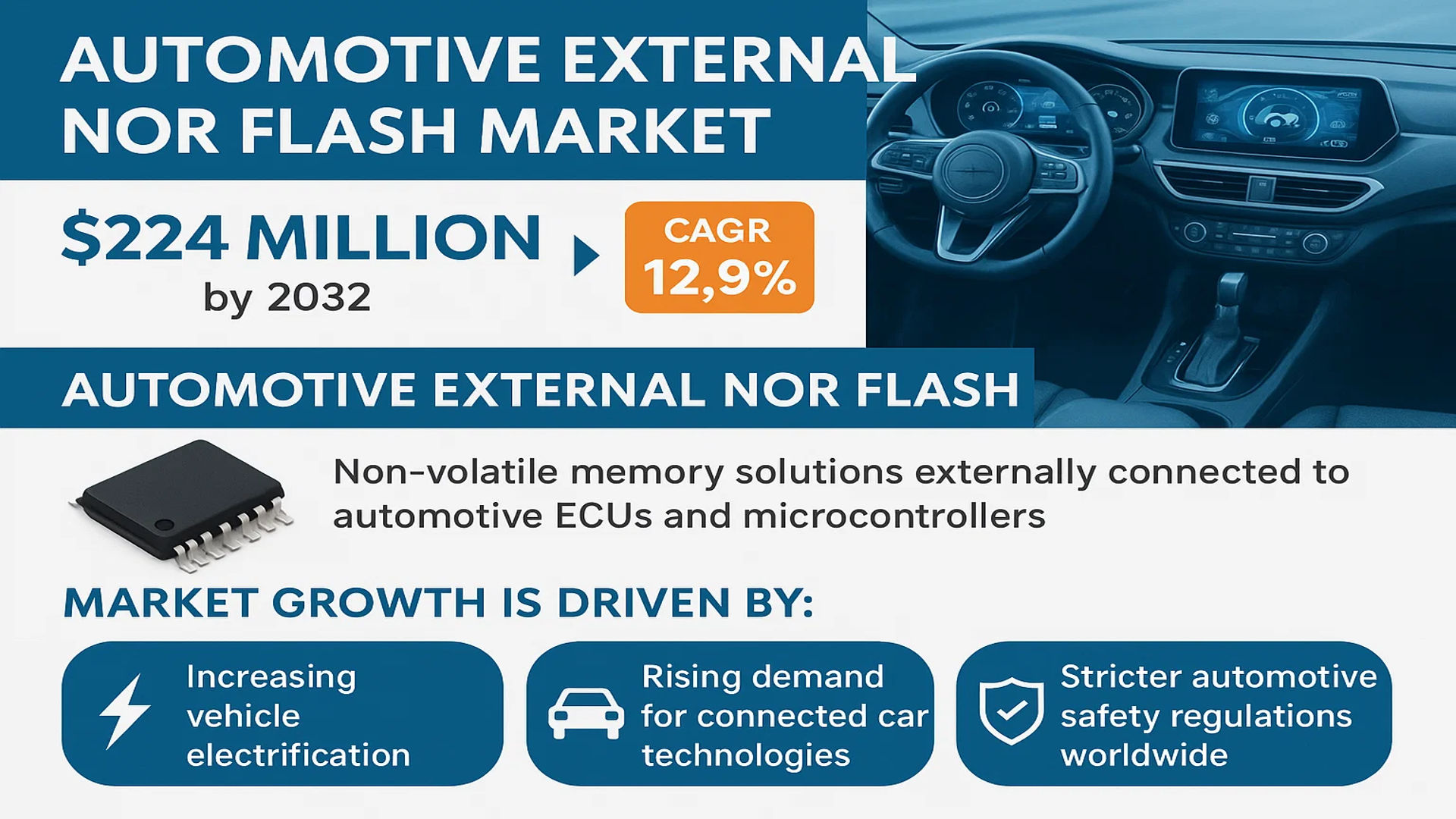
The global Automotive External NOR Flash Market was valued at 224 million in 2024 and is projected to reach US$ 510 million by 2032, at a CAGR of 12.9% during the forecast period.
Automotive External NOR Flash refers to non-volatile memory solutions that are externally connected to automotive electronic control units (ECUs) and microcontrollers. These components provide critical storage for firmware, configuration data, and system parameters in vehicles, ensuring data persistence even when power is disconnected. The technology finds extensive application in advanced driver-assistance systems (ADAS), infotainment units, and telematics due to its fast read speeds and reliability in harsh automotive environments.
The market growth is driven by increasing vehicle electrification, rising demand for connected car technologies, and stricter automotive safety regulations worldwide. While North America currently dominates the market with significant technological adoption, the Asia-Pacific region is expected to witness the fastest growth due to expanding automotive production in China and India. Leading manufacturers like Infineon Technologies and Micron are investing in high-capacity NOR Flash solutions to meet the growing data storage requirements of next-generation vehicles.
MARKET DYNAMICS
MARKET DRIVERS
Advancement in Automotive Electronics to Accelerate NOR Flash Adoption
The automotive industry is undergoing a technological revolution with the increasing integration of advanced electronics in modern vehicles. ADAS (Advanced Driver Assistance Systems), infotainment systems, and autonomous driving capabilities require reliable non-volatile memory solutions like External NOR Flash for firmware storage and quick boot-up times. As vehicles become more connected and software-defined, the demand for high-performance NOR Flash memory is projected to grow significantly. The global automotive semiconductor market is expected to expand at a CAGR of over 8% through 2030, driving parallel growth in supporting memory technologies. Recent developments in vehicle-to-everything (V2X) communication systems further amplify this need, as they require robust data storage solutions for safety-critical functions.
Stringent Automotive Safety Standards to Boost Market Growth
Global automotive safety regulations are becoming increasingly rigorous, mandating sophisticated safety systems that rely on fault-tolerant memory solutions. NOR Flash memory’s reliability in extreme conditions (-40°C to 125°C operating range) and its ability to prevent data corruption make it ideal for automotive applications. The AEC-Q100 qualification standard for automotive-grade components has become a key requirement, pushing memory manufacturers to develop specialized NOR Flash solutions. This regulatory pressure, combined with growing safety consciousness among consumers, is creating sustained demand for automotive-grade External NOR Flash memory. Furthermore, the integration of ISO 26262 functional safety requirements in vehicle electronics development is further driving the need for certified memory solutions.
Electric Vehicle Revolution to Create New Demand Streams
The rapid growth of electric vehicles represents a significant opportunity for the External NOR Flash market. EVs require more advanced battery management systems, power electronics, and charging infrastructure – all of which utilize NOR Flash memory for critical operations. Projections indicate that EVs will account for over 30% of new car sales globally by 2030, creating significant demand for supporting electronic components. The unique requirements of EV systems, including extended temperature ranges and higher reliability standards, are driving innovation in automotive memory solutions. Additionally, the development of wireless firmware updates (OTA) for EVs is increasing the need for robust external flash memory to safely store and execute update packages while maintaining system redundancy.
MARKET RESTRAINTS
High Certification Costs to Limit Market Accessibility
The automotive industry’s stringent qualification requirements present significant barriers to entry for NOR Flash memory suppliers. Achieving AEC-Q100 Grade 1 or 2 certification involves extensive testing and validation processes that can take 12-18 months and cost several million dollars. This high barrier prevents smaller memory manufacturers from competing in the automotive market, potentially limiting innovation and price competition. Additionally, the ongoing costs of maintaining certifications and implementing rigorous quality control processes add to the total cost of ownership for automotive-grade NOR Flash solutions. These factors create a challenging environment for new market entrants and can restrict the overall market growth.
Supply Chain Fragility to Impact Market Stability
The automotive NOR Flash market faces significant supply chain challenges that can disrupt steady growth. The semiconductor industry’s cyclical nature, coupled with recent global supply chain disruptions, has created volatility in memory component availability. Automotive production requires long-term supply commitments that sometimes conflict with the memory industry’s production flexibility requirements. When demand spikes occur in consumer electronics (which share similar NOR Flash technologies), production capacity can be diverted away from automotive-grade components. Such supply-demand imbalances have led to extended lead times (up to 52 weeks for some automotive memory products) and price volatility, discouraging some automotive OEMs from expanding their memory specifications.
Technological Obsolescence Concerns to Restrain Investments
While NOR Flash remains essential for boot code storage in automotive applications, emerging memory technologies and architectural innovations pose long-term challenges. The development of embedded non-volatile memory alternatives (such as MRAM and ReRAM) integrated directly into microcontrollers could potentially reduce the need for external NOR Flash in future vehicle designs. Additionally, the migration towards more advanced process nodes (below 40nm) presents technical challenges for NOR Flash manufacturers in maintaining the required reliability and endurance characteristics at smaller geometries. These technological uncertainties may cause automakers to delay memory architecture decisions or limit investments in NOR Flash-based designs, temporarily restraining market growth.
MARKET OPPORTUNITIES
Rise of Software-Defined Vehicles to Create New Memory Requirements
The automotive industry’s transition to software-defined vehicle architectures presents significant opportunities for External NOR Flash providers. Modern vehicles now require over-the-air (OTA) update capabilities, advanced cybersecurity features, and flexible software configurations – all of which increase the demand for reliable external memory solutions. This architectural shift is driving requirements for higher-density NOR Flash devices (512Mb and above) that can store multiple firmware versions and configuration sets. The global market for vehicle software is projected to grow at a CAGR of over 15% through 2030, creating corresponding demand for supporting memory technologies. Autonomous vehicle development, particularly in L3 and L4 systems, represents another high-growth segment requiring fault-tolerant memory solutions for critical decision-making systems.
Regional Market Expansion to Drive Growth Diversification
Emerging automotive production hubs in Asia and Eastern Europe present substantial growth opportunities for External NOR Flash suppliers. China’s aggressive push into electric vehicle manufacturing, combined with government support for domestic semiconductor production, is creating new demand centers. Similarly, the expansion of automotive electronics manufacturing capabilities in Southeast Asia is driving regional demand for qualified memory solutions. These developing markets often have less stringent requirements for legacy vehicle architectures, allowing memory suppliers to introduce newer, higher-margin products. Furthermore, regional trade policies and local content requirements are encouraging memory manufacturers to establish localized production and qualification capabilities, opening new avenues for market expansion.
Memory-Centric Security Solutions to Enable Premium Offerings
Growing concerns about automotive cybersecurity are creating opportunities for advanced External NOR Flash solutions with built-in security features. New requirements for secure boot, authenticated firmware updates, and hardware root-of-trust implementations are driving demand for memory devices with integrated security functions. Features like one-time programmable (OTP) memory areas, hardware-based encryption, and tamper detection are becoming critical differentiators in the automotive memory market. As automotive OEMs implement more sophisticated cybersecurity measures to meet upcoming UN R155 and ISO/SAE 21434 standards, NOR Flash manufacturers have the opportunity to develop value-added solutions that command premium pricing. The integration of these security features without compromising performance or reliability represents a significant technological and market opportunity.
MARKET CHALLENGES
Product Longevity Requirements to Strain Development Cycles
The automotive industry’s extended product lifecycles present unique challenges for NOR Flash memory suppliers. Unlike consumer electronics with 2-3 year replacement cycles, vehicle platforms often remain in production for 7-10 years, with additional 10-15 year service life requirements. This creates pressure on memory manufacturers to maintain product availability and process consistency for extended periods, often requiring special inventory management strategies. Additionally, the need for long-term reliability (endurance of 100,000+ write cycles and data retention of 20+ years at elevated temperatures) necessitates more rigorous design validation and testing than commercial-grade memory products. These requirements increase development costs and time-to-market while limiting the ability to quickly adopt newer process technologies or manufacturing optimizations.
Heterogeneous Architectures to Complicate Design Integration
The increasing complexity of automotive electronic architectures presents significant integration challenges for External NOR Flash solutions. Modern vehicles utilize multiple electronic control units (ECUs) from different suppliers, each with potentially different memory interface requirements. This heterogeneity makes it difficult to standardize memory solutions across vehicle platforms. The coexistence of legacy interfaces (like parallel NOR) with newer serial interfaces (SPI, xSPI) requires memory suppliers to maintain broader product portfolios and support multiple generations of technology. Additionally, the automotive industry’s shift towards domain controllers and zonal architectures may alter traditional memory hierarchies, requiring NOR Flash providers to adapt their product roadmaps to evolving system requirements.
Material Science Limitations to Constrain Performance Gains
NOR Flash technology faces fundamental material science challenges that limit its ability to scale with automotive performance requirements. The floating-gate transistor architecture that forms the basis of NOR Flash memory becomes increasingly difficult to manufacture reliably at smaller process nodes, particularly while maintaining the high endurance and data retention required for automotive applications. As vehicle systems demand higher-density memory with faster read/write performance, traditional NOR Flash architectures approach physical limitations. These challenges may require significant R&D investments in alternative materials (such as charge-trapping technologies) or three-dimensional architectures to maintain competitiveness against emerging non-volatile memory technologies. The need to balance these technological advancements with automotive reliability requirements creates a complex engineering challenge for memory manufacturers.
AUTOMOTIVE EXTERNAL NOR FLASH MARKET TRENDS
Increasing Demand for Advanced Automotive Systems Drives NOR Flash Adoption
The automotive industry is undergoing a significant transformation with the rise of connected vehicles, ADAS (Advanced Driver Assistance Systems), and in-vehicle infotainment systems, fueling the demand for high-performance External NOR Flash memory. Vehicles now require larger storage capacities to accommodate real-time data processing, firmware updates, and over-the-air (OTA) software upgrades, making NOR Flash essential for modern automotive applications. In 2024, the global Automotive External NOR Flash market was valued at $224 million, with projections indicating robust growth to $510 million by 2032, reflecting a 12.9% CAGR. Key manufacturers like Infineon Technologies, Micron, and GigaDevice are innovating to meet the stringent requirements of automotive-grade memory solutions.
Other Trends
Transition to High-Speed Serial NOR Flash
Automotive electronics are increasingly adopting Serial NOR Flash due to its compact footprint, lower power consumption, and faster read-write capabilities compared to Parallel NOR Flash. With the continuous evolution of autonomous driving technologies, the demand for low-latency non-volatile memory has surged. The Serial NOR Flash segment is expected to witness substantial growth, with some projections indicating a high CAGR over the next six years, driven by the need for robust and fast storage solutions in next-generation automotive control units.
Regional Growth and Competitive Landscape
North America and Asia-Pacific dominate the Automotive External NOR Flash market, with the U.S. and China leading in demand due to rapid advancements in vehicle electrification and software-defined architectures. Top manufacturers are expanding their portfolios with automotive-compliant NOR Flash modules that adhere to AEC-Q100 standards, ensuring reliability in harsh automotive environments. Furthermore, strategic partnerships between memory suppliers and automakers are accelerating innovation, as the industry shifts toward software-centric vehicle development.
COMPETITIVE LANDSCAPE
Key Industry Players
Leading Companies Expand NOR Flash Solutions for Automotive Applications
The Automotive External NOR Flash market features a mix of established semiconductor manufacturers and specialized memory solution providers. Infineon Technologies remains a dominant player, leveraging its automotive expertise and broad portfolio of system solutions. The company has strengthened its position through strategic partnerships with auto manufacturers, particularly in Europe and North America.
Micron Technology and Macronix collectively accounted for a significant portion of the 2024 market share. Micron’s automotive-grade NOR flash products have gained traction in advanced driver-assistance systems (ADAS), while Macronix continues to lead in cost-effective solutions for mid-range vehicles. Both companies are investing heavily in ultra-reliable memory solutions that meet stringent automotive safety standards.
The competitive intensity is increasing as companies expand their manufacturing capacities and develop new products specifically for electric vehicles (EVs) and connected cars. Several manufacturers are transitioning to 55nm and 40nm process nodes to enhance performance while reducing power consumption – a critical factor for battery-powered vehicles.
Emerging players like GigaDevice and Ingenic Semiconductor are making notable progress through innovative packaging technologies and localized support in China’s rapidly growing automotive market. Meanwhile, Microchip Technology maintains its strong position in specialty automotive memory through continuous R&D investments and firmware optimization for mission-critical applications.
List of Key Automotive External NOR Flash Manufacturers
- Infineon Technologies (Germany)
- Macronix International (Taiwan)
- Micron Technology (U.S.)
- Winbond Electronics (Taiwan)
- GigaDevice Semiconductor (China)
- Ingenic Semiconductor (China)
- Microchip Technology (U.S.)
Segment Analysis:
By Type
Serial NOR Flash Dominates the Market Due to High Demand for Compact and High-Speed Memory Solutions
The market is segmented based on type into:
- Serial NOR Flash
- Parallel NOR Flash
By Application
Passenger Cars Segment Leads Due to Increased Adoption of Advanced Driver Assistance Systems (ADAS)
The market is segmented based on application into:
- Passenger Cars
- Commercial Cars
By Memory Density
16Mb–128Mb Segment Dominates Due to Balanced Performance and Cost-Effectiveness
The market is segmented based on memory density into:
- 1Mb–16Mb
- 16Mb–128Mb
- 128Mb–512Mb
- Above 512Mb
By Technology
Embedded NOR Flash Adoption Grows Due to Demand for Integrated Memory Solutions
The market is segmented based on technology into:
- Standalone
- Embedded
Regional Analysis: Automotive External NOR Flash Market
Asia-Pacific
The Asia-Pacific region dominates the global Automotive External NOR Flash market, primarily driven by China, Japan, and South Korea. These countries collectively account for over 45% of global automotive production, creating substantial demand for NOR Flash memory solutions. China’s rapid electrification of vehicles and advanced infotainment system adoption in passenger cars fuels market growth. Japan and South Korea benefit from their strong semiconductor manufacturing ecosystems, with companies like Winbond and GigaDevice expanding production capacities to meet regional demand. While cost sensitivity remains a challenge, increasing investments in ADAS (Advanced Driver Assistance Systems) and connected vehicle technologies are pushing OEMs toward higher-quality NOR Flash solutions.
North America
Stringent automotive safety regulations and the shift toward autonomous driving technologies are accelerating NOR Flash adoption in North America. The U.S. leads with significant investments in vehicle-to-everything (V2X) communication systems, requiring robust external memory solutions. Major players like Micron and Microchip Technology are focusing on developing high-temperature tolerant NOR Flash variants suitable for under-hood applications. The region also shows strong preference for Serial NOR Flash due to its compact footprint and lower power consumption – critical factors for electric vehicles where energy efficiency is paramount.
Europe
Europe’s market is characterized by strict automotive cybersecurity requirements and the rapid transition to electric vehicles. Germany’s automotive sector, with its focus on premium vehicle segments, demands high-endurance NOR Flash solutions for firmware storage in advanced ECUs. The European Union’s General Safety Regulation mandates increasing levels of vehicle automation, directly boosting demand for reliable non-volatile memory. Companies like Infineon Technologies are strengthening their position through strategic partnerships with tier-1 automotive suppliers, while regional players emphasize compliance with AEC-Q100 qualification standards for automotive-grade components.
Middle East & Africa
This emerging market shows promising growth potential, though from a smaller base. The UAE and Saudi Arabia are leading the adoption of advanced automotive electronics in luxury vehicles, while South Africa serves as an automotive manufacturing hub for international brands. Market expansion is somewhat constrained by limited local semiconductor infrastructure and reliance on imports. However, increasing investments in smart city projects and the gradual electrification of public transport fleets are expected to drive long-term demand for Automotive External NOR Flash solutions in the region.
South America
The South American market remains the smallest globally, constrained by economic volatility and slower adoption of advanced automotive technologies. Brazil’s automotive industry shows the most promise, with growing production of entry-level vehicles incorporating basic infotainment systems requiring NOR Flash memory. The lack of domestic semiconductor manufacturing means the region depends entirely on imports, primarily from Asian suppliers. While political and economic challenges persist, the gradual modernization of vehicle fleets and increasing safety regulation enforcement offer prospects for measured market growth in the coming decade.
Report Scope
This market research report provides a comprehensive analysis of the Global Automotive External NOR Flash market, covering the forecast period 2025–2032. It offers detailed insights into market dynamics, technological advancements, competitive landscape, and key trends shaping the industry.
Key focus areas of the report include:
- Market Size & Forecast: Historical data and future projections for revenue, unit shipments, and market value across major regions and segments. The Global Automotive External NOR Flash market was valued at USD 224 million in 2024 and is projected to reach USD 510 million by 2032, at a CAGR of 12.9% during the forecast period.
- Segmentation Analysis: Detailed breakdown by product type (Serial NOR Flash, Parallel NOR Flash), application (Passenger Cars, Commercial Cars), and end-user industry to identify high-growth segments and investment opportunities.
- Regional Outlook: Insights into market performance across North America, Europe, Asia-Pacific, Latin America, and the Middle East & Africa, including country-level analysis. The U.S. market is estimated at USD million in 2024, while China is projected to reach USD million by 2032.
- Competitive Landscape: Profiles of leading market participants, including Infineon Technologies, Macronix, Micron, Winbond, GigaDevice, Ingenic Semiconductor, and Microchip Technology, their product offerings, R&D focus, manufacturing capacity, pricing strategies, and recent developments such as mergers, acquisitions, and partnerships.
- Technology Trends & Innovation: Assessment of emerging technologies, integration of AI/IoT, semiconductor design trends, fabrication techniques, and evolving industry standards in Automotive External NOR Flash applications.
- Market Drivers & Restraints: Evaluation of factors driving market growth such as increasing demand for advanced automotive electronics and infotainment systems, along with challenges including supply chain constraints and regulatory issues.
- Stakeholder Analysis: Insights for component suppliers, automotive OEMs, system integrators, investors, and policymakers regarding the evolving ecosystem and strategic opportunities in the Automotive External NOR Flash market.
Primary and secondary research methods are employed, including interviews with industry experts, data from verified sources, and real-time market intelligence to ensure the accuracy and reliability of the insights presented.
FREQUENTLY ASKED QUESTIONS:
What is the current market size of Global Automotive External NOR Flash Market?
-> Automotive External NOR Flash Market was valued at 224 million in 2024 and is projected to reach US$ 510 million by 2032, at a CAGR of 12.9% during the forecast period.
Which key companies operate in Global Automotive External NOR Flash Market?
-> Key players include Infineon Technologies, Macronix, Micron, Winbond, GigaDevice, Ingenic Semiconductor, and Microchip Technology, among others.
What are the key growth drivers?
-> Key growth drivers include increasing demand for advanced automotive electronics, growth in electric vehicle adoption, and the need for reliable non-volatile memory solutions in automotive applications.
Which region dominates the market?
-> Asia-Pacific is the fastest-growing region, driven by automotive manufacturing growth in China, Japan, and South Korea, while North America remains a significant market due to advanced automotive technologies.
What are the emerging trends?
-> Emerging trends include higher density NOR Flash solutions, integration with automotive AI systems, and development of more robust memory solutions for harsh automotive environments.

Get Sample Report PDF for Exclusive Insights
Report Sample Includes
- Table of Contents
- List of Tables & Figures
- Charts, Research Methodology, and more...
 Download Sample Report PDF


