Market Insights
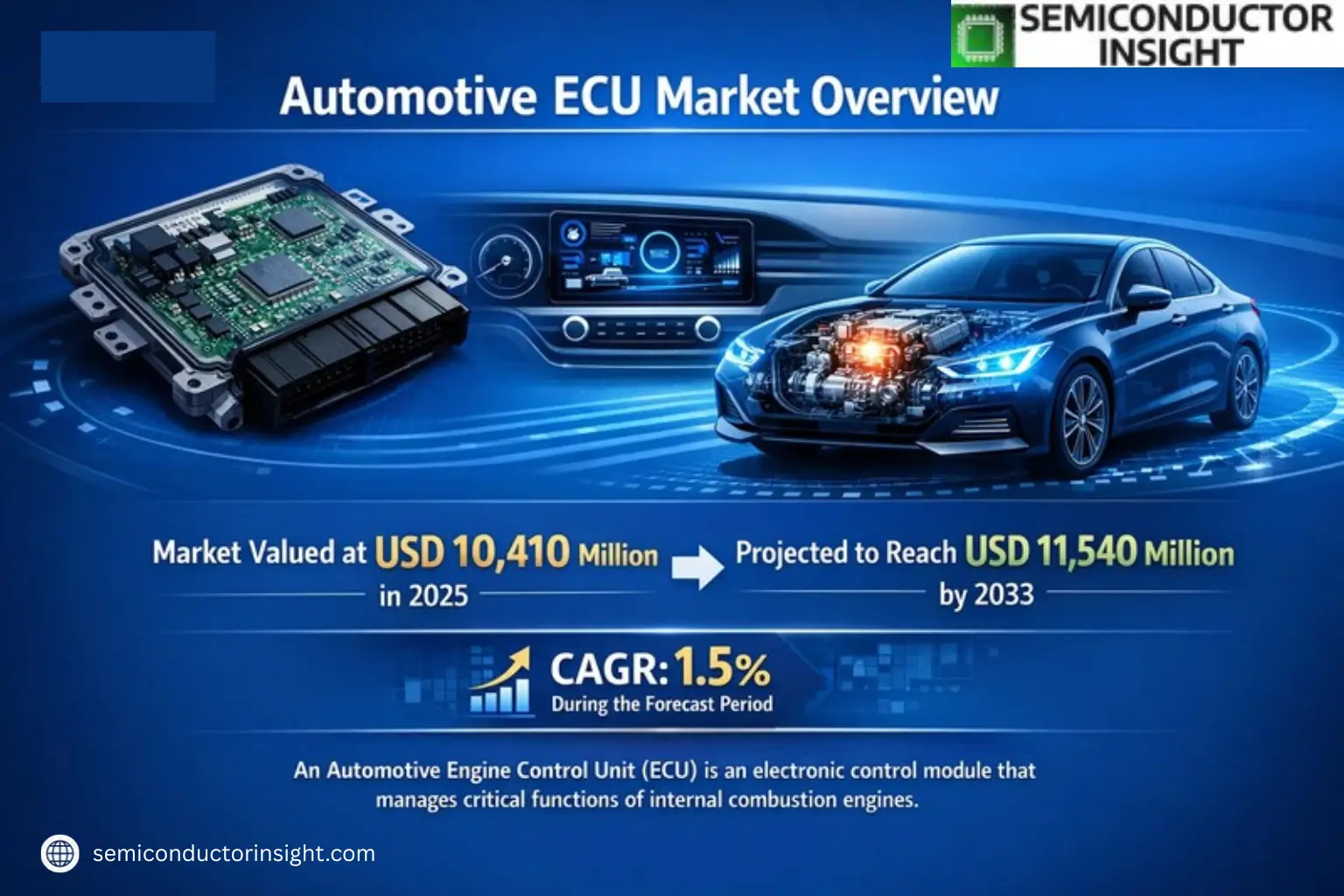
Global Automotive ECU Market was valued at USD 10,410 million in 2025 and is projected to reach USD 11,540 million by 2033, exhibiting a CAGR of 1.5% during the forecast period.
An Automotive Engine Control Unit (ECU) is an electronic control module that manages critical functions of internal combustion engines. It processes data from multiple sensors to optimize performance metrics such as air-fuel ratio, ignition timing, and idle speed through multidimensional lookup tables. Unlike traditional mechanical systems, ECUs enable precise digital control over engine operations.
The market growth is driven by increasing vehicle electrification and stringent emission regulations worldwide. China dominates with over 25% market share, followed by Europe and North America at approximately 20% each. Gasoline ECUs account for more than 80% of the market, primarily serving passenger vehicles which represent the largest application segment. Key players including BOSCH, Continental, DENSO and Delphi collectively hold nearly 65% of the global market share.
MARKET DRIVERS
Increasing Vehicle Electrification
The rapid shift toward electric and hybrid vehicles is accelerating the demand for advanced automotive ECUs. These control units are essential for managing battery systems, power distribution, and energy efficiency in modern electric vehicles. Global push for emission reductions and stricter regulations is further propelling ECU adoption.
Rising Demand for Advanced Driver-Assistance Systems (ADAS)
ADAS technologies, including adaptive cruise control and lane-keeping assistance, rely heavily on sophisticated automotive ECUs for real-time data processing. As safety regulations tighten and consumer demand for autonomous features grows, the ECU market is experiencing significant expansion.
Additionally, the integration of connected car technologies with cloud-based services is creating new opportunities for ECU functionalities, enhancing vehicle performance and diagnostics.
MARKET CHALLENGES
High Development and Testing Costs
The complexity of designing and validating automotive ECUs for safety-critical applications remains a major hurdle. Developing robust ECUs that meet stringent automotive standards requires substantial R&D investment and extended testing cycles.
Other Challenges
Cybersecurity Vulnerabilities
As vehicles become more connected, automotive ECUs are increasingly exposed to cyber threats. Ensuring secure firmware updates and preventing unauthorized access remain critical challenges for manufacturers.
MARKET RESTRAINTS
Semiconductor Supply Chain Disruptions
Shortages of microcontrollers and other semiconductor components continue to constrain Automotive ECU production. Geopolitical factors and pandemic-related disruptions have prolonged lead times, affecting OEM assembly lines globally.
MARKET OPPORTUNITIES
Emergence of Domain Control Units (DCUs)
The transition from distributed ECU architectures to centralized domain controllers presents a key growth opportunity. DCUs consolidate multiple functions into high-performance computing units, reducing vehicle complexity while enabling new software-defined features.
Expansion in Emerging Markets
Growing vehicle production in Asia-Pacific, particularly in China and India, is creating substantial demand for cost-effective automotive ECUs. Local manufacturers are investing in regional supply chains to capitalize on this expanding market segment.
Automotive ECU Market Trends
Steady Growth in Automotive ECU Market
Global Automotive ECU Market is projected to grow from USD 10,410 million in 2025 to USD 11,540 million by 2033, registering a CAGR of 1.5%. This growth is driven by increasing vehicle production, stricter emission regulations, and rising demand for advanced engine management systems. China dominates the market with over 25% share, followed by Europe and North America with 20% each. The top four manufacturers – BOSCH, DENSO, Continental, and Delphi – collectively hold 65% of the market share.
Other Trends
Shift Toward Electric Vehicle ECUs
While gasoline ECUs currently hold 80% market share, there’s growing investment in ECUs for hybrid and electric vehicles. Major players are developing specialized control units to manage complex powertrain systems in next-generation vehicles. Passenger vehicles remain the primary application segment (75%), with increasing ECU integration in commercial vehicles for fleet management and telematics.
Regional Market Developments
Emerging markets in Southeast Asia and India are showing accelerated growth in Automotive ECU adoption, driven by rising vehicle ownership and manufacturing localizations. Meanwhile, established markets in Europe and North America are focusing on high-performance ECUs with enhanced connectivity features. Suppliers are establishing regional production facilities to meet local demand and reduce supply chain risks.
Technology Advancements Driving Innovation
Modern Automotive ECUs are evolving with AI-based predictive maintenance capabilities, over-the-air update functionality, and cybersecurity protections. Integration with Vehicle-to-Everything (V2X) communication systems is becoming standard, requiring more sophisticated ECU architectures. These technological enhancements contribute to improved fuel efficiency and reduced emissions across vehicle segments.
COMPETITIVE LANDSCAPE
Key Industry Players
Bosch Leads Consolidated Automotive ECU Market with 35% Share
Global Automotive ECU Market remains highly concentrated, with the top four players Bosch, Continental, DENSO, and Delphi controlling approximately 65% of the market share. Bosch dominates the landscape with a 35% revenue share, leveraging its technological expertise in engine management systems and strategic OEM partnerships. Tier-1 suppliers continue to integrate advanced functionalities like AI-powered predictive diagnostics and over-the-air update capabilities into their ECU offerings.
Specialized players like Mitsubishi Electric and Hitachi Automotive have carved notable niches in hybrid/electric vehicle ECUs, while regional champions such as China’s UAES and Weifu Group are gaining traction through cost-competitive solutions. The market sees increasing R&D focus on domain controllers that consolidate multiple ECUs, with Marelli and LinControl emerging as innovators in this transition phase. TRW and Hyundai AUTRON maintain strong positions in safety-critical ECUs for autonomous driving applications.
List of Key Automotive ECU Companies Profiled
- Robert Bosch GmbH
- Continental AG
- DENSO Corporation
- Delphi Technologies
- ZF TRW
- Hyundai AUTRON
- Marelli Holdings
- Mitsubishi Electric Corporation
- United Automotive Electronic Systems (UAES)
- Weifu High-Technology Group
- LinControl
- Troiltec France
- Hitachi Automotive Systems
- Aptiv PLC
- Magna International
Segment Analysis:
| Segment Category | Sub-Segments | Key Insights |
| By Type |
|
Gasoline Automotive ECU dominates the segment due to:
|
| By Application |
|
Passenger Vehicles represent the key application segment because:
|
| By End User |
|
OEMs represent the primary end users due to:
|
| By Technology |
|
Traditional ECUs remain prevalent while newer technologies gain traction:
|
| By Vehicle Type |
|
Conventional Vehicles maintain leadership with specific considerations:
|
Regional Analysis: Automotive ECU Market
Proximity to semiconductor manufacturers and automotive clusters gives Asia-Pacific ECU suppliers logistical and cost benefits, with just-in-time delivery models supporting OEM production schedules across the region’s sprawling vehicle assembly networks.
Electric vehicle adoption mandates in China and Southeast Asia drive specialized ECU development, with regional manufacturers pioneering compact control units for battery management systems and integrated power electronics.
Chinese and Japanese tech firms lead in AI-powered ECU development, producing control units with advanced machine learning capabilities for autonomous driving features and predictive maintenance systems.
Government policies across the region promote domestic ECU production through tax incentives and R&D grants, encouraging localization of automotive electronics to reduce dependence on foreign suppliers.
Europe
Europe’s Automotive ECU Market benefits from stringent vehicle safety regulations driving advanced driver-assistance system adoption. German automakers lead in domain controller development, integrating multiple ECUs into centralized computing platforms. The region’s focus on premium vehicles sustains demand for high-performance electronic control units with functional safety certifications. Strong collaborations between automotive OEMs and semiconductor companies accelerate innovation in powertrain ECUs for hybrid vehicles. Brexit-related supply chain adjustments have prompted ECU manufacturers to establish duplicate production facilities within the EU.
North America
The North American Automotive ECU Market shows strong growth in vehicle electrification and connectivity features. Detroit’s Big Three automakers prioritize cybersecurity-enhanced control units, while Silicon Valley influences ECU architecture with cloud integration capabilities. Regional standards for vehicle-to-everything (V2X) communication spur development of specialized telematics control units. Cross-border ECU trade flows with Mexico and Canada optimize production costs, though semiconductor supply constraints occasionally disrupt just-in-time manufacturing models.
South America
South America’s Automotive ECU Market focuses on cost-optimized solutions for entry-level vehicles, with Brazil serving as the regional production hub. Local content requirements foster ECU assembly operations, though semiconductor shortages sometimes delay production. Aftermarket ECU modifications remain popular for performance vehicles, creating parallel market dynamics. Regional automakers prioritize fuel efficiency-oriented engine control units to address consumer sensitivity to gasoline prices.
Middle East & Africa
The Middle East’s luxury vehicle preference drives demand for premium ECUs, while Africa’s market focuses on durable control units for harsh operating conditions. GCC countries invest in connected car infrastructure, elevating telematics ECU requirements. South Africa serves as an ECU manufacturing base for vehicles sold across the continent, with localization strategies adapting European-designed control units for African road conditions and fuel quality variations.
Report Scope
This market research report provides a comprehensive analysis of the Automotive ECU Market , covering the forecast period 2025–2033. It offers detailed insights into market dynamics, technological advancements, competitive landscape, and key trends shaping the industry.
Key focus areas of the report include:
- Market Overview: The report begins with an overview outlining its current market scenario, key growth indicators, and industry transformation drivers. It discusses macroeconomic factors, demand–supply balance, regulatory landscape, and the strategic role of semiconductors in powering advancements across industries such as automotive, telecommunications, consumer electronics, and industrial automation.
- Market Size & Forecast: Historical data and future projections for revenue, unit shipments, and market value across major regions and segments.
- Segmentation Analysis: Detailed breakdown by product type, technology, application, and end-user industry to identify high-growth segments and investment opportunities.
- Regional Insights: Insights into market performance across North America, Europe, Asia-Pacific, Latin America, and the Middle East & Africa, including country-level analysis where relevant.
- Competitive Landscape: Profiles of leading market participants, including their product offerings, R&D focus, manufacturing capacity, pricing strategies, and recent developments such as mergers, acquisitions, and partnerships.
- Technology Trends & Innovation: Assessment of emerging technologies, integration of AI/IoT, semiconductor design trends, fabrication techniques, and evolving industry standards.
- Market Drivers & Restraints: Evaluation of factors driving market growth along with challenges, supply chain constraints, regulatory issues, and market-entry barriers.
- Stakeholder Insights: Insights for component suppliers, OEMs, system integrators, investors, and policymakers regarding the evolving ecosystem and strategic opportunities.
Primary and secondary research methods are employed, including interviews with industry experts, data from verified sources, and real-time market intelligence to ensure the accuracy and reliability of the insights presented.
FREQUENTLY ASKED QUESTIONS:
What is the current market size of Automotive ECU Market?
-> Automotive ECU Market was valued at USD 10,410 million in 2025 and is projected to reach USD 11,540 million by 2033, exhibiting a CAGR of 1.5% during the forecast period.
Which key companies operate in Automotive ECU Market?
-> Key players include BOSCH, DENSO, Continental, Delphi, TRW, Hyundai AUTRON, Marelli, and Mitsubishi Electric. The top four manufacturers hold nearly 65% market share.
What are the key growth drivers?
-> Key growth drivers include increasing vehicle electrification, demand for fuel-efficient engines, and advancements in automotive sensor technologies.
Which region dominates the market?
-> China is the largest market with over 25% share, followed by Europe and North America, each with over 20% market share.
What are the emerging trends?
-> Emerging trends include integration of AI in ECU systems, development of autonomous vehicle control units, and lightweight ECU designs.

Get Sample Report PDF for Exclusive Insights
Report Sample Includes
- Table of Contents
- List of Tables & Figures
- Charts, Research Methodology, and more...
 Download Sample Report PDF