Automotive Crystal and Oscilators Market, Trends, Business Strategies 2025-2032

Automotive Crystal and Oscilators Market was valued at 673 million in 2024 and is projected to reach US$ 972 million by 2032, at a CAGR of 5.5% during the forecast period

PDF Icon Download Sample Report PDF
  • Quick Dispatch

    All Orders

  • Secure Payment

    100% Secure Payment

Price range: $1,500.00 through $4,250.00

Clear

MARKET INSIGHTS

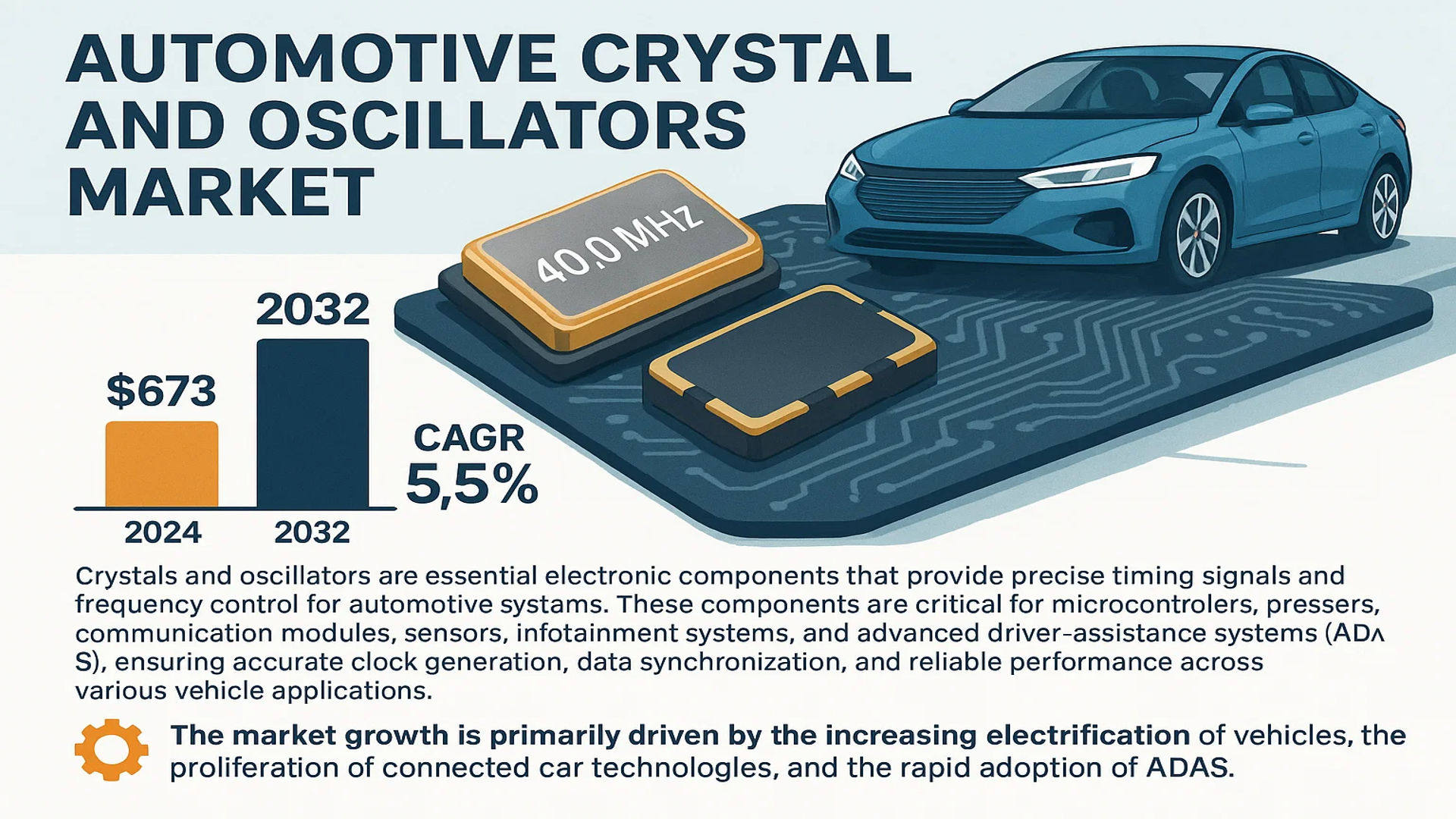
The global Automotive Crystal and Oscilators Market was valued at 673 million in 2024 and is projected to reach US$ 972 million by 2032, at a CAGR of 5.5% during the forecast period.

Crystals and oscillators are essential electronic components that provide precise timing signals and frequency control for automotive systems. These components are critical for the operation of microcontrollers, processors, communication modules, sensors, infotainment systems, and advanced driver-assistance systems (ADAS), ensuring accurate clock generation, data synchronization, and reliable performance across various vehicle applications.

The market growth is primarily driven by the increasing electrification of vehicles, the proliferation of connected car technologies, and the rapid adoption of ADAS. The expansion of electric vehicle production, which requires sophisticated electronic control units, further fuels demand. However, manufacturers face significant challenges, including the need to meet stringent automotive-grade standards like AEC-Q200 and to ensure component reliability amidst harsh operating conditions involving extreme temperatures, vibration, and electromagnetic interference.
Automotive Crystal and Oscilators Market

MARKET DYNAMICS

MARKET DRIVERS

Proliferation of Advanced Driver Assistance Systems (ADAS) to Drive Market Expansion

The rapid adoption of Advanced Driver Assistance Systems (ADAS) is significantly propelling the automotive crystal and oscillators market. These systems rely on precise timing components for sensor fusion, radar operation, LiDAR scanning, and camera synchronization. With over 50 million vehicles equipped with ADAS globally in 2024, the demand for high-precision timing solutions continues to escalate. The integration of autonomous driving functionalities requires timing accuracy within nanoseconds to ensure real-time decision-making and collision avoidance. Automotive-grade crystals and oscillators provide the necessary frequency stability and phase noise performance for these critical safety applications, making them indispensable components in modern vehicle architectures.

Electric Vehicle Revolution to Accelerate Market Growth

The global transition toward electric vehicles represents a substantial growth driver for automotive crystals and oscillators. Electric vehicle production increased by approximately 35% in 2024 compared to the previous year, reaching over 14 million units worldwide. These vehicles require sophisticated battery management systems, power electronics, and motor control units that depend on precise timing components. Crystals and oscillators ensure accurate switching frequencies for power converters, synchronization for battery management systems, and timing references for vehicle control units. The complexity of electric powertrains, which can contain up to 10,000 individual electronic components, necessitates reliable timing solutions that maintain performance across varying temperature conditions and electromagnetic environments.

Vehicle Connectivity and Infotainment Systems to Boost Demand

The integration of advanced connectivity features and infotainment systems in modern vehicles is driving substantial growth in the automotive crystal and oscillators market. Current vehicle architectures incorporate multiple connectivity modules including 5G, V2X communication, GPS navigation, and Wi-Fi/Bluetooth systems, each requiring dedicated timing components. The average premium vehicle now contains approximately 15 separate timing devices to support these functions. The growing consumer demand for seamless connectivity, high-definition audio/video streaming, and real-time navigation services necessitates oscillators with low jitter and high frequency stability. Furthermore, the emergence of software-defined vehicles and over-the-air update capabilities requires robust timing solutions that can maintain synchronization across multiple electronic control units.

Moreover, regulatory mandates for vehicle safety and communication standards are expected to further fuel market growth.

For instance, recent automotive safety regulations in multiple regions now require specific timing accuracy standards for vehicle-to-everything (V2X) communication systems to ensure interoperability and road safety.

Furthermore, the increasing integration of artificial intelligence and machine learning algorithms in vehicle systems is anticipated to drive additional demand for high-performance timing components throughout the forecast period.

MARKET CHALLENGES

Stringent Automotive-Grade Certification Requirements to Challenge Market Participants

The automotive crystal and oscillators market faces significant challenges related to the rigorous certification standards required for automotive applications. Components must meet AEC-Q200 qualification standards, which involve extensive testing under extreme conditions including temperature cycling from -40°C to +125°C, mechanical shock testing up to 1500G, and humidity resistance requirements. The certification process typically adds 20-30% to development costs and extends product development cycles by 6-12 months. These requirements create substantial barriers for new market entrants and smaller manufacturers who may lack the resources for comprehensive testing facilities and quality management systems.

Other Challenges

Harsh Operating Environment Constraints
Automotive electronic components must operate reliably in extremely challenging environments characterized by wide temperature variations, constant vibration, and electromagnetic interference. Crystals and oscillators are particularly sensitive to these conditions, with performance degradation occurring at temperature extremes beyond their specified ranges. Vehicle manufacturers require components that maintain frequency stability within ±50 ppm across the entire operating temperature range, which demands sophisticated compensation techniques and robust packaging solutions.

Electromagnetic Compatibility Issues
The increasing density of electronic systems in modern vehicles creates significant electromagnetic compatibility challenges. Timing components must minimize electromagnetic emissions while maintaining immunity to external interference. The proliferation of high-frequency communication systems and power electronics in electric vehicles exacerbates these challenges, requiring advanced shielding techniques and careful circuit layout considerations that add complexity and cost to component design.

MARKET RESTRAINTS

Supply Chain Constraints and Component Shortages to Deter Market Growth

The automotive crystal and oscillators market faces significant restraints due to ongoing supply chain challenges and component shortages. The global semiconductor crisis that began in recent years continues to affect timing component availability, with lead times for certain automotive-grade oscillators extending beyond 52 weeks. Automotive manufacturers require components with zero defect rates, which limits the pool of qualified suppliers and creates dependency on a few established manufacturers. The specialized manufacturing processes for quartz crystals and the limited global production capacity for high-quality quartz materials further constrain market growth. These supply chain issues have caused production delays and increased costs throughout the automotive industry.

Additionally, the concentration of manufacturing capabilities in specific geographic regions creates vulnerability to geopolitical tensions and trade restrictions. The automotive industry’s just-in-time manufacturing philosophy exacerbates these challenges, as inventory buffers remain minimal despite extended component lead times.

Furthermore, the increasing complexity of automotive electronic systems requires more specialized timing components, which limits the ability to substitute alternative products during shortage situations, thereby restraining market expansion.

MARKET OPPORTUNITIES

Emergence of Silicon-Based MEMS Oscillators to Create New Growth Opportunities

The development and adoption of silicon-based MEMS (Micro-Electro-Mechanical Systems) oscillators present significant growth opportunities for the automotive timing components market. MEMS technology offers advantages over traditional quartz-based solutions, including better shock and vibration resistance, smaller form factors, and improved scalability. The market for MEMS-based timing solutions in automotive applications is projected to grow at a compound annual growth rate exceeding 15% through 2032. These devices demonstrate performance stability within ±25 ppm across automotive temperature ranges while offering reduced susceptibility to acoustic noise and mechanical stress. Major automotive semiconductor manufacturers are investing heavily in MEMS oscillator technology, with several companies announcing new product developments specifically designed for automotive applications.

Additionally, the integration of multiple timing functions into single-chip solutions provides opportunities for component consolidation and system cost reduction. The ability to program oscillator frequencies digitally enables greater flexibility in automotive electronic design and simplifies inventory management for manufacturers.

Furthermore, advancements in packaging technology and the development of system-in-package solutions that combine oscillators with other automotive ICs are expected to create additional market opportunities while addressing space constraints in increasingly crowded vehicle electronic systems.

AUTOMOTIVE CRYSTAL AND OSCILLATORS MARKET TRENDS

Advanced Driver Assistance Systems (ADAS) and Autonomous Driving to Emerge as a Key Trend

The proliferation of Advanced Driver Assistance Systems (ADAS) and the ongoing development of autonomous driving technologies represent a dominant trend significantly accelerating demand for high-performance automotive crystals and oscillators. These components are fundamental to the precise timing and synchronization required for sensor fusion, where data from radar, LiDAR, cameras, and ultrasonic sensors must be integrated in real-time. For instance, a typical Level 2+ autonomous vehicle can utilize over 30 individual timing devices to coordinate these complex systems. The shift towards higher levels of automation, particularly Level 3 and Level 4, necessitates oscillators with exceptional frequency stability, often requiring tolerances as tight as ±10 ppm across an extended automotive temperature range of -40°C to +125°C. This is because even minor timing inaccuracies can lead to significant errors in object detection and path planning algorithms. Furthermore, the integration of V2X (Vehicle-to-Everything) communication, a cornerstone for fully autonomous ecosystems, relies heavily on highly accurate and stable reference clocks to ensure seamless and secure data exchange between vehicles and infrastructure, further cementing the critical role of these components.

Other Trends

Electrification of Powertrains

The global transition towards electric vehicles (EVs) and hybrid electric vehicles (HEVs) is creating a substantial and distinct demand vector for crystals and oscillators. Unlike traditional internal combustion engines, electric powertrains are fundamentally managed by sophisticated electronic control units (ECUs) that require precise timing for functions like battery management (BMS), inverter control, and motor drive synchronization. The BMS alone, critical for monitoring cell voltage, temperature, and state of charge, depends on accurate clock signals for its analog-to-digital converters and communication buses. The powertrain domain in an EV is estimated to consume a significantly higher number of timing components compared to a conventional vehicle. Moreover, the high-power electronics environment within an EV, characterized by significant electrical noise and rapid switching frequencies, demands oscillators with superior electromagnetic compatibility (EMC) and low jitter performance to prevent signal integrity issues that could impact vehicle efficiency and safety.

Integration of Advanced In-Vehicle Infotainment (IVI) and Connectivity

The consumer expectation for a seamless digital experience within the automobile is pushing the boundaries of in-vehicle infotainment (IVI) systems, directly influencing the specifications of associated timing components. Modern IVI systems have evolved into complex computing hubs, often featuring multiple high-resolution displays, powerful multi-core processors, and sophisticated audio systems. These systems require a variety of crystals and oscillators to manage clock generation for graphics processing, audio sampling, and video synchronization. The trend is further amplified by the integration of 5G connectivity modules, Wi-Fi 6, and Bluetooth 5.2 for high-speed internet access and device integration. Each wireless technology operates on specific frequency bands and requires dedicated, stable reference clocks to maintain robust communication links and prevent data packet loss. This convergence of high-performance computing and multi-standard connectivity within the cabin is driving demand for miniaturized, low-power, and highly reliable timing solutions that can operate flawlessly alongside other electronic systems without causing interference.

COMPETITIVE LANDSCAPE

Key Industry Players

Technological Innovation and Strategic Expansion Define Market Leadership

The global automotive crystal and oscillators market exhibits a semi-consolidated competitive structure, characterized by the presence of established multinational corporations, specialized medium-sized enterprises, and emerging regional players. This dynamic is driven by the critical need for high-reliability, automotive-grade components that meet stringent industry standards like AEC-Q200. NDK (Nihon Dempa Kogyo Co., Ltd.) and Murata Manufacturing Co., Ltd. are recognized as dominant forces, leveraging their extensive R&D capabilities, robust global supply chains, and comprehensive portfolios of quartz crystals and oscillators specifically engineered for harsh automotive environments. Their leadership is further solidified by long-standing relationships with Tier-1 automotive suppliers and direct engagements with major OEMs.

Japanese manufacturers, including Seiko Epson Corp and KDS (Daishinku Corp), also command a significant portion of the market share. Their growth is intrinsically linked to decades of expertise in precision frequency control devices and a deep understanding of the quality and reliability demands of the global automotive industry. These companies consistently invest in developing products that offer enhanced resistance to vibration, extreme temperatures, and electromagnetic interference, which are paramount for applications in Advanced Driver-Assistance Systems (ADAS) and electric vehicle powertrains.

Furthermore, strategic initiatives such as capacity expansions, targeted mergers and acquisitions, and the launch of innovative, miniaturized components are expected to be key growth levers for these leading players over the forecast period. For instance, the push towards higher-frequency, low-power oscillators for 5G-enabled telematics and V2X communication modules represents a significant area of development.

Meanwhile, companies like Microchip Technology Inc. and SiTime Corporation are aggressively strengthening their market positions. They are doing so through substantial investments in MEMS (Micro-Electro-Mechanical Systems) technology, which offers advantages in shock resistance and reliability over traditional quartz. Their strategy involves forming strategic partnerships with semiconductor makers and focusing on providing highly programmable timing solutions that offer greater design flexibility for automotive engineers working on next-generation electronic control units (ECUs) and infotainment systems.

List of Key Automotive Crystal and Oscillator Companies Profiled

Segment Analysis:

By Type

Crystal Oscillators Segment Dominates the Market Due to Critical Role in Advanced Automotive Electronics

The market is segmented based on type into:

  • Crystal Units
  • Crystal Oscillators

By Application

Passenger Car Segment Leads Due to Higher Electronics Integration and Consumer Demand for Advanced Features

The market is segmented based on application into:

  • Commercial Vehicle
  • Passenger Car

By Vehicle Technology

Advanced Driver Assistance Systems (ADAS) Segment Represents Significant Growth Opportunity Due to Safety Mandates

The market is segmented based on vehicle technology into:

  • Advanced Driver Assistance Systems (ADAS)
  • Infotainment Systems
  • Powertrain Control
  • Body Electronics
  • Chassis Systems

By Vehicle Propulsion

Electric Vehicle Segment Shows Strong Growth Potential Driven by Electrification Trends

The market is segmented based on vehicle propulsion into:

  • Internal Combustion Engine Vehicles
  • Hybrid Electric Vehicles
  • Battery Electric Vehicles

Regional Analysis: Automotive Crystal and Oscillators Market

Asia-Pacific
The Asia-Pacific region dominates the global automotive crystal and oscillators market, accounting for over 45% of total consumption in 2024. This leadership position is driven by China’s massive automotive manufacturing sector, which produced approximately 30 million vehicles in 2023, alongside Japan and South Korea’s advanced automotive electronics industries. The region benefits from extensive manufacturing clusters for both vehicles and electronic components, creating a robust ecosystem for timing device suppliers. While cost sensitivity remains a factor, the rapid adoption of electric vehicles – particularly in China, which represents over 60% of global EV sales – and increasing integration of ADAS features in mid-range vehicles are driving demand for higher-quality, automotive-grade crystals and oscillators. The presence of major global suppliers like TXC Corporation, NDK, and Murata Manufacturing in the region further strengthens the supply chain.

North America
North America represents a sophisticated market characterized by stringent automotive electronics standards and rapid adoption of advanced vehicle technologies. The region’s emphasis on vehicle safety and connectivity drives demand for high-reliability crystals and oscillators that meet AEC-Q200 qualifications and can withstand harsh automotive environments. The United States, with its robust automotive industry and significant investments in autonomous vehicle development, accounts for approximately 85% of the regional market. Major automotive manufacturers and tier-1 suppliers increasingly require MEMS-based oscillators for their superior performance in vibration-intensive applications. The region’s growing electric vehicle market, supported by government incentives and infrastructure investments, further accelerates demand for precision timing components in battery management and powertrain control systems.

Europe
Europe’s automotive crystal and oscillators market is characterized by rigorous quality standards and innovation-driven demand. German automotive manufacturers, particularly those in the premium segment, are leading adopters of advanced timing solutions for their sophisticated ADAS and infotainment systems. The region’s strong focus on vehicle safety and the EU’s strict regulations regarding electronic component reliability drive the adoption of automotive-grade crystals and oscillators that exceed standard industrial specifications. European automakers’ rapid transition toward electric vehicles – with several manufacturers committing to full electrification by 2030 – creates substantial opportunities for timing component suppliers. The presence of specialized manufacturers like Micro Crystal provides local sourcing options for high-precision timing solutions tailored to European automotive requirements.

South America
South America’s automotive crystal and oscillators market is developing, with Brazil and Argentina representing the primary demand centers. The region’s automotive production, while significant, tends to focus on cost-effective vehicles with less sophisticated electronics compared to other regions. This results in greater demand for standard crystal units rather than advanced oscillators. Economic volatility and currency fluctuations sometimes constrain automotive manufacturers’ ability to invest in advanced electronic systems, though the gradual modernization of vehicle fleets and increasing safety regulations are driving steady growth. Local content requirements in countries like Brazil encourage some level of regional manufacturing, though most advanced components are still imported from global suppliers.

Middle East & Africa
The Middle East & Africa region represents an emerging market for automotive crystals and oscillators, with growth primarily driven by vehicle imports rather than local manufacturing. The UAE and Saudi Arabia are the most developed markets, with luxury vehicle segments showing strongest demand for advanced timing components. South Africa maintains some automotive manufacturing capability, particularly for commercial vehicles, creating localized demand for basic timing components. The region’s challenging climate conditions, with extreme temperatures and dust, create specific requirements for components that can operate reliably under harsh environmental stress. While the market remains relatively small compared to other regions, increasing vehicle electrification and connectivity features in imported vehicles are driving gradual market expansion.

Report Scope

This market research report provides a comprehensive analysis of the global and regional Automotive Crystal and Oscillators markets, covering the forecast period 2025–2032. It offers detailed insights into market dynamics, technological advancements, competitive landscape, and key trends shaping the industry.

Key focus areas of the report include:

  • Market Size & Forecast: Historical data and future projections for revenue, unit shipments, and market value across major regions and segments.
  • Segmentation Analysis: Detailed breakdown by product type, technology, application, and end-user industry to identify high-growth segments and investment opportunities.
  • Regional Outlook: Insights into market performance across North America, Europe, Asia-Pacific, Latin America, and the Middle East & Africa, including country-level analysis where relevant.
  • Competitive Landscape: Profiles of leading market participants, including their product offerings, R&D focus, manufacturing capacity, pricing strategies, and recent developments such as mergers, acquisitions, and partnerships.
  • Technology Trends & Innovation: Assessment of emerging technologies, integration of AI/IoT, semiconductor design trends, fabrication techniques, and evolving industry standards.
  • Market Drivers & Restraints: Evaluation of factors driving market growth along with challenges, supply chain constraints, regulatory issues, and market-entry barriers.
  • Stakeholder Analysis: Insights for component suppliers, OEMs, system integrators, investors, and policymakers regarding the evolving ecosystem and strategic opportunities.

Primary and secondary research methods are employed, including interviews with industry experts, data from verified sources, and real-time market intelligence to ensure the accuracy and reliability of the insights presented.

FREQUENTLY ASKED QUESTIONS:

What is the current market size of Global Automotive Crystal and Oscillators Market?

-> Automotive Crystal and Oscilators Market was valued at 673 million in 2024 and is projected to reach US$ 972 million by 2032, at a CAGR of 5.5% during the forecast period.

Which key companies operate in Global Automotive Crystal and Oscillators Market?

-> Key players include Seiko Epson Corp, TXC Corporation, NDK, Microchip, Murata Manufacturing, SiTime, Rakon, Hosonic Electronic, Siward Crystal Technology, and River Eletec Corporation, among others.

What are the key growth drivers?

-> Key growth drivers include vehicle connectivity expansion, Advanced Driver Assistance Systems (ADAS) adoption, electric vehicle proliferation, infotainment system demand, and compliance with automotive-grade standards.

Which region dominates the market?

-> Asia-Pacific is the dominant market region, accounting for over 45% of global market share in 2024, driven by automotive manufacturing hubs in China, Japan, and South Korea.

What are the emerging trends?

-> Emerging trends include miniaturization of components, MEMS-based oscillators, higher frequency stability requirements, integration with AI/ML systems, and development of ultra-low power consumption oscillators for next-generation automotive applications.

Automotive Crystal and Oscilators Market, Trends, Business Strategies 2025-2032

Get Sample Report PDF for Exclusive Insights

Report Sample Includes

  • Table of Contents
  • List of Tables & Figures
  • Charts, Research Methodology, and more...

PDF Icon Download Sample Report PDF

Download Sample Report

Table of Content

1 Introduction to Research & Analysis Reports
1.1 Automotive Crystal and Oscilators Market Definition
1.2 Market Segments
1.2.1 Segment by Type
1.2.2 Segment by Application
1.3 Global Automotive Crystal and Oscilators Market Overview
1.4 Features & Benefits of This Report
1.5 Methodology & Sources of Information
1.5.1 Research Methodology
1.5.2 Research Process
1.5.3 Base Year
1.5.4 Report Assumptions & Caveats
2 Global Automotive Crystal and Oscilators Overall Market Size
2.1 Global Automotive Crystal and Oscilators Market Size: 2024 VS 2032
2.2 Global Automotive Crystal and Oscilators Market Size, Prospects & Forecasts: 2020-2032
2.3 Global Automotive Crystal and Oscilators Sales: 2020-2032
3 Company Landscape
3.1 Top Automotive Crystal and Oscilators Players in Global Market
3.2 Top Global Automotive Crystal and Oscilators Companies Ranked by Revenue
3.3 Global Automotive Crystal and Oscilators Revenue by Companies
3.4 Global Automotive Crystal and Oscilators Sales by Companies
3.5 Global Automotive Crystal and Oscilators Price by Manufacturer (2020-2025)
3.6 Top 3 and Top 5 Automotive Crystal and Oscilators Companies in Global Market, by Revenue in 2024
3.7 Global Manufacturers Automotive Crystal and Oscilators Product Type
3.8 Tier 1, Tier 2, and Tier 3 Automotive Crystal and Oscilators Players in Global Market
3.8.1 List of Global Tier 1 Automotive Crystal and Oscilators Companies
3.8.2 List of Global Tier 2 and Tier 3 Automotive Crystal and Oscilators Companies
4 Sights by Product
4.1 Overview
4.1.1 Segment by Type – Global Automotive Crystal and Oscilators Market Size Markets, 2024 & 2032
4.1.2 Crystal Units
4.1.3 Crystal Oscillators
4.2 Segment by Type – Global Automotive Crystal and Oscilators Revenue & Forecasts
4.2.1 Segment by Type – Global Automotive Crystal and Oscilators Revenue, 2020-2025
4.2.2 Segment by Type – Global Automotive Crystal and Oscilators Revenue, 2026-2032
4.2.3 Segment by Type – Global Automotive Crystal and Oscilators Revenue Market Share, 2020-2032
4.3 Segment by Type – Global Automotive Crystal and Oscilators Sales & Forecasts
4.3.1 Segment by Type – Global Automotive Crystal and Oscilators Sales, 2020-2025
4.3.2 Segment by Type – Global Automotive Crystal and Oscilators Sales, 2026-2032
4.3.3 Segment by Type – Global Automotive Crystal and Oscilators Sales Market Share, 2020-2032
4.4 Segment by Type – Global Automotive Crystal and Oscilators Price (Manufacturers Selling Prices), 2020-2032
5 Sights by Application
5.1 Overview
5.1.1 Segment by Application – Global Automotive Crystal and Oscilators Market Size, 2024 & 2032
5.1.2 Commercial Vehicle
5.1.3 Passenger Car
5.2 Segment by Application – Global Automotive Crystal and Oscilators Revenue & Forecasts
5.2.1 Segment by Application – Global Automotive Crystal and Oscilators Revenue, 2020-2025
5.2.2 Segment by Application – Global Automotive Crystal and Oscilators Revenue, 2026-2032
5.2.3 Segment by Application – Global Automotive Crystal and Oscilators Revenue Market Share, 2020-2032
5.3 Segment by Application – Global Automotive Crystal and Oscilators Sales & Forecasts
5.3.1 Segment by Application – Global Automotive Crystal and Oscilators Sales, 2020-2025
5.3.2 Segment by Application – Global Automotive Crystal and Oscilators Sales, 2026-2032
5.3.3 Segment by Application – Global Automotive Crystal and Oscilators Sales Market Share, 2020-2032
5.4 Segment by Application – Global Automotive Crystal and Oscilators Price (Manufacturers Selling Prices), 2020-2032
6 Sights by Region
6.1 By Region – Global Automotive Crystal and Oscilators Market Size, 2024 & 2032
6.2 By Region – Global Automotive Crystal and Oscilators Revenue & Forecasts
6.2.1 By Region – Global Automotive Crystal and Oscilators Revenue, 2020-2025
6.2.2 By Region – Global Automotive Crystal and Oscilators Revenue, 2026-2032
6.2.3 By Region – Global Automotive Crystal and Oscilators Revenue Market Share, 2020-2032
6.3 By Region – Global Automotive Crystal and Oscilators Sales & Forecasts
6.3.1 By Region – Global Automotive Crystal and Oscilators Sales, 2020-2025
6.3.2 By Region – Global Automotive Crystal and Oscilators Sales, 2026-2032
6.3.3 By Region – Global Automotive Crystal and Oscilators Sales Market Share, 2020-2032
6.4 North America
6.4.1 By Country – North America Automotive Crystal and Oscilators Revenue, 2020-2032
6.4.2 By Country – North America Automotive Crystal and Oscilators Sales, 2020-2032
6.4.3 United States Automotive Crystal and Oscilators Market Size, 2020-2032
6.4.4 Canada Automotive Crystal and Oscilators Market Size, 2020-2032
6.4.5 Mexico Automotive Crystal and Oscilators Market Size, 2020-2032
6.5 Europe
6.5.1 By Country – Europe Automotive Crystal and Oscilators Revenue, 2020-2032
6.5.2 By Country – Europe Automotive Crystal and Oscilators Sales, 2020-2032
6.5.3 Germany Automotive Crystal and Oscilators Market Size, 2020-2032
6.5.4 France Automotive Crystal and Oscilators Market Size, 2020-2032
6.5.5 U.K. Automotive Crystal and Oscilators Market Size, 2020-2032
6.5.6 Italy Automotive Crystal and Oscilators Market Size, 2020-2032
6.5.7 Russia Automotive Crystal and Oscilators Market Size, 2020-2032
6.5.8 Nordic Countries Automotive Crystal and Oscilators Market Size, 2020-2032
6.5.9 Benelux Automotive Crystal and Oscilators Market Size, 2020-2032
6.6 Asia
6.6.1 By Region – Asia Automotive Crystal and Oscilators Revenue, 2020-2032
6.6.2 By Region – Asia Automotive Crystal and Oscilators Sales, 2020-2032
6.6.3 China Automotive Crystal and Oscilators Market Size, 2020-2032
6.6.4 Japan Automotive Crystal and Oscilators Market Size, 2020-2032
6.6.5 South Korea Automotive Crystal and Oscilators Market Size, 2020-2032
6.6.6 Southeast Asia Automotive Crystal and Oscilators Market Size, 2020-2032
6.6.7 India Automotive Crystal and Oscilators Market Size, 2020-2032
6.7 South America
6.7.1 By Country – South America Automotive Crystal and Oscilators Revenue, 2020-2032
6.7.2 By Country – South America Automotive Crystal and Oscilators Sales, 2020-2032
6.7.3 Brazil Automotive Crystal and Oscilators Market Size, 2020-2032
6.7.4 Argentina Automotive Crystal and Oscilators Market Size, 2020-2032
6.8 Middle East & Africa
6.8.1 By Country – Middle East & Africa Automotive Crystal and Oscilators Revenue, 2020-2032
6.8.2 By Country – Middle East & Africa Automotive Crystal and Oscilators Sales, 2020-2032
6.8.3 Turkey Automotive Crystal and Oscilators Market Size, 2020-2032
6.8.4 Israel Automotive Crystal and Oscilators Market Size, 2020-2032
6.8.5 Saudi Arabia Automotive Crystal and Oscilators Market Size, 2020-2032
6.8.6 UAE Automotive Crystal and Oscilators Market Size, 2020-2032
7 Manufacturers & Brands Profiles
7.1 Seiko Epson Corp
7.1.1 Seiko Epson Corp Company Summary
7.1.2 Seiko Epson Corp Business Overview
7.1.3 Seiko Epson Corp Automotive Crystal and Oscilators Major Product Offerings
7.1.4 Seiko Epson Corp Automotive Crystal and Oscilators Sales and Revenue in Global (2020-2025)
7.1.5 Seiko Epson Corp Key News & Latest Developments
7.2 TXC Corporation
7.2.1 TXC Corporation Company Summary
7.2.2 TXC Corporation Business Overview
7.2.3 TXC Corporation Automotive Crystal and Oscilators Major Product Offerings
7.2.4 TXC Corporation Automotive Crystal and Oscilators Sales and Revenue in Global (2020-2025)
7.2.5 TXC Corporation Key News & Latest Developments
7.3 NDK
7.3.1 NDK Company Summary
7.3.2 NDK Business Overview
7.3.3 NDK Automotive Crystal and Oscilators Major Product Offerings
7.3.4 NDK Automotive Crystal and Oscilators Sales and Revenue in Global (2020-2025)
7.3.5 NDK Key News & Latest Developments
7.4 KCD
7.4.1 KCD Company Summary
7.4.2 KCD Business Overview
7.4.3 KCD Automotive Crystal and Oscilators Major Product Offerings
7.4.4 KCD Automotive Crystal and Oscilators Sales and Revenue in Global (2020-2025)
7.4.5 KCD Key News & Latest Developments
7.5 KDS
7.5.1 KDS Company Summary
7.5.2 KDS Business Overview
7.5.3 KDS Automotive Crystal and Oscilators Major Product Offerings
7.5.4 KDS Automotive Crystal and Oscilators Sales and Revenue in Global (2020-2025)
7.5.5 KDS Key News & Latest Developments
7.6 Microchip
7.6.1 Microchip Company Summary
7.6.2 Microchip Business Overview
7.6.3 Microchip Automotive Crystal and Oscilators Major Product Offerings
7.6.4 Microchip Automotive Crystal and Oscilators Sales and Revenue in Global (2020-2025)
7.6.5 Microchip Key News & Latest Developments
7.7 SiTime
7.7.1 SiTime Company Summary
7.7.2 SiTime Business Overview
7.7.3 SiTime Automotive Crystal and Oscilators Major Product Offerings
7.7.4 SiTime Automotive Crystal and Oscilators Sales and Revenue in Global (2020-2025)
7.7.5 SiTime Key News & Latest Developments
7.8 TKD Science
7.8.1 TKD Science Company Summary
7.8.2 TKD Science Business Overview
7.8.3 TKD Science Automotive Crystal and Oscilators Major Product Offerings
7.8.4 TKD Science Automotive Crystal and Oscilators Sales and Revenue in Global (2020-2025)
7.8.5 TKD Science Key News & Latest Developments
7.9 Rakon
7.9.1 Rakon Company Summary
7.9.2 Rakon Business Overview
7.9.3 Rakon Automotive Crystal and Oscilators Major Product Offerings
7.9.4 Rakon Automotive Crystal and Oscilators Sales and Revenue in Global (2020-2025)
7.9.5 Rakon Key News & Latest Developments
7.10 Murata Manufacturing
7.10.1 Murata Manufacturing Company Summary
7.10.2 Murata Manufacturing Business Overview
7.10.3 Murata Manufacturing Automotive Crystal and Oscilators Major Product Offerings
7.10.4 Murata Manufacturing Automotive Crystal and Oscilators Sales and Revenue in Global (2020-2025)
7.10.5 Murata Manufacturing Key News & Latest Developments
7.11 Harmony
7.11.1 Harmony Company Summary
7.11.2 Harmony Business Overview
7.11.3 Harmony Automotive Crystal and Oscilators Major Product Offerings
7.11.4 Harmony Automotive Crystal and Oscilators Sales and Revenue in Global (2020-2025)
7.11.5 Harmony Key News & Latest Developments
7.12 Hosonic Electronic
7.12.1 Hosonic Electronic Company Summary
7.12.2 Hosonic Electronic Business Overview
7.12.3 Hosonic Electronic Automotive Crystal and Oscilators Major Product Offerings
7.12.4 Hosonic Electronic Automotive Crystal and Oscilators Sales and Revenue in Global (2020-2025)
7.12.5 Hosonic Electronic Key News & Latest Developments
7.13 Siward Crystal Technology
7.13.1 Siward Crystal Technology Company Summary
7.13.2 Siward Crystal Technology Business Overview
7.13.3 Siward Crystal Technology Automotive Crystal and Oscilators Major Product Offerings
7.13.4 Siward Crystal Technology Automotive Crystal and Oscilators Sales and Revenue in Global (2020-2025)
7.13.5 Siward Crystal Technology Key News & Latest Developments
7.14 Micro Crystal
7.14.1 Micro Crystal Company Summary
7.14.2 Micro Crystal Business Overview
7.14.3 Micro Crystal Automotive Crystal and Oscilators Major Product Offerings
7.14.4 Micro Crystal Automotive Crystal and Oscilators Sales and Revenue in Global (2020-2025)
7.14.5 Micro Crystal Key News & Latest Developments
7.15 Failong Crystal Technologies
7.15.1 Failong Crystal Technologies Company Summary
7.15.2 Failong Crystal Technologies Business Overview
7.15.3 Failong Crystal Technologies Automotive Crystal and Oscilators Major Product Offerings
7.15.4 Failong Crystal Technologies Automotive Crystal and Oscilators Sales and Revenue in Global (2020-2025)
7.15.5 Failong Crystal Technologies Key News & Latest Developments
7.16 River Eletec Corporation
7.16.1 River Eletec Corporation Company Summary
7.16.2 River Eletec Corporation Business Overview
7.16.3 River Eletec Corporation Automotive Crystal and Oscilators Major Product Offerings
7.16.4 River Eletec Corporation Automotive Crystal and Oscilators Sales and Revenue in Global (2020-2025)
7.16.5 River Eletec Corporation Key News & Latest Developments
7.17 ZheJiang East Crystal
7.17.1 ZheJiang East Crystal Company Summary
7.17.2 ZheJiang East Crystal Business Overview
7.17.3 ZheJiang East Crystal Automotive Crystal and Oscilators Major Product Offerings
7.17.4 ZheJiang East Crystal Automotive Crystal and Oscilators Sales and Revenue in Global (2020-2025)
7.17.5 ZheJiang East Crystal Key News & Latest Developments
7.18 Guoxin Micro
7.18.1 Guoxin Micro Company Summary
7.18.2 Guoxin Micro Business Overview
7.18.3 Guoxin Micro Automotive Crystal and Oscilators Major Product Offerings
7.18.4 Guoxin Micro Automotive Crystal and Oscilators Sales and Revenue in Global (2020-2025)
7.18.5 Guoxin Micro Key News & Latest Developments
8 Global Automotive Crystal and Oscilators Production Capacity, Analysis
8.1 Global Automotive Crystal and Oscilators Production Capacity, 2020-2032
8.2 Automotive Crystal and Oscilators Production Capacity of Key Manufacturers in Global Market
8.3 Global Automotive Crystal and Oscilators Production by Region
9 Key Market Trends, Opportunity, Drivers and Restraints
9.1 Market Opportunities & Trends
9.2 Market Drivers
9.3 Market Restraints
10 Automotive Crystal and Oscilators Supply Chain Analysis
10.1 Automotive Crystal and Oscilators Industry Value Chain
10.2 Automotive Crystal and Oscilators Upstream Market
10.3 Automotive Crystal and Oscilators Downstream and Clients
10.4 Marketing Channels Analysis
10.4.1 Marketing Channels
10.4.2 Automotive Crystal and Oscilators Distributors and Sales Agents in Global
11 Conclusion
12 Appendix
12.1 Note
12.2 Examples of Clients
12.3 DisclaimerList of Tables
Table 1. Key Players of Automotive Crystal and Oscilators in Global Market
Table 2. Top Automotive Crystal and Oscilators Players in Global Market, Ranking by Revenue (2024)
Table 3. Global Automotive Crystal and Oscilators Revenue by Companies, (US$, Mn), 2020-2025
Table 4. Global Automotive Crystal and Oscilators Revenue Share by Companies, 2020-2025
Table 5. Global Automotive Crystal and Oscilators Sales by Companies, (K Units), 2020-2025
Table 6. Global Automotive Crystal and Oscilators Sales Share by Companies, 2020-2025
Table 7. Key Manufacturers Automotive Crystal and Oscilators Price (2020-2025) & (US$/Unit)
Table 8. Global Manufacturers Automotive Crystal and Oscilators Product Type
Table 9. List of Global Tier 1 Automotive Crystal and Oscilators Companies, Revenue (US$, Mn) in 2024 and Market Share
Table 10. List of Global Tier 2 and Tier 3 Automotive Crystal and Oscilators Companies, Revenue (US$, Mn) in 2024 and Market Share
Table 11. Segment by Type – Global Automotive Crystal and Oscilators Revenue, (US$, Mn), 2024 & 2032
Table 12. Segment by Type – Global Automotive Crystal and Oscilators Revenue (US$, Mn), 2020-2025
Table 13. Segment by Type – Global Automotive Crystal and Oscilators Revenue (US$, Mn), 2026-2032
Table 14. Segment by Type – Global Automotive Crystal and Oscilators Sales (K Units), 2020-2025
Table 15. Segment by Type – Global Automotive Crystal and Oscilators Sales (K Units), 2026-2032
Table 16. Segment by Application – Global Automotive Crystal and Oscilators Revenue, (US$, Mn), 2024 & 2032
Table 17. Segment by Application – Global Automotive Crystal and Oscilators Revenue, (US$, Mn), 2020-2025
Table 18. Segment by Application – Global Automotive Crystal and Oscilators Revenue, (US$, Mn), 2026-2032
Table 19. Segment by Application – Global Automotive Crystal and Oscilators Sales, (K Units), 2020-2025
Table 20. Segment by Application – Global Automotive Crystal and Oscilators Sales, (K Units), 2026-2032
Table 21. By Region – Global Automotive Crystal and Oscilators Revenue, (US$, Mn), 2025-2032
Table 22. By Region – Global Automotive Crystal and Oscilators Revenue, (US$, Mn), 2020-2025
Table 23. By Region – Global Automotive Crystal and Oscilators Revenue, (US$, Mn), 2026-2032
Table 24. By Region – Global Automotive Crystal and Oscilators Sales, (K Units), 2020-2025
Table 25. By Region – Global Automotive Crystal and Oscilators Sales, (K Units), 2026-2032
Table 26. By Country – North America Automotive Crystal and Oscilators Revenue, (US$, Mn), 2020-2025
Table 27. By Country – North America Automotive Crystal and Oscilators Revenue, (US$, Mn), 2026-2032
Table 28. By Country – North America Automotive Crystal and Oscilators Sales, (K Units), 2020-2025
Table 29. By Country – North America Automotive Crystal and Oscilators Sales, (K Units), 2026-2032
Table 30. By Country – Europe Automotive Crystal and Oscilators Revenue, (US$, Mn), 2020-2025
Table 31. By Country – Europe Automotive Crystal and Oscilators Revenue, (US$, Mn), 2026-2032
Table 32. By Country – Europe Automotive Crystal and Oscilators Sales, (K Units), 2020-2025
Table 33. By Country – Europe Automotive Crystal and Oscilators Sales, (K Units), 2026-2032
Table 34. By Region – Asia Automotive Crystal and Oscilators Revenue, (US$, Mn), 2020-2025
Table 35. By Region – Asia Automotive Crystal and Oscilators Revenue, (US$, Mn), 2026-2032
Table 36. By Region – Asia Automotive Crystal and Oscilators Sales, (K Units), 2020-2025
Table 37. By Region – Asia Automotive Crystal and Oscilators Sales, (K Units), 2026-2032
Table 38. By Country – South America Automotive Crystal and Oscilators Revenue, (US$, Mn), 2020-2025
Table 39. By Country – South America Automotive Crystal and Oscilators Revenue, (US$, Mn), 2026-2032
Table 40. By Country – South America Automotive Crystal and Oscilators Sales, (K Units), 2020-2025
Table 41. By Country – South America Automotive Crystal and Oscilators Sales, (K Units), 2026-2032
Table 42. By Country – Middle East & Africa Automotive Crystal and Oscilators Revenue, (US$, Mn), 2020-2025
Table 43. By Country – Middle East & Africa Automotive Crystal and Oscilators Revenue, (US$, Mn), 2026-2032
Table 44. By Country – Middle East & Africa Automotive Crystal and Oscilators Sales, (K Units), 2020-2025
Table 45. By Country – Middle East & Africa Automotive Crystal and Oscilators Sales, (K Units), 2026-2032
Table 46. Seiko Epson Corp Company Summary
Table 47. Seiko Epson Corp Automotive Crystal and Oscilators Product Offerings
Table 48. Seiko Epson Corp Automotive Crystal and Oscilators Sales (K Units), Revenue (US$, Mn) and Average Price (US$/Unit) & (2020-2025)
Table 49. Seiko Epson Corp Key News & Latest Developments
Table 50. TXC Corporation Company Summary
Table 51. TXC Corporation Automotive Crystal and Oscilators Product Offerings
Table 52. TXC Corporation Automotive Crystal and Oscilators Sales (K Units), Revenue (US$, Mn) and Average Price (US$/Unit) & (2020-2025)
Table 53. TXC Corporation Key News & Latest Developments
Table 54. NDK Company Summary
Table 55. NDK Automotive Crystal and Oscilators Product Offerings
Table 56. NDK Automotive Crystal and Oscilators Sales (K Units), Revenue (US$, Mn) and Average Price (US$/Unit) & (2020-2025)
Table 57. NDK Key News & Latest Developments
Table 58. KCD Company Summary
Table 59. KCD Automotive Crystal and Oscilators Product Offerings
Table 60. KCD Automotive Crystal and Oscilators Sales (K Units), Revenue (US$, Mn) and Average Price (US$/Unit) & (2020-2025)
Table 61. KCD Key News & Latest Developments
Table 62. KDS Company Summary
Table 63. KDS Automotive Crystal and Oscilators Product Offerings
Table 64. KDS Automotive Crystal and Oscilators Sales (K Units), Revenue (US$, Mn) and Average Price (US$/Unit) & (2020-2025)
Table 65. KDS Key News & Latest Developments
Table 66. Microchip Company Summary
Table 67. Microchip Automotive Crystal and Oscilators Product Offerings
Table 68. Microchip Automotive Crystal and Oscilators Sales (K Units), Revenue (US$, Mn) and Average Price (US$/Unit) & (2020-2025)
Table 69. Microchip Key News & Latest Developments
Table 70. SiTime Company Summary
Table 71. SiTime Automotive Crystal and Oscilators Product Offerings
Table 72. SiTime Automotive Crystal and Oscilators Sales (K Units), Revenue (US$, Mn) and Average Price (US$/Unit) & (2020-2025)
Table 73. SiTime Key News & Latest Developments
Table 74. TKD Science Company Summary
Table 75. TKD Science Automotive Crystal and Oscilators Product Offerings
Table 76. TKD Science Automotive Crystal and Oscilators Sales (K Units), Revenue (US$, Mn) and Average Price (US$/Unit) & (2020-2025)
Table 77. TKD Science Key News & Latest Developments
Table 78. Rakon Company Summary
Table 79. Rakon Automotive Crystal and Oscilators Product Offerings
Table 80. Rakon Automotive Crystal and Oscilators Sales (K Units), Revenue (US$, Mn) and Average Price (US$/Unit) & (2020-2025)
Table 81. Rakon Key News & Latest Developments
Table 82. Murata Manufacturing Company Summary
Table 83. Murata Manufacturing Automotive Crystal and Oscilators Product Offerings
Table 84. Murata Manufacturing Automotive Crystal and Oscilators Sales (K Units), Revenue (US$, Mn) and Average Price (US$/Unit) & (2020-2025)
Table 85. Murata Manufacturing Key News & Latest Developments
Table 86. Harmony Company Summary
Table 87. Harmony Automotive Crystal and Oscilators Product Offerings
Table 88. Harmony Automotive Crystal and Oscilators Sales (K Units), Revenue (US$, Mn) and Average Price (US$/Unit) & (2020-2025)
Table 89. Harmony Key News & Latest Developments
Table 90. Hosonic Electronic Company Summary
Table 91. Hosonic Electronic Automotive Crystal and Oscilators Product Offerings
Table 92. Hosonic Electronic Automotive Crystal and Oscilators Sales (K Units), Revenue (US$, Mn) and Average Price (US$/Unit) & (2020-2025)
Table 93. Hosonic Electronic Key News & Latest Developments
Table 94. Siward Crystal Technology Company Summary
Table 95. Siward Crystal Technology Automotive Crystal and Oscilators Product Offerings
Table 96. Siward Crystal Technology Automotive Crystal and Oscilators Sales (K Units), Revenue (US$, Mn) and Average Price (US$/Unit) & (2020-2025)
Table 97. Siward Crystal Technology Key News & Latest Developments
Table 98. Micro Crystal Company Summary
Table 99. Micro Crystal Automotive Crystal and Oscilators Product Offerings
Table 100. Micro Crystal Automotive Crystal and Oscilators Sales (K Units), Revenue (US$, Mn) and Average Price (US$/Unit) & (2020-2025)
Table 101. Micro Crystal Key News & Latest Developments
Table 102. Failong Crystal Technologies Company Summary
Table 103. Failong Crystal Technologies Automotive Crystal and Oscilators Product Offerings
Table 104. Failong Crystal Technologies Automotive Crystal and Oscilators Sales (K Units), Revenue (US$, Mn) and Average Price (US$/Unit) & (2020-2025)
Table 105. Failong Crystal Technologies Key News & Latest Developments
Table 106. River Eletec Corporation Company Summary
Table 107. River Eletec Corporation Automotive Crystal and Oscilators Product Offerings
Table 108. River Eletec Corporation Automotive Crystal and Oscilators Sales (K Units), Revenue (US$, Mn) and Average Price (US$/Unit) & (2020-2025)
Table 109. River Eletec Corporation Key News & Latest Developments
Table 110. ZheJiang East Crystal Company Summary
Table 111. ZheJiang East Crystal Automotive Crystal and Oscilators Product Offerings
Table 112. ZheJiang East Crystal Automotive Crystal and Oscilators Sales (K Units), Revenue (US$, Mn) and Average Price (US$/Unit) & (2020-2025)
Table 113. ZheJiang East Crystal Key News & Latest Developments
Table 114. Guoxin Micro Company Summary
Table 115. Guoxin Micro Automotive Crystal and Oscilators Product Offerings
Table 116. Guoxin Micro Automotive Crystal and Oscilators Sales (K Units), Revenue (US$, Mn) and Average Price (US$/Unit) & (2020-2025)
Table 117. Guoxin Micro Key News & Latest Developments
Table 118. Automotive Crystal and Oscilators Capacity of Key Manufacturers in Global Market, 2023-2025 (K Units)
Table 119. Global Automotive Crystal and Oscilators Capacity Market Share of Key Manufacturers, 2023-2025
Table 120. Global Automotive Crystal and Oscilators Production by Region, 2020-2025 (K Units)
Table 121. Global Automotive Crystal and Oscilators Production by Region, 2026-2032 (K Units)
Table 122. Automotive Crystal and Oscilators Market Opportunities & Trends in Global Market
Table 123. Automotive Crystal and Oscilators Market Drivers in Global Market
Table 124. Automotive Crystal and Oscilators Market Restraints in Global Market
Table 125. Automotive Crystal and Oscilators Raw Materials
Table 126. Automotive Crystal and Oscilators Raw Materials Suppliers in Global Market
Table 127. Typical Automotive Crystal and Oscilators Downstream
Table 128. Automotive Crystal and Oscilators Downstream Clients in Global Market
Table 129. Automotive Crystal and Oscilators Distributors and Sales Agents in Global Market

List of Figures
Figure 1. Automotive Crystal and Oscilators Product Picture
Figure 2. Automotive Crystal and Oscilators Segment by Type in 2024
Figure 3. Automotive Crystal and Oscilators Segment by Application in 2024
Figure 4. Global Automotive Crystal and Oscilators Market Overview: 2024
Figure 5. Key Caveats
Figure 6. Global Automotive Crystal and Oscilators Market Size: 2024 VS 2032 (US$, Mn)
Figure 7. Global Automotive Crystal and Oscilators Revenue: 2020-2032 (US$, Mn)
Figure 8. Automotive Crystal and Oscilators Sales in Global Market: 2020-2032 (K Units)
Figure 9. The Top 3 and 5 Players Market Share by Automotive Crystal and Oscilators Revenue in 2024
Figure 10. Segment by Type – Global Automotive Crystal and Oscilators Revenue, (US$, Mn), 2024 & 2032
Figure 11. Segment by Type – Global Automotive Crystal and Oscilators Revenue Market Share, 2020-2032
Figure 12. Segment by Type – Global Automotive Crystal and Oscilators Sales Market Share, 2020-2032
Figure 13. Segment by Type – Global Automotive Crystal and Oscilators Price (US$/Unit), 2020-2032
Figure 14. Segment by Application – Global Automotive Crystal and Oscilators Revenue, (US$, Mn), 2024 & 2032
Figure 15. Segment by Application – Global Automotive Crystal and Oscilators Revenue Market Share, 2020-2032
Figure 16. Segment by Application – Global Automotive Crystal and Oscilators Sales Market Share, 2020-2032
Figure 17. Segment by Application -Global Automotive Crystal and Oscilators Price (US$/Unit), 2020-2032
Figure 18. By Region – Global Automotive Crystal and Oscilators Revenue, (US$, Mn), 2025 & 2032
Figure 19. By Region – Global Automotive Crystal and Oscilators Revenue Market Share, 2020 VS 2024 VS 2032
Figure 20. By Region – Global Automotive Crystal and Oscilators Revenue Market Share, 2020-2032
Figure 21. By Region – Global Automotive Crystal and Oscilators Sales Market Share, 2020-2032
Figure 22. By Country – North America Automotive Crystal and Oscilators Revenue Market Share, 2020-2032
Figure 23. By Country – North America Automotive Crystal and Oscilators Sales Market Share, 2020-2032
Figure 24. United States Automotive Crystal and Oscilators Revenue, (US$, Mn), 2020-2032
Figure 25. Canada Automotive Crystal and Oscilators Revenue, (US$, Mn), 2020-2032
Figure 26. Mexico Automotive Crystal and Oscilators Revenue, (US$, Mn), 2020-2032
Figure 27. By Country – Europe Automotive Crystal and Oscilators Revenue Market Share, 2020-2032
Figure 28. By Country – Europe Automotive Crystal and Oscilators Sales Market Share, 2020-2032
Figure 29. Germany Automotive Crystal and Oscilators Revenue, (US$, Mn), 2020-2032
Figure 30. France Automotive Crystal and Oscilators Revenue, (US$, Mn), 2020-2032
Figure 31. U.K. Automotive Crystal and Oscilators Revenue, (US$, Mn), 2020-2032
Figure 32. Italy Automotive Crystal and Oscilators Revenue, (US$, Mn), 2020-2032
Figure 33. Russia Automotive Crystal and Oscilators Revenue, (US$, Mn), 2020-2032
Figure 34. Nordic Countries Automotive Crystal and Oscilators Revenue, (US$, Mn), 2020-2032
Figure 35. Benelux Automotive Crystal and Oscilators Revenue, (US$, Mn), 2020-2032
Figure 36. By Region – Asia Automotive Crystal and Oscilators Revenue Market Share, 2020-2032
Figure 37. By Region – Asia Automotive Crystal and Oscilators Sales Market Share, 2020-2032
Figure 38. China Automotive Crystal and Oscilators Revenue, (US$, Mn), 2020-2032
Figure 39. Japan Automotive Crystal and Oscilators Revenue, (US$, Mn), 2020-2032
Figure 40. South Korea Automotive Crystal and Oscilators Revenue, (US$, Mn), 2020-2032
Figure 41. Southeast Asia Automotive Crystal and Oscilators Revenue, (US$, Mn), 2020-2032
Figure 42. India Automotive Crystal and Oscilators Revenue, (US$, Mn), 2020-2032
Figure 43. By Country – South America Automotive Crystal and Oscilators Revenue Market Share, 2020-2032
Figure 44. By Country – South America Automotive Crystal and Oscilators Sales, Market Share, 2020-2032
Figure 45. Brazil Automotive Crystal and Oscilators Revenue, (US$, Mn), 2020-2032
Figure 46. Argentina Automotive Crystal and Oscilators Revenue, (US$, Mn), 2020-2032
Figure 47. By Country – Middle East & Africa Automotive Crystal and Oscilators Revenue, Market Share, 2020-2032
Figure 48. By Country – Middle East & Africa Automotive Crystal and Oscilators Sales, Market Share, 2020-2032
Figure 49. Turkey Automotive Crystal and Oscilators Revenue, (US$, Mn), 2020-2032
Figure 50. Israel Automotive Crystal and Oscilators Revenue, (US$, Mn), 2020-2032
Figure 51. Saudi Arabia Automotive Crystal and Oscilators Revenue, (US$, Mn), 2020-2032
Figure 52. UAE Automotive Crystal and Oscilators Revenue, (US$, Mn), 2020-2032
Figure 53. Global Automotive Crystal and Oscilators Production Capacity (K Units), 2020-2032
Figure 54. The Percentage of Production Automotive Crystal and Oscilators by Region, 2024 VS 2032
Figure 55. Automotive Crystal and Oscilators Industry Value Chain
Figure 56. Marketing Channels