MARKET INSIGHTS
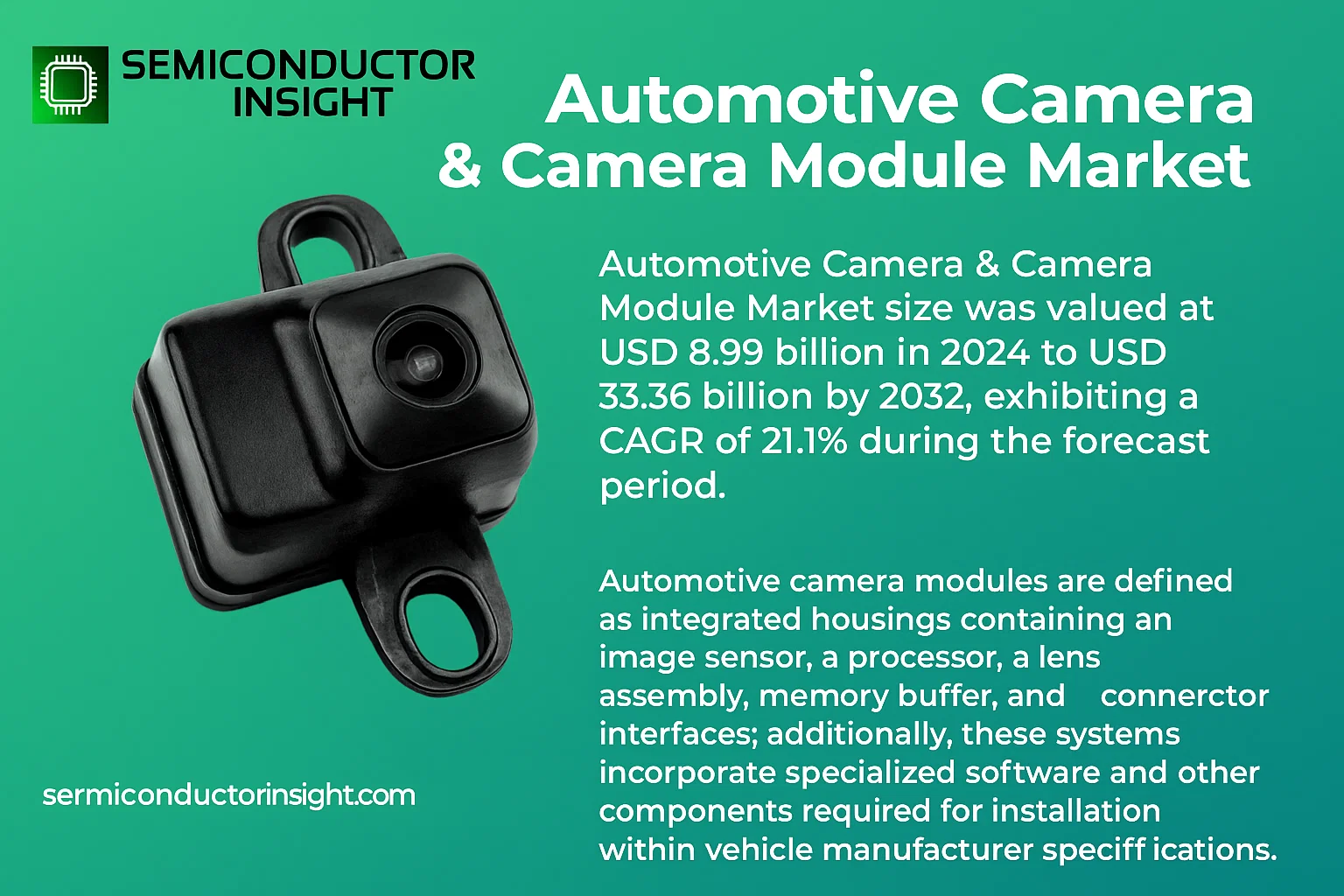
Global Automotive Camera & Camera Module Market size was valued at USD 8.99 billion in 2024 to USD 33.36 billion by 2032, exhibiting a CAGR of 21.1% during the forecast period.
Automotive camera modules are defined as integrated housings containing an image sensor, a processor, a lens assembly, memory buffer, and connector interfaces; additionally, these systems incorporate specialized software and other components required for installation within vehicle manufacturer specifications. These sophisticated vision systems enable critical functions including advanced driver assistance systems (ADAS), parking assistance, surround-view monitoring, and driver monitoring capabilities.
The market is experiencing robust growth driven by multiple factors, including increasing regulatory mandates for vehicle safety features, rising consumer demand for advanced safety technologies, and growing adoption of autonomous driving capabilities. Furthermore, technological advancements in image sensor resolution, night vision capabilities, and artificial intelligence integration are accelerating market expansion. Strategic initiatives by industry leaders are also contributing significantly to market development. For instance, in March 2024, Continental AG announced a partnership with Ambarella to develop next-generation ADAS solutions featuring high-resolution surround-view cameras with computer vision processing. Panasonic Corporation, Magna International Inc., Veoneer Inc., Sony Semiconductor Solutions Corporation, and ZF Friedrichshafen AG represent some of the prominent players operating in this competitive landscape with diverse product portfolios.
MARKET DRIVERS
Rising Demand for Advanced Driver-Assistance Systems (ADAS)
The automotive industry is experiencing a significant shift towards autonomous driving capabilities. This has created immense demand for automotive cameras, which are fundamental sensors for systems like lane departure warning, automatic emergency braking, and adaptive cruise control. Stringent safety regulations, such as the European Union’s General Safety Regulation mandating specific ADAS features in new vehicles, are a primary force propelling market growth globally. Adoption rates are accelerating as these technologies become standard in mid-range and even entry-level vehicles.
Progression Towards Higher Vehicle Autonomy Levels
As the industry advances from Level 2 to Level 3 and higher autonomy, the number of cameras per vehicle is increasing significantly. A vehicle with Level 2 autonomy may require 5-8 cameras, while a vehicle targeting Level 3+ autonomy can utilize 10-12 cameras or more for a 360-degree surround view, driver monitoring, and robust object recognition. This exponential increase in camera count per vehicle is a powerful driver for the market’s expansion in both volume and value.
Furthermore, the consumer expectation for enhanced in-cabin experiences and convenience features, such as rear-view camera systems that have become standard in many regions, continues to drive the aftermarket and OEM integration of camera modules.
MARKET CHALLENGES
High Development and Integration Costs
Developing advanced camera modules that meet the rigorous automotive-grade standards for reliability, temperature resistance, and longevity involves significant R&D investment. The sophisticated image sensors, lenses, and processing chips required for high-performance ADAS applications are costly. Integrating these complex systems into vehicle architectures while ensuring seamless communication with other electronic control units (ECUs) presents substantial engineering and cost challenges for manufacturers.
Other Challenges
Performance in Adverse Conditions
Automotive cameras must perform reliably in diverse and challenging environmental conditions, including low light, heavy rain, fog, and direct sunlight. Ensuring consistent image quality and accurate data interpretation for critical safety systems under these variable conditions remains a significant technical hurdle.
Complex Supply Chain and Component Shortages
The market is susceptible to disruptions in the global semiconductor supply chain. Shortages of key components like image sensors and processors can delay production and increase costs, impacting the ability of manufacturers to meet the growing demand from automotive OEMs.
MARKET RESTRAINTS
Cybersecurity and Data Privacy Concerns
As vehicles become more connected and reliant on cameras that capture vast amounts of visual data, they become potential targets for cyberattacks. A compromised camera system could lead to severe safety risks or privacy breaches. The need for robust, and often expensive, cybersecurity solutions to protect these systems from unauthorized access acts as a restraint, adding complexity and cost to development.
Technical Limitations in Extreme Scenarios
Despite technological advancements, camera-based vision systems have inherent limitations. They can be momentarily blinded by direct sunlight, heavy snowfall, or mud splashes, creating a potential safety gap. While sensor fusion with radar and LiDAR is the answer, the current reliance on cameras alone for certain functions presents a restraint that the industry continues to address.
MARKET OPPORTUNITIES
Expansion of In-Cabin Monitoring Systems
The focus on interior sensing presents a major growth opportunity. Driver monitoring systems (DMS) that detect drowsiness or distraction are becoming a regulatory requirement in some regions. Furthermore, interior cameras are being developed for occupant monitoring, child presence detection, and gesture control, opening up new application areas beyond external ADAS functions. This expansion significantly increases the total available market for camera modules per vehicle.
Advancements in Camera Technology
The development of higher-resolution sensors, thermal imaging cameras, and event-based vision sensors offers substantial opportunities. These technologies provide superior performance in challenging conditions, such as night driving or adverse weather, enhancing the reliability of ADAS. The integration of artificial intelligence for real-time image processing directly within the camera module is another key trend, enabling faster decision-making and reducing latency for autonomous functions.
Automotive Camera & Camera Module Market Trends
Explosive Growth Fueled by Safety and Autonomy
Global automotive camera and camera module market is experiencing a period of significant expansion, driven by the increasing integration of advanced driver-assistance systems (ADAS) and the push toward higher levels of vehicle automation. Valued at approximately USD 8,990 million in 2024, the market is projected to surge to USD 33,360 million by 2032, representing a compound annual growth rate (CAGR) of 21.1%. This robust growth trajectory is underpinned by stringent government safety regulations mandating features like rearview cameras and the rising consumer demand for vehicles equipped with enhanced safety and convenience features. An automotive camera module is defined as a housing containing an image sensor, a processor, a lens, a buffer, and connector points, forming a critical component for these systems.
Other Trends
Consolidation of Market Leadership
The competitive landscape is characterized by a high degree of consolidation, with the top five manufacturers including Panasonic, Veoneer, Magna, Sony, and ZF TRW collectively holding over 50% of the global market share. This concentration of market power among a few key players highlights the significant capital investment and technological expertise required to compete effectively. These companies are continuously investing in research and development to enhance image quality, reduce module size, and improve reliability, which are key differentiators in this highly competitive space.
Dominance of Rear Camera Modules and Passenger Car Segment
In terms of product segmentation, the Rear Camera Module is the largest segment, accounting for approximately 32% of the market. This dominance is a direct result of safety regulations in many regions requiring rearview cameras as standard equipment. Regarding application, the Passenger Car segment is the largest consumer of camera modules, followed closely by SUVs. The high production volumes of passenger cars and the increasing fitment of multiple camera systems in premium and mid-range models are primary drivers for this segment’s leadership.
Regional Market Dynamics and Future Outlook
Geographically, the market shows varied dynamics. Asia is a dominant force, driven by high vehicle production in China, Japan, and South Korea, alongside growing safety awareness. North America and Europe also represent significant markets, propelled by regulatory mandates and high consumer adoption of ADAS. The future of the market hinges on the evolution of autonomous driving technology, which will necessitate even more sophisticated camera systems, including high-resolution stereo cameras and thermal imaging cameras, to enable complex object recognition and scene interpretation in all driving conditions.
COMPETITIVE LANDSCAPE
Key Industry Players
Consolidated Market Leadership Drives Innovation in ADAS and Autonomous Driving
Global Automotive Camera & Camera Module market is characterized by a high degree of consolidation, where the top five manufacturers collectively command over 50% of the market share. Prominent leaders such as Panasonic, Veoneer, Magna, Sony, and ZF TRW have established strong positions through their extensive product portfolios, significant investment in research and development for advanced driver-assistance systems (ADAS), and established relationships with major global automakers. The technological focus is on enhancing image sensor resolution, improving low-light performance, and developing more compact and robust camera modules for critical applications like surround-view systems and driver monitoring. This concentration of market power among a few large players creates high barriers to entry, fostering an environment of intense competition primarily based on technological innovation, product reliability, and cost-effectiveness at scale.
Beyond the dominant players, a second tier of significant suppliers contributes to the dynamic competitive environment by focusing on specific niches or regional markets. Companies such as Continental, Bosch, and Valeo leverage their broader automotive electronics expertise to offer integrated vision systems. Specialized manufacturers like LG Innotek, SEMCO, and MCNEX are key players in the supply chain, providing high-volume manufacturing capabilities. Furthermore, companies including Aptiv, Mobis, and Tung Thih have carved out significant roles, often securing contracts with specific OEMs or specializing in particular camera types, such as rear-view or side-view modules. These niche players drive competition through supply chain agility, customization, and cost-optimized solutions, particularly for mid-range vehicle segments.
List of Key Automotive Camera & Camera Module Companies Profiled
- Magna
- Panasonic
- Sony
- Valeo
- ZF TRW
- MCNEX
- LG Innotek
- Continental
- Veoneer
- SEMCO
- Sharp
- Bosch
- Tung Thih
- Power Logics
- Sekonix
- Aptiv
- Mobis
Segment Analysis:
| Segment Category | Sub-Segments | Key Insights |
| By Type |
|
Rear Camera Module has emerged as the dominant segment, primarily driven by widespread global regulations mandating rearview visibility systems for enhanced safety. Its market leadership is further solidified by its role as the foundational technology for parking assistance, making it a standard feature across numerous vehicle tiers. The segment benefits from continuous innovation, with integration into advanced driver-assistance systems contributing to sustained demand. This position is expected to be maintained as feature enhancements and cost reductions make the technology increasingly accessible. |
| By Application |
|
Passenger Car application represents the most significant market segment due to the sheer volume of global vehicle production and the rapid adoption of advanced safety and convenience features in this category. The segment’s leadership is fueled by consumer demand for enhanced safety systems and the integration of cameras into infotainment and autonomous driving functionalities. The high degree of customization and feature differentiation available in passenger cars creates diverse and sustained demand for various camera modules, from basic rearview systems to sophisticated multi-camera setups for surround-view monitoring. |
| By End User |
|
OEMs (Original Equipment Manufacturers) constitute the dominant end-user segment, as the vast majority of camera modules are integrated into vehicles during the manufacturing process. This leadership is attributed to the seamless integration, reliability, and warranty support associated with factory-installed systems. The push towards higher levels of vehicle autonomy and stringent safety regulations directly influences OEM specifications, making advanced camera systems a critical component of new vehicle design. The trend of bundling camera features with other ADAS packages further entrenches OEMs as the primary channel. |
| By Vehicle Electrification |
|
Battery Electric Vehicles (BEVs) are increasingly becoming a critical and high-growth segment for camera module adoption. BEVs are often positioned as technology flagships, leading to a higher standard inclusion of advanced camera systems for safety, autonomous driving capabilities, and user experience features like bird’s-eye view. The native integration of sophisticated electronic architectures in BEVs facilitates the seamless incorporation of multiple high-resolution cameras, making this segment a key driver for innovation and premium camera module integration. |
| By Technology Level |
|
Surround-View Systems represent the leading edge of technology adoption, driving significant value growth in the market. This segment’s prominence is fueled by the superior safety and convenience it offers, providing drivers with a composite 360-degree view of their vehicle’s surroundings. The complexity of integrating multiple camera feeds and processing the data positions this as a high-value segment for manufacturers. As autonomous driving functionalities advance, the demand for these sophisticated systems is expected to accelerate, making them a focal point for research and development efforts across the industry. |
Regional Analysis: Automotive Camera & Camera Module Market
The region’s dominance is anchored in its unparalleled electronics manufacturing ecosystem. Countries like China, Taiwan, and South Korea host the world’s leading semiconductor and sensor fabs, enabling efficient, high-volume production of camera modules. This integrated supply chain, from raw materials to finished goods, provides significant cost and speed advantages, making Asia-Pacific the primary global supplier.
Government mandates for ADAS features like autonomous emergency braking and lane departure warning are a primary growth driver. Combined with a highly tech-savvy consumer base that actively demands advanced safety and convenience features, this creates a powerful, sustained pull for camera integration in both domestic and exported vehicles.
Significant investments are being made in R&D for next-generation camera technologies, including higher-resolution sensors, thermal imaging, and sophisticated image processing software for object recognition. The collaborative environment between leading automotive OEMs and tech giants in the region fosters rapid innovation and the early adoption of new camera applications.
Major players in Asia-Pacific are not only catering to domestic demand but are also strategically expanding their global footprint through exports and partnerships. This outward expansion allows them to leverage their scale and technological expertise to capture market share in other regions, further cementing their influential role in the global market landscape.
North America
North America represents a highly mature and technologically advanced market for automotive cameras, characterized by strong consumer demand for safety and a robust regulatory framework. High disposable income levels drive the adoption of premium vehicles equipped with multiple camera systems for parking assistance, surround-view, and advanced ADAS functionalities. The region is a key hub for autonomous vehicle development, with significant investments from both traditional automakers and technology companies, creating a strong pull for sophisticated camera modules capable of supporting higher levels of automation. Stringent safety ratings from organizations like the IIHS and NHTSA regulations encourage the standardization of camera-based safety systems across vehicle segments.
Europe
The European market is heavily influenced by stringent regional safety regulations, such as the General Safety Regulation, which mandates specific camera-based ADAS features on all new vehicles. This regulatory push ensures a consistent and high baseline demand for camera modules. European premium and luxury automakers are at the forefront of integrating high-resolution, multi-camera systems for enhanced safety and autonomous driving capabilities. The region also exhibits a strong focus on innovation, with leading Tier-1 suppliers and automakers developing advanced image processing algorithms and specialized cameras for challenging weather conditions, ensuring robust performance and reliability.
South America
The Automotive Camera & Camera Module market in South America is in a growth phase, with adoption primarily concentrated in the premium vehicle segment. Economic factors play a significant role, limiting widespread penetration across all vehicle classes. However, increasing awareness of safety benefits and gradual regulatory developments are encouraging uptake. The market is largely supplied by imports from Asia and North America, with local manufacturing still developing. Growth is expected to be steady as economic conditions stabilize and regional safety standards evolve to encourage broader adoption of basic camera systems for applications like rearview cameras.
Middle East & Africa
This region presents a diverse and emerging market landscape. Wealthier Gulf Cooperation Council (GCC) countries show strong demand for luxury vehicles, which are typically equipped with advanced camera systems, driving the high-end segment of the market. In contrast, broader adoption across the region is slower, influenced by economic variability and less stringent vehicle safety regulations. The harsh environmental conditions, including dust and extreme temperatures, create specific requirements for camera module durability and reliability. The market is primarily import-dependent, with potential for growth as regional economic development continues and safety awareness increases.
Report Scope
This market research report provides a comprehensive analysis of the Automotive Camera & Camera Module Market , covering the forecast period 2025–2032. It offers detailed insights into market dynamics, technological advancements, competitive landscape, and key trends shaping the industry.
Key focus areas of the report include:
- Market Overview: The report begins with an overview outlining its current market scenario, key growth indicators, and industry transformation drivers. It discusses macroeconomic factors, demand–supply balance, regulatory landscape, and the strategic role of semiconductors in powering advancements across industries such as automotive, telecommunications, consumer electronics, and industrial automation.
- Market Size & Forecast: Historical data and future projections for revenue, unit shipments, and market value across major regions and segments.
- Segmentation Analysis: Detailed breakdown by product type, technology, application, and end-user industry to identify high-growth segments and investment opportunities.
- Regional Insights: Insights into market performance across North America, Europe, Asia-Pacific, Latin America, and the Middle East & Africa, including country-level analysis where relevant.
- Competitive Landscape: Profiles of leading market participants, including their product offerings, R&D focus, manufacturing capacity, pricing strategies, and recent developments such as mergers, acquisitions, and partnerships.
- Technology Trends & Innovation: Assessment of emerging technologies, integration of AI/IoT, semiconductor design trends, fabrication techniques, and evolving industry standards.
- Market Drivers & Restraints: Evaluation of factors driving market growth along with challenges, supply chain constraints, regulatory issues, and market-entry barriers.
- Stakeholder Insights: Insights for component suppliers, OEMs, system integrators, investors, and policymakers regarding the evolving ecosystem and strategic opportunities.
Primary and secondary research methods are employed, including interviews with industry experts, data from verified sources, and real-time market intelligence to ensure the accuracy and reliability of the insights presented.
FREQUENTLY ASKED QUESTIONS:
What is the current market size of Automotive Camera & Camera Module Market?
-> Automotive Camera & Camera Module Market size was valued at USD 8.99 billion in 2024 to USD 33.36 billion by 2032, exhibiting a CAGR of 21.1% during the forecast period.
Which key companies operate in Automotive Camera & Camera Module Market?
-> Key players include Panasonic, Veoneer, Magna, Sony, ZF TRW, Valeo, MCNEX, LG Innotek, Continental, and SEMCO, among others. Global top five manufacturers hold a share over 50%.
What are the key growth drivers?
-> Key growth drivers include increasing vehicle safety regulations, rising demand for advanced driver assistance systems (ADAS), and the growing adoption of autonomous driving technologies.
Which region dominates the market?
-> Asia is a significant market, with key countries including China, Japan, and South Korea, while North America and Europe are also major regions with established automotive industries.
What are the emerging trends?
-> Emerging trends include the integration of higher resolution cameras, the development of surround-view camera systems, and the increasing use of cameras for interior monitoring and driver-state analysis.

Get Sample Report PDF for Exclusive Insights
Report Sample Includes
- Table of Contents
- List of Tables & Figures
- Charts, Research Methodology, and more...
 Download Sample Report PDF