Automotive AI Semiconductor Market Insights
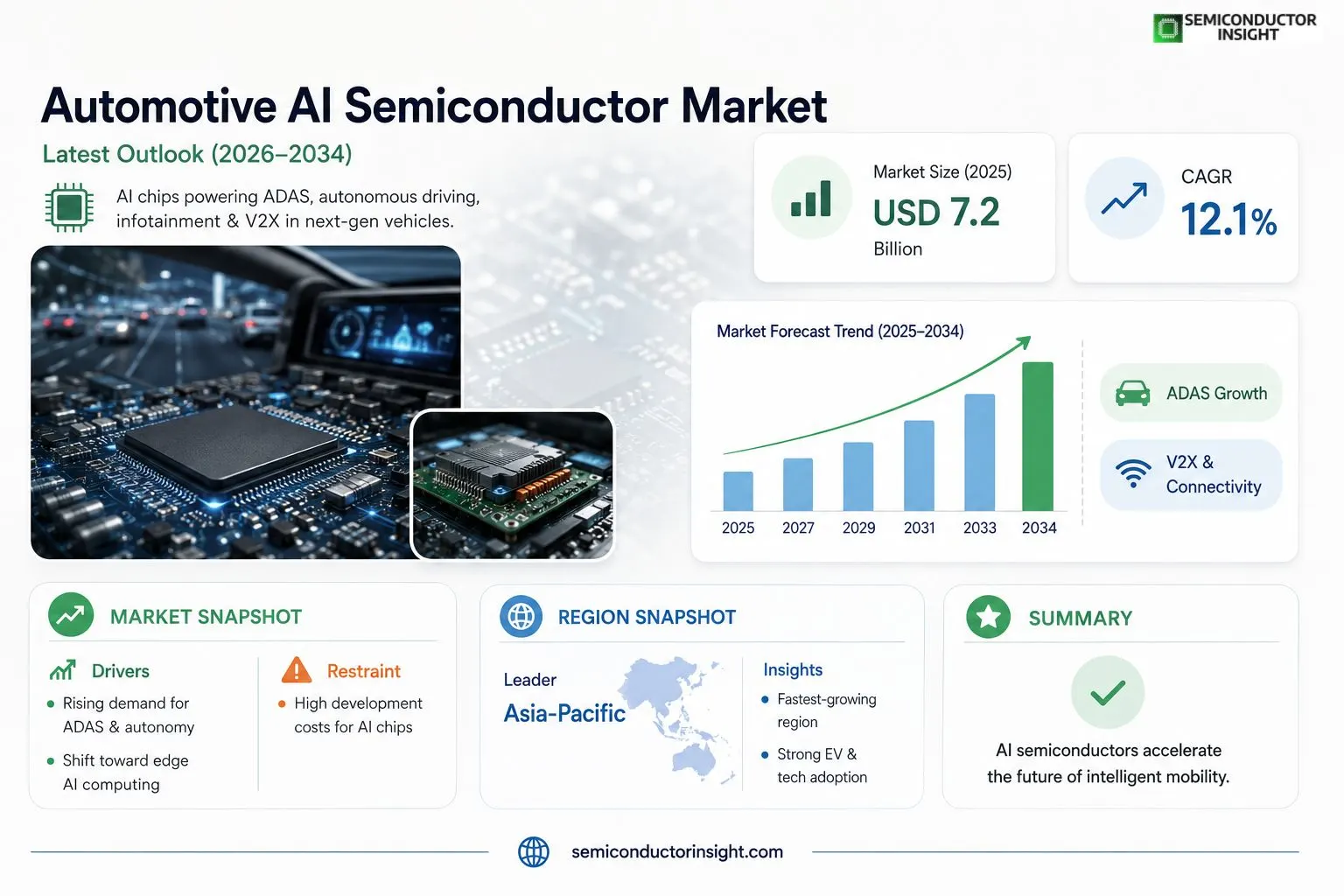
Global automotive AI semiconductor market size was valued at USD 7.2 billion in 2025. The market is projected to grow from USD 7.8 billion in 2026 to USD 31.4 billion by 2034, exhibiting a CAGR of 12.1% during the forecast period.
Automotive AI semiconductors are specialized integrated circuits designed to enable advanced driver‑assistance systems (ADAS), autonomous driving functions, infotainment, and vehicle‑to‑everything (V2X) communications. These chips combine high‑performance compute cores, neural‑network accelerators, and low‑power sensor interfaces to process massive streams of camera, radar, lidar, and ultrasonic data in real time.The market is experiencing rapid growth because vehicle manufacturers are accelerating electrification and autonomy roadmaps while regulators tighten safety standards worldwide. However, supply‑chain constraints for advanced silicon and the high cost of development pose challenges. Furthermore, strategic collaborations,such as NVIDIA’s partnership with Mercedes‑Benz on the DRIVE Orin platform and Qualcomm’s alliance with Hyundai Motor Group for Snapdragon Ride,are fueling adoption. Key players including Intel (Mobileye), NXP Semiconductors, Renesas Electronics, and Tesla’s custom Dojo processor continue expanding their portfolios to meet escalating demand.
MARKET DRIVERS
Rising Demand for Advanced Driver‑Assistance Systems (ADAS)
Automakers are integrating increasingly sophisticated ADAS functions, which require high‑performance AI chips to process sensor data in real time. This surge in vehicle connectivity fuels growth in Automotive AI Semiconductor Market, as manufacturers seek processors that can support lane‑keeping, adaptive cruise control, and emergency braking.
Shift Toward Edge‑Based Computing
Edge computing reduces latency by performing inference directly within the vehicle, eliminating reliance on cloud links. **Silicon designers** are therefore prioritizing low‑power, high‑density AI accelerators, a trend that directly propels market expansion.
➤ Manufacturers that adopt heterogeneous integration techniques can achieve up to 30% better energy efficiency, accelerating the rollout of autonomous features.
Combined with supportive OEM roadmaps, these drivers create a robust pipeline of orders, positioning Automotive AI Semiconductor Market for sustained double‑digit growth through the next decade.
MARKET CHALLENGES
Regulatory and Safety Certification Hurdles
Stringent safety standards such as ISO 26262 and upcoming functional‑safety mandates increase development cycles and validation costs for AI chips, slowing time‑to‑market for new semiconductor solutions.
Other Challenges
Supply‑Chain Volatility
Global semiconductor shortages and geopolitical tensions can disrupt component availability, forcing automotive OEMs to hold higher inventories and impacting price stability.
MARKET RESTRAINTS
High Development Costs for AI‑Optimized Chips
Designing AI‑centric semiconductor platforms requires extensive R&D investment, proprietary IP, and advanced fabrication nodes. These capital‑intensive requirements limit participation to a few large players, constraining market diversification.
MARKET OPPORTUNITIES
Emergence of 5G‑Enabled V2X Communications
The rollout of 5G creates new bandwidth for vehicle‑to‑everything (V2X) interactions, demanding AI semiconductors capable of real‑time decision‑making at the edge. Companies that can integrate 5G modems with AI accelerators are poised to capture a significant share of upcoming contracts.
Automotive AI Semiconductor Market Trends
Accelerating Adoption of High‑Performance Compute in Vehicles
The automotive sector is integrating increasingly sophisticated AI semiconductor solutions to meet the growing demand for advanced driver‑assistance systems and autonomous functions. Modern chips combine high‑throughput compute cores, dedicated neural‑network accelerators, and ultra‑low‑power sensor interfaces, allowing real‑time processing of data streams from cameras, radar, lidar, and ultrasonic sensors. This integration supports seamless V2X communication, richer infotainment experiences, and more robust safety mechanisms, positioning Automotive AI Semiconductor Market as a critical enabler of next‑generation vehicle intelligence.
Other Trends
Supply‑Chain Bottlenecks
Production of advanced silicon is constrained by limited fab capacity and the complexity of integrating heterogeneous components on a single die. Manufacturers face longer lead times and higher component costs, which slow the rollout of AI‑enabled platforms across model line‑ups. Moreover, the need for stringent automotive‑grade reliability testing adds further pressure on component availability, prompting OEMs to secure long‑term supply agreements and explore alternative packaging technologies.
Strategic Partnerships Driving Ecosystem Expansion
Collaborations between chip makers and vehicle manufacturers are reshaping the competitive landscape. Notable examples include NVIDIA’s partnership with Mercedes‑Benz on the DRIVE Orin platform and Qualcomm’s alliance with Hyundai Motor Group for the Snapdragon Ride solution. These joint efforts accelerate integration timelines, leverage shared R&D resources, and create standardized software stacks for autonomous driving workloads. Key players such as Intel (Mobileye), NXP Semiconductors, Renesas Electronics, and Tesla’s custom Dojo processor are also expanding their portfolios, reinforcing the momentum of Automotive AI Semiconductor Market through diversified product roadmaps and cross‑industry ecosystems.
COMPETITIVE LANDSCAPEKey Industry Players
Automotive AI Semiconductor Market – Competitive Overview
The market is dominated by a handful of technology powerhouses that combine deep automotive expertise with advanced silicon design. NVIDIA leads with its DRIVE Orin platform, leveraging high‑performance GPU cores and dedicated neural‑network accelerators for autonomous driving. Intel’s Mobileye, backed by years of vision‑based ADAS experience, provides system‑on‑chip solutions that integrate perception and decision‑making. Qualcomm’s Snapdragon Ride series offers a robust compute‑fabric for sensor fusion, while Samsung Electronics supplies memory‑centric AI chips that address the data‑intensive workloads of next‑gen vehicles. These incumbents benefit from strategic OEM partnerships, extensive IP portfolios, and the financial resources to sustain long development cycles, shaping a market structure that is concentrated but rapidly evolving.Beyond the headline players, a vibrant cohort of niche specialists contributes critical capabilities. NXP Semiconductors and Renesas Electronics focus on automotive‑grade microcontrollers and radar front‑ends, ensuring reliable sensor interfacing. STMicroelectronics and Infineon Technologies deliver power‑efficient mixed‑signal ASICs for V2X communications. Texas Instruments and ON Semiconductor supply analog and power management solutions that complement AI compute blocks. Emerging contributors such as AMD (through Xilinx FPGA platforms), MediaTek, and Huawei’s HiSilicon bring customizable programmable logic and cost‑effective AI accelerators, enabling smaller OEMs and Tier‑1 suppliers to differentiate their offerings.
List of Key Automotive AI Semiconductor Companies Profiled
- NVIDIA Corporation
- Intel (Mobileye)
- Qualcomm Inc.
- Samsung Electronics
- NXP Semiconductors
- Renesas Electronics
- STMicroelectronics
- Infineon Technologies
- Texas Instruments
- ON Semiconductor
- AMD (Xilinx)
- MediaTek Inc.
- Huawei HiSilicon
- Tesla (Dojo Custom Processor)
- Broadcom Inc.
Segment Analysis:
| Segment Category | Sub-Segments | Key Insights |
| By Type |
|
Neural‑network accelerators
|
| By Application |
|
ADAS & FSD platforms
|
| By End User |
|
OEMs
|
| By Architecture |
|
System‑on‑Chip (SoC) solutions
|
| By Integration Level |
|
Co‑located with sensors
|
Regional Analysis: North America
North America
North America boasts a vibrant innovation ecosystem, with leading research institutions, venture capital firms, and a strong talent pool dedicated to advancing Automotive AI Semiconductor technologies. This collaborative environment fosters the development of cutting-edge solutions and accelerates market adoption.
ADAS & Autonomous DrivingThe adoption of Advanced Driver-Assistance Systems (ADAS) and the pursuit of autonomous driving are primary drivers of semiconductor demand in North America. Stringent safety regulations and consumer preference for enhanced vehicle safety features are propelling this trend.
The demand for sophisticated in-car infotainment systems and robust connectivity solutions is significantly impacting Automotive AI Semiconductor Market. Consumers are increasingly expecting seamless integration of digital services, requiring advanced processing power and connectivity capabilities.
The rapid growth of the electric vehicle market in North America is a key factor driving demand for specialized semiconductors optimized for EV powertrains, battery management systems, and charging infrastructure.
Europe
Europe is experiencing a steady expansion in Automotive AI Semiconductor Market, driven by stringent environmental regulations and a growing focus on sustainable mobility. The region’s automotive industry is heavily invested in electrification and autonomous driving, creating significant opportunities for semiconductor suppliers. European OEMs are collaborating with technology providers to develop innovative solutions for reducing emissions and enhancing vehicle safety. The push towards connected vehicles further fuels the demand for advanced semiconductor components.
Asia-Pacific
Asia-Pacific is emerging as the fastest-growing region in Automotive AI Semiconductor Market, particularly China. The region’s robust automotive production, coupled with supportive government policies and a rapidly expanding electric vehicle market, is fueling substantial demand for semiconductors. China’s ambitious plans for autonomous driving and connected vehicles are creating a fertile ground for innovation and investment.
South America
South America represents a relatively nascent market for Automotive AI Semiconductors, with growth potential tied to increasing automotive production and a gradual adoption of advanced technologies. The region is witnessing a growing interest in electric vehicles, particularly in Brazil and Argentina. Government initiatives aimed at promoting local manufacturing and technological development are expected to drive future growth.
Middle East & Africa
The Middle East & Africa region presents a moderate growth opportunity for Automotive AI Semiconductor Market. The automotive sector in these regions is steadily expanding, driven by rising disposable incomes and increasing urbanization. The demand for connected car features and safety technologies is gaining traction. Government investments in infrastructure projects and smart city initiatives are also contributing to market growth.
Report Scope
This market research report provides a comprehensive analysis of the Automotive AI Semiconductor Market , covering the forecast period 2026–2034. It offers detailed insights into market dynamics, technological advancements, competitive landscape, and key trends shaping the industry.
Key focus areas of the report include:
- Market Overview: The report begins with an overview outlining its current market scenario, key growth indicators, and industry transformation drivers. It discusses macroeconomic factors, demand–supply balance, regulatory landscape, and the strategic role of semiconductors in powering advancements across industries such as automotive, telecommunications, consumer electronics, and industrial automation.
- Market Size & Forecast: Historical data and future projections for revenue, unit shipments, and market value across major regions and segments.
- Segmentation Analysis: Detailed breakdown by product type, technology, application, and end-user industry to identify high-growth segments and investment opportunities.
- Regional Insights: Insights into market performance across North America, Europe, Asia-Pacific, Latin America, and the Middle East & Africa, including country-level analysis where relevant.
- Competitive Landscape: Profiles of leading market participants, including their product offerings, R&D focus, manufacturing capacity, pricing strategies, and recent developments such as mergers, acquisitions, and partnerships.
- Technology Trends & Innovation: Assessment of emerging technologies, integration of AI/IoT, semiconductor design trends, fabrication techniques, and evolving industry standards.
- Market Drivers & Restraints: Evaluation of factors driving market growth along with challenges, supply chain constraints, regulatory issues, and market-entry barriers.
- Stakeholder Insights: Insights for component suppliers, OEMs, system integrators, investors, and policymakers regarding the evolving ecosystem and strategic opportunities.
Primary and secondary research methods are employed, including interviews with industry experts, data from verified sources, and real-time market intelligence to ensure the accuracy and reliability of the insights presented.
FREQUENTLY ASKED QUESTIONS:
What is the current market size of Automotive AI Semiconductor Market?
-> Automotive AI Semiconductor Market was valued at USD 7.2 billion in 2025 and is expected to reach USD 31.4 billion by 2034.
Which key companies operate in Automotive AI Semiconductor Market?
-> Key players include Intel (Mobileye), NXP Semiconductors, Renesas Electronics, Tesla, NVIDIA, Qualcomm, among others.
What are the key growth drivers?
-> Key growth drivers include accelerating vehicle electrification, autonomy roadmaps, stringent safety regulations, increasing demand for ADAS and V2X communications, and strategic collaborations among chipmakers and OEMs.
Which region dominates the market?
-> Asia-Pacific is the fastest-growing region, while North America remains the largest market.
What are the emerging trends?
-> Emerging trends include integration of AI accelerators, edge computing for autonomous driving, advanced 3nm/2nm process technologies, and a focus on low‑power, high‑performance solutions for V2X and sensor‑fusion applications.
Get Sample Report PDF for Exclusive Insights
Report Sample Includes
- Table of Contents
- List of Tables & Figures
- Charts, Research Methodology, and more...
 Download Sample Report PDF