Automotive AI Processor Market Insights
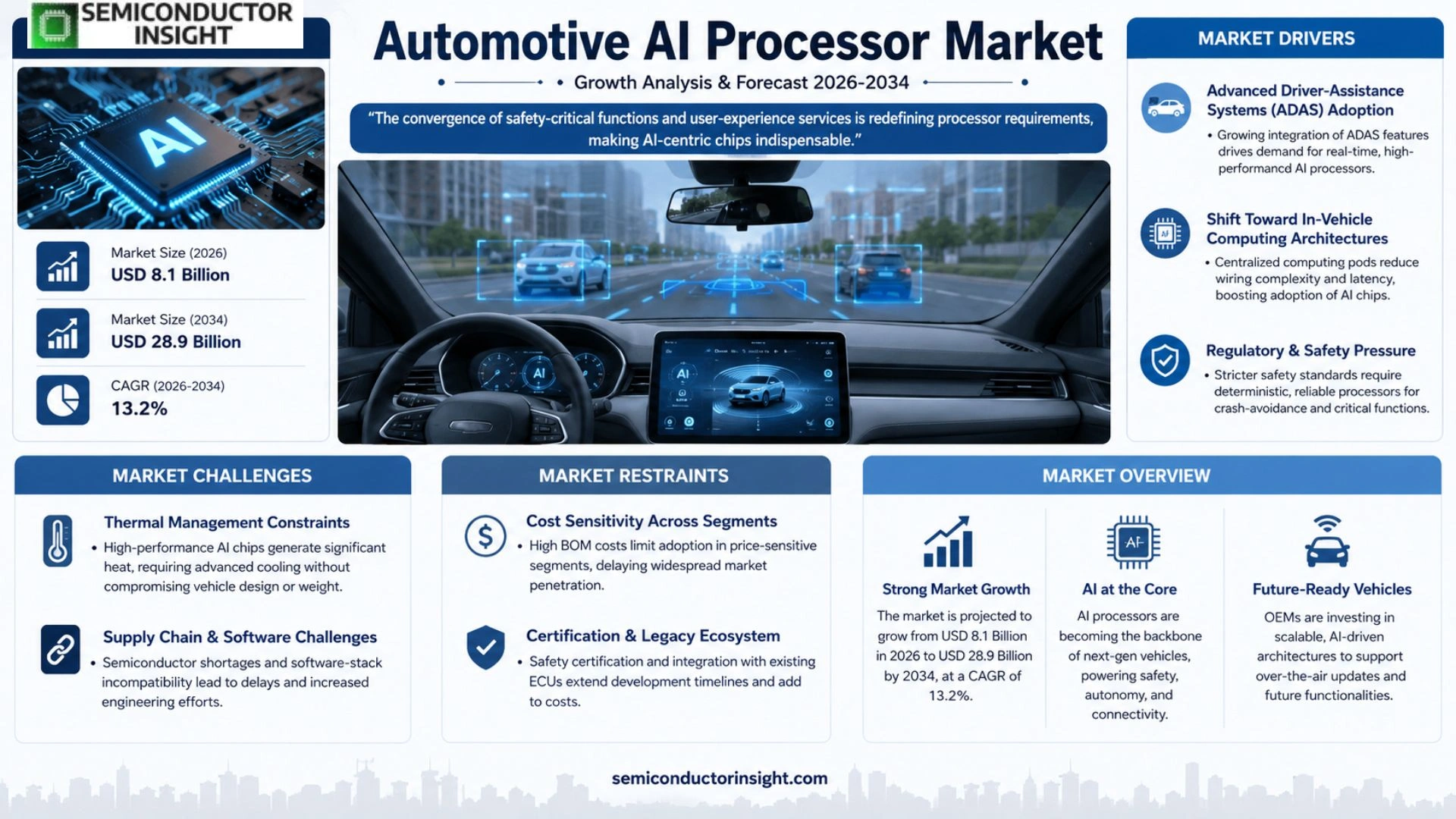
Global Automotive AI Processor market size was valued at USD 7.3 billion in 2025. The market is projected to grow from USD 8.1 billion in 2026 to USD 28.9 billion by 2034, exhibiting a CAGR of 13.2% during the forecast period.
Automotive AI processors are purpose‑built semiconductor chips that run machine‑learning workloads inside vehicles. They power perception stacks, sensor fusion and decision‑making needed for advanced driver‑assistance systems (ADAS) and higher levels of autonomy while keeping latency low and power consumption manageable.
The growth curve reflects expanding deployment of level‑3/4 autonomous features, tighter safety mandates requiring on‑board analytics, and rising consumer demand for intelligent infotainment experiences. Recent collaborations,such as Nvidia’s partnership with Toyota announced in June 2024 to embed the DRIVE Orin platform,speed ecosystem adoption. Core players like Qualcomm Snapdragon Ride, Intel Mobileye EyeQ series and Huawei Ascend chips continue broadening their offerings alongside emerging firms focused on edge‑AI efficiency.
MARKET DRIVERS
Advanced Driver‑Assistance Systems (ADAS) Adoption
OEMs are integrating increasingly sophisticated ADAS functions,such as lane‑keeping, adaptive cruise control, and predictive emergency braking,into new vehicle platforms. These features demand on‑board processors capable of real‑time inference, pushing manufacturers toward dedicated AI silicon rather than legacy microcontrollers. Performance margins and power‑efficiency ratios have become decisive criteria in component selection.
Shift Toward In‑Vehicle Computing Architectures
Recent vehicle architectures favor centralized computing pods that host multiple workloads, from infotainment to sensor fusion. Consolidating these workloads onto a single AI processor reduces wiring complexity and improves latency, creating a clear incentive for suppliers to market high‑throughput, multi‑core designs. This trend also aligns with automakers’ ambition to future‑proof platforms for over‑the‑air updates.
➤ “The convergence of safety‑critical functions and user‑experience services is redefining processor requirements, making AI‑centric chips indispensable.”
Regulatory pressure to meet stricter safety standards further accelerates the move to AI‑enabled hardware. When crash‑avoidance systems rely on deterministic processing times, manufacturers turn to processors specifically engineered for deterministic latency, thereby reinforcing demand for specialized AI chips within Automotive AI Processor Market.
MARKET CHALLENGES
Thermal Management Constraints
High‑performance AI processors generate considerable heat, yet the vehicle cabin imposes strict limits on allowable temperature rise. Designers must balance computational capability with cooling solutions that do not compromise vehicle packaging or add excessive weight. Failure to resolve this trade‑off can delay model roll‑out schedules.
Other Challenges
Supply‑Chain Vulnerabilities
The semiconductor ecosystem remains sensitive to raw‑material shortages and geopolitical tensions. Fluctuations in wafer fab capacity translate into longer lead times for automotive‑grade AI chips, forcing OEMs to adopt conservative inventory strategies that may dampen short‑term demand.
Software‑stack compatibility also poses a hurdle; legacy automotive software often lacks the interfaces required to exploit the full potential of modern AI processors, necessitating substantial engineering effort to bridge the gap.
MARKET RESTRAINTS
Cost Sensitivity Across Vehicle Segments
While premium models can absorb the added expense of cutting‑edge AI silicon, volume‑sensitive segments such as compact cars and emerging markets remain highly price‑driven. The incremental bill‑of‑materials (BOM) cost associated with advanced processors can erode profit margins, prompting manufacturers to defer adoption until economies of scale lower unit prices.
The certification process for automotive safety standards (e.g., ISO 26262) adds another layer of restraint. Achieving functional safety compliance for a new processor architecture involves extensive validation cycles, which can extend time‑to‑market and increase development budgets.
Finally, legacy ECU (Electronic Control Unit) ecosystems in many existing fleets create inertia; retrofitting AI processors into older platforms is technically complex and often deemed uneconomical, limiting the addressable market for immediate upgrades.
MARKET OPPORTUNITIES
Edge‑AI for Predictive Maintenance
Emerging use‑cases that run diagnostic models directly on the vehicle enable real‑time wear‑prediction for critical components. By processing sensor streams at the edge, manufacturers can offer subscription‑based maintenance services, opening a recurring‑revenue stream that justifies investment in more capable AI processors.
Integration with 5G‑Enabled V2X Networks
The rollout of 5G connectivity facilitates vehicle‑to‑everything (V2X) communications, demanding on‑board processors that can fuse external data with internal sensor inputs instantly. Companies that position their chips as the hub for V2X analytics stand to capture a sizable slice of the next wave of connected‑car services.
Furthermore, the rise of autonomous driving pilots in controlled environments (e.g., logistics hubs, campuses) creates a testing ground for high‑density AI workloads. Suppliers that deliver scalable, modular processor families can lock in early partnerships, leveraging pilot successes to expand into broader passenger‑vehicle segments.
Automotive AI Processor Market Trends
Edge‑AI Becomes Central to ADAS Evolution
The shift from host‑CPU reliance to dedicated automotive AI processors reflects a practical response to the latency and power constraints of advanced driver‑assistance systems. By embedding machine‑learning inference directly on a silicon platform tuned for automotive temperatures, OEMs can execute perception and sensor‑fusion workloads within milliseconds, a prerequisite for reliable Level‑3 and Level‑4 features. This technical advantage also aligns with tightening safety regulations that now demand on‑board analytics capable of independent decision making. Consequently, vehicle architects are redesigning electronic architectures around these processors, reducing reliance on external compute resources and simplifying software integration across infotainment, navigation, and safety domains.
Other Trends
Integration of Automotive‑Specific GPUs
Automotive‑grade graphics processing units are being merged with AI cores to address the dual need for visual rendering and real‑time object classification. Manufacturers such as Qualcomm and Intel have introduced SoCs that couple high‑throughput GPU pipelines with neural‑network accelerators, allowing a single chip to drive both the cockpit experience and autonomous perception. The convergence reduces board count, eases thermal management, and offers a unified development stack, which shortens time‑to‑market for new infotainment features that rely on AI‑enhanced voice and gesture controls.
Strategic Alliances Accelerating Deployment
Recent partnership announcements illustrate how ecosystem collaboration is fast‑tracking adoption. Nvidia’s June 2024 agreement with Toyota to embed the DRIVE Orin platform exemplifies a model where a chipset supplier supplies a turnkey AI solution while the automaker integrates it across multiple vehicle families. Similar joint efforts between Huawei and several Chinese OEMs, and the expansion of Mobileye’s EyeQ series through co‑development programs, create a feedback loop: more data from production vehicles refines algorithms, which in turn justifies larger silicon investments. For suppliers, this translates into predictable volume pipelines; for carmakers, it delivers differentiated ADAS capabilities without the overhead of building custom silicon from scratch.
COMPETITIVE LANDSCAPE
Key Industry Players
Automotive AI Processor Market: Competitive Overview
Nvidia remains the dominant force, leveraging its DRIVE Orin architecture to secure multiple OEM contracts, including the recent integration with Toyota’s next‑generation vehicle platforms. The company’s ability to combine high‑performance GPU cores with dedicated tensor accelerators has created a de‑facto standard for level‑3 and level‑4 autonomy solutions. This leadership has forced smaller rivals to specialize, prompting a tiered market where a handful of silicon giants dominate the high‑end segment while a growing cohort of edge‑focused firms target cost‑sensitive models and infotainment‑centric workloads.
Beyond the headline names, a diverse set of manufacturers is shaping the ecosystem. Qualcomm’s Snapdragon Ride platform offers a compelling balance of compute density and power efficiency for mid‑range ADAS, while Intel’s Mobileye EyeQ series continues to deepen its sensor‑fusion capabilities through aggressive firmware updates. Huawei’s Ascend line and Samsung’s Exynos Auto chipsets are expanding their global footprint by aligning with Chinese and European carmakers. Emerging contenders such as Horizon Robotics, Valeo, and NXP Semiconductors emphasize ultra‑low‑latency designs for cockpit AI and vehicle‑to‑anything (V2X) communications. The overall competitive picture is one of strategic partnerships, differentiated product roadmaps, and a clear push toward in‑vehicle AI that can operate under stringent thermal and power budgets.
List of Key Automotive AI Processor Companies Profiled
- Nvidia Corporation
- Qualcomm Inc.
- Intel Corporation (Mobileye)
- Huawei Technologies Co., Ltd.
- Samsung Electronics
- Texas Instruments
- NXP Semiconductors
- Renesas Electronics
- STMicroelectronics
- Continental AG
- Valeo SA
- Horizon Robotics
- ON Semiconductor
- Advanced Micro Devices (AMD)
- Apple Inc.
Segment Analysis:
| Segment Category | Sub-Segments | Key Insights |
| By Type |
|
Domain‑specific AI processors
|
| By Application |
|
Advanced Driver Assistance Systems
|
| By End User |
|
Original Equipment Manufacturers (OEMs)
|
| By Architecture |
|
NPU‑centric
|
| By Function |
|
Perception
|
Regional Analysis: Automotive AI Processor Market
North America
A cluster of AI chip firms and research labs in California supplies most of the cutting‑edge intellectual property that powers next‑generation automotive processors. The proximity of venture capital, university talent, and automotive test sites creates a rapid prototyping cycle that translates academic breakthroughs into production‑ready silicon within months.
Leading vehicle manufacturers have signed multi‑year development agreements with processor vendors, aligning chip roadmaps with platform cycles. These joint ventures ensure that silicon performance targets are calibrated to real‑world power budgets and thermal envelopes.
Federal safety standards now require demonstrable functional safety at the silicon level, prompting designers to embed redundancy and fail‑safe mechanisms directly into AI processors. Compliance pressures accelerate the adoption of safety‑centric design methodologies.
Recent disruptions have motivated OEMs to diversify wafer fabs across North America, reducing over‑reliance on overseas foundries and shortening lead times for critical AI processor batches.
Europe
European nations combine stringent safety legislation with a strong tradition of automotive engineering, fostering a market where processor reliability is as valued as raw performance. German and French OEMs are investing heavily in in‑house AI accelerator teams, seeking to retain core IP within the continent. This approach is reinforced by EU funding programs that reward collaborations between chip designers and autonomous‑driving pilots, encouraging a steady flow of proof‑of‑concept deployments across test tracks. The result is a nuanced market where incremental improvements in processor efficiency are prized for their impact on vehicle range and emissions compliance.
Asia‑Pacific
Asia‑Pacific remains the most diverse arena for automotive AI processors, with China, Japan, and South Korea each pursuing distinct pathways. China’s policy thrust accelerates mass production of AI chips through subsidies and dedicated industrial parks, while Japanese firms leverage long‑standing expertise in sensor integration to craft processors optimized for hardware‑level safety. South Korean conglomerates prioritize integration of memory and compute, delivering highly integrated system‑on‑chip solutions that appeal to cost‑sensitive manufacturers. The regional mosaic generates a competitive pressure that pushes the global market toward both high‑volume, low‑cost designs and premium, performance‑centric platforms.
South America
In South America, emerging economies are beginning to adopt advanced driver‑assist features, prompting local automakers to source AI processors that balance cost with basic perception capabilities. Partnerships with North American chip firms are common, as they provide technology transfer while allowing regional assembly to meet tariff considerations. The market focus is on scalable architectures that can be upgraded as infrastructure for autonomous testing expands across major urban corridors.
Middle East & Africa
The Middle East and Africa exhibit a nascent but growing appetite for AI‑enabled automotive solutions, driven largely by luxury vehicle demand and a push toward smart city initiatives. Investment in data‑center proximity and 5G rollout creates an environment where edge AI processors can offload some computational load to the cloud, reducing on‑board silicon complexity. Regional authorities are also beginning to draft guidelines for autonomous vehicle operation, which will gradually shape processor safety requirements and stimulate local supplier participation.
Report Scope
This market research report provides a comprehensive analysis of the Automotive AI Processor Market , covering the forecast period 2026–2034. It offers detailed insights into market dynamics, technological advancements, competitive landscape, and key trends shaping the industry.
Key focus areas of the report include:
- Market Overview: The report begins with an overview outlining its current market scenario, key growth indicators, and industry transformation drivers. It discusses macroeconomic factors, demand–supply balance, regulatory landscape, and the strategic role of semiconductors in powering advancements across industries such as automotive, telecommunications, consumer electronics, and industrial automation.
- Market Size & Forecast: Historical data and future projections for revenue, unit shipments, and market value across major regions and segments.
- Segmentation Analysis: Detailed breakdown by product type, technology, application, and end-user industry to identify high-growth segments and investment opportunities.
- Regional Insights: Insights into market performance across North America, Europe, Asia-Pacific, Latin America, and the Middle East & Africa, including country-level analysis where relevant.
- Competitive Landscape: Profiles of leading market participants, including their product offerings, R&D focus, manufacturing capacity, pricing strategies, and recent developments such as mergers, acquisitions, and partnerships.
- Technology Trends & Innovation: Assessment of emerging technologies, integration of AI/IoT, semiconductor design trends, fabrication techniques, and evolving industry standards.
- Market Drivers & Restraints: Evaluation of factors driving market growth along with challenges, supply chain constraints, regulatory issues, and market-entry barriers.
- Stakeholder Insights: Insights for component suppliers, OEMs, system integrators, investors, and policymakers regarding the evolving ecosystem and strategic opportunities.
Primary and secondary research methods are employed, including interviews with industry experts, data from verified sources, and real-time market intelligence to ensure the accuracy and reliability of the insights presented.
FREQUENTLY ASKED QUESTIONS:
What is the current market size of Automotive AI Processor Market?
-> Automotive AI Processor market is projected to grow from USD 8.1 billion in 2026 to USD 28.9 billion by 2034
Which key companies operate in Automotive AI Processor Market?
-> Key players include Nvidia, Qualcomm (Snapdragon Ride), Intel (Mobileye EyeQ), and Huawei, among others.
What are the key growth drivers?
-> Key growth drivers include deployment of Level‑3/4 autonomous features, tighter safety mandates requiring on‑board analytics, and rising consumer demand for intelligent infotainment experiences.
Which region dominates the market?
-> Regional dominance is not specified in the provided data.
What are the emerging trends?
-> Emerging trends include strategic collaborations between chipmakers and OEMs (e.g., Nvidia‑Toyota partnership), edge‑AI efficiency improvements, and expanding AI‑enabled infotainment and ADAS functionalities.

Get Sample Report PDF for Exclusive Insights
Report Sample Includes
- Table of Contents
- List of Tables & Figures
- Charts, Research Methodology, and more...
 Download Sample Report PDF