Market Insights
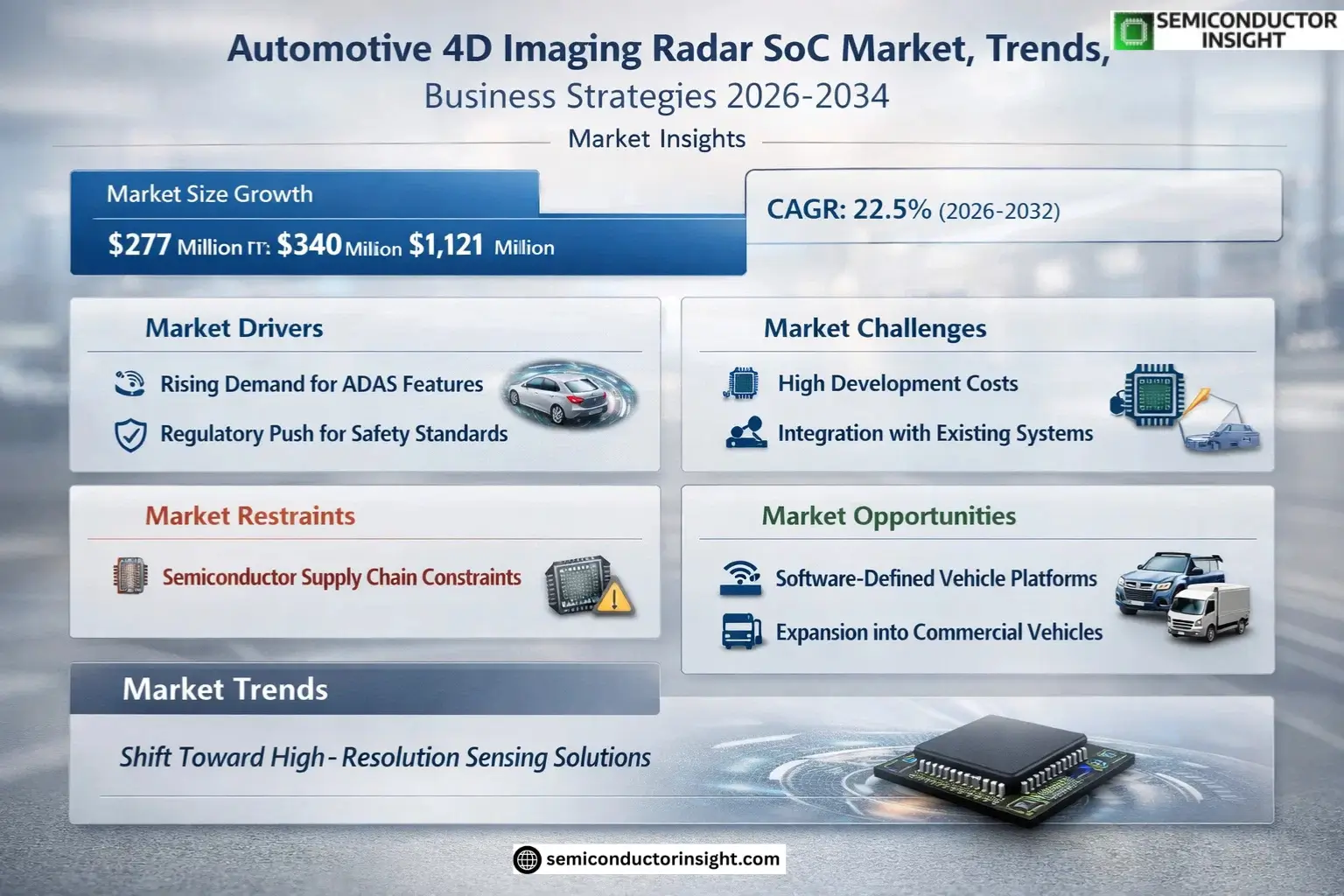
Global Automotive 4D Imaging Radar SoC Market size was valued at USD 277 million in 2025. The market is projected to grow from USD 340 million in 2026 to USD 1,121 million by 2032, exhibiting a CAGR of 22.5% during the forecast period.
Automotive 4D Imaging Radar SoC is a highly integrated radar system-on-chip operating in the typical 77GHz automotive millimeter-wave band, combining RF front-end circuitry, digital signal processing units, and control modules within a single CMOS-based architecture. It enables miniaturized, low-power, and highly stable signal-chain performance while supporting high-resolution detection with elevation perception required by angle radar and forward radar in advanced automotive sensing.
The market growth is driven by increasing demand for autonomous driving technologies and advanced driver-assistance systems (ADAS), which require superior object detection capabilities. While traditional millimeter-wave radars lack height measurement and high-density point cloud imaging, 4D imaging radar overcomes these limitations without the cost and reliability challenges of lidar systems. Key industry players like Texas Instruments, Infineon Technologies, and Arbe Robotics are accelerating innovation through product development and strategic partnerships to meet growing automotive safety requirements.
MARKET DRIVERS
Rising Demand for Advanced Driver Assistance Systems (ADAS)
Automotive 4D Imaging Radar SoC Market is propelled by increasing adoption of ADAS features. With over 45% of new vehicles now equipped with collision avoidance systems, the demand for high-resolution radar solutions like 4D imaging radar SoCs continues to grow. These chips enable superior object detection and classification in all weather conditions.
Regulatory Push for Vehicle Safety Standards
Global safety regulations such as Euro NCAP and NHTSA requirements are mandating advanced safety features. This has accelerated OEM investments in 4D imaging radar SoC technology, which provides the high angular resolution needed to meet these stricter standards.
Automotive manufacturers are increasingly viewing 4D imaging radar SoCs as a cost-effective alternative to LiDAR for Level 3+ autonomous vehicles.
MARKET CHALLENGES
High Development Costs and Complexity
Automotive 4D Imaging Radar SoC Market faces significant R&D challenges. Developing high-resolution radar systems-on-chip requires substantial investments in RF engineering and signal processing expertise, creating barriers to entry for smaller players.
Other Challenges
Integration with Existing Vehicle Architectures
Legacy vehicle electronic systems often lack the bandwidth and processing capabilities needed for 4D imaging radar data, requiring extensive redesigns of vehicle electrical architectures.
MARKET RESTRAINTS
Semiconductor Supply Chain Constraints
Automotive 4D Imaging Radar SoC Market has been impacted by ongoing semiconductor shortages. The specialized manufacturing processes required for these chips have led to longer lead times and allocation challenges for automotive OEMs.
MARKET OPPORTUNITIES
Emergence of Software-Defined Vehicle Platforms
The shift toward software-defined vehicles is creating new opportunities for 4D imaging radar SoC suppliers. These platforms require flexible, updateable sensor solutions that can evolve with over-the-air updates, perfectly aligning with the capabilities of modern radar SoCs.
Expansion into Commercial Vehicle Segment
Truck and bus manufacturers are increasingly adopting 4D imaging radar SoCs to meet new regulatory requirements. This represents a significant growth avenue, with the commercial vehicle segment expected to account for 30% of the market by 2026.
Automotive 4D Imaging Radar SoC Market Trends
Shift Toward High-Resolution Sensing Solutions
The automotive industry’s transition toward autonomous driving is accelerating demand for 4D imaging radar SoCs, which provide superior resolution compared to traditional radar systems. These advanced chips incorporate elevation data and high-density point cloud imaging, addressing limitations of conventional millimeter-wave radars that lack height measurement capabilities. Leading OEMs are integrating 4D imaging radar SoCs into corner and front radar applications to enable precise object classification and improved safety.
Other Trends
CMOS Process Node Advancements
Manufacturers are rapidly migrating from 40nm to 28nm process nodes to improve power efficiency and integration capabilities. This technological progression enables higher transistor densities while maintaining automotive-grade reliability, with Texas Instruments and Infineon Technologies leading the transition. The move to smaller nodes supports the integration of RF front-ends with digital signal processors on single chips.
Supply Chain Optimization and Capacity Expansion
With current capacity utilization at approximately 60%, major semiconductor suppliers are strategically expanding production to meet growing OEM demand. The market is seeing increased collaboration between foundries and automotive radar specialists to enhance yield rates and reduce lead times. Process improvements have helped maintain healthy gross margins around 55% despite rising material costs.
Regional Market Dynamics
Asia Pacific dominates production and consumption, with China’s automotive manufacturers driving significant adoption of 4D imaging radar SoCs. European and North American markets show strong growth potential as regulatory frameworks for autonomous driving evolve. Suppliers are establishing local design centers and test facilities to better serve regional OEM requirements.
Functional Safety Standardization
The industry is converging on ISO 26262 ASIL-B and ASIL-C compliance for 4D imaging radar SoCs, with safety-certified designs becoming a key differentiator. This standardization enables seamless integration with automotive ADAS architectures while meeting stringent reliability requirements. Manufacturers are investing heavily in verification and validation processes to achieve these certifications.
COMPETITIVE LANDSCAPE
Key Industry Players
Technological Innovation Drives Market Share Among Key 4D Imaging Radar SoC Suppliers
Automotive 4D Imaging Radar SoC Market is dominated by semiconductor giants like Texas Instruments and Infineon Technologies, which collectively hold over 40% market share through their advanced CMOS-based radar solutions. These leaders benefit from established automotive relationships, ASIL-D compliant designs, and volume production capabilities at 28nm/40nm nodes. Their technology enables <8cm range resolution and <1° angular accuracy – critical for autonomous driving applications.
Emerging specialists like Arbe Robotics and Calterah Semiconductor are gaining traction with innovative architectures offering 300m+ detection range and dense point cloud generation. Chinese players including Muniu Tech and WHST demonstrate strong regional supply chain advantages, while Smartmicro focuses on software-defined radar solutions with flexible beamforming capabilities. This competitive dynamic pushes annual R&D investments above 15% of revenue across the sector.
List of Key Automotive 4D Imaging Radar SoC Companies Profiled
- Texas Instruments
- Infineon Technologies
- Arbe Robotics
- Smartmicro
- Muniu Tech
- WHST
- HUAWEI
- Calterah Semiconductor
- NXP Semiconductors
- STMicroelectronics
- Aptiv
- Vayyar Imaging
- Uhnder
- Metawave
- Continental AG
Segment Analysis:
| Segment Category | Sub-Segments | Key Insights |
| By Type |
|
4Tx/4Rx emerges as the preferred configuration due to its superior performance characteristics:
|
| By Application |
|
Front Radar applications dominate demand with critical advantages:
|
| By End User |
|
Tier 1 Suppliers represent the primary consumption channel:
|
| By Process Node |
|
28nm process technology shows strongest adoption trends:
|
| By Safety Grade |
|
ASIL-B solutions demonstrate strongest market traction:
|
Regional Analysis: Global Automotive 4D Imaging Radar SoC Market
FMVSS and NHTSA guidelines accelerate 4D radar deployment by mandating collision avoidance capabilities. California’s AV testing policies create real-world validation environments that shape global standards.
Seamless fusion of 4D radar SoCs with lidar and camera systems distinguishes North American autonomous stacks. OEMs leverage radar’s all-weather reliability to complement optical sensors.
Concentration of semiconductor fabs and automotive suppliers in Michigan-Texas corridor enables rapid prototyping. Just-in-time production models support agile radar SoC development cycles.
Strategic partnerships between defense contractors and automotive startups drive innovation in mmWave radar technologies. Venture funding focuses on AI-enhanced radar processing algorithms.
Europe
Europe’s Automotive 4D Imaging Radar SoC Market thrives under Euro NCAP’s stringent safety protocols. German automakers lead in integrating radar SoCs with premium vehicle platforms, while Nordic countries pioneer cold-climate performance optimization. The EU’s Cooperative Intelligent Transport Systems (C-ITS) framework encourages radar-to-infrastructure communication development. Specialized semiconductor firms in the Netherlands and Belgium supply critical analog front-end components. Regulatory pressure to reduce false positives in pedestrian detection systems drives innovations in radar signal processing architectures.
Asia-Pacific
Asia-Pacific emerges as the fastest-growing Automotive 4D Imaging Radar SoC Market, with China mandating ADAS features in all new vehicles by 2025. Japanese manufacturers focus on compact radar SoC designs for urban mobility solutions, while South Korean firms excel in chipset miniaturization. Taiwan’s semiconductor foundries play a pivotal role in mass-producing radar SoCs at competitive nodes. India’s expanding electric vehicle market creates new demand for cost-optimized radar solutions tailored for emerging economy road conditions.
South America
Brazil’s automotive sector shows increasing appetite for 4D Imaging Radar SoCs in premium vehicle segments, though adoption lags behind global leaders. Aftermarket ADAS retrofits using entry-level radar modules gain traction in urban centers. Argentina develops niche expertise in agricultural vehicle radar applications, leveraging the region’s strong agritech sector. Infrastructure challenges drive unique use cases for ruggedized radar systems capable of handling poorly marked roads and unpredictable traffic patterns.
Middle East & Africa
Gulf Cooperation Council countries prioritize 4D radar for luxury vehicles and smart city projects, with Dubai leading in autonomous shuttle deployments. South Africa develops localized radar solutions for mining and off-road vehicle safety systems. The region’s extreme temperatures and dust conditions test the environmental durability of radar SoC packaging, influencing global design standards. Limited semiconductor infrastructure leads to reliance on imported radar modules with local value-added integration services.
Report Scope
This market research report provides a comprehensive analysis of the Automotive 4D Imaging Radar SoC Market , covering the forecast period 2025–2032. It offers detailed insights into market dynamics, technological advancements, competitive landscape, and key trends shaping the industry.
Key focus areas of the report include:
- Market Overview: The report begins with an overview outlining its current market scenario, key growth indicators, and industry transformation drivers. It discusses macroeconomic factors, demand–supply balance, regulatory landscape, and the strategic role of semiconductors in powering advancements across industries such as automotive, telecommunications, consumer electronics, and industrial automation.
- Market Size & Forecast: Historical data and future projections for revenue, unit shipments, and market value across major regions and segments.
- Segmentation Analysis: Detailed breakdown by product type, technology, application, and end-user industry to identify high-growth segments and investment opportunities.
- Regional Insights: Insights into market performance across North America, Europe, Asia-Pacific, Latin America, and the Middle East & Africa, including country-level analysis where relevant.
- Competitive Landscape: Profiles of leading market participants, including their product offerings, R&D focus, manufacturing capacity, pricing strategies, and recent developments such as mergers, acquisitions, and partnerships.
- Technology Trends & Innovation: Assessment of emerging technologies, integration of AI/IoT, semiconductor design trends, fabrication techniques, and evolving industry standards.
- Market Drivers & Restraints: Evaluation of factors driving market growth along with challenges, supply chain constraints, regulatory issues, and market-entry barriers.
- Stakeholder Insights: Insights for component suppliers, OEMs, system integrators, investors, and policymakers regarding the evolving ecosystem and strategic opportunities.
Primary and secondary research methods are employed, including interviews with industry experts, data from verified sources, and real-time market intelligence to ensure the accuracy and reliability of the insights presented.
FREQUENTLY ASKED QUESTIONS:
What is the current market size of Automotive 4D Imaging Radar SoC Market?
-> Automotive 4D Imaging Radar SoC Market size was valued at USD 277 million in 2025. The market is projected to grow from USD 340 million in 2026 to USD 1,121 million by 2032, exhibiting a CAGR of 22.5% during the forecast period.
What is the growth rate of this market?
-> The market is expected to grow at a CAGR of 22.5% during the forecast period (2025-2032).
Which key companies operate in Automotive 4D Imaging Radar SoC Market?
-> Key players include Texas Instruments, Infineon Technologies, Arbe Robotics, Smartmicro, Muniu Tech, WHST, HUAWEI, and Calterah Semiconductor, among others.
What are the key applications of 4D Imaging Radar SoCs?
-> Key applications include Corner Radar (56% market share) and Front Radar (36% market share) in automotive ADAS systems.
What was the production volume in 2025?
-> The industry produced approximately 6.73 million units in 2025 with an average price of USD 45 per unit.
Which region dominates the market?
-> Asia holds the largest market share, with key players located in China, Japan, and South Korea.
Get Sample Report PDF for Exclusive Insights
Report Sample Includes
- Table of Contents
- List of Tables & Figures
- Charts, Research Methodology, and more...
 Download Sample Report PDF