ATR Fiber Optic Probes Market Insights
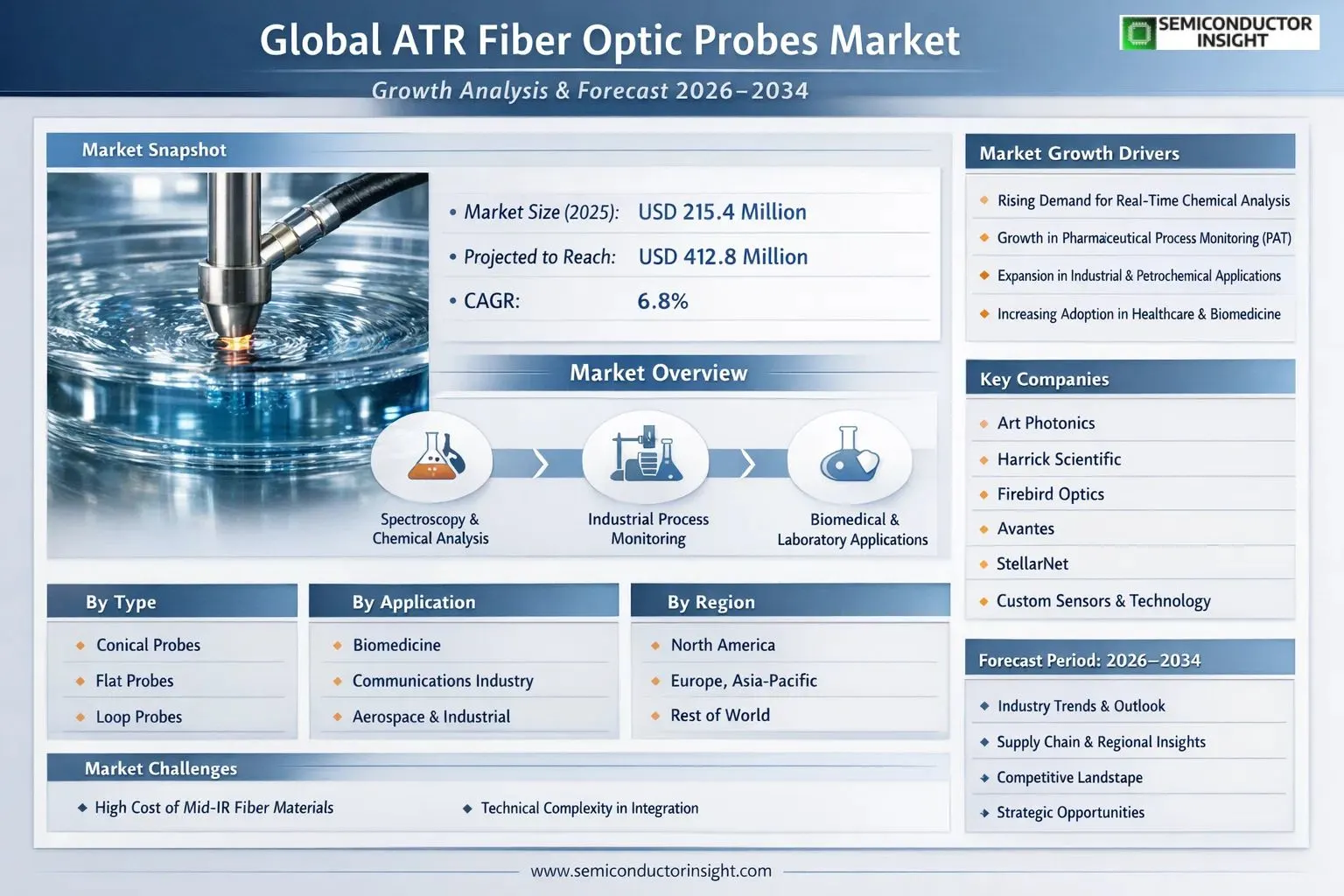
Global ATR Fiber Optic Probes market size was valued at USD 215.4 million in 2025. The market is projected to grow from USD 228.6 million in 2026 to USD 412.8 million by 2034, exhibiting a CAGR of 6.8% during the forecast period.
ATR Fiber Optic Probes are advanced spectroscopic instruments that combine the principles of Attenuated Total Reflectance (ATR) with mid-infrared optical fiber technology. The ATR probe consists of an ATR crystal tip at the end of the immersible section , commonly referred to as the shaft , and a mid-IR optical fiber split into two branches with an SMA connector. The ATR technique leverages the total internal reflection properties of the crystal, which generates an evanescent wave that extends into the surrounding sample medium. This enables direct measurement of liquids, slurries, and solids with very high optical density, allowing spectral analysis without the need for sample dilution or preparation.
The market is witnessing steady growth driven by rising demand for real-time, in-situ chemical analysis across industries such as biomedicine, communications, and aerospace. The increasing adoption of mid-infrared spectroscopy in pharmaceutical process monitoring and industrial quality control is further accelerating market expansion. Key manufacturers operating in this space include Art Photonics, Firebird Optics, Harrick Scientific, Ostec Corporate Group, Custom Sensors & Technology, Avantes North America, and StellarNet, among others, each contributing to a competitive and innovation-driven global landscape.
MARKET DRIVERS
Rising Demand for Real-Time, Non Destructive Chemical Analysis Across Industries
ATR Fiber Optic Probes Market is experiencing notable growth driven by the increasing need for real-time, in-situ chemical analysis in industries such as pharmaceuticals, food and beverage, petrochemicals, and environmental monitoring. Attenuated Total Reflectance (ATR) technology, when integrated with fiber optic probes, enables direct measurement of liquid, semi-solid, and solid samples without the need for extensive sample preparation. This capability significantly reduces analysis time and improves operational efficiency, making it an attractive solution for quality control and process monitoring applications. The shift toward inline and online spectroscopic monitoring across manufacturing sectors is a primary force accelerating adoption of ATR fiber optic probe systems.
Growth in Pharmaceutical Process Analytical Technology (PAT) Initiatives
Regulatory frameworks encouraging the adoption of Process Analytical Technology (PAT) in pharmaceutical manufacturing have created substantial demand for advanced spectroscopic tools, including ATR fiber optic probes. Regulatory bodies such as the U.S. Food and Drug Administration (FDA) have long advocated for PAT as a means to ensure product quality through continuous monitoring rather than end-point testing. ATR fiber optic probes, when coupled with mid-infrared (MIR) and near-infrared (NIR) spectrometers, enable continuous monitoring of critical quality attributes such as polymorphic form, API concentration, and moisture content during drug manufacturing. This regulatory alignment is a consistent and structured driver supporting long-term market growth.
➤ ATR fiber optic probes are increasingly being deployed in continuous manufacturing environments within the pharmaceutical industry, where real-time feedback loops are essential for maintaining batch consistency and regulatory compliance.
The expanding application of ATR fiber optic probes in chemical and petrochemical process control further reinforces market momentum. Industries handling hazardous or reactive materials benefit from the remote sensing capability of fiber optic-based ATR systems, which allow spectroscopic analysis to be conducted at a safe distance from harsh or high-pressure environments. The ability to transmit infrared signals over extended fiber lengths without significant signal degradation has broadened the operational scope of these probes, enabling deployment in scenarios that were previously inaccessible to conventional ATR accessories.
MARKET CHALLENGES
Technical Complexity and Integration Barriers Limiting Broader Adoption
Despite its clear analytical advantages, ATR Fiber Optic Probes Market faces meaningful challenges related to technical complexity and system integration. Fiber optic-coupled ATR probes must be carefully matched with compatible spectrometer platforms, and the optical alignment requirements can be demanding. Signal attenuation in certain fiber materials, particularly in the mid-infrared spectral range, remains a technical hurdle. Chalcogenide and silver halide fibers used for MIR transmission are fragile and sensitive to physical stress, limiting their durability in certain industrial environments. These material limitations can increase maintenance costs and reduce the operational lifespan of probes deployed in demanding process settings.
Other Challenges
High Initial Cost of ATR Fiber Optic Probe Systems
The upfront investment required for ATR fiber optic probe systems, including the probe itself, compatible spectrometer hardware, and chemometric software, can be significant. For small and mid-sized enterprises, this capital expenditure presents a barrier to entry, particularly when the return on investment is not immediately quantifiable. The cost of specialized fiber materials with high infrared transmittance further compounds this challenge, limiting accessibility for cost-sensitive end users.
Requirement for Specialized Expertise in Spectral Interpretation
Effective use of ATR fiber optic probes requires a working knowledge of infrared spectroscopy and chemometric modeling. Organizations lacking in-house expertise may struggle to develop robust calibration models or interpret complex spectral data accurately. This skills gap can delay implementation timelines and reduce confidence in analytical results, particularly in regulated industries where method validation is mandatory. The need for ongoing training and software support adds to the total cost of ownership and can deter adoption among organizations with limited technical resources.
MARKET RESTRAINTS
Limitations in Spectral Range and Material Compatibility of Fiber Optic Components
A significant restraint affecting ATR Fiber Optic Probes Market is the inherent limitation in the spectral transmission range of available fiber optic materials. Standard silica fibers, while cost-effective and mechanically robust, are largely limited to near-infrared wavelengths and do not support mid-infrared transmission where many molecular fingerprinting applications are conducted. Fibers capable of transmitting in the mid-infrared, such as chalcogenide glass or polycrystalline silver halide fibers, are considerably more expensive, fragile, and difficult to manufacture in long lengths, restricting the design flexibility of ATR probe assemblies. These material constraints continue to limit the addressable application range of fiber optic ATR systems in certain analytical use cases.
Sensitivity to Environmental and Sample Conditions Affecting Measurement Reliability
The analytical performance of ATR fiber optic probes can be adversely affected by environmental factors such as temperature fluctuations, vibration, and sample fouling on the ATR crystal surface. Probe crystals made from zinc selenide, germanium, or diamond are susceptible to surface contamination in complex sample matrices, which can introduce spectral artifacts and reduce measurement accuracy. In industrial environments where process streams contain particulates, viscous materials, or aggressive chemical species, maintaining a clean and optically consistent crystal interface presents an ongoing operational challenge. These reliability concerns can limit confidence in ATR fiber optic probe systems for certain continuous process monitoring applications, acting as a restraint on market penetration in some industrial segments.
MARKET OPPORTUNITIES
Expanding Applications in Environmental Monitoring and Water Quality Analysis
ATR Fiber Optic Probes Market holds considerable opportunity in the growing field of environmental monitoring, particularly for the detection and quantification of contaminants in water bodies, soil extracts, and industrial effluents. The capability of ATR fiber optic systems to analyze aqueous samples directly, without complex sample preparation, positions them as practical tools for detecting organic pollutants, microplastics, and chemical residues in environmental matrices. As regulatory scrutiny around water quality and industrial discharge tightens globally, demand for reliable, field-deployable spectroscopic monitoring solutions is expected to rise, creating new end-use segments for ATR fiber optic probe manufacturers and solution providers.
Integration with Miniaturized and Portable Spectrometer Platforms
The ongoing miniaturization of infrared spectrometer technology presents a significant commercial opportunity for ATR Fiber Optic Probes Market. As compact, handheld, and portable spectrometers become increasingly capable and cost-effective, the integration of fiber optic ATR probes with these platforms extends the reach of spectroscopic analysis beyond centralized laboratory settings into field, clinical, and point-of-care environments. This convergence supports use cases in food authentication, pharmaceutical verification, and materials identification where portability and speed are valued. Manufacturers who develop ATR fiber optic probes optimized for compatibility with miniaturized spectrometer systems are well-positioned to capture emerging market segments driven by decentralized analytical workflows.
Advancement of Diamond ATR Crystal Technology Enabling Broader Industrial Use
Diamond ATR crystals represent a technologically advanced and increasingly accessible opportunity within ATR Fiber Optic Probes Market. Diamond offers exceptional chemical inertness, mechanical hardness, and a broad infrared transmission window, making it suitable for analyzing corrosive, abrasive, or high-temperature samples that would damage conventional crystal materials. As manufacturing advances continue to reduce the cost of synthetic diamond components, their integration into fiber optic ATR probe designs is becoming more commercially viable. This trend opens opportunities for probe deployment in previously inaccessible industrial applications, including polymer melt analysis, high-pressure reaction monitoring, and the characterization of aggressive chemical intermediates, broadening the overall market addressable by ATR fiber optic probe technology.
ATR Fiber Optic Probes Market Trends
Rising Demand for In-Situ and Real-Time Spectroscopic Analysis
One of the most defining trends shaping ATR Fiber Optic Probes Market is the accelerating shift toward real-time, in-situ chemical analysis across process industries. These probes, which leverage attenuated total reflectance (ATR) technology through mid-IR optical fibers and ATR crystal tips, allow direct immersion into liquid, slurry, or solid samples without the need for sample dilution or preparation. This capability is increasingly valued in process monitoring environments where operational continuity and measurement accuracy are paramount. Pharmaceutical manufacturing, chemical processing, and food quality control sectors have all demonstrated growing reliance on ATR fiber optic probes to enable continuous spectral measurements under live process conditions. The ability to generate evanescent wave-based absorption data from optically dense media without sample disruption continues to distinguish these instruments from conventional spectroscopic alternatives, driving sustained adoption across industrial end-users globally.
Other Trends
Expansion Across Biomedical and Life Sciences Applications
The biomedicine segment represents a significant and expanding application area within ATR Fiber Optic Probes Market. Researchers and clinical diagnostics professionals are increasingly utilizing these probes for tissue analysis, biological fluid characterization, and non-destructive examination of pharmaceutical compounds. The probes’ compatibility with high optical density media makes them particularly suited for biological samples that would otherwise pose challenges for transmission-based infrared spectroscopy. Leading manufacturers, including Art Photonics, Harrick Scientific, and Avantes North America, have developed specialized probe configurations,such as conical and flat probe variants,to address the specific sampling geometries required in biomedical environments. This trend aligns with the broader movement toward non-invasive and minimally disruptive analytical methods in life sciences research and diagnostics.
Technological Advancement in Probe Design and Fiber Materials
Innovation in ATR crystal materials and fiber optic construction is a key trend influencing market evolution. Manufacturers are investing in the development of probes with enhanced chemical resistance, broader spectral transmission ranges, and improved mechanical durability suited for harsh industrial environments. The integration of SMA connectors and dual-branch fiber configurations has improved compatibility with a wider range of spectrometer systems, expanding the addressable customer base. Companies such as StellarNet, Firebird Optics, and Ostec Corporate Group are actively advancing probe geometries,including loop and conical designs,to optimize evanescent wave penetration depth and sampling efficiency across diverse applications in aerospace, communications, and industrial process control.
Geographic Expansion and Competitive Landscape Dynamics
Geographically, North America and Europe remain established markets for ATR Fiber Optic Probes, supported by strong research infrastructure and the presence of key global manufacturers. Meanwhile, Asia-Pacific, particularly China and Japan, is emerging as an important growth region driven by expanding pharmaceutical manufacturing capacity and increasing investment in analytical instrumentation. The competitive landscape is characterized by a concentrated group of specialized manufacturers,including Custom Sensors & Technology and Art Photonics,who compete on the basis of probe customization, spectral range, and application-specific expertise. Strategic collaborations between probe manufacturers and spectrometer system providers are becoming increasingly common, reflecting the market’s movement toward integrated, turnkey spectroscopic solutions.
COMPETITIVE LANDSCAPE
Key Industry Players
ATR Fiber Optic Probes Market Global Competitive Landscape and Leading Manufacturer Profiles
Global ATR Fiber Optic Probes market is characterized by a moderately consolidated competitive environment, with a handful of specialized photonics and spectroscopy companies commanding the majority of revenue share. Art Photonics, a Berlin-based pioneer in mid-infrared fiber optic solutions, stands out as one of the most prominent players, offering a comprehensive portfolio of ATR probes engineered for demanding in-situ and in-line process monitoring applications. Harrick Scientific and Firebird Optics also maintain strong market positions, leveraging deep expertise in attenuated total reflectance technology and optical crystal manufacturing. These leading firms differentiate themselves through proprietary crystal geometries , including conical, flat, and loop probe configurations , advanced fiber optic coatings, and SMA-compatible connectivity that enables seamless integration with FTIR and Raman spectrometers. The top five global players collectively accounted for a significant share of total market revenue in 2025, underscoring the market’s reliance on technically sophisticated, application-specific product lines serving industries such as biomedicine, communications, and aerospace.
Beyond the market leaders, a robust ecosystem of niche and regional players contributes meaningfully to the competitive dynamics of ATR Fiber Optic Probes Market. Ostec Corporate Group has established a solid foothold in Eastern European and Asian markets, while Custom Sensors & Technology and Avantes North America cater to specialized OEM and laboratory segments with customizable probe assemblies. StellarNet continues to grow its presence by bundling ATR probe solutions with compact spectrometer systems, appealing to cost-sensitive research and industrial customers. Other noteworthy participants , including Ocean Insight (a subsidiary of Halma plc), Remspec Corporation, Hellma Analytics, Pike Technologies, and Axiom Analytical , serve distinct vertical markets with tailored ATR probe chemistries and crystal materials such as diamond, ZnSe, germanium, and silicon. Competitive strategies across the landscape increasingly emphasize miniaturization, durability for harsh-environment deployment, and expanded spectral range, reflecting growing end-user demand for real-time, non-destructive sample analysis without dilution or sample preparation.
List of Key ATR Fiber Optic Probes Companies Profiled
- Art Photonics
- Firebird Optics
- Harrick Scientific
- Ostec Corporate Group
- Custom Sensors & Technology
- Avantes North America
- StellarNet
- Ocean Insight (Halma plc)
- Remspec Corporation
- Hellma Analytics
- Pike Technologies
- Axiom Analytical
- Infrared Fiber Systems (IFS)
- Specac Ltd.
- Bruker Corporation
Segment Analysis:
| Segment Category | Sub-Segments | Key Insights |
| By Type |
|
Conical Probes represent the leading segment in ATR Fiber Optic Probes Market by product type, driven by their superior ability to interface with highly viscous, opaque, or heterogeneous sample media without requiring sample preparation.
|
| By Application |
|
Biomedicine stands as the dominant application segment for ATR Fiber Optic Probes, owing to the increasing adoption of real-time, non-destructive spectroscopic analysis across pharmaceutical development, clinical diagnostics, and bioprocess monitoring.
|
| By End User |
|
Pharmaceutical & Biotechnology Companies constitute the leading end-user segment, as the imperative for real-time quality monitoring, contamination detection, and process optimization in drug manufacturing environments continues to grow substantially.
|
| By Crystal Material |
|
Diamond ATR Probes lead this segment due to their unmatched chemical inertness, mechanical hardness, and broad spectral transmission range, making them the preferred choice for aggressive chemical environments and demanding analytical applications.
|
| By Connectivity & Integration |
|
SMA Connector-Based Probes dominate this segment as the industry-standard connectivity format, offering broad compatibility with a wide range of FTIR spectrometers and optical instrumentation platforms from leading manufacturers.
|
Regional Analysis: ATR Fiber Optic Probes Market
North America
North America’s pharmaceutical and biotechnology industries represent a primary end-user segment for ATR fiber optic probes. Stringent FDA guidelines on continuous process verification and process analytical technology (PAT) frameworks have significantly elevated the adoption of fiber optic-based ATR spectroscopy. These probes enable real-time, non-destructive monitoring of chemical reactions, ensuring consistent product quality and regulatory compliance across drug manufacturing facilities.
The United States and Canada host a dense network of research universities and national laboratories that actively deploy ATR fiber optic probes for advanced spectroscopic analysis. These institutions are central to pioneering new probe configurations, material innovations, and application methodologies. Federal funding through agencies such as the NIH, NSF, and DOE continues to sustain robust procurement activity, strengthening the region’s technological leadership.
Chemical manufacturers and petroleum refiners across North America are integrating ATR fiber optic probes into their process monitoring systems to improve operational efficiency and ensure safety compliance. The probes’ ability to withstand harsh chemical environments while delivering accurate spectral data in real time makes them particularly valuable in high-throughput industrial settings, driving consistent demand growth across this application segment.
North America is home to several prominent manufacturers and innovators in ATR Fiber Optic Probes Market, fostering a competitive landscape that continuously raises the bar for product performance and customization. Ongoing investments in mid-infrared fiber development, robust probe housing materials, and enhanced optical coatings are expected to yield next-generation solutions tailored for increasingly specialized end-user requirements through 2034.
Europe
Europe represents the second most significant regional market for ATR fiber optic probes, driven by a sophisticated industrial ecosystem encompassing specialty chemicals, advanced pharmaceuticals, food and beverage processing, and environmental monitoring. Germany, the United Kingdom, France, and Switzerland serve as primary growth engines, hosting major chemical conglomerates and world-class research centers that demand high-performance analytical instrumentation. The European Medicines Agency’s stringent quality assurance mandates and the region’s robust environmental regulatory landscape collectively encourage widespread adoption of real-time spectroscopic tools. European manufacturers are also at the forefront of developing eco-compliant probe materials and energy-efficient analytical systems, aligning with the region’s broader sustainability objectives. The ongoing digital transformation of European manufacturing under the “Industry 4.0” and “Horizon Europe” initiatives is further propelling investment in intelligent process monitoring technologies, including ATR fiber optic probes, across the continent.
Asia-Pacific
The Asia-Pacific region is emerging as the fastest-growing market for ATR fiber optic probes, propelled by rapid industrialization, expanding pharmaceutical manufacturing capacity, and significant government investment in scientific infrastructure across China, India, Japan, and South Korea. China’s dominance in chemical production and its ambition to advance domestic analytical instrumentation capabilities are central to the region’s growth trajectory. India’s burgeoning generics pharmaceutical sector increasingly demands process analytical technologies that ensure quality and regulatory compliance for global export markets. Japan and South Korea contribute through their leadership in precision manufacturing and advanced materials research. The region’s relatively lower production costs and growing pool of technically skilled professionals are attracting global manufacturers to establish regional operations, further stimulating local market development in the ATR fiber optic probes sector.
South America
South America presents a steadily developing market for ATR fiber optic probes, with Brazil and Argentina leading regional adoption. The region’s agricultural processing, mining, and petrochemical industries are gradually integrating advanced spectroscopic technologies to improve process efficiency and product quality. Brazil’s expanding pharmaceutical manufacturing base and its alignment with international quality standards are creating incremental demand for sophisticated analytical instrumentation, including ATR fiber optic probes. While infrastructure limitations and economic volatility pose challenges to rapid market expansion, increasing foreign direct investment in industrial modernization projects and growing awareness of process analytical technology benefits are gradually overcoming these barriers. The long-term outlook for South America in ATR Fiber Optic Probes Market remains cautiously optimistic through the 2026–2034 forecast period.
Middle East & Africa
The Middle East and Africa region occupies a nascent but gradually evolving position in Global ATR fiber optic probes market. The Middle East, led by Saudi Arabia and the UAE, is investing heavily in petrochemical refining and diversification of its industrial base beyond hydrocarbons, creating selective demand for advanced process monitoring technologies. South Africa serves as the primary adoption hub within the African continent, driven by its relatively mature mining and chemical processing sectors. While widespread adoption of ATR fiber optic probes remains constrained by limited local technical expertise, underdeveloped distribution channels, and budgetary restrictions, growing partnerships with global instrumentation suppliers and expanding government-funded research initiatives are beginning to create a more favorable environment for long-term market development in this region.
Report Scope
This market research report provides a comprehensive analysis of ATR Fiber Optic Probes Market, covering the forecast period 2026–2034. It offers detailed insights into market dynamics, technological advancements, competitive landscape, and key trends shaping the industry.
Key focus areas of the report include:
- Market Overview: The report begins with an overview outlining its current market scenario, key growth indicators, and industry transformation drivers. It discusses macroeconomic factors, demand–supply balance, regulatory landscape, and the strategic role of ATR Fiber Optic Probes in powering advancements across industries such as communications, biomedicine, aerospace, and industrial automation.
- Market Size & Forecast: Historical data and future projections for revenue, unit shipments, and market value across major regions and segments.
- Segmentation Analysis: Detailed breakdown by product type (Conical Probes, Flat Probes, Loop Probes), application, and end-user industry to identify high-growth segments and investment opportunities.
- Regional Insights: Insights into market performance across North America, Europe, Asia-Pacific, Latin America, and the Middle East & Africa, including country-level analysis where relevant.
- Competitive Landscape: Profiles of leading market participants, including their product offerings, R&D focus, manufacturing capacity, pricing strategies, and recent developments such as mergers, acquisitions, and partnerships.
- Technology Trends & Innovation: Assessment of emerging technologies, integration of AI/IoT, mid-IR optical fiber design trends, ATR crystal fabrication techniques, and evolving industry standards.
- Market Drivers & Restraints: Evaluation of factors driving market growth along with challenges, supply chain constraints, regulatory issues, and market-entry barriers.
- Stakeholder Insights: Insights for component suppliers, OEMs, system integrators, investors, and policymakers regarding the evolving ecosystem and strategic opportunities.
Primary and secondary research methods are employed, including interviews with industry experts, data from verified sources, and real-time market intelligence to ensure the accuracy and reliability of the insights presented.
FREQUENTLY ASKED QUESTIONS:
What is the current market size of ATR Fiber Optic Probes Market?
-> ATR Fiber Optic Probes Market was valued at USD 215.4 million in 2025. and is expected to reach USD 412.8 million by 2034 growing at a CAGR of 6.8% during the forecast period 2026–2034.
Which key companies operate in ATR Fiber Optic Probes Market?
-> Key players include Art Photonics, Firebird Optics, Harrick Scientific, Ostec Corporate Group, Custom Sensors & Technology, Avantes North America, and StellarNet, among others. In 2025, Global top five players held approximately % of the market in terms of revenue.
What are the key growth drivers?
-> Key growth drivers include rising demand for non-destructive spectral measurement solutions, increasing adoption of ATR probes in biomedicine and communications industries, growing need for in-situ analysis of liquids and slurries without sample dilution, and expanding applications in aerospace and industrial process monitoring.
Which region dominates the market?
-> North America represents a significant market, with the U.S. market estimated at USD million in 2025. Asia-Pacific is among the fastest-growing regions, with China projected to reach USD million during the forecast period.
What are the emerging trends?
-> Emerging trends include advancements in mid-IR optical fiber technology, miniaturization of ATR probe designs, integration of SMA connectors for enhanced compatibility, growing use of evanescent wave-based sensing in high optical density media, and expanded adoption of Conical, Flat, and Loop probe variants across diverse industrial applications.

Get Sample Report PDF for Exclusive Insights
Report Sample Includes
- Table of Contents
- List of Tables & Figures
- Charts, Research Methodology, and more...
 Download Sample Report PDF