Anti-Stealth Radar Market Insights
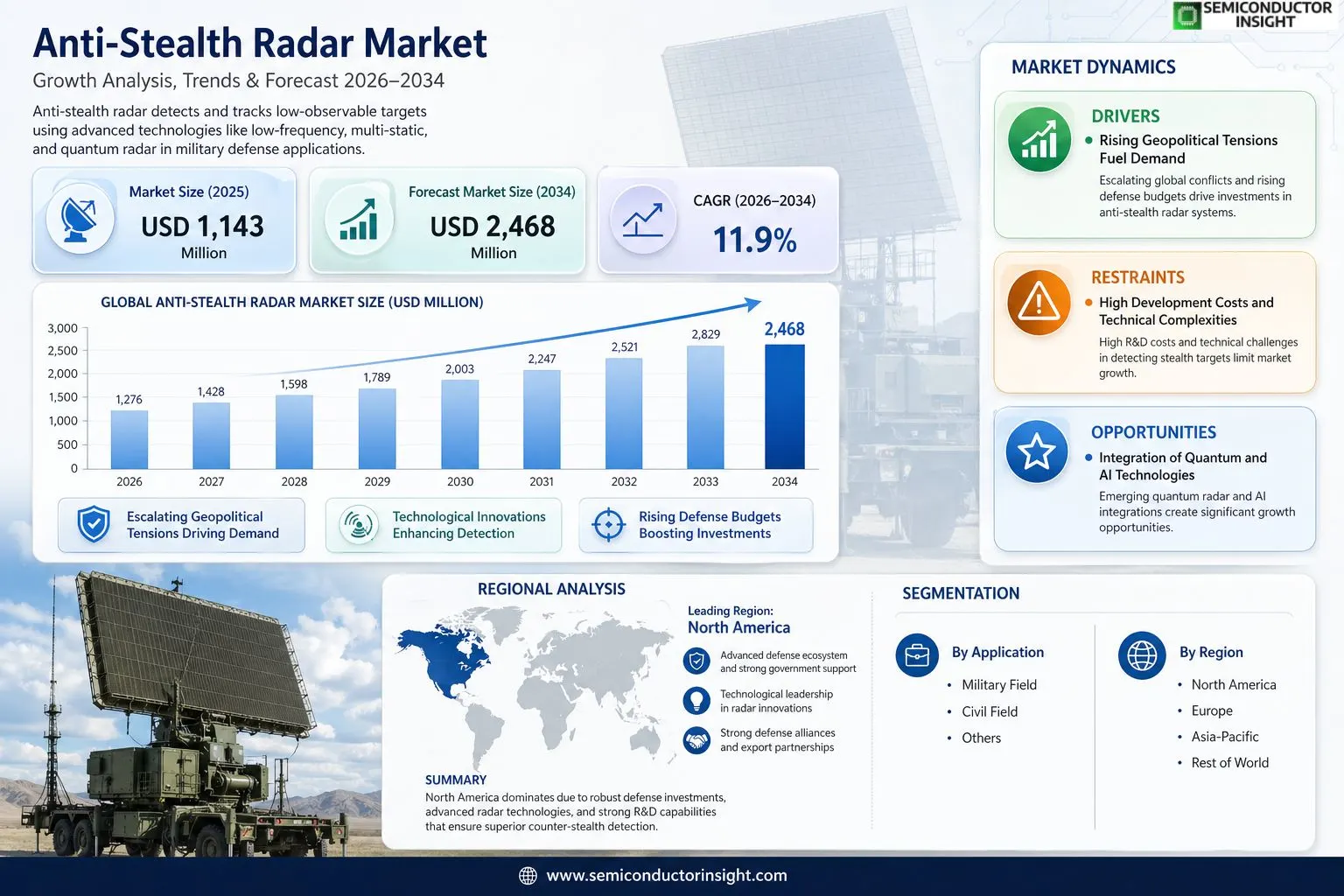
Global Anti-Stealth Radar market size was valued at USD 1,143 million in 2025. The market is projected to reach USD 2,468 million by 2034, exhibiting a CAGR of 11.9% during the forecast period.
Anti-stealth radar is a radar system specially designed to detect and track stealth targets, such as stealth fighters. These systems leverage advanced technologies like low-frequency meter wave radar and multi-static radar configurations to enhance detection and tracking capabilities against low-observable aircraft. Key types include Meter Wave Radar, Passive Radar, Quantum Radar, and others.
The market is experiencing robust growth driven by escalating geopolitical tensions, surging global defense budgets, and the proliferation of stealth aircraft technologies. Furthermore, advancements in radar signal processing and quantum sensing are bolstering counter-stealth effectiveness. Initiatives by leading players continue to propel expansion. For instance, major firms are investing heavily in multi-static and cognitive radar innovations. Lockheed Martin (USA), Raytheon Company (USA), Hensoldt (Germany), Thales Group (France), BAE Systems plc (UK), and China Electronics Technology Group Corporation Limited (China) are among the key players operating with diverse portfolios.
MARKET DRIVERS
Rising Geopolitical Tensions Fuel Demand
Anti-Stealth Radar Market is propelled by escalating global security concerns, with nations like China, Russia, and the United States prioritizing countermeasures against stealth technologies. Defense budgets worldwide reached approximately $2.2 trillion in 2023, with a significant portion allocated to radar advancements, driving market expansion at a projected CAGR of 9.2% through 2030.
Technological Advancements in Detection
Innovations in low-frequency radars, such as VHF and UHF systems, enhance detection capabilities against low-observable aircraft. Integration of AI and machine learning algorithms improves signal processing, reducing false positives and enabling real-time threat assessment in Anti-Stealth Radar Market.
➤ Major powers are investing over $15 billion annually in next-gen radar systems to counter stealth threats like the F-35.
These drivers collectively position Anti-Stealth Radar Market for sustained growth amid evolving aerial warfare dynamics.
MARKET CHALLENGES
Technical Complexities in Stealth Detection
Developing effective anti-stealth radars faces hurdles in achieving high resolution at low frequencies, where stealth aircraft exploit radar cross-section reductions. Current systems often struggle with range and accuracy trade-offs, limiting deployment in Anti-Stealth Radar Market.
Other Challenges
High Development Costs and Integration Issues
R&D expenses exceed $500 million per advanced system, straining budgets for smaller nations. Compatibility with existing air defense networks adds further complexity, delaying widespread adoption.Supply chain disruptions for critical components like gallium nitride semiconductors exacerbate these issues, impacting production timelines in Anti-Stealth Radar Market.
MARKET RESTRAINTS
Regulatory and Export Restrictions
Stringent international arms control agreements and export regulations, such as ITAR in the US, limit technology transfers, constraining Anti-Stealth Radar Market growth. These barriers hinder sales to allied nations seeking enhanced defenses.Budget reallocations in defense spending prioritize hypersonics and cyber over radar upgrades, with only 12% of 2024 allocations dedicated to radar tech in key markets.Additionally, vulnerability to electronic warfare countermeasures poses ongoing risks, tempering enthusiasm for large-scale investments in Anti-Stealth Radar Market.
MARKET OPPORTUNITIES
Integration of Quantum and AI Technologies
Emerging quantum radar prototypes promise unprecedented detection accuracy by leveraging entangled photons, opening new avenues in Anti-Stealth Radar Market projected to reach $4.5 billion by 2028.Collaborations between defense contractors and tech firms accelerate AI-enhanced signal analysis, improving performance against advanced stealth coatings.Expansion into Asia-Pacific and Middle East markets, driven by regional conflicts, offers substantial growth potential for tailored Anti-Stealth Radar solutions.
Anti-Stealth Radar Market Trends
Advancements in Detection Technologies
Anti-Stealth Radar Market is witnessing significant progress driven by innovations in low-frequency ranging radar and multi-static radar systems. These technologies enhance the ability to detect and track stealth targets, such as advanced fighter aircraft, by exploiting vulnerabilities in stealth coatings at longer wavelengths. Meter wave radar remains a cornerstone segment, offering reliable performance against low-observable platforms due to its propagation characteristics. Meanwhile, passive radar systems are gaining traction for their covert operation, reducing the risk of detection by enemy electronic warfare assets. Quantum radar emerges as a promising frontier, leveraging quantum entanglement principles to potentially overcome traditional radar limitations against stealth designs.
Other Trends
Expansion into Diverse Applications
Beyond traditional military uses, Anti-Stealth Radar Market shows potential growth in civil applications, including air traffic management and border surveillance. However, the military field continues to dominate, with demand fueled by escalating geopolitical tensions and the proliferation of stealth-capable aircraft. Key developments include integration with networked sensor architectures, enabling fused data from multiple radars for improved accuracy and real-time tracking.
Intensifying Competition Among Global Leaders
Competition in Anti-Stealth Radar Market is heating up, with established players like Lockheed Martin, Raytheon Company, and Thales Group advancing their portfolios through ongoing research into hybrid systems. European firms such as Hensoldt and BAE Systems are focusing on modular designs for interoperability in multinational operations. Meanwhile, Chinese entities like China Electronics Technology Group Corporation and Russian institutes including the Russian Resonance Scientific Research Center and Nizhny Novgorod Radio Equipment Research Institute are accelerating indigenous developments, emphasizing meter wave and passive configurations. This global race underscores a trend toward enhanced export controls and strategic partnerships to counter emerging threats from stealth technologies.
COMPETITIVE LANDSCAPE
Key Industry Players
Dominating the Global Anti-Stealth Radar Market
Anti-Stealth Radar Market is characterized by an oligopolistic structure dominated by a handful of major defense contractors, primarily from the United States, Europe, and key Asian and Russian players. Lockheed Martin and Raytheon Company (now part of RTX) lead the pack, leveraging their extensive experience in advanced radar technologies and substantial R&D investments to capture significant market share. In 2025, the global top five players collectively held a substantial portion of revenue, driven by demand for meter wave radars, passive systems, and emerging quantum radar innovations tailored for detecting stealth aircraft. These leaders benefit from long-standing government contracts, particularly in North America and Europe, where military applications dominate over 90% of the market.
Beyond the frontrunners, niche yet significant players from Russia, China, and other regions contribute through specialized technologies like multi-static and low-frequency systems. Companies such as China Electronics Technology Group Corporation Limited and Almaz-Antey Group focus on cost-effective solutions for high-volume deployment, while European firms like Hensoldt and Thales Group emphasize integration with broader air defense networks. Russian entities, including the Nizhny Novgorod Radio Equipment Research Institute, excel in resonant detection methods resilient to stealth coatings. This fragmented yet competitive landscape fosters innovation amid geopolitical tensions, with ongoing mergers, R&D collaborations, and regional expansions shaping future dynamics in both military and nascent civil applications.
List of Key Anti-Stealth Radar Companies Profiled
- Lockheed Martin (USA)
- Raytheon Company (USA)
- Hensoldt (Germany)
- Thales Group (France)
- BAE Systems plc (UK)
- China Electronics Technology Group Corporation Limited (China)
- Russian Resonance Scientific Research Center (Russia)
- Nizhny Novgorod Radio Equipment Research Institute (Russia)
- Roke Manor (UK)
- Institute of High Frequency Physics, German Defense Research Institute
- Almaz-Antey Group (Russia)
- Selex Sistemi Integrati (Italy)
- ERA (Czech Republic)
Segment Analysis:
| Segment Category | Sub-Segments | Key Insights |
| By Type |
|
Meter Wave Radar
|
| By Application |
|
Military Field
|
| By End User |
|
Air Force
|
| By Platform |
|
Ground-Based
|
| By Component |
|
Hardware
|
Regional Analysis: Anti-Stealth Radar Market
North America
North America’s Anti-Stealth Radar Market thrives on pioneering developments in VHF and UHF bands, which exploit stealth vulnerabilities at longer wavelengths. Integration of machine learning enhances clutter rejection, while hybrid active-passive designs boost detection ranges without compromising stealth countermeasures.
Dominant firms like Raytheon and Lockheed Martin drive Anti-Stealth Radar Market with proven systems deployed in national defenses. Their expertise in scalable architectures supports customized solutions, fostering market leadership through rigorous testing and field validations.
Robust procurement frameworks and modernization programs underpin North America’s Anti-Stealth Radar Market growth. Strategic doctrines prioritize counter-stealth capabilities, enabling agile funding for prototypes that align with joint operations and allied interoperability.
Strong international collaborations extend North America’s Anti-Stealth Radar Market influence, with technology transfers enhancing partner nations’ defenses. Focus on modular systems facilitates seamless adoption, strengthening global supply chains and diplomatic ties.
Europe
Europe’s Anti-Stealth Radar Market features collaborative frameworks among nations, emphasizing multinational projects like those under NATO auspices to address stealth threats collectively. Countries such as the UK and France lead with advanced over-the-horizon radars that leverage networked sensor fusion for comprehensive coverage. Emphasis on dual-use technologies supports both civilian and military applications, while EU funding accelerates innovations in cognitive radar systems. Market dynamics hinge on standardization efforts, enabling cost-effective deployments across diverse terrains. Ongoing R&D in bistatic configurations counters evolving stealth tactics, positioning Europe as a hub for integrated defense solutions in Anti-Stealth Radar Market.
Asia-Pacific
The Asia-Pacific Anti-Stealth Radar Market is rapidly expanding amid geopolitical tensions, with China and India investing heavily in indigenous capabilities to neutralize stealth advantages. Focus on long-range early-warning systems using ionospheric propagation enhances regional security postures. Local manufacturers prioritize affordable, ruggedized designs suited to vast geographies, incorporating AI for real-time threat classification. Government mandates for self-reliance drive technological leaps, while joint ventures with international partners infuse best practices. This region’s vibrant dynamics underscore a shift toward asymmetric defenses in Anti-Stealth Radar Market.
South America
South America’s Anti-Stealth Radar Market remains nascent but gains momentum through border security and aerial surveillance needs, particularly in Brazil and Chile. Emphasis on mobile, low-cost VHF radars addresses fiscal constraints while providing effective stealth detection over challenging terrains. Regional alliances facilitate knowledge sharing, bolstering local R&D in signal enhancement techniques. Market growth aligns with modernization drives, integrating radars into multi-domain operations to counter illicit activities and external threats within Anti-Stealth Radar Market landscape.
Middle East & Africa
In the Middle East & Africa, Anti-Stealth Radar Market is propelled by heightened defense expenditures and strategic partnerships, with nations like Israel and Saudi Arabia pioneering advanced counter-stealth networks. Desert-adapted systems featuring high-resolution imaging excel in arid environments, supported by US and European collaborations. Focus on electronic warfare integration counters sophisticated stealth incursions, fostering a resilient market. African countries explore scalable solutions for peacekeeping, driving gradual adoption and innovation in Anti-Stealth Radar Market.
Report Scope
This market research report provides a comprehensive analysis of the Anti-Stealth Radar Market , covering the forecast period 2026–2034. It offers detailed insights into market dynamics, technological advancements, competitive landscape, and key trends shaping the industry.
Key focus areas of the report include:
- Market Overview: The report begins with an overview outlining its current market scenario, key growth indicators, and industry transformation drivers. It discusses macroeconomic factors, demand–supply balance, regulatory landscape, and the strategic role of anti-stealth radars in powering advancements across industries such as military defense, aerospace, surveillance, and security systems.
- Market Size & Forecast: Historical data and future projections for revenue, unit shipments, and market value across major regions and segments.
- Segmentation Analysis: Detailed breakdown by product type, technology, application, and end-user industry to identify high-growth segments and investment opportunities.
- Regional Insights: Insights into market performance across North America, Europe, Asia-Pacific, Latin America, and the Middle East & Africa, including country-level analysis where relevant.
- Competitive Landscape: Profiles of leading market participants, including their product offerings, R&D focus, manufacturing capacity, pricing strategies, and recent developments such as mergers, acquisitions, and partnerships.
- Technology Trends & Innovation: Assessment of emerging technologies, integration of AI/IoT, semiconductor design trends, fabrication techniques, and evolving industry standards.
- Market Drivers & Restraints: Evaluation of factors driving market growth along with challenges, supply chain constraints, regulatory issues, and market-entry barriers.
- Stakeholder Insights: Insights for component suppliers, OEMs, system integrators, investors, and policymakers regarding the evolving ecosystem and strategic opportunities.
Primary and secondary research methods are employed, including interviews with industry experts, data from verified sources, and real-time market intelligence to ensure the accuracy and reliability of the insights presented.
FREQUENTLY ASKED QUESTIONS:
What is the current market size of Anti-Stealth Radar Market?
-> Global Anti-Stealth Radar market was valued at USD 1143 million in 2025 and is projected to reach USD 2468 million by 2034, at a CAGR of 11.9% during the forecast period.
Which key companies operate in Anti-Stealth Radar Market?
-> Key players include Lockheed Martin (USA), Raytheon Company (USA), Hensoldt (Germany), Thales Group (France), BAE Systems plc (UK), and China Electronics Technology Group Corporation Limited (China), among others.
What are the key growth drivers?
-> Key growth drivers include advancements in low-frequency and multi-static radar technologies, rising defense investments, and need to detect stealth targets.
Which region dominates the market?
-> North America dominates the market, while Asia, led by China, is a key growth region.
What are the emerging trends?
-> Emerging trends include Meter Wave Radar, Passive Radar, Quantum Radar, and enhanced multi-static systems.

Get Sample Report PDF for Exclusive Insights
Report Sample Includes
- Table of Contents
- List of Tables & Figures
- Charts, Research Methodology, and more...
 Download Sample Report PDF