Animal EID Tags Market Insights
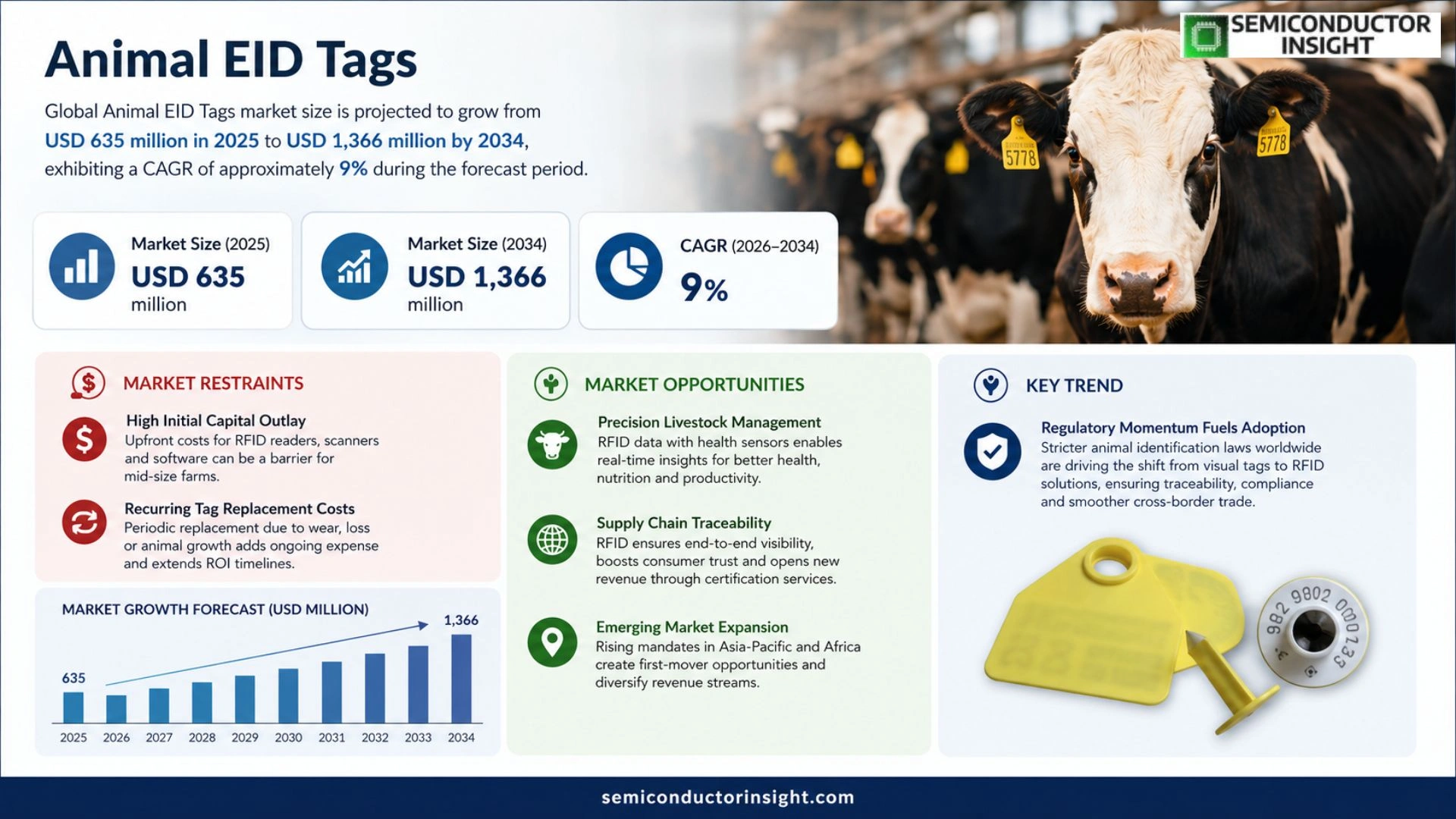
Global Animal EID Tags market size was valued at USD 635 million in 2025. The market is projected to grow from USD 635 million in 2025 to USD 1,366 million by 2034, exhibiting a CAGR of approximately 9 % during the forecast period.
Animal EID Tags are electronic identification devices that assign a unique digital identity to each animal through an embedded RFID microchip or transponder. The tags are integrated into ear‑tags, implants, boluses or external attachments and communicate wirelessly with handheld or fixed readers that comply with international RFID standards. By enabling real‑time tracking of movement, health status, breeding cycles and regulatory compliance, these tags support precision livestock management across cattle, sheep, goats, swine and companion‑animal sectors.
The expansion of the market stems from tightening government traceability mandates, heightened biosecurity concerns and growing adoption of data‑driven herd‑management platforms. While manufacturers focus on improving tag durability and signal stability under harsh farm conditions, downstream users benefit from reduced manual record‑keeping errors and faster disease‑outbreak response capabilities. Recent collaborations among leading RFID chip suppliers and livestock‑technology firms have accelerated integration of tags with weighing scales, herd‑management software and cloud‑based analytics, further cementing their role as essential infrastructure for modern animal agriculture.
MARKET DRIVERS
Regulatory Mandates Accelerate Adoption
Recent amendments to livestock traceability statutes across North America and Europe compel producers to embed RFID identifiers on each animal. This compliance pressure has turned passive tagging into a non‑negotiable expense, prompting equipment manufacturers to scale production and drive down unit costs for Animal EID Tags Market. The ripple effect is a faster shift from manual ear‑marking to electronic solutions.
Cost Efficiency Drives Farmer Adoption
Economic analyses reveal that farms integrating electronic identification experience a 12% reduction in labor hours related to animal inventory. The savings stem from automated data capture, streamlined health‑record updates, and fewer errors in feed allocation. As margins tighten, producers view RFID tags not as a cost but as a modest investment that safeguards profitability.
➤ Current surveys indicate that more than 70% of large‑scale dairy operations have transitioned to RFID‑based identification within the past three years.
The convergence of tighter regulation and demonstrable cost benefits creates a reinforcing loop: higher adoption rates attract further R&D funding, which in turn introduces more resilient tag designs suited for rugged farm environments, reinforcing growth momentum in Animal EID Tags Market.
MARKET CHALLENGES
Technical Integration Barriers
While RFID hardware has matured, many farms still operate legacy management platforms that cannot ingest tag data without custom middleware. The friction of retrofitting legacy systems discourages smaller operators from investing, limiting market penetration outside of large agribusinesses.
Other Challenges
Data Interoperability
Inconsistent tag data standards across regions generate duplicate entries when animals cross borders, hampering seamless traceability and inflating administrative overhead.
MARKET RESTRAINTS
High Initial Capital Outlay
Purchasing RFID readers, handheld scanners, and the accompanying software suites requires a sizeable upfront budget. For mid‑size farms operating on thin cash flows, the payback period can extend beyond three years, curbing immediate uptake of Animal EID Tags Market solutions.
Additionally, the need for periodic tag replacement,driven by wear, loss, or animal growth,adds recurring expense that some operators deem difficult to justify without clear, quantifiable ROI metrics.
MARKET OPPORTUNITIES
Precision Livestock Management Solutions
Integrating RFID data with real‑time health sensors unlocks a new tier of precision farming. By correlating tag identifiers with temperature, activity, and feed intake metrics, producers can predict disease outbreaks and optimize nutrition, creating a high‑value add‑on service that propels demand for advanced tags.
Supply chain traceability initiatives are gaining traction among retailers seeking consumer confidence. Embedding RFID identifiers at the farm level enables end‑to‑end visibility, opening revenue streams for tag suppliers that can bundle certification services with their hardware.
Emerging markets in Asia‑Pacific, especially Vietnam and Kenya, are witnessing policy shifts that mandate electronic tagging for meat export compliance. Early entry into these regions offers manufacturers a first‑mover advantage and diversifies the revenue base of Animal EID Tags Market.
Animal EID Tags Market Trends
Regulatory Momentum Fuels Adoption
The tightening of animal‑identification statutes across North America, Europe and parts of Asia is reshaping purchasing patterns for livestock producers. Mandatory tagging for disease traceability and export certification compels farms to replace legacy visual tags with RFID‑based solutions. This shift creates a steady pipeline of retrofit projects, especially among medium‑scale dairies that must align herd records with governmental databases. Suppliers that can certify compliance with international RFID standards enjoy a distinct advantage, because cross‑border interoperability reduces administrative friction for exporters. Consequently, Animal EID Tags Market is seeing a gradual but consistent influx of new entrants seeking to capture niche compliance‑driven demand.
Other Trends
Supply‑Chain Innovations
Manufacturers are redefining the upstream value chain by consolidating chip sourcing with polymer molding operations. The introduction of high‑yield antenna designs cuts material waste and improves signal stability in harsh barn environments. Simultaneously, advances in low‑temperature encapsulation extend tag life in extreme climates, reducing replacement cycles for outdoor herds. These engineering improvements translate into tighter gross margins, allowing producers to justify upfront expenditures through longer service intervals. Companies that invest in automated coding and calibration stations also accelerate time‑to‑market, a critical factor when government‑mandated rollout dates loom.
Integration with Precision Livestock Platforms
Beyond basic identification, RFID tags are increasingly embedded within broader data ecosystems that link herd‑management software, weigh‑in scales and health‑monitoring sensors. This convergence enables real‑time analytics on growth rates, reproductive cycles and pathogen exposure, turning each animal into a data point for farm‑level optimization. Providers that offer open APIs gain traction with technology‑forward growers, who seek to layer predictive models onto tag‑derived datasets. The resulting feedback loop,where insights drive management actions that improve animal welfare and productivity,creates a self‑reinforcing demand for richer tag functionality, positioning Animal EID Tags Market at the heart of next‑generation precision agriculture.
COMPETITIVE LANDSCAPE
Key Industry Players
Animal EID Tags Market Competitive Overview
Allflex, operating under MSD Animal Health, commands the largest share of global animal EID tag supply. Its portfolio spans passive ear‑tag transponders, active implantable modules and a suite of herd‑management software that integrates directly with major livestock data platforms. The company’s vertically integrated manufacturing line,from RFID chip procurement to polymer molding,delivers consistent margin performance while enabling rapid rollout of region‑specific compliance solutions. Allflex’s extensive R&D pipeline focuses on low‑frequency antenna designs that maintain read reliability under harsh barn conditions, reinforcing its position as the benchmark supplier for large‑scale dairy and beef operations.
Beyond the market leader, a cluster of specialists differentiates itself through niche capabilities. HID Global leverages its broader security‑credential portfolio to offer ultra‑high‑frequency readers that pair with standard tags, appealing to export‑oriented farms. Avery Dennison’s strength lies in high‑volume polymer extrusion, delivering cost‑effective passive tags for smallholder herds. Companies such as Shearwell Data, Caisley and Kupsan concentrate on custom coding and on‑tag printing services that support traceability mandates in Europe and Asia. ARDES and Dalton Tags emphasize ruggedized designs for feedlot environments, while CowManager integrates biometric sensors with EID technology to generate real‑time health alerts. Emerging innovators,including Somark Innovations, Moocall, Ceres Tag, Laipson Information Technology, Xiamen Innov Information Technology and Wuxi FOFLA Technology,focus on active‑powered implants, low‑cost pet identification solutions, and cloud‑based analytics that extend the value chain beyond simple identification.
List of Key Animal EID Tags Companies Profiled
- Allflex (MSD Animal Health)
- HID Global
- Avery Dennison
- Shearwell Data
- Caisley
- Kupsan
- ARDES
- Dalton Tags
- CowManager
- Somark Innovations
- Moocall
- Ceres Tag
- Laipson Information Technology
- Xiamen Innov Information Technology
- Wuxi FOFLA Technology
Segment Analysis:
| Segment Category | Sub-Segments | Key Insights |
| By Type |
|
Ear Tags remain the dominant type because they combine durability with low cost, and they fit seamlessly into existing livestock handling routines.
|
| By Application |
|
Animal Husbandry Management drives adoption as producers seek precise control over breeding cycles, health monitoring, and movement records.
|
| By End User |
|
Large‑scale Livestock Farms prioritize robust tag solutions that can endure harsh outdoor conditions and high animal densities.
|
| By Power Supply |
|
Passive tags dominate because they require no battery replacement, aligning with the low‑maintenance expectations of livestock producers.
|
| By Distribution Channel |
|
Specialized Distributors are critical for reaching fragmented farm segments where personal relationships and on‑site technical support influence purchase decisions.
|
Regional Analysis: Animal EID Tags Market
North America
The convergence of food safety legislation and consumer demand for provenance drives producers to embed electronic ID tags early in animal lifecycles. Operational efficiencies,such as automated feeding schedules linked to tag data,further incentivize adoption across dairy and swine sectors.
USDA’s mandatory RFID tagging for cattle over 12 months establishes a predictable demand floor, while state‑level traceability programs add granular compliance layers that manufacturers must support through firmware updates and data standards.
Low‑frequency passive RFID dominates beef operations for its reliability in harsh barn environments, whereas high‑frequency active tags are gaining favor in intensive poultry systems where real‑time location data adds operational value.
Market incumbents leverage vertically integrated manufacturing to secure cost advantages, while niche players differentiate through alloy‑based tags that resist corrosion, appealing to producers in humid climates.
Europe
European livestock producers encounter a patchwork of traceability mandates, ranging from the EU’s Animal Health Law to country‑specific RFID requirements for bovine and ovine sectors. The regulatory mosaic encourages manufacturers to offer region‑tailored solutions, often integrating Bluetooth Low Energy modules to satisfy both compliance and precision‑farming objectives. Sustainability agendas amplify interest in data‑driven herd health monitoring, prompting partnerships between tag vendors and agritech platforms that promise reduced antimicrobial usage. While market penetration lags behind North America, the convergence of stringent animal‑welfare standards and premium‑price incentives for traceable meat positions Europe as a growth frontier for advanced tagging solutions.
Asia‑Pacific
In the Asia‑Pacific corridor, rapid intensification of poultry and aquaculture farms creates a fertile ground for electronic identification technologies. Countries such as China and India are rolling out national livestock identification programs to curb zoonotic outbreaks, albeit at varying implementation speeds. Cultural preferences for small‑holder farming temper the pace of large‑scale tag deployment, yet the rise of cooperative farmer groups accelerates collective procurement. Vendors that can adapt tag form factors to diverse species,from swine to buffalo,and that supply low‑cost, battery‑free solutions are gaining footholds, especially where herd visibility directly influences export market access.
South America
South American cattle corridors, particularly Brazil and Argentina, are integrating electronic tags to satisfy export certifiers demanding full traceability from farm to fork. The region’s expansive pasture systems present logistical challenges, prompting a shift toward rugged, long‑range RFID tags that can be read from vehicles during roundup events. Local manufacturers are responding with domestically sourced materials, reducing lead times and price points. Concurrently, government‑led initiatives aim to formalize animal health records, offering a policy incentive that could convert a traditionally informal sector into a data‑rich environment.
Middle East & Africa
In the Middle East and Africa, Animal EID Tags Market faces a dual narrative of opportunity and constraint. Wealthier Gulf states are investing heavily in high‑tech ranches, adopting active RFID tags that integrate with satellite‑based herd tracking for desert‑based livestock. Conversely, sub‑Saharan markets contend with limited electrification and fragmented supply chains, driving demand for ultra‑low‑cost, passive tags that function without battery support. International development programs that link animal identification to veterinary outreach are gradually expanding adoption, especially where disease surveillance hinges on rapid animal identification.
Report Scope
This market research report provides a comprehensive analysis of the Animal EID Tags Market , covering the forecast period 2026–2034. It offers detailed insights into market dynamics, technological advancements, competitive landscape, and key trends shaping the industry.
Key focus areas of the report include:
- Market Overview: The report begins with an overview outlining its current market scenario, key growth indicators, and industry transformation drivers. It discusses macroeconomic factors, demand–supply balance, regulatory landscape, and the strategic role of semiconductors in powering advancements across industries such as automotive, telecommunications, consumer electronics, and industrial automation.
- Market Size & Forecast: Historical data and future projections for revenue, unit shipments, and market value across major regions and segments.
- Segmentation Analysis: Detailed breakdown by product type, technology, application, and end-user industry to identify high-growth segments and investment opportunities.
- Regional Insights: Insights into market performance across North America, Europe, Asia-Pacific, Latin America, and the Middle East & Africa, including country-level analysis where relevant.
- Competitive Landscape: Profiles of leading market participants, including their product offerings, R&D focus, manufacturing capacity, pricing strategies, and recent developments such as mergers, acquisitions, and partnerships.
- Technology Trends & Innovation: Assessment of emerging technologies, integration of AI/IoT, semiconductor design trends, fabrication techniques, and evolving industry standards.
- Market Drivers & Restraints: Evaluation of factors driving market growth along with challenges, supply chain constraints, regulatory issues, and market-entry barriers.
- Stakeholder Insights: Insights for component suppliers, OEMs, system integrators, investors, and policymakers regarding the evolving ecosystem and strategic opportunities.
Primary and secondary research methods are employed, including interviews with industry experts, data from verified sources, and real-time market intelligence to ensure the accuracy and reliability of the insights presented.
FREQUENTLY ASKED QUESTIONS:
What is the current market size of Animal EID Tags Market?
-> Animal EID Tags Market was valued at USD 635 million in 2025 and is expected to reach USD 1150 million by 2032, growing at a CAGR of 9.0%
Which key companies operate in Animal EID Tags Market?
-> Key players include Allflex (MSD Animal Health), HID Global, Avery Dennison, Shearwell Data, Caisley, Kupsan, ARDES, Dalton Tags, CowManager, Somark Innovations, Moocall, Ceres Tag, Laipson Information Technology, Xiamen Innov Information Technology, Wuxi FOFlA Technology.
What are the key growth drivers?
-> Key growth drivers include increasing regulatory requirements for animal identification, heightened disease monitoring needs, food supply chain transparency demands, and the shift from manual to digital herd management enabled by RFID and traceability platforms.
Which region dominates the market?
-> North America and Europe are the largest markets due to mature livestock industries and stringent traceability regulations, while Asia is emerging rapidly driven by expanding livestock production and government‑backed identification programs.
What are the emerging trends?
-> Emerging trends include integration of RFID tags with IoT‑enabled herd management software, AI‑driven health monitoring, and cloud‑based traceability databases that provide real‑time animal lifecycle data.

Get Sample Report PDF for Exclusive Insights
Report Sample Includes
- Table of Contents
- List of Tables & Figures
- Charts, Research Methodology, and more...
 Download Sample Report PDF