MARKET INSIGHTS
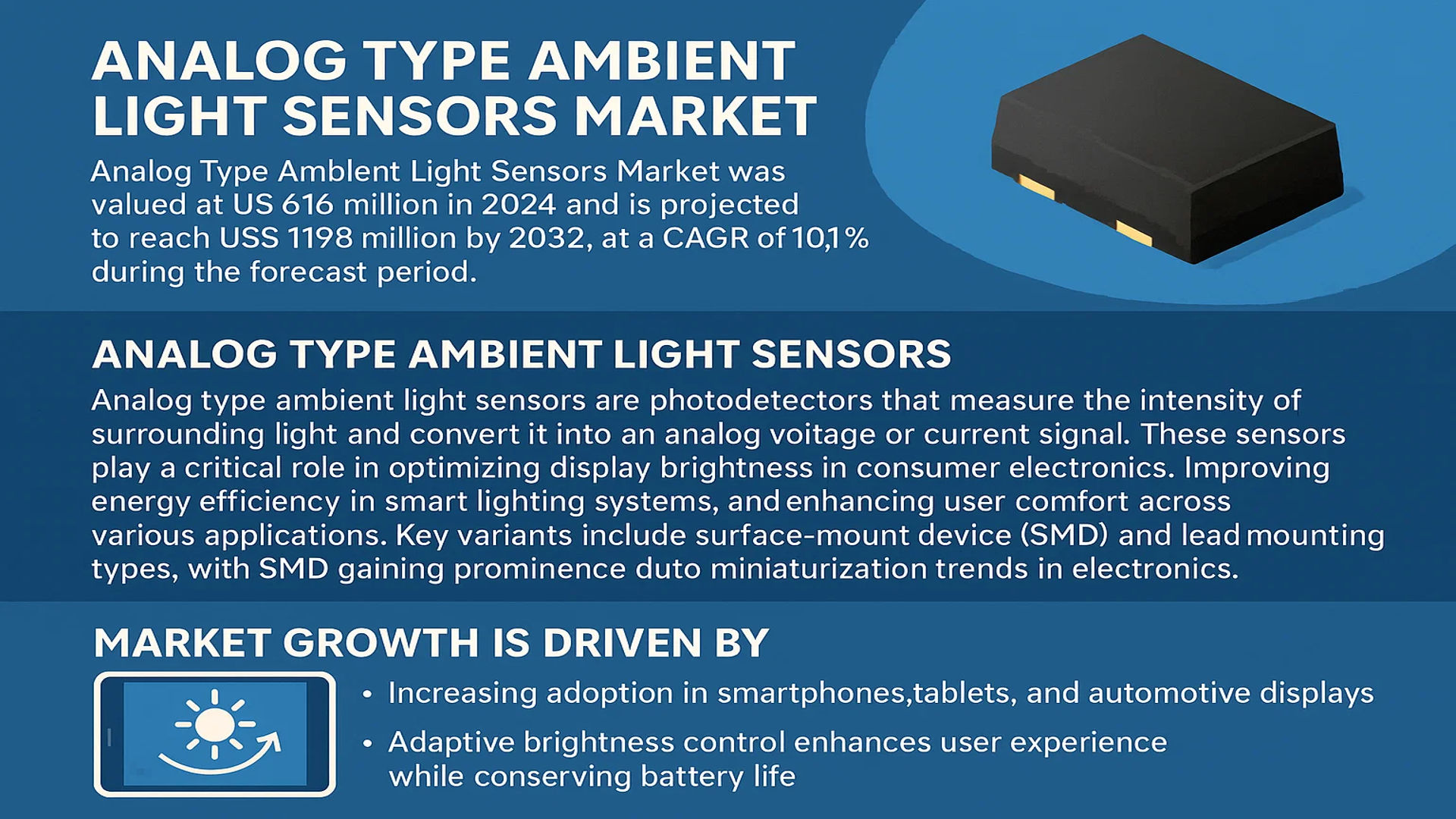
The global Analog Type Ambient Light Sensors Market was valued at 616 million in 2024 and is projected to reach US$ 1198 million by 2032, at a CAGR of 10.1% during the forecast period.
Analog type ambient light sensors are photodetectors that measure the intensity of surrounding light and convert it into an analog voltage or current signal. These sensors play a critical role in optimizing display brightness in consumer electronics, improving energy efficiency in smart lighting systems, and enhancing user comfort across various applications. Key variants include surface-mount device (SMD) and leaded mounting types, with SMD gaining prominence due to miniaturization trends in electronics.
Market growth is driven by increasing adoption in smartphones, tablets, and automotive displays, where adaptive brightness control enhances user experience while conserving battery life. However, the industry faces challenges from the rising popularity of digital light sensors, which offer superior precision and integration capabilities. Leading manufacturers including Ams OSRAM AG, Texas Instruments, and STMicroelectronics are investing in advanced fabrication technologies to improve sensor sensitivity and reduce power consumption, further propelling market expansion.
MARKET DYNAMICS
MARKET DRIVERS
Proliferation of Smart Devices to Fuel Analog Ambient Light Sensor Demand
The exponential growth in smart devices, particularly smartphones and tablets, is a primary driver for the analog ambient light sensor market. These sensors play a crucial role in optimizing display brightness based on environmental lighting conditions – enhancing user experience while conserving battery life. With global smartphone shipments exceeding 1.4 billion units annually, the demand for energy-efficient display management solutions has never been higher. Manufacturers are increasingly integrating these sensors across mid-range and premium devices to deliver automatic brightness adjustment features that consumers now expect as standard.
Energy Efficiency Regulations Accelerating Market Adoption
Stringent energy efficiency standards worldwide are compelling device manufacturers to incorporate ambient light sensors into their products. The sensors’ ability to dynamically adjust backlight intensity can reduce display power consumption by up to 30%, making them invaluable for compliance with evolving environmental regulations. In the automotive sector, similar regulations are driving adoption as manufacturers seek to optimize instrument cluster and infotainment system power usage. The convergence of regulatory requirements and consumer demand for sustainable products creates powerful market momentum for analog ambient light sensor solutions.
Advancements in IoT and Smart Home Technologies Creating New Applications
The rapid expansion of IoT ecosystems presents significant growth opportunities for analog ambient light sensors. These components are becoming integral to smart lighting systems that automatically adjust based on natural light availability, potentially reducing energy consumption in commercial and residential buildings by significant margins. The growing smart home market, projected to exceed US$ 390 billion by 2030, relies heavily on ambient light sensing for automated environment controls. Device manufacturers are developing sensors with improved sensitivity and faster response times to meet the exacting requirements of next-generation IoT applications.
MARKET RESTRAINTS
Pricing Pressures from Digital Sensor Alternatives Challenge Market Growth
While analog ambient light sensors maintain certain performance advantages, they face intensifying competition from digital alternatives that offer integrated signal processing capabilities. The digital sensors’ ability to provide direct digital output eliminates the need for additional analog-to-digital conversion components in many applications, potentially reducing overall system costs. This price-performance tradeoff creates significant challenges for analog sensor manufacturers, particularly in price-sensitive consumer electronics segments where component cost reductions are aggressively pursued.
Integration Complexities in Miniaturized Designs Pose Implementation Challenges
The relentless drive toward smaller form factors in consumer electronics presents technical hurdles for analog ambient light sensor implementation. As device footprints shrink, designers face difficulties in achieving optimal sensor placement to ensure accurate ambient light measurement while avoiding interference from internal light sources. Additionally, analog sensor designs must contend with electromagnetic interference in densely packed circuit boards, requiring careful shielding and layout considerations that can increase development complexity and time-to-market for new products.
Inherent Limitations in Measurement Accuracy Create Application Constraints
Analog ambient light sensors, while cost-effective, face inherent limitations in measurement precision compared to more sophisticated digital alternatives. This accuracy gap becomes particularly apparent in applications requiring high dynamic range or extremely low-light detection capabilities. In automotive applications, for instance, the sensors must reliably operate across illumination levels ranging from bright sunlight to moonlit conditions, pushing analog designs to their performance limits. These technological constraints may lead some manufacturers to adopt hybrid or all-digital solutions for demanding applications.
MARKET OPPORTUNITIES
Emerging Applications in Healthcare Present New Growth Avenues
The healthcare sector offers substantial opportunities for analog ambient light sensor deployment in medical devices and monitoring equipment. These sensors are finding applications in sleep monitoring devices that track environmental light exposure patterns, as well as in diagnostic equipment requiring consistent illumination conditions. The ability to provide reliable light measurement at lower cost points makes analog sensors particularly attractive for disposable or single-use medical devices where component economics are critical.
Automotive Interior Sensing Revolution Creates Demand Surge
The automotive industry’s shift toward smart interior environments presents significant opportunities for analog ambient light sensor manufacturers. Modern vehicles increasingly incorporate ambient lighting systems that automatically adjust based on external conditions, requiring multiple light sensing points throughout the cabin. Additionally, the growth of advanced driver assistance systems (ADAS) creates demand for reliable ambient light measurement to optimize display visibility and camera-based systems. The automotive sector’s stringent reliability requirements provide a competitive advantage to established sensor manufacturers with proven quality standards.
Industrial Automation and Smart Infrastructure Expansion Drive New Use Cases
The industrial sector’s accelerating automation trends and smart city initiatives are creating novel applications for ambient light sensing technology. In industrial settings, these sensors enable optimized lighting control in warehouses and manufacturing facilities to enhance worker safety and energy efficiency. Municipal smart lighting projects utilize ambient light sensors to dynamically adjust public street lighting based on natural light conditions and pedestrian activity. The industrial market’s emphasis on robustness and long-term reliability aligns well with the inherent durability of well-designed analog sensor solutions.
MARKET CHALLENGES
Supply Chain Vulnerabilities Impact Component Availability
The semiconductor industry’s ongoing supply chain disruptions continue to affect analog ambient light sensor availability, particularly for specialized components requiring specific fabrication processes. Manufacturers face challenges in securing stable supplies of photodiodes and other critical sensor elements, leading to extended lead times and allocation scenarios. These supply constraints are further compounded by fluctuating demand patterns across different end-use sectors, making inventory management and production planning increasingly complex for sensor suppliers.
Rapid Technological Evolution Requires Continuous R&D Investment
The fast-paced advancement in sensing technologies demands substantial ongoing R&D investment to maintain competitiveness. Analog sensor manufacturers must continuously improve sensitivity, reduce power consumption, and enhance environmental robustness while keeping costs in check. This innovation imperative places significant financial pressure on industry players, particularly smaller suppliers competing against larger semiconductor companies with broader product portfolios and deeper R&D resources.
Standardization Gaps Create Implementation Hurdles
The lack of universal standards for ambient light sensor performance characterization and interface protocols creates adoption challenges across the industry. Device manufacturers must contend with varying sensor output characteristics, calibration requirements, and interface protocols that complicate design integration. This standardization gap increases development time and cost, potentially slowing market growth as designers evaluate multiple sensor alternatives for each new application.
ANALOG TYPE AMBIENT LIGHT SENSORS MARKET TRENDS
Increasing Demand for Energy Efficiency in Consumer Electronics Drives Market Growth
The rise in demand for energy-efficient devices has significantly accelerated the adoption of analog ambient light sensors, particularly in consumer electronics. These sensors optimize screen brightness based on surrounding light conditions, reducing power consumption in smartphones, tablets, and laptops. With the consumer electronics sector projected to grow at a steady rate, manufacturers are integrating high-precision light sensors for enhanced user experience. The inclusion of these sensors in wearables, such as smartwatches and fitness trackers, further underscores their importance in power management solutions.
Other Trends
Automotive Sector Embraces Smart Lighting Solutions
The automotive industry is increasingly incorporating analog ambient light sensors for adaptive interior and exterior lighting systems, enhancing both energy efficiency and safety. Key applications include automatic dashboard illumination adjustment and dynamic headlight control, which ensure optimal visibility for drivers. As luxury and mid-range vehicles integrate more IoT-based smart lighting features, the demand for reliable analog light sensors is expected to grow considerably in this segment.
Expansion of Smart Home and IoT Applications
The proliferation of smart home systems and IoT devices has fueled the need for ambient light sensing technologies. These sensors enable intelligent lighting systems to adjust brightness automatically, improving comfort while minimizing energy waste. Furthermore, advancements in sensor accuracy and low-power operation have made them indispensable in smart thermostats, security systems, and voice-controlled home assistants. With smart home adoption increasing globally, the market for analog ambient light sensors is set to expand significantly.
COMPETITIVE LANDSCAPE
Key Industry Players
Leading Manufacturers Focus on Innovation to Capture Market Share
The global analog type ambient light sensors market exhibits a competitive yet fragmented landscape, with key players vying for dominance through technological advancements and strategic partnerships. AMS OSRAM AG and Texas Instruments currently lead the market, collectively accounting for a significant revenue share in 2024. These companies maintain their leadership positions through continuous R&D investments and extensive product portfolios that cater to multiple industries, including consumer electronics and automotive applications.
ROHM Semiconductor has emerged as another strong contender, particularly in the Asian market, where its high-performance ambient light sensors are widely adopted in smartphone and display applications. Meanwhile, ON Semiconductor has strengthened its foothold through strategic acquisitions and expansion of its sensor solutions portfolio, enabling it to address growing demand across industrial and healthcare sectors.
The competitive intensity is further heightened by mid-sized players like Vishay Intertechnology and Broadcom, which are focusing on developing energy-efficient solutions for IoT applications. These companies are leveraging their expertise in semiconductor technology to create sensors with improved accuracy and lower power consumption, factors that are becoming increasingly critical in battery-powered devices.
Market players are also adopting collaborative strategies, with several sensor manufacturers forming partnerships with display panel and automobile component suppliers. Such alliances help sensor companies integrate their solutions more effectively into end-use products while giving them access to new customer bases. The trend toward miniaturization and smart home applications has prompted additional innovation, with companies racing to develop smaller form factor sensors without compromising performance.
List of Key Analog Type Ambient Light Sensor Manufacturers
- ams OSRAM AG (Austria)
- Analog Devices, Inc. (U.S.)
- Bourns, Inc. (U.S.)
- Broadcom Inc. (U.S.)
- Honeywell International Inc. (U.S.)
- Infineon Technologies AG (Germany)
- Maxim Integrated (U.S.)
- NXP Semiconductors N.V. (Netherlands)
- ON Semiconductor (U.S.)
- ROHM Semiconductor (Japan)
- Sharp Corporation (Japan)
- STMicroelectronics (Switzerland)
- Texas Instruments Incorporated (U.S.)
- Toshiba Electronic Devices & Storage Corporation (Japan)
- Vishay Intertechnology, Inc. (U.S.)
Segment Analysis:
By Type
SMD Mounting Type Segment Dominates Market Due to High Adoption in Compact Electronics
The market is segmented based on mounting type into:
- SMD Mounting Type
- Subtypes: Chip-scale packages, leadless packages
- Leaded Mounting Type
- Subtypes: Through-hole, surface mount
- Hybrid Mounting
By Application
Consumer Electronics Segment Leads Due to Widespread Use in Smart Devices
The market is segmented based on application into:
- Consumer Electronics
- Subtypes: Smartphones, tablets, laptops, TVs
- Automotive
- Subtypes: Dashboard displays, infotainment systems
- Healthcare
- Subtypes: Medical displays, diagnostic equipment
- Aerospace and Defense
- Retail
By Technology
Silicon Photodiode Technology Prevails Due to Cost-Effectiveness
The market is segmented based on technology into:
- Silicon Photodiodes
- Cadmium Sulfide (CdS) Photocells
- Gallium Nitride (GaN) Sensors
- Organic Sensors
By Output Type
Voltage Output Segment Maintains Dominance for Easy Integration
The market is segmented based on output type into:
- Voltage Output
- Current Output
- Digital Output (with integrated ADC)
Regional Analysis: Analog Type Ambient Light Sensors Market
Asia-Pacific
The Asia-Pacific region is the largest and fastest-growing market for Analog Type Ambient Light Sensors, driven by the robust expansion of consumer electronics and automotive industries. Countries like China, Japan, South Korea, and India dominate demand due to high smartphone penetration, IoT adoption, and increasing smart lighting applications. China alone contributes over 40% of the regional market share, supported by its strong semiconductor manufacturing ecosystem. While cost-effective SMD-mounted sensors are widely preferred, there is growing demand for high-precision variants in automotive display applications. However, supply chain disruptions and component shortages occasionally hinder market stability.
North America
North America remains a technology leader in analog ambient light sensor adoption, with the U.S. accounting for the majority of regional demand. The market is characterized by stringent regulatory standards for energy efficiency in devices, pushing manufacturers toward advanced sensor solutions. Applications in automotive infotainment systems and smart home devices are primary growth drivers. Key players like Texas Instruments and Broadcom maintain strong R&D investments in the region. A shift toward lead-free and miniaturized sensors is gaining momentum, though higher costs compared to Asian alternatives pose a challenge for mass-market adoption.
Europe
Europe’s market growth is fueled by the automotive sector’s emphasis on driver-assistance systems and EU-mandated energy efficiency standards for consumer electronics. Germany and France lead in technological adoption, particularly in luxury vehicles and industrial automation. The region shows strong preference for analog sensors with integrated functions (e.g., IR rejection) despite their premium pricing. Environmental directives like RoHS and WEEE influence material choices, making compliance a key competitive differentiator. However, slower replacement cycles for consumer electronics compared to Asia limit volume growth potential.
South America
The South American market is emerging, with Brazil and Argentina showing gradual uptake in consumer electronics manufacturing. Economic volatility and import dependency constrain market expansion, though local assembly of automotive components creates niche opportunities. Price sensitivity leads to dominance of basic analog sensor models, with limited adoption of advanced features. Infrastructure challenges in rural areas also restrict smart lighting applications. Nonetheless, urban modernization projects and increasing smartphone affordability indicate long-term growth potential.
Middle East & Africa
This region presents a developing market, with growth concentrated in GCC countries and South Africa. Demand is primarily driven by smart city initiatives and luxury automotive imports. The lack of local semiconductor production results in complete import reliance, making the market vulnerable to global supply fluctuations. High disposable income in oil-rich nations supports premium electronics adoption, whereas broader market penetration faces hurdles due to economic disparities. Strategic partnerships between global sensor manufacturers and regional distributors are slowly improving market accessibility.
Report Scope
This market research report provides a comprehensive analysis of the Global Analog Type Ambient Light Sensors market, covering the forecast period 2024–2032. It offers detailed insights into market dynamics, technological advancements, competitive landscape, and key trends shaping the industry.
Key focus areas of the report include:
- Market Size & Forecast: Historical data and future projections for revenue, unit shipments, and market value across major regions and segments. The global market was valued at USD 616 million in 2024 and is projected to reach USD 1198 million by 2032, growing at a CAGR of 10.1%.
- Segmentation Analysis: Detailed breakdown by product type (SMD Mounting Type, Leaded Mounting Type), application (Consumer Electronics, Automotive, Healthcare, Aerospace & Defense, Retail), and end-user industry to identify high-growth segments.
- Regional Outlook: Insights into market performance across North America, Europe, Asia-Pacific, Latin America, and Middle East & Africa. The U.S. and China are key growth markets.
- Competitive Landscape: Profiles of 15+ leading market participants including ams OSRAM AG, Analog Devices, Broadcom, Infineon Technologies, and Texas Instruments, covering their product portfolios, market share, and strategic developments.
- Technology Trends: Assessment of emerging innovations in light sensing technology, integration with IoT devices, and energy-efficient solutions.
- Market Drivers & Restraints: Evaluation of factors such as growing demand for smart displays, automotive applications, along with challenges like supply chain constraints and pricing pressures.
- Stakeholder Analysis: Strategic insights for sensor manufacturers, OEMs, system integrators, and investors regarding market opportunities.
The research methodology combines primary interviews with industry experts and analysis of verified market data from reliable sources to ensure accuracy and reliability.
FREQUENTLY ASKED QUESTIONS:
What is the current market size of Global Analog Type Ambient Light Sensors Market?
-> Analog Type Ambient Light Sensors Market was valued at 616 million in 2024 and is projected to reach US$ 1198 million by 2032, at a CAGR of 10.1% during the forecast period.
Which key companies operate in this market?
-> Leading players include ams OSRAM AG, Analog Devices, Broadcom, Infineon Technologies, Texas Instruments, ON Semiconductor, and STMicroelectronics.
What are the key growth drivers?
-> Growth is driven by increasing demand for smart displays, automotive applications, and energy-efficient IoT devices.
Which region dominates the market?
-> Asia-Pacific leads in both production and consumption, while North America shows strong growth in automotive applications.
What are the emerging trends?
-> Emerging trends include miniaturization of sensors, integration with AI-based systems, and development of ultra-low-power solutions.

Get Sample Report PDF for Exclusive Insights
Report Sample Includes
- Table of Contents
- List of Tables & Figures
- Charts, Research Methodology, and more...