
Aluminum Alloy Vacuum Chamber Market Insights
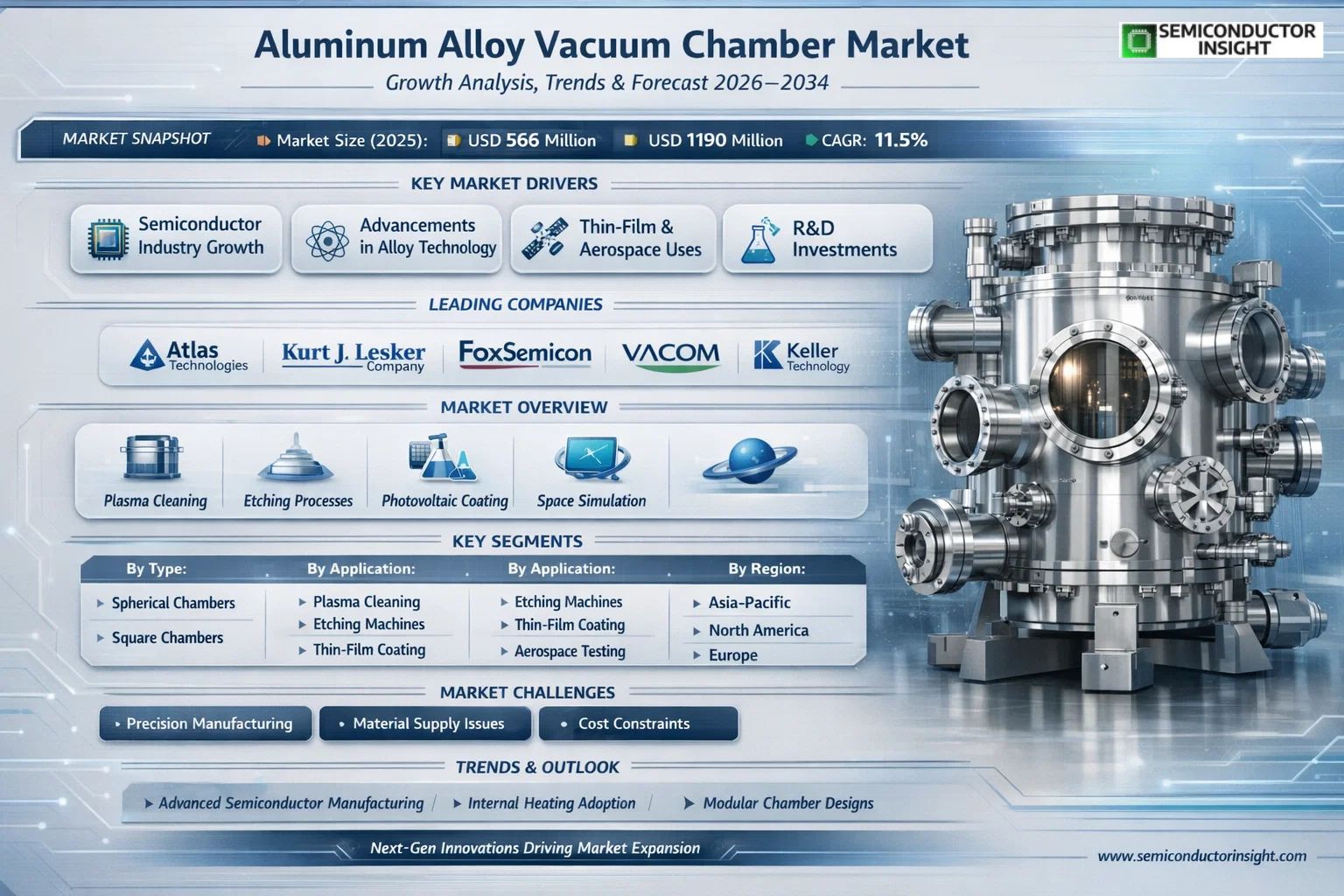
Global Aluminum Alloy Vacuum Chamber market size was valued at USD 566 million in 2025. The market is projected to grow from USD 631 million in 2026 to USD 1,190 million by 2034, exhibiting a CAGR of 11.5% during the forecast period.
Aluminum alloy vacuum chambers are specialized enclosures designed to maintain a high or ultra-high vacuum environment for critical industrial and research processes. These chambers are essential components in semiconductor manufacturing, particularly for plasma cleaning and etching machines, where they provide a controlled atmosphere free of contaminants. Their construction from aluminum alloys offers advantages such as excellent thermal conductivity, good machinability, and favorable outgassing properties after proper surface treatment.
The market is experiencing robust growth due to several factors, including the relentless expansion of the global semiconductor industry and increasing investments in advanced electronics manufacturing. Furthermore, the rising adoption of these chambers in emerging applications like aerospace component testing and thin-film coating for photovoltaics is contributing to market expansion. Initiatives by key players to develop larger, more complex chambers for next-generation chip fabrication are also expected to fuel market growth. For instance, leading suppliers are continuously innovating to meet the stringent purity and precision requirements of sub-7nm and smaller semiconductor nodes. Atlas Technologies, Kurt J. Lesker Company, and VACOM GmbH are some of the key players that operate in the market with a wide range of portfolios.
MARKET DRIVERS
Growing Demand from Advanced Manufacturing and R&D
The expansion of Global Aluminum Alloy Vacuum Chamber market is propelled by its critical role in high-technology sectors. These chambers, prized for their excellent strength-to-weight ratio and superior thermal conductivity, are essential in semiconductor fabrication, thin-film coating, and space simulation. The relentless miniaturization of electronics demands ultra-high vacuum environments, which these specialized chambers reliably provide. Investment in research and development for quantum computing and advanced materials science further solidifies their necessity in modern industrial processes.
Advancements in Aluminum Alloy Technology
Technological improvements in material science directly drive market growth. The development of novel aluminum alloys with enhanced outgassing properties, greater corrosion resistance, and improved machinability allows for the production of more reliable and durable vacuum chambers. This evolution enables longer operational lifespans and lower maintenance costs, making Aluminum Alloy Vacuum Chamber solutions economically attractive for a broader range of applications, from academic laboratories to industrial production lines.
➤ The shift towards modular and customizable chamber designs is a significant trend, allowing for rapid system integration and adaptation to specific research or production needs.
The overarching push for sustainability and energy efficiency in manufacturing also contributes. Aluminum is highly recyclable, and the efficient thermal management of these chambers can reduce overall energy consumption in processes like physical vapor deposition (PVD), aligning with global environmental, social, and governance (ESG) investment criteria.
MARKET CHALLENGES
High Precision Manufacturing and Quality Control Hurdles
Manufacturing a high-integrity Aluminum Alloy Vacuum Chamber presents significant technical challenges. Achieving and maintaining the necessary ultra-high vacuum (UHV) or extreme high vacuum (XHV) conditions requires flawless welding techniques, such as electron beam or TIG welding, to prevent virtual leaks. Every seam and fitting must be engineered to micron-level precision, making the production process capital-intensive and reliant on highly skilled labor. Any defect can lead to costly system failures and production downtime for end-users.
Other Challenges
Competition from Alternative Materials
While aluminum alloys offer distinct advantages, they face competition from stainless steel and specialized ceramics in certain high-temperature or corrosive applications, requiring continuous innovation to justify their use-case superiority.
Supply Chain and Raw Material Volatility
The market is sensitive to fluctuations in the prices and availability of high-grade aluminum and specialty alloying elements. Geopolitical tensions and trade policies can disrupt the supply of these critical raw materials, impacting production schedules and final costs for the Aluminum Alloy Vacuum Chamber Market.
MARKET RESTRAINTS
High Initial Investment and Economic Sensitivity
The capital expenditure required for high-performance vacuum chamber systems, particularly those made from specialized aluminum alloys, is substantial. This high entry cost can restrain adoption, especially among small to medium-sized enterprises and academic institutions with limited budgets. Furthermore, the market is closely tied to cyclical investment in its core end-user industries, such as semiconductor capital equipment and aerospace. During economic downturns, capital spending in these sectors often contracts, directly impacting demand for new chamber installations and upgrades.
Technical Complexity in System Integration
A significant restraint is the complexity involved in integrating a vacuum chamber into a larger operational system. It requires precise compatibility with pumps, gauges, feedthroughs, and process tools. This complexity necessitates extensive engineering support and can lead to prolonged installation and commissioning times, acting as a barrier for faster market penetration and scalability for manufacturers in the Aluminum Alloy Vacuum Chamber Market.
MARKET OPPORTUNITIES
Expansion into Emerging Technological Frontiers
The rise of frontier technologies presents substantial growth avenues. The burgeoning fields of nuclear fusion research and satellite constellation deployment create unprecedented demand for large-scale, lightweight vacuum testing environments. Aluminum alloy chambers are ideally suited for these applications due to their scalability and material properties. Similarly, the growth of the electric vehicle battery industry drives need for precision coating and drying processes conducted under vacuum, opening a new volume market for chamber manufacturers.
Adoption of Smart Manufacturing and IoT Integration
The integration of Industry 4.0 principles offers a transformative opportunity. Incorporating sensors for real-time monitoring of pressure, temperature, and structural integrity can transform a passive chamber into a smart component. This enables predictive maintenance, optimizes process control, and provides valuable data analytics, creating a premium market segment for connected Aluminum Alloy Vacuum Chamber systems that offer greater operational efficiency and reduced total cost of ownership.
Geographic Market Diversification
While established markets in North America, Europe, and parts of Asia remain strong, significant untapped potential exists in emerging economies. Government initiatives in countries like India and those in Southeast Asia to build domestic semiconductor and aerospace capabilities are fostering new demand. Establishing local manufacturing partnerships or service centers in these regions represents a strategic opportunity for market expansion in Global Aluminum Alloy Vacuum Chamber market.
Aluminum Alloy Vacuum Chamber Market Trends
Expansion in Advanced Semiconductor Manufacturing
Global Aluminum Alloy Vacuum Chamber market is experiencing robust growth, fueled by its critical role in the semiconductor industry. These chambers are fundamental to the manufacturing processes of plasma cleaning and etching machines, essential for producing components in the LCD, LED, and integrated circuit sectors. The precision engineering of aluminum alloy vacuum chambers provides the necessary cleanliness stability for advanced processes, supporting the production of next-generation devices. Major regions like the United States and China are significant contributors to this expansion, with both industrial capacity and technological demand shaping the market’s trajectory as new semiconductor fabs come online worldwide.
Other Trends
Heating Technology Evolution
A notable trend within the Aluminum Alloy Vacuum Chamber market is the increasing adoption of internal heating methods over traditional external heating. Internal heating allows for direct heat application within the chamber, offering superior temperature control precision and faster response times compared to the conductive and radiative heat transfer of external systems. This enhanced control is critical for process repeatability in sensitive vacuum applications such as thin-film deposition and surface treatment, driving manufacturers to innovate and design chambers that optimize thermal management for higher yields and efficiency.
Segmentation and Competitive Landscape Trends
The market structure is diversifying by product type, with spherical and square vacuum chambers serving distinct applications. The competitive landscape is consolidated among key global manufacturers like Atlas Technologies, Kurt J. Lesker, and Vacgen, which focus on technological advancement and strategic growth to maintain their positions. Continuous investment in research and development is aimed at improving chamber reliability, vacuum integrity, and compatibility with emerging process chemistries. This dynamic environment encourages collaboration and specialization, ensuring the Aluminum Alloy Vacuum Chamber market evolves to meet the stringent demands of high-tech manufacturing sectors globally.
COMPETITIVE LANDSCAPE
Key Industry Players
A Consolidated Market Driven by High-Tech Manufacturing Demand
Global Aluminum Alloy Vacuum Chamber market presents a competitive structure characterized by a mix of established global leaders and specialized technology suppliers. Atlas Technologies, Kurt J. Lesker, and Ferrotec are among the dominant entities, leveraging extensive R&D capabilities and long-standing relationships within the high-precision manufacturing sectors, primarily semiconductor fabrication. The top five players collectively held a significant revenue share in the recent market landscape. These leading manufacturers benefit from vertically integrated production processes and a deep understanding of application-specific requirements in plasma cleaning and etching machines, which are critical for LCD, LED, and IC packaging processes.
Beyond the market leaders, a tier of specialized and regional players competes effectively in niche segments. Companies like Vacgen, VACOM, and Foxsemicon focus on delivering high-performance standard and customized chambers, often with advantages in specific regional supply chains or material processing technologies. Firms such as Diener Electronic and GNB Corporation are recognized for their expertise in integrated systems, particularly those involving internal heating methods which offer superior temperature control accuracy. The market’s growth, projected to reach approximately US$ 1190 million by 2034, continues to attract technological refinement and competition, particularly from Asian manufacturers strengthening their presence in the global supply chain.
List of Key Aluminum Alloy Vacuum Chamber Companies Profiled
- Atlas Technologies
- Kurt J. Lesker Company
- Ferrotec Corporation
- Vacgen Ltd.
- Foxsemicon Integrated Technology Inc.
- VACOM GmbH
- Keller Technology Corporation
- Diener Electronic GmbH + Co. KG
- GNB Corporation
- Chung-Hsin Electric and Machinery Manufacturing Corp. (CHEM)
- Htc Vacuum Products
- Changqiao Vacuum Technology
- Pfeiffer Vacuum (Assumed significant player)
- ULVAC, Inc. (Assumed significant player)
- Shimadzu Corporation (Assumed significant player)
Segment Analysis:
| Segment Category | Sub-Segments | Key Insights |
| By Type |
|
Spherical Vacuum Chamber has emerged as a significant design category favored for applications requiring superior structural integrity and uniform stress distribution under high vacuum conditions.
|
| By Application |
|
Plasma Cleaning Machine applications represent the dominant and most mature end-use for aluminum alloy vacuum chambers, driving a substantial portion of market demand.
|
| By End User |
|
Semiconductor Fabrication Facilities (Fabs) are the primary and most demanding end-user segment, setting the technological and quality benchmarks for the entire market.
|
| By Heating Method |
|
Internal Heating is increasingly preferred for applications demanding high precision and rapid thermal response, marking a key technological distinction in chamber performance.
|
| By System Integration Level |
|
Customized & Application-Specific Chambers represent a high-growth, value-added segment as end-users seek optimized solutions for unique process challenges.
|
Regional Analysis: Global
Asia-Pacific
The region’s unparalleled manufacturing ecosystem for electronics and semiconductors provides an integrated supply chain for vacuum chamber components. This proximity reduces lead times and costs for end-users, solidifying its position as the primary production and consumption hub for the Aluminum Alloy Vacuum Chamber market.
Substantial state funding for national science and technology programs actively promotes the development of next-generation manufacturing equipment. This policy-driven environment accelerates the adoption of advanced Aluminum Alloy Vacuum Chamber technologies in cutting-edge fields like quantum computing and advanced packaging.
Beyond semiconductors, thriving industries in electric vehicle battery production, flat-panel displays, and satellite manufacturing contribute to a diversified and resilient demand base for high-grade aluminum alloy vacuum chambers, mitigating reliance on any single application.
A dense concentration of both large multinational equipment makers and agile local fabricators creates a highly competitive vendor environment. This competition drives rapid iterations in chamber design, focusing on improved thermal management, corrosion resistance, and ultra-high vacuum compatibility.
North America
The North American market for Aluminum Alloy Vacuum Chambers is characterized by high-value, research-intensive applications and stringent performance requirements. The United States is the core driver, with its world-leading aerospace, defense, and advanced physics research sectors demanding chambers for satellite testing, thin-film coating for optics, and particle accelerator components. Innovation here focuses on custom, large-scale, and highly specialized chambers that can withstand extreme conditions. While manufacturing volume may be lower than in Asia-Pacific, the region commands a premium for its technological sophistication and is a critical center for pioneering the next generation of applications that later diffuse globally.
Europe
Europe maintains a strong, innovation-driven position in the Aluminum Alloy Vacuum Chamber market, centered around precision engineering, advanced materials science, and sustainable manufacturing initiatives. Germany, the UK, and France are key contributors, with demand stemming from the automotive industry’s shift towards electric powertrains, the thriving pharmaceutical and medical device sectors requiring coating processes, and fundamental research at institutions like CERN. European manufacturers are renowned for their expertise in complex welding techniques, surface finishing, and adherence to rigorous international vacuum standards, catering to customers who prioritize reliability, precision, and long-term operational stability over lowest cost.
South America
The Aluminum Alloy Vacuum Chamber market in South America is emerging, with growth primarily linked to regional investments in mining technology, agricultural research, and gradual industrial modernization. Brazil is the most significant market, where chambers are utilized in R&D for new materials and in analytical laboratories servicing the mining and energy sectors. The market is currently defined by import dependency for high-end systems, but local fabrication capabilities for standard and mid-range chamber requirements are developing. Growth is steady but paced by broader economic conditions and the rate of technological adoption in local manufacturing and scientific communities.
Middle East & Africa
This region represents a nascent but strategically growing segment of the global market, with potential driven by economic diversification agendas. In the Middle East, investments in aerospace, satellite programs, and downstream petrochemical research are creating new demand for specialized vacuum processing equipment. The Aluminum Alloy Vacuum Chamber market here is project-based and often tied to large-scale national infrastructure or research initiatives. In Africa, development is at an early stage, focusing primarily on academic and research institutions, with adoption in industrial settings gradually increasing as manufacturing bases expand.
Report Scope
This market research report provides a comprehensive analysis of the Aluminum Alloy Vacuum Chamber Market, covering the forecast period 2026–2034. It offers detailed insights into market dynamics, technological advancements, the competitive landscape, and key trends shaping the industry.
Key focus areas of the report include:
- Market Overview: The report begins with an overview outlining the current market scenario, key growth indicators, and industry transformation drivers. It discusses macroeconomic factors, demand-supply dynamics, the regulatory landscape, and the strategic role of vacuum technologies in powering advancements across industries such as semiconductors, electronics, and advanced materials.
- Market Size & Forecast: Historical data and future projections for revenue, unit shipments, and market value across major regions and segments.
- Segmentation Analysis: Detailed breakdown by product type (e.g., Spherical, Square), application (e.g., Plasma Cleaning Machine, Etching Machine), and end-user industry to identify high-growth segments and investment opportunities.
- Regional Insights: Insights into market performance across North America, Europe, Asia-Pacific, South America, and the Middle East & Africa, including country-level analysis where relevant.
- Competitive Landscape: Profiles of leading market participants, including their product offerings, market share, manufacturing capacity, pricing strategies, and recent developments such as mergers, acquisitions, and partnerships.
- Technology Trends & Innovation: Assessment of emerging technologies, heating methods (internal vs. external), fabrication techniques, and evolving industry standards.
- Market Drivers & Restraints: Evaluation of factors driving market growth along with challenges, supply chain constraints, regulatory issues, and market-entry barriers.
- Stakeholder Insights: Insights for component suppliers, OEMs, system integrators, investors, and policymakers regarding the evolving ecosystem and strategic opportunities.
Primary and secondary research methods are employed, including interviews with industry experts, data from verified sources, and real-time market intelligence to ensure the accuracy and reliability of the insights presented. The report is based on a detailed survey of manufacturers, suppliers, distributors, and industry experts conducted by MARKET MONITOR GLOBAL, INC (MMG).
FREQUENTLY ASKED QUESTIONS:
What is the current market size of Aluminum Alloy Vacuum Chamber Market?
-> Global Aluminum Alloy Vacuum Chamber Market was valued at USD 566 million in 2025 and is projected to reach USD 1190 million by 2034, growing at a CAGR of 11.5% during the forecast period.
Which key companies operate in Aluminum Alloy Vacuum Chamber Market?
-> Key players include Atlas Technologies, Vacgen, Foxsemicon, Kurt J. Lesker, VACOM, Keller Technology, Diener Electronic, GNB Corporation, Chung-Hsin Electric and Machinery Manufacturing Corp. (CHEM), Ferrotec, Htc Vacuum, and Changqiao Vacuum Technology, among others. The top five players held a significant revenue share in 2025.
What are the key growth drivers?
-> Key growth drivers include high demand from the semiconductor industry, particularly for plasma cleaning and etching machines, advancements in heating technology for precise temperature control, and expanding applications in processes like LCD surface mount, LED packaging, and IC packaging.
Which region dominates the market?
-> The market is analyzed across key regions including North America, Europe, Asia, South America, and the Middle East & Africa. Specific regional data points include the U.S. and China market sizes being estimated for 2025, with detailed country-level analysis provided in the full report.
What are the emerging trends?
-> Emerging trends include technological differentiation between internal and external heating methods for improved process control, increasing adoption in specialized surface treatment applications, and the growth of specific product segments like the Spherical Vacuum Chamber.

Get Sample Report PDF for Exclusive Insights
Report Sample Includes
- Table of Contents
- List of Tables & Figures
- Charts, Research Methodology, and more...
 Download Sample Report PDF


