AI Vision Processor Market Insights
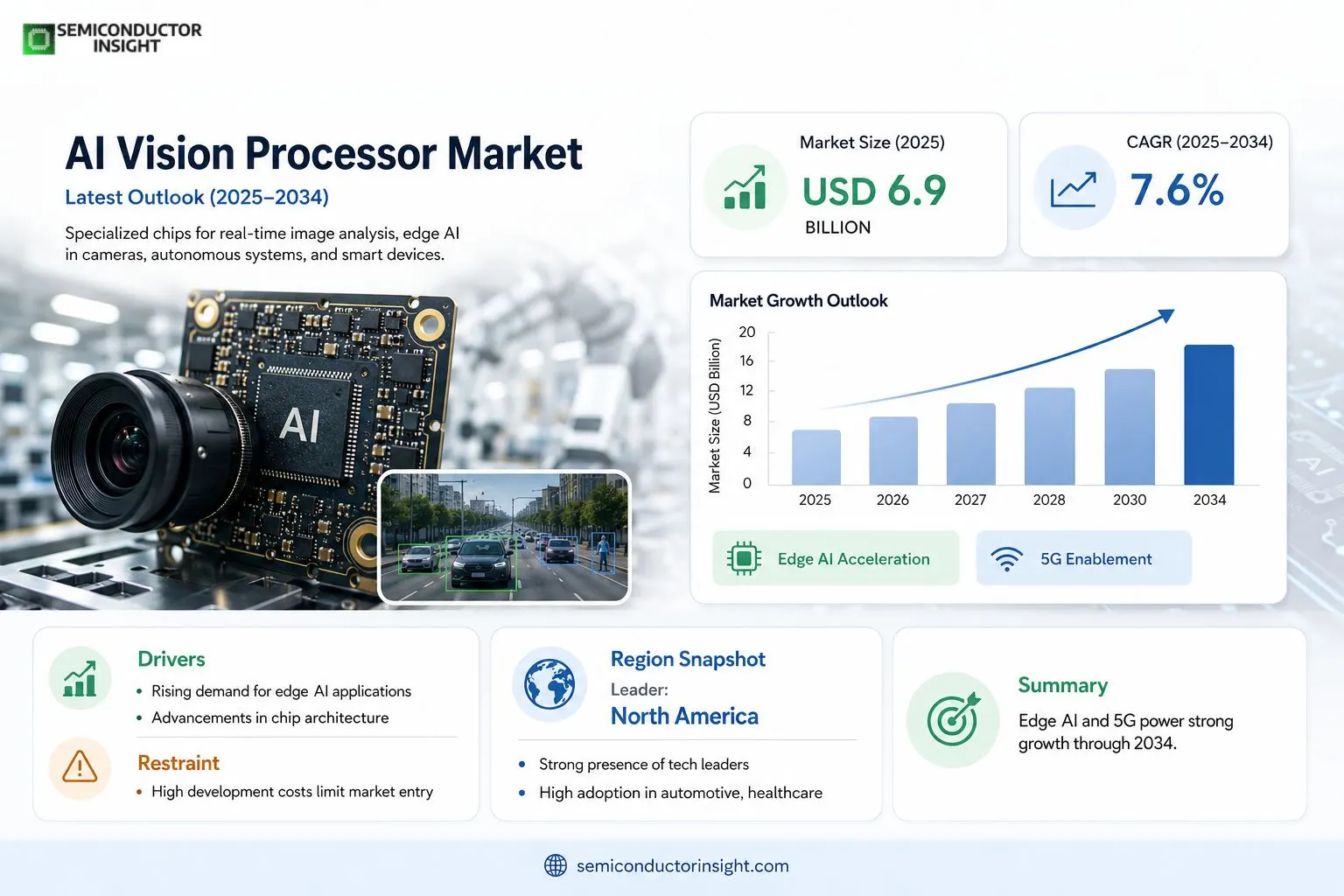
Global AI Vision Processor market is projected to grow from USD 6.9 billion in 2025 to USD 15.3 billion by 2034, exhibiting a CAGR of 7.6% during the forecast period.
AI vision processors are specialized semiconductor devices optimized for real‑time image and video analysis, edge inference, and deep‑learning workloads in cameras, autonomous systems, robotics, and smart retail. These processors combine high‑throughput neural‑network accelerators with low‑power image signal processing pipelines and dedicated memory hierarchies to deliver sub‑millisecond latency while minimizing energy consumption.The market is accelerating because of rising demand for edge AI applications, increased adoption of autonomous vehicles, and expanding smart‑city initiatives worldwide. Furthermore, advancements in heterogeneous integration and the rollout of 5G are enabling richer visual data streams at the edge. Key players such as Qualcomm, MediaTek, NVIDIA, Intel, and Ambarella are investing heavily in next‑generation vision IPs and forming strategic partnerships to capture emerging opportunities.
MARKET DRIVERS
Rising Demand for Edge AI
AI Vision Processor Market is propelled by the surge in edge‑AI applications such as smart cameras, drones, and industrial robots. Companies are adopting on‑device processing to reduce latency and bandwidth costs, which directly fuels processor shipments. Recent surveys indicate that over 65% of manufacturers plan to embed vision processors in new products within the next two years.
Advancements in Chip Architecture
Innovations in heterogeneous computing and low‑power design have unlocked higher performance per watt, making AI vision chips viable for battery‑operated devices. The integration of neural‑network accelerators with traditional image‑signal processors is cutting design cycles by up to 30%, encouraging OEMs to invest heavily in next‑gen silicon.
➤ “Embedding vision processors at the edge is accelerating AI adoption across multiple verticals, creating a virtuous growth loop.”
These technological and market forces combine to create a robust growth trajectory, with analysts projecting a compound annual growth rate above 23% through 2032 for AI Vision Processor Market.
MARKET CHALLENGES
Technical Complexity
Designing processors that can handle high‑resolution video streams while running deep‑learning inference remains a formidable engineering challenge. Teams must balance memory bandwidth, power envelopes, and thermal constraints, often requiring specialized talent that is scarce in the industry.
Other Challenges
Regulatory Hurdles
Privacy regulations such as GDPR and emerging AI‑specific guidelines impose strict data‑handling requirements, complicating the deployment of vision systems in public spaces and slowing time‑to‑market.
MARKET RESTRAINTS
High Development Costs
R&D expenditures for AI vision chips exceed $150 million per project, creating a barrier for smaller players. The capital intensity restricts market entry, leading to concentration among a few dominant vendors and limiting price competition.
MARKET OPPORTUNITIES
Expansion in Autonomous Vehicles
Autonomous driving platforms demand real‑time object detection and classification, positioning vision processors as a critical component. Projected vehicle integration rates suggest a potential $8 billion revenue uplift for AI Vision Processor Market by 2030, driven by both passenger cars and commercial fleets.
AI Vision Processor Market Trends
Edge AI Adoption Drives Processor Innovation
AI Vision Processor Market is being reshaped by a surge in edge AI applications that require instantaneous visual interpretation. Autonomous‑driving platforms, smart‑city surveillance networks, and collaborative industrial robots now depend on compact vision chips that deliver sub‑millisecond response while consuming minimal power. Manufacturers are therefore engineering ASICs that fuse high‑throughput neural‑network engines with dedicated image‑signal pipelines, allowing devices to execute complex inference directly at the sensor. This trend reduces latency, eases bandwidth pressure on back‑haul networks, and opens new revenue streams for OEMs that can embed vision capabilities into traditionally non‑visual products.
Other Trends
Heterogeneous Integration and 5G Enablement
Recent progress in heterogeneous integration enables vision processors to be co‑packaged with high‑density memory, RF front‑ends, and power‑management ICs, dramatically shrinking board real‑estate and improving thermal performance. At the same time, the global rollout of 5G furnishes the bandwidth necessary for transmitting ultra‑high‑definition video streams, prompting developers to shift from cloud‑centric analytics toward on‑device inference. This convergence of hardware miniaturization and network capability accelerates the deployment of AI‑driven visual analytics in sectors such as retail analytics, drone inspection, and remote health monitoring, where rapid decision‑making at the edge is critical.
Strategic Partnerships Accelerate Ecosystem Growth
Leading silicon providers,including Qualcomm, MediaTek, NVIDIA, Intel, and Ambarella,are forging strategic alliances with camera module makers, automotive tier‑one suppliers, and software platform vendors. These collaborations focus on joint IP development, unified programming models, and co‑validation of reference designs, shortening time‑to‑market for next‑generation vision solutions. By aligning hardware roadmaps with application‑specific requirements, the ecosystem gains consistency, reduces integration risk, and fosters a broader developer community that can leverage pre‑optimized libraries for object detection, pose estimation, and semantic segmentation. The resulting synergy is expected to sustain the market’s upward trajectory over the coming decade.
COMPETITIVE LANDSCAPEKey Industry Players
AI Vision Processor Market Competitive Dynamics
AI Vision Processor Market is anchored by a handful of technology giants that command the bulk of design IP and silicon integration. Qualcomm leads with its Snapdragon® Vision platform, leveraging a mature mobile ecosystem to deliver high‑throughput neural accelerators combined with low‑power image signal processing. NVIDIA extends its dominance from data‑center GPUs to edge AI via the Jetson series, offering heterogeneous compute cores that handle complex vision workloads at sub‑millisecond latencies. Intel’s Movidius and Xe‑Scale vision chips provide a strong foothold in industrial and automotive segments, while Ambarella’s CVflow® family remains a preferred choice for automotive cameras and smart‑retail devices. Collectively, these leaders drive the market’s projected growth from USD 6.9 billion in 2025 to USD 15.3 billion by 2034, underpinning a CAGR of roughly 7.6% through aggressive R&D, strategic partnerships, and broad portfolio roll‑outs.Beyond the core tier, a diverse set of specialized firms enhances competitive depth. MediaTek supplies cost‑effective vision solutions for consumer IoT, whereas Samsung integrates its ISOCELL sensors with proprietary AI processors for premium smartphones. Emerging Chinese players such as Horizon Robotics, Cambricon, and Himax focus on autonomous driving and edge robotics, delivering compact, power‑efficient chips that address niche market demands. Additional contributors like Texas Instruments, Sony, Xilinx (AMD), Lattice Semiconductor, and Bitmain introduce niche accelerators, FPGA‑based vision pipelines, or ASICs targeted at specific verticals, reinforcing a fragmented yet innovative landscape that pressures incumbents to continuously evolve.
List of Key AI Vision Processor Companies Profiled
- Qualcomm
- NVIDIA
- Intel
- Ambarella
- MediaTek
- Samsung Electronics
- Horizon Robotics
- Cambricon
- Himax Technologies
- Texas Instruments
- Sony Corporation
- Xilinx (AMD)
- Lattice Semiconductor
- Bitmain
Segment Analysis:
| Segment Category | Sub-Segments | Key Insights |
| By Type |
|
CNN Accelerators
|
| By Application |
|
Smart Surveillance
|
| By End User |
|
Automotive OEMs
|
| By Architecture |
|
ASIC‑Based Vision Processors
|
| By Deployment Mode |
|
Edge Devices
|
Regional Analysis: North America
North America
The automotive sector in North America is at the forefront of integrating AI vision processors for advanced driver-assistance systems (ADAS) and autonomous driving technologies. This integration demands high-performance and energy-efficient processors, driving innovation and market growth.
AI vision processors are transforming healthcare through applications like medical image analysis, diagnostics, and robotic surgery. The increasing need for accurate and timely diagnoses is propelling the adoption of these processors in hospitals and research facilities.
The retail and security sectors are leveraging AI vision processors for tasks such as inventory management, customer analytics, and surveillance. Enhanced security measures and optimized retail operations are key growth drivers in this segment.
North American industries are increasingly employing AI vision processors for quality control, predictive maintenance, and robotic process automation, leading to improved efficiency and reduced operational costs.
Europe
Europe presents a significant and expanding market for AI Vision Processors. Driven by stringent data privacy regulations and a focus on industrial modernization, the region is witnessing a steady adoption of these technologies. The European automotive sector, in particular, is investing heavily in advanced driver-assistance systems (ADAS) and autonomous driving capabilities, creating substantial demand for high-performance vision processors. Furthermore, the healthcare and manufacturing industries are recognizing the transformative potential of AI vision for enhanced diagnostics, quality control, and automation. The emphasis on sustainable manufacturing practices is also fostering innovation in AI-powered visual inspection systems.
Asia-Pacific
The Asia-Pacific region is emerging as the fastest-growing market for AI Vision Processors. Countries like China, Japan, and South Korea are leading this growth, fueled by rapid industrialization, increasing automation efforts, and substantial government investments in technology. The electronics manufacturing sector in Asia-Pacific is a major driver of demand, utilizing AI vision for quality inspection and assembly processes. The retail sector is also witnessing a surge in adoption for applications like intelligent checkout systems and customer behavior analysis. The expanding autonomous vehicle market in China further contributes to the region’s prominence in the AI vision processor landscape.
South America
South America represents a developing market with increasing opportunities for AI Vision Processors. The industrial sector in countries like Brazil and Argentina is gradually adopting these technologies for manufacturing automation, quality control, and logistics optimization. The agricultural sector is also exploring the use of AI vision for crop monitoring and yield prediction. While the adoption rate is currently lower compared to North America and Asia-Pacific, the region holds significant long-term growth potential.
Middle East & Africa
The Middle East and Africa exhibit a nascent yet promising market for AI Vision Processors. The automotive sector in countries like Saudi Arabia and the UAE is driving initial demand for ADAS and autonomous driving solutions. The security and surveillance industries are also showing increasing interest in AI-powered visual analytics. The region’s focus on infrastructure development and smart city initiatives is expected to create further opportunities for AI vision applications in the future.
Report Scope
This market research report provides a comprehensive analysis of the AI Vision Processor Market , covering the forecast period 2026–2034. It offers detailed insights into market dynamics, technological advancements, competitive landscape, and key trends shaping the industry.
Key focus areas of the report include:
- Market Overview: ✅ The report begins with an overview outlining its current market scenario, key growth indicators, and industry transformation drivers. It discusses macroeconomic factors, demand–supply balance, regulatory landscape, and the strategic role of semiconductors in powering advancements across industries such as automotive, telecommunications, consumer electronics, and industrial automation.
- ✅ Market Size & Forecast: Historical data and future projections for revenue, unit shipments, and market value across major regions and segments.
- ✅ Segmentation Analysis: Detailed breakdown by product type, technology, application, and end-user industry to identify high-growth segments and investment opportunities.
- ✅ Regional Insights: Insights into market performance across North America, Europe, Asia-Pacific, Latin America, and the Middle East & Africa, including country-level analysis where relevant.
- ✅ Competitive Landscape: Profiles of leading market participants, including their product offerings, R&D focus, manufacturing capacity, pricing strategies, and recent developments such as mergers, acquisitions, and partnerships.
- ✅ Technology Trends & Innovation: Assessment of emerging technologies, integration of AI/IoT, semiconductor design trends, fabrication techniques, and evolving industry standards.
- ✅ Market Drivers & Restraints: Evaluation of factors driving market growth along with challenges, supply chain constraints, regulatory issues, and market-entry barriers.
- ✅ Stakeholder Insights: Insights for component suppliers, OEMs, system integrators, investors, and policymakers regarding the evolving ecosystem and strategic opportunities.
Primary and secondary research methods are employed, including interviews with industry experts, data from verified sources, and real-time market intelligence to ensure the accuracy and reliability of the insights presented.
FREQUENTLY ASKED QUESTIONS:
What is the current market size of AI Vision Processor Market?
-> AI Vision Processor Market was valued at USD 6.9 billion in 2025 and is expected to reach USD 15.3 billion by 2034.
Which key companies operate in AI Vision Processor Market?
-> Key players include Qualcomm, MediaTek, NVIDIA, Intel, and Ambarella, among others.
What are the key growth drivers?
-> Key growth drivers include rising demand for edge AI applications, increased adoption of autonomous vehicles, expanding smart‑city initiatives, the rollout of 5G, and advancements in heterogeneous integration.
Which region dominates the market?
-> The reference does not specify a single dominant region; growth is observed globally with strong adoption in multiple regions.
What are the emerging trends?
-> Emerging trends include heterogeneous integration of vision IP, edge‑AI acceleration, real‑time video analytics, and the convergence of AI with 5G connectivity.

Get Sample Report PDF for Exclusive Insights
Report Sample Includes
- Table of Contents
- List of Tables & Figures
- Charts, Research Methodology, and more...
 Download Sample Report PDF