AI-Specific Wet Chemicals Market Insights
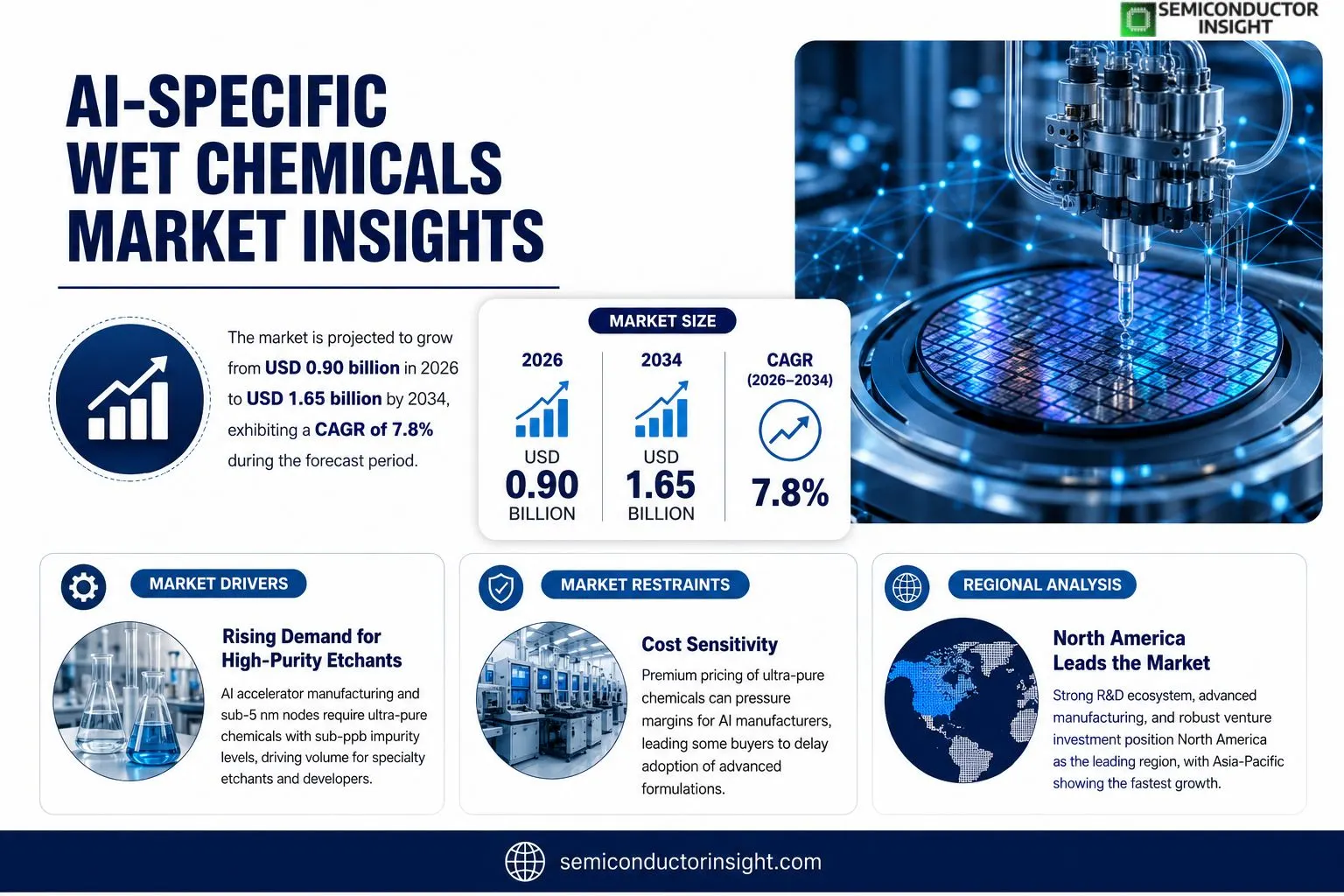
AI‑Specific Wet Chemicals market size was valued at USD 0.85 billion in 2025. The market climbs from USD 0.90 billion in 2026 to USD 1.65 billion by 2034, exhibiting a CAGR of 7.8% during the forecast period.
AI‑Specific Wet Chemicals comprise high‑purity solvents, etchants, photoresists and cleaning agents formulated expressly for artificial‑intelligence chip fabrication and data‑center hardware processing. These reagents enable precise patterning, defect removal and surface conditioning essential for advanced neural‑network processors.The sector gains momentum because semiconductor manufacturers are scaling up AI‑accelerator production, while data‑center builders seek higher yields through tighter process control. Investment surges from both venture capital and major equipment suppliers accelerate R&D pipelines, prompting firms such as BASF SE, Merck KGaA and MilliporeSigma to expand dedicated portfolios.
MARKET DRIVERS
Rising Demand for High‑Purity Etchants
AI‑Specific Wet Chemicals Market is being pulled forward by the acceleration of AI accelerator manufacturing. As fab lines transition from legacy nodes to sub‑5 nm processes, the tolerance for contaminant residues shrinks dramatically. Engineers therefore favor wet‑chemical formulations that deliver sub‑part‑per‑billion impurity levels, a requirement that elevates volume for specialty etchants and developers.
Regulatory Push for Sustainable Processing
Environmental statutes in North America and Europe increasingly mandate reduced volatile organic compound (VOC) emissions. Suppliers that embed biodegradable solvents into their AI‑specific wet‑chemical portfolios gain a competitive edge, prompting end‑users to revise procurement policies in favor of greener options. This shift not only safeguards compliance costs but also aligns with corporate ESG targets.
➤ “Clients are willing to pay a premium for chemicals that guarantee both performance and compliance, turning sustainability into a price‑setting factor.”
In parallel, the expansion of AI‑centric foundries in Asia‑Pacific creates a localized demand cluster. Proximity to production sites shortens logistics cycles, reduces spoilage risk, and encourages joint R&D initiatives that tailor wet‑chemical blends to next‑generation AI chip architectures.
MARKET CHALLENGES
Process Complexity
Advanced AI chip designs introduce multilayered stack architectures, demanding multi‑step wet processes with tightly controlled temperature and pH windows. Operators often encounter yield variance when chemical stability degrades under repeated cycling, compelling manufacturers to invest heavily in precise monitoring systems.
Other Challenges
Supply Chain Volatility
semiconductor supply fluctuations have ripple effects on wet‑chemical availability. Periodic shortages of high‑purity precursors force fabs to hold larger safety inventories, inflating working‑capital requirements and compressing margins for end‑users.
MARKET RESTRAINTS
Cost Sensitivity
Despite premium pricing rationale, many AI‑focused manufacturers operate under tight cost structures imposed by aggressive volume targets. The added expense of ultra‑pure reagents can erode profitability unless process efficiencies offset the outlay. Consequently, price‑conscious buyers may defer adoption of the most advanced formulations, limiting overall market expansion.
MARKET OPPORTUNITIES
Emerging AI Chip Architectures
Novel chip designs such as neuromorphic processors and optical AI engines require bespoke wet‑chemical solutions that address unconventional material stacks. Early‑stage collaborations between chemical firms and AI silicon designers open pathways for co‑development agreements, positioning suppliers to capture a share of the next wave of AI hardware demand.
AI-Specific Wet Chemicals Market Trends
Scaling AI‑Accelerator Production Drives Chemical Demand
Manufacturers of AI‑focused processors are rapidly expanding output to meet the growing appetite for neural‑network chips. This scale‑up puts pressure on every step of the fab line, especially on the wet‑process stages where pattern fidelity and defect mitigation depend on ultra‑pure solvents, etchants and cleaning agents. Suppliers that can guarantee batch‑to‑batch consistency see orders swell, while those lagging in purity specifications lose contracts. The ripple effect reaches equipment integrators, who must redesign delivery systems to handle larger volumes without contaminating the process flow. Geographically, fabs in East Asia are leading the ramp‑up, which forces logistics providers to develop cold‑chain capabilities for temperature‑sensitive reagents. At the same time, the scarcity of certain high‑purity precursors has prompted manufacturers to negotiate longer‑term supply contracts, reshaping the bargaining‑power balance.
Other Trends
Data‑Center Builders Prioritize Yield Optimization
Operators constructing next‑generation data centres are shifting focus from sheer capacity to manufacturing yield. Higher yields translate into lower total cost of ownership for server manufacturers, prompting them to demand tighter process control during wafer fabrication. This has spurred a wave of specialized photoresists and surface‑conditioning agents designed to reduce particle contamination. Companies that bundle chemicals with in‑line monitoring tools are positioning themselves as strategic partners rather than mere component vendors. Regulatory scrutiny on waste streams is also tightening, pushing vendors to formulate greener solvents that meet both performance and compliance thresholds. The cost differential between legacy chemicals and these newer formulations is narrowing, making the upgrade path financially viable for large‑scale producers.
Venture Capital and OEM Investment Accelerates Portfolio Expansion
In parallel, venture capital funds and original equipment manufacturers are injecting capital into R&D pipelines targeting AI‑Specific Wet Chemicals Market. The influx of financing has enabled firms such as BASF SE, Merck KGaA and MilliporeSigma to launch dedicated product lines and secure patents around high‑purity formulations. As portfolios diversify, the competitive landscape fragments, encouraging smaller specialty chemical firms to carve out niche applications. For end‑users, the heightened innovation pace promises more tailored solutions but also introduces pricing pressure as players vie for market share. Collaborative R&D agreements between chemical firms and semiconductor equipment makers are emerging, aimed at co‑optimizing process recipes and reducing time‑to‑volume. Observers note that the next wave of growth may derive from integrated chemical‑tool suites rather than standalone reagents, a shift that could redefine supplier relationships.
COMPETITIVE LANDSCAPE
Key Industry Players
Competitive Overview of AI‑Specific Wet Chemicals Suppliers
AI‑Specific Wet Chemicals Market is currently dominated by a small cohort of multinational chemical producers that have leveraged decades of specialty formulation expertise to meet the stringent purity requirements of neural‑processor fabs. BASF SE leads the landscape, capitalising on its extensive portfolio of high‑purity solvents and photoresists, and its distribution network that aligns closely with leading semiconductor foundries. Merck KGaA follows closely, drawing on its Life Science division to supply ultra‑clean etchants and surface‑treatment agents that support wafer‑level defect mitigation. MilliporeSigma, the U.S. arm of Merck KGaA, contributes a complementary line of aqueous cleaning chemistries, reinforcing the concentration of capability within a handful of integrated suppliers. This concentration reflects the high barriers to entry associated with contaminant‑free production, regulatory compliance, and the need for sustained R&D investment. As AI accelerator demand accelerates, these incumbents are expanding dedicated production lines and forging long‑term supply agreements, thereby reinforcing their strategic foothold in the market.Beyond the tier‑one conglomerates, a diverse set of specialists is carving out niche positions by tailoring chemistries to emerging process nodes and unique substrate materials. JSR Corporation supplies high‑performance photoresist formulations that address the sub‑20 nm lithography challenges of AI chips, while Cabot Microelectronics focuses on nano‑particle‑based etchants designed for three‑dimensional stacking. Dow Inc. leverages its polymer expertise to offer dielectric‑cleaning agents that minimise residue on advanced interconnects. Entegris Inc. differentiates through ultra‑pure delivery systems coupled with specialised solvent blends for wafer‑level rinsing. Industrial gas firms such as Linde plc and Air Liquide provide carrier gases and moisture‑control solutions that are integral to maintaining process stability. Ashland Inc. and H.C. Starck supply specialty surfactants and metal‑passivation reagents that improve yield on heterogeneous integration platforms. Daikin Industries, traditionally known for refrigerants, has entered the market with environmentally‑friendly cleaning formulations, whereas LyondellBasell expands its portfolio with fluorinated solvents targeting high‑temperature cleaning steps. Collectively, these players intensify competition, push innovation cycles, and give fab operators multiple sourcing options that can reduce procurement risk and enhance cost‑effectiveness.
List of Key AI‑Specific Wet Chemicals Companies Profiled
- BASF SE
- Merck KGaA
- MilliporeSigma
- Dow Inc.
- JSR Corporation
- Cabot Microelectronics
- Entegris Inc.
- Linde plc
- Air Liquide
- Ashland Inc.
- H.C. Starck
- LyondellBasell
Segment Analysis:
| Segment Category | Sub-Segments | Key Insights |
| By Type |
|
High‑Purity Solvents are the cornerstone for AI‑accelerator wafer processing, offering unparalleled resistivity control and low‑contamination environments.
|
| By Application |
|
Defect Remediation drives the most strategic value as AI‑specific wafers demand near‑zero defect densities.
|
| By End User |
|
AI‑Chip Foundries shape the demand landscape by prioritizing reagents that sustain high‑volume, high‑precision production cycles.
|
| By Process Stage |
|
Lithography benefits from solvent blends specifically engineered for high‑index‑of‑refraction photoresists used in AI processors.
|
| By Technology |
|
Neuromorphic Processors demand chemicals that support ultra‑dense interconnect patterns and novel 3‑D stacking techniques.
|
Regional Analysis: AI-Specific Wet Chemicals Market
North America
Leading firms are embedding AI algorithms into logistics planning, enabling real‑time adjustments to raw‑material sourcing and inventory buffers. This reduces lead times for specialty solvents, a critical advantage given the tight tolerances demanded by AI hardware manufacturers.
Collaboration between chemical producers and semiconductor equipment vendors is deepening, with joint R&D programs aimed at co‑designing reagents that match next‑generation AI chip architectures, thereby securing long‑term revenue streams.
The region benefits from a pipeline of chemists and data scientists who are versed in both wet‑chemical processes and machine‑learning, fostering a culture of cross‑disciplinary innovation that is hard to replicate elsewhere.
Clear guidance from agencies on the environmental impact of advanced wet chemicals allows companies to plan product lifecycles confidently, facilitating larger scale investments in AI‑specific formulations.
Europe
European players are leveraging the bloc’s strong sustainability agenda to differentiate their wet‑chemical offerings. Regulations encouraging circular‑economy practices have nudged manufacturers toward recyclable solvent systems, which appeals to AI chip producers seeking greener supply chains. Moreover, several EU research programmes are subsidizing projects that fuse AI analytics with chemical synthesis, creating a pipeline of low‑impurity reagents tailored for high‑performance computing hardware. Companies that can certify carbon‑footprint reductions alongside performance gains are poised to capture premium contracts with European OEMs, especially in nations where green procurement policies are mandatory. The strategic takeaway is that environmental compliance will increasingly function as a market access lever in Europe.
Asia‑Pacific
The Asia‑Pacific region is witnessing rapid scaling of AI chip fabs, prompting a surge in demand for specialized wet chemicals that can meet the stringent cleanliness standards of densely packed node technologies. While cost‑competitiveness remains a core driver, customers are also prioritizing suppliers that offer localized technical support and rapid formulation adjustments. Emerging tech clusters in Taiwan, South Korea, and Singapore are fostering ecosystems where chemical firms can test new reagents on pilot lines within weeks, a speed advantage that translates into quicker time‑to‑market for AI hardware. Firms that embed on‑site analytical labs and AI‑based predictive models into their service portfolio will likely secure enduring partnerships across the region.
South America
South American markets are still nascent in the AI‑Specific Wet Chemicals space, yet the region’s growing interest in AI‑accelerated data‑center construction is laying groundwork for future demand. Local manufacturers are beginning to upgrade facilities to handle higher purity specifications, often under joint ventures with multinational partners. This hybrid model introduces advanced process controls while retaining cost advantages that appeal to regional chip assemblers. Stakeholders should monitor governmental incentives aimed at fostering high‑tech chemical production, as these could accelerate the maturation of the supply base and open doors for early‑stage collaborations.
Middle East & Africa
In the Middle East and Africa, AI‑Specific Wet Chemicals Market is shaped by ambitious digital‑infrastructure projects and a push toward localized high‑tech manufacturing. Governments are investing heavily in AI research parks, which include dedicated chemical labs for semiconductor cleaning and surface treatment. While the market size remains modest, the willingness to import expertise and co‑develop proprietary formulations suggests a long‑term growth trajectory. Companies that can provide turnkey solutionscombining chemical supply, process engineering, and AI‑driven quality assurancewill likely become preferred partners as the region seeks to reduce reliance on imported wet‑chemical imports.
Report Scope
This market research report provides a comprehensive analysis of the AI-Specific Wet Chemicals Market , covering the forecast period 2026–2034. It offers detailed insights into market dynamics, technological advancements, competitive landscape, and key trends shaping the industry.
Key focus areas of the report include:
- Market Overview: The report begins with an overview outlining its current market scenario, key growth indicators, and industry transformation drivers. It discusses macroeconomic factors, demand–supply balance, regulatory landscape, and the strategic role of semiconductors in powering advancements across industries such as automotive, telecommunications, consumer electronics, and industrial automation.
- Market Size & Forecast: Historical data and future projections for revenue, unit shipments, and market value across major regions and segments.
- Segmentation Analysis: Detailed breakdown by product type, technology, application, and end-user industry to identify high-growth segments and investment opportunities.
- Regional Insights: Insights into market performance across North America, Europe, Asia-Pacific, Latin America, and the Middle East & Africa, including country-level analysis where relevant.
- Competitive Landscape: Profiles of leading market participants, including their product offerings, R&D focus, manufacturing capacity, pricing strategies, and recent developments such as mergers, acquisitions, and partnerships.
- Technology Trends & Innovation: Assessment of emerging technologies, integration of AI/IoT, semiconductor design trends, fabrication techniques, and evolving industry standards.
- Market Drivers & Restraints: Evaluation of factors driving market growth along with challenges, supply chain constraints, regulatory issues, and market-entry barriers.
- Stakeholder Insights: Insights for component suppliers, OEMs, system integrators, investors, and policymakers regarding the evolving ecosystem and strategic opportunities.
Primary and secondary research methods are employed, including interviews with industry experts, data from verified sources, and real-time market intelligence to ensure the accuracy and reliability of the insights presented.
FREQUENTLY ASKED QUESTIONS:
What is the current market size of AI-Specific Wet Chemicals Market?
-> AI-Specific Wet Chemicals Market was valued at USD 0.85 billion in 2025 and is expected to reach USD 1.65 billion by 2034, reflecting a CAGR of 7.8 % over the forecast period.
Which key companies operate in AI-Specific Wet Chemicals Market?
-> Key players include BASF SE, Merck KGaA, and MilliporeSigma, among other specialists developing high‑purity solvents, etchants, photoresists and cleaning agents for AI‑chip fabrication.
What are the key growth drivers?
-> Growth is driven by the rapid scaling of AI‑accelerator production, heightened demand for higher‑yield data‑center hardware, and strong investment from venture capital and equipment manufacturers accelerating R&D pipelines.
Which region dominates the market?
-> The market is ly distributed, with significant activity in North America, Europe, and Asia‑Pacific, reflecting worldwide semiconductor manufacturing expansion.
What are the emerging trends?
-> Emerging trends include development of ultra‑high‑purity solvents, customized photoresists for neural‑network processors, and integration of AI‑driven process control to improve defect removal and surface conditioning.
Get Sample Report PDF for Exclusive Insights
Report Sample Includes
- Table of Contents
- List of Tables & Figures
- Charts, Research Methodology, and more...
 Download Sample Report PDF