AI-Specific SSD Controller Market Insights
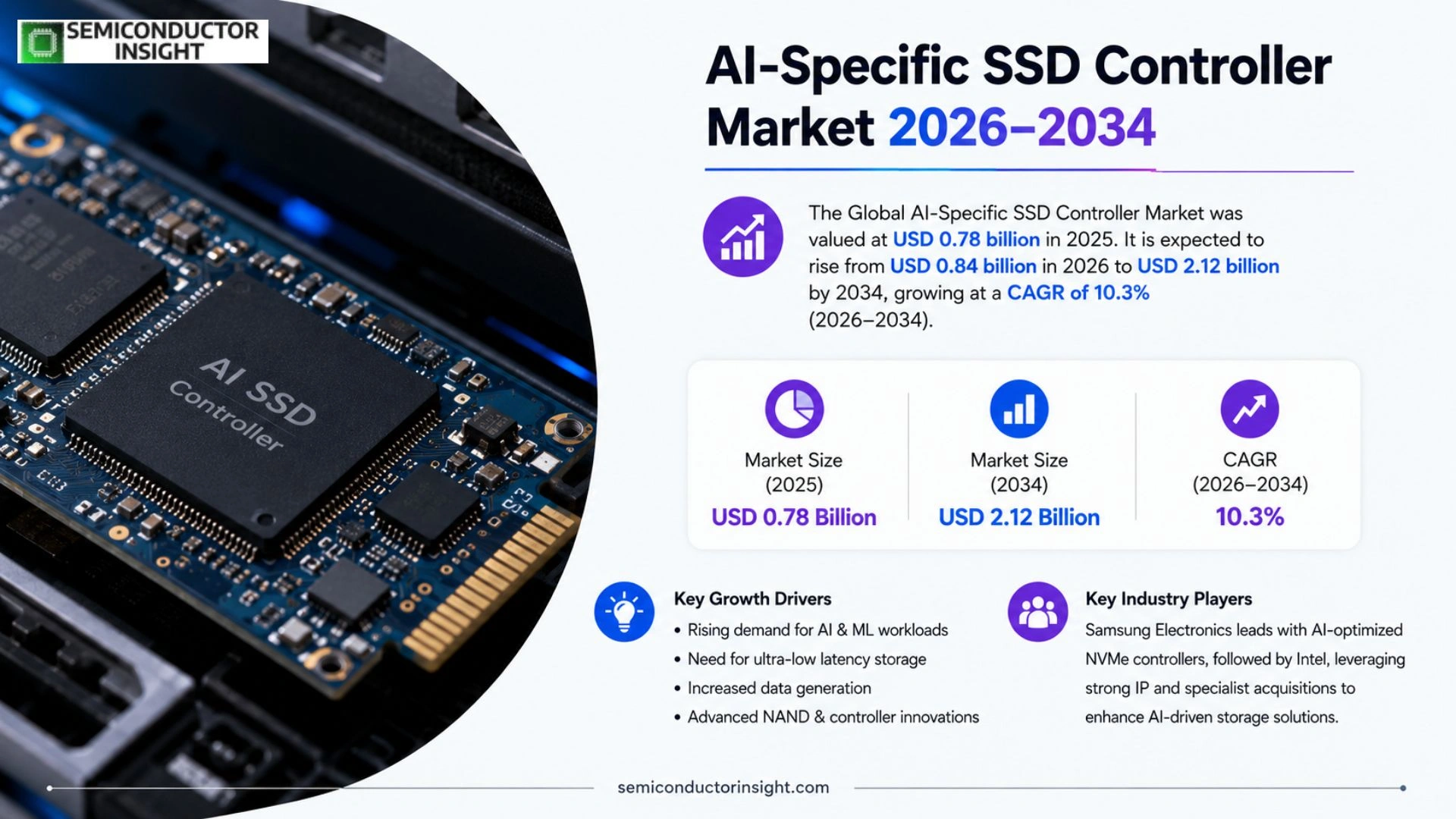
Global AI‑Specific SSD Controller market size was valued at USD 0.78 billion in 2025. It is expected to rise from USD 0.84 billion in 2026 to USD 2.12 billion by 2034, exhibiting a CAGR of 10.3 % during the forecast period.
AI‑Specific SSD controllers are purpose‑built semiconductor chips that manage flash memory access patterns optimized for machine‑learning workloads, reducing latency and improving throughput for large model training and inference.
The market is gaining momentum because enterprises are scaling AI clusters, edge devices require fast local storage, and cloud providers are integrating specialized controllers into their infrastructure offerings. Recent announcements such as NVIDIA’s acquisition of an SSD‑controller startup in early 2024 and Samsung’s launch of an AI‑tuned NVMe line illustrate how leading vendors are expanding their portfolios.
MARKET DRIVERS
Growing Demand for Edge‑AI Compute
Enterprises are shifting AI inference workloads from centralized data centers to edge locations to reduce latency and bandwidth costs. This migration forces a need for storage solutions that can keep pace with high‑throughput tensor operations, positioning the AI‑Specific SSD Controller Market as a critical enabler. Companies that embed AI accelerators directly onto SSDs can deliver sub‑millisecond response times, a differentiation that many OEMs now prize.
Convergence of 3D‑NAND and Compute fabrics
Recent silicon‑level breakthroughs allow 3D‑NAND stacks to be co‑located with custom compute blocks, shrinking the data path between storage and AI engines. This architectural shift reduces energy per operation and unlocks new performance headroom, prompting system designers to prioritize controllers that are optimized for AI matrix multiplications. The resulting efficiency gains are compelling enough to motivate early adoption across high‑performance computing clusters.
➤ “Integrating AI logic into SSD controllers turns storage into a processing tier, reshaping how workloads are partitioned across the system.” – Senior Analyst, Semiconductor Advisory Group
Because the AI‑Specific SSD Controller Market delivers both storage density and compute, firms can consolidate hardware footprints while maintaining scalability. This dual capability directly addresses the pressure on data‑center real estate and power budgets, making the technology an attractive investment for organizations pursuing aggressive cost‑per‑inference targets.
MARKET CHALLENGES
Thermal Management at High Throughput
AI‑centric controllers generate appreciable heat when sustaining peak tensor flows, especially in confined edge enclosures. Without advanced cooling strategies, thermal throttling can erode the performance advantage they promise, leading designers to weigh the added complexity of heat‑sink integration against latency gains.
Other Challenges
Supply‑Chain Volatility
The semiconductor ecosystem continues to grapple with material shortages and logistics bottlenecks. Limited availability of high‑bandwidth memory and specialized ASIC fabs can delay time‑to‑market for next‑generation AI SSD controllers, pressuring manufacturers to maintain buffer inventories.
MARKET RESTRAINTS
Elevated Development Expenditure
Designing a controller that blends storage protocols with AI‑optimized instruction sets demands multidisciplinary engineering teams and extensive validation cycles. The upfront capital outlay often exceeds the budgets of mid‑size OEMs, restraining broader market penetration until economies of scale are realized.
MARKET OPPORTUNITIES
AI‑Driven Data‑Lake Acceleration
Enterprises building massive data lakes for training generative models are encountering I/O bottlenecks that traditional SSDs cannot alleviate. Controllers engineered for AI workloads can offload preprocessing tasks, such as data sharding and compression, directly at the storage tier. This capability opens a revenue stream for vendors that can certify their solutions against emerging data‑lake frameworks.
Additionally, regulatory trends that emphasize data sovereignty are prompting organizations to localize AI inference. The ability to embed AI logic within SSDs enables compliant, on‑premise processing without sacrificing speed, presenting a niche yet rapidly expanding segment for the AI‑Specific SSD Controller Market.
AI-Specific SSD Controller Market Trends
Enterprise AI Cluster Scaling Fuels Controller Adoption
The surge in large‑scale machine‑learning workloads compels data‑center operators to revisit storage architectures. Traditional controllers, designed for generic I/O, struggle with the bursty, high‑throughput patterns that training jobs generate. By embedding AI‑aware scheduling logic directly into the silicon, purpose‑built controllers cut latency and free CPU cycles for compute tasks. This efficiency gain translates into lower total cost of ownership for firms that run continuous model refinement cycles. Consequently, procurement budgets now earmark a distinct line for AI‑specific SSD controllers, treating them as a strategic enabler rather than a peripheral component.
Other Trends
Edge AI Storage Acceleration
Edge deployments increasingly run inference models locally to meet latency constraints and privacy requirements. In those settings, the distance between sensor and storage is minimal, yet the flash subsystem must still juggle simultaneous reads and writes generated by real‑time analytics. AI‑optimized controllers address this mismatch by prioritizing inference‑critical blocks and smoothing write amplification. Vendors that bundle these controllers with edge‑grade NVMe drives report faster model cold‑starts and more stable power‑draw profiles, which are decisive factors for battery‑operated devices. The ripple effect is a modest but measurable shift in OEM specifications toward controller‑centric designs.
Cloud Providers Integrate AI‑Tuned Controllers
Major cloud platforms have begun offering storage tiers explicitly labeled for AI workloads. Internally, these tiers rely on controllers that expose firmware hooks for model‑aware caching and direct memory access pathways. Such capabilities allow tenants to achieve higher throughput without over‑provisioning compute nodes. The operational advantage manifests as reduced queue times for batch training jobs, which in turn improves overall platform utilization. As service contracts increasingly include performance‑based SLAs for AI, providers are likely to expand the portfolio of AI‑specific SSD controllers to differentiate their offerings.
COMPETITIVE LANDSCAPE
Key Industry Players
AI‑Specific SSD Controllers: Competitive Overview
Samsung Electronics dominates the AI‑specific SSD controller segment by leveraging its extensive NAND expertise and a portfolio that now includes an NVMe line tuned for machine‑learning workloads. The company’s ability to co‑design firmware and silicon gives it a decisive edge in latency‑critical data centers, a factor that has encouraged several cloud operators to standardize on Samsung‑based solutions. Intel follows closely, capitalizing on its long‑standing controller IP and recent integration of an acquired specialist to broaden its AI‑oriented storage offerings. Both firms benefit from deep relationships with server OEMs, which translates into preferential access to high‑performance AI clusters and accelerates adoption of their controller architectures.
Beyond the two market leaders, a constellation of specialized and diversified players shapes the competitive fabric. Western Digital’s recent rollout of an AI‑optimized controller demonstrates its intent to transition from pure storage to compute‑adjacent solutions, while Micron’s focus on low‑power edge modules positions it well for on‑device inference deployments. Marvell and SK hynix have introduced controller ASICs that prioritize bandwidth scaling, targeting hyperscale operators requiring clustered storage fabrics. Smaller firms such as Kingston, ADATA, and Corsair are carving niches by offering cost‑effective, plug‑and‑play cards for research labs. Meanwhile, enterprise‑focused vendors like HPE, Dell, and IBM embed these controllers within turnkey AI infrastructure, reinforcing the trend toward integrated hardware stacks.
List of Key AI‑Specific SSD Controller Companies Profiled
- Samsung Electronics
- Intel Corp.
- Western Digital
- Micron Technology
- SK hynix
- Marvell Technology Group
- Kingston Technology
- Corsair
- ADATA
- HPE
- Dell Technologies
- IBM
- NVIDIA (post‑acquisition controller unit)
- Seagate Technology
- Kioxia
Segment Analysis:
| Segment Category | Sub-Segments | Key Insights |
| By Type |
|
General‑purpose AI‑tuned controllers
|
| By Application |
|
Data‑center training clusters
|
| By End User |
|
Technology enterprises
|
| By Architecture |
|
Neuromorphic‑optimized controllers
|
| By Integration Level |
|
Embedded controllers within ASICs
|
Regional Analysis: AI-Specific SSD Controller Market
The region benefits from a dense network of university labs, venture‑backed startups, and established semiconductor firms. Collaboration lounges in Silicon Valley and Toronto accelerate prototype-to‑product cycles, allowing AI‑specific SSD controllers to incorporate the latest machine‑learning primitives with minimal lag.
Domestic fabs and diversified foundry partnerships reduce exposure to geopolitical shocks, ensuring that component shortages do not cascade into controller availability gaps for latency‑critical deployments.
Large‑scale data centers are re‑evaluating storage tiering strategies, choosing AI‑aware controllers to keep inference data close to compute, which trims network hops and improves overall system responsiveness.
While the United States maintains a generally permissive stance on AI hardware, emerging data‑privacy rules encourage on‑premise processing, nudging enterprises toward controllers that can execute models without sending raw data to the cloud.
Europe
European manufacturers blend strict data‑sovereignty regulations with a strong emphasis on sustainability. Companies are looking for AI‑specific SSD controllers that can deliver performance while adhering to energy‑efficiency standards mandated by the EU Green Deal. This dual pressure drives design teams to integrate on‑chip power‑gating and dynamic workload scaling, positioning Europe as a hub for eco‑conscious AI hardware solutions.
Asia‑Pacific
In the Asia‑Pacific corridor, the market is fueled by a rapid rise in AI‑enabled consumer electronics and burgeoning smart‑city initiatives. Nations such as Japan, South Korea, and Singapore invest heavily in edge compute platforms, which require storage controllers capable of processing neural‑network inference locally. The regional push for localized chip design accelerates partnerships between OEMs and foundries, fostering a competitive environment for differentiated controller features.
South America
South American enterprises are beginning to migrate legacy storage workloads to AI‑aware platforms as part of broader digital transformation agendas. The primary challenge lies in balancing cost constraints with the need for high‑throughput inference processing. Consequently, regional players are favoring modular controller architectures that can be retrofitted into existing storage arrays, offering a pragmatic upgrade path without extensive capital outlay.
Middle East & Africa
The Middle East & Africa region exhibits a growing appetite for AI‑driven analytics in sectors such as oil‑and‑gas, telecommunications, and public safety. While infrastructure maturity varies across countries, the strategic focus remains on deploying controllers that can handle large‑scale sensor streams at the network edge. Partnerships with global silicon vendors are increasingly common, as local system integrators seek to embed AI capabilities without sacrificing reliability.
Report Scope
This market research report provides a comprehensive analysis of the AI-Specific SSD Controller Market , covering the forecast period 2026–2034. It offers detailed insights into market dynamics, technological advancements, competitive landscape, and key trends shaping the industry.
Key focus areas of the report include:
- Market Overview: The report begins with an overview outlining its current market scenario, key growth indicators, and industry transformation drivers. It discusses macroeconomic factors, demand–supply balance, regulatory landscape, and the strategic role of semiconductors in powering advancements across industries such as automotive, telecommunications, consumer electronics, and industrial automation.
- Market Size & Forecast: Historical data and future projections for revenue, unit shipments, and market value across major regions and segments.
- Segmentation Analysis: Detailed breakdown by product type, technology, application, and end-user industry to identify high-growth segments and investment opportunities.
- Regional Insights: Insights into market performance across North America, Europe, Asia-Pacific, Latin America, and the Middle East & Africa, including country-level analysis where relevant.
- Competitive Landscape: Profiles of leading market participants, including their product offerings, R&D focus, manufacturing capacity, pricing strategies, and recent developments such as mergers, acquisitions, and partnerships.
- Technology Trends & Innovation: Assessment of emerging technologies, integration of AI/IoT, semiconductor design trends, fabrication techniques, and evolving industry standards.
- Market Drivers & Restraints: Evaluation of factors driving market growth along with challenges, supply chain constraints, regulatory issues, and market-entry barriers.
- Stakeholder Insights: Insights for component suppliers, OEMs, system integrators, investors, and policymakers regarding the evolving ecosystem and strategic opportunities.
Primary and secondary research methods are employed, including interviews with industry experts, data from verified sources, and real-time market intelligence to ensure the accuracy and reliability of the insights presented.
FREQUENTLY ASKED QUESTIONS:
What is the current market size of AI-Specific SSD Controller Market?
-> AI-Specific SSD Controller Market was valued at USD 0.78 billion in 2025 and is expected to reach USD 2.12 billion by 2034 (CAGR 10.3%).
Which key companies operate in AI-Specific SSD Controller Market?
-> Key players include NVIDIA, Samsung Electronics, Intel Corporation, Western Digital, and Micron Technology, among others.
What are the key growth drivers?
-> Key growth drivers include rising AI and machine‑learning workloads in data centers, expansion of edge computing devices, and increasing demand for low‑latency, high‑throughput storage solutions.
Which region dominates the market?
-> Asia‑Pacific is the fastest‑growing region, while North America remains the largest market by revenue.
What are the emerging trends?
-> Emerging trends include AI‑optimized NVMe interfaces, integration of AI inference accelerators within SSD controllers, and development of low‑power, high‑density flash architectures for edge AI applications.
Get Sample Report PDF for Exclusive Insights
Report Sample Includes
- Table of Contents
- List of Tables & Figures
- Charts, Research Methodology, and more...
 Download Sample Report PDF