AI-Specific Mold Compound for Fan-Out Packages Market Insights
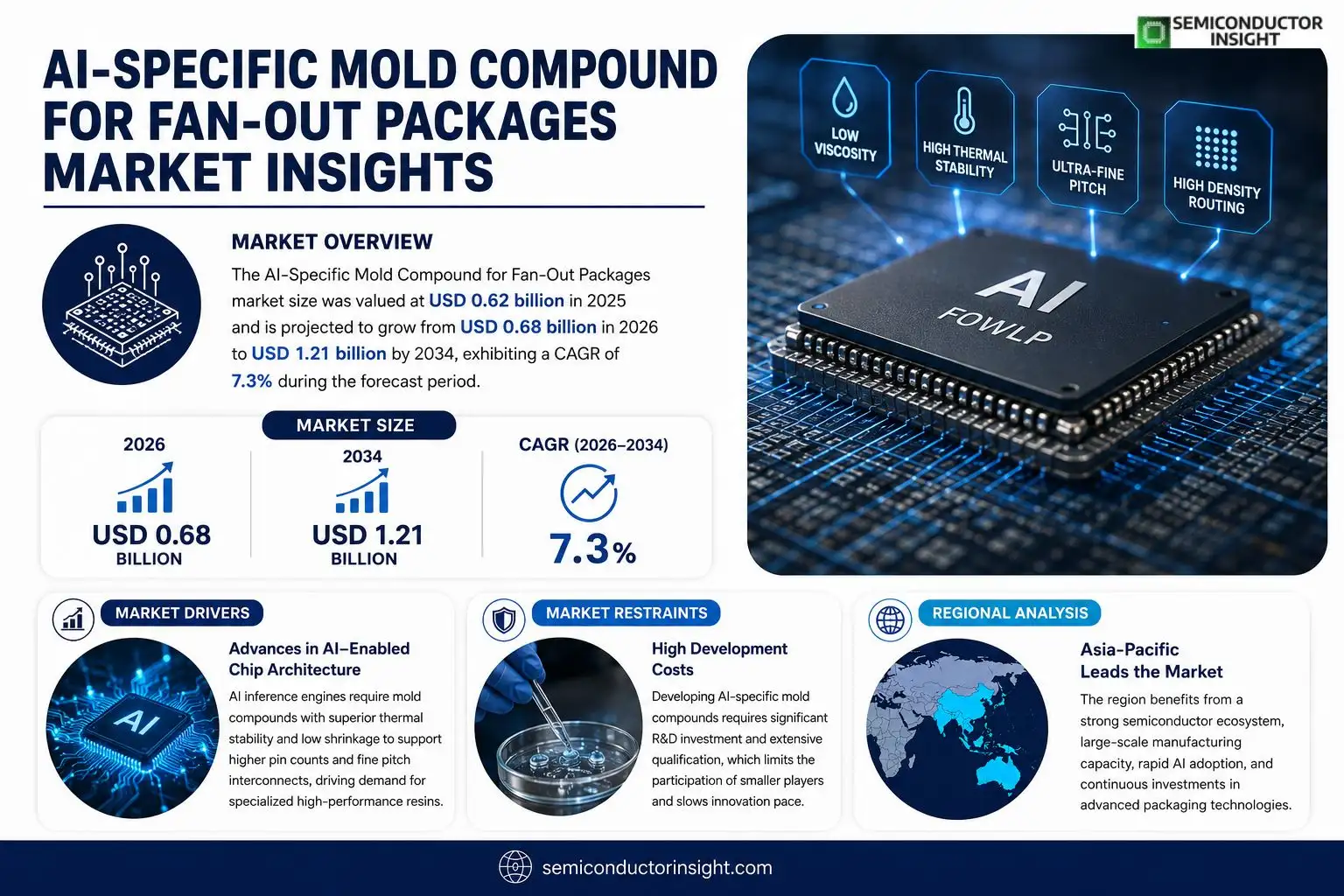
AI-Specific Mold Compound for Fan-Out Packages market size was valued at USD 0.62 billion in 2025. The market is projected to grow from USD 0.68 billion in 2026 to USD 1.21 billion by 2034, exhibiting a CAGR of 7.3% during the forecast period.
AI‑specific mold compounds are specialized resin systems formulated for fan‑out wafer‑level packaging (FOWLP). They deliver low viscosity, high thermal stability and precise flow control that enable ultra‑fine pitch interconnects and dense routing essential for artificial‑intelligence processors.The market is experiencing rapid growth due to several factors, including heightened investment in AI hardware, rising demand for high‑performance packaging solutions, and continuous advancements in semiconductor manufacturing techniques. Furthermore, broader adoption of heterogeneous integration and chiplet architectures fuels expansion, while recent product launchessuch as a low‑k AI‑optimized mold compound announced in March 2024illustrate how suppliers are responding to evolving design requirements.
MARKET DRIVERS
Advances in AI‑Enabled Chip Architecture
Design teams are embedding inference engines directly onto fan‑out substrates, a shift that demands mold compounds capable of tolerating higher thermal cycles while preserving dielectric integrity. The resulting material specifications push suppliers toward formulations that balance low shrinkage with enhanced conductivity, thereby creating a niche where specialized compounds can command premium pricing.
Supply‑Chain Efficiency Pressures
Manufacturers are compressing lead times to meet aggressive production schedules for AI‑centric devices. By adopting mold compounds engineered for rapid cure and minimal rework, fabs can streamline panel handling and reduce wasted silicon, a tangible cost advantage that is reshaping procurement criteria across the ecosystem.
➤ “When a compound can sustain the thermal budget of next‑gen AI packages while delivering lower defect rates, fabs experience a measurable uplift in throughput.”
These dynamics collectively reinforce the rationale for investing in AI‑specific mold compounds, as they directly address the twin imperatives of performance fidelity and operational agility within the Fan‑Out Packages market.
MARKET CHALLENGES
Material Compatibility with Emerging Substrates
New low‑k dielectric layers introduce adhesion challenges that traditional compounds struggle to overcome. The need for extensive qualification cycles heightens engineering overhead, slowing adoption rates for innovative formulations.
Other Challenges
Regulatory and Environmental Compliance
Stringent RoHS and REACH mandates limit the use of certain additives, compelling suppliers to reformulate compounds without compromising thermal performancea process that can extend time‑to‑market.
MARKET RESTRAINTS
High Development Costs
Creating a mold compound that satisfies AI‑specific thermal and electrical thresholds requires substantial R&D investment. Smaller players often lack the financial bandwidth to sustain such programs, resulting in a market concentration that may inhibit broader innovation.
MARKET OPPORTUNITIES
Customization Services for Tier‑1 Fab Operators
Fabs are increasingly seeking partner‑driven development models where compound manufacturers co‑engineer formulations tailored to specific process windows. This collaborative approach offers a pathway to differentiate product lines, capture higher margins, and accelerate the rollout of AI‑specific Fan‑Out Packages.
AI-Specific Mold Compound for Fan-Out Packages Market Trends
Surge in AI‑Driven Packaging Demand
The acceleration of AI accelerator roll‑outs has tightened tolerances on wafer‑level interconnects. Engineers need a molding medium that can traverse sub‑100‑micron channels without entrapping voids while withstanding the 250 °C processing windows typical of high‑performance compute chips. Consequently, the AI‑Specific Mold Compound for Fan‑Out Packages Market is benefitting from a convergence of higher pin counts and finer pitch, which renders conventional epoxy insufficient. Suppliers able to guarantee low viscosity at elevated temperatures secure a competitive edge because manufacturers can trim cycle time and boost yield on 12‑inch wafers. This pressure has spurred foundries to qualify new resin chemistries that balance thermal stability with a low dielectric constant, preserving signal integrity in dense AI cores. In addition, the cost premium of these specialized compounds is increasingly justified as designers capture higher performance per watt, a metric that directly influences total‑cost‑of‑ownership calculations for AI servers.
Other Trends
Material Innovations for Thermal Management
Recent product introductions illustrate how material science is adapting to the escalating thermal envelope of AI chips. A low‑k, AI‑optimized mold compound announced in March 2024 demonstrated a 15 % reduction in coefficient of thermal expansion compared with the previous generation, enabling tighter stacking of chiplets without inducing warpage. The formulation incorporates fluorinated siloxane linkages that preserve flowability at 260 °C while delivering superior heat dissipation. Early adopters report a measurable decrease in hot‑spot formation during thermal cycling, which translates to longer module lifetimes. Such innovations are not confined to a single supplier; several major resin manufacturers have filed patents on nanoparticle‑reinforced matrices that aim to further curtail thermal resistance, signaling an industry‑wide pivot toward heat‑centric compound design.
Shift Toward Heterogeneous Integration
Chiplet‑based heterogeneous integration is reshaping the requirements for fan‑out packaging. By distributing functionality across multiple smaller dies, designers achieve higher yields and faster time‑to‑market, but the interposer must accommodate a mosaic of disparate materials and signal speeds. The AI‑Specific Mold Compound for Fan‑Out Packages Market now faces the challenge of delivering uniform flow across irregular die footprints while maintaining adhesion to both silicon and organic substrates. Companies that can engineer compounds with adjustable rheologyallowing fine‑tuning for each chiplet layoutare positioned to capture design wins in data‑center accelerators and edge AI modules. As system‑level integration deepens, the strategic importance of a reliable mold compound grows, because any defect at the packaging stage reverberates through performance, power, and reliability metrics that dictate a product’s commercial viability.
COMPETITIVE LANDSCAPE
Key Industry Players
AI‑Specific Mold Compound Landscape: Leaders, Innovators, and Emerging Specialists
The AI‑specific mold‑compound segment for fan‑out wafer‑level packaging is still dominated by a handful of multinational resin producers that have leveraged decades of experience in semiconductor materials. Dow Chem, with its extensive portfolio of low‑k and high‑performance epoxies, commands a sizable share because its compounds balance viscosity control with thermal stabilityattributes critical for ultra‑fine pitch interconnects in AI processors. Shin‑Etsu Chemical follows closely, differentiating through proprietary siloxane‑based chemistries that enable tighter line‑width tolerances. Both firms have invested heavily in R&D pipelines that align with the accelerating adoption of heterogeneous integration, making them default partners for leading fabs and design houses. The market structure therefore resembles a tiered oligopoly where a couple of giants set the technical benchmark while smaller players chase niche requirements.Beyond the headline names, a diverse set of specialists is shaping the competitive fabric. JSR Corporation and Fujifilm Electronic Materials have introduced low‑k formulations tailored for AI‑optimized chiplets, targeting design rules that traditional resins cannot meet. Toray Industries and Sumitomo Chemical focus on high‑temperature stability, catering to emerging silicon‑photonic and power‑AI modules. European outfits such as Heraeus Materials and HTA Group provide precision‑engineered compounds for niche EUV‑based processes, while Asian innovators like SPI Materials and Munich Chemie expand the supply chain with cost‑effective alternatives for volume‑centric producers. These companies collectively add depth to the ecosystem, forcing incumbents to refine performance claims and accelerate product roll‑outs.
List of Key AI‑Specific Mold Compound for Fan‑Out Packages Companies Profiled
- Dow Chem
- Shin‑Etsu Chemical
- JSR Corporation
- Fujifilm Electronic Materials
- Toray Industries
- Sumitomo Chemical
- Heraeus Materials
- HTA Group
- SPI Materials
- Munich Chemie
- AkzoNobel Advanced Materials
- Aramco Materials
- Nan Ya Plastics
- LG Chem
- Daicel Chemicals
Segment Analysis:
| Segment Category | Sub-Segments | Key Insights |
| By Type |
|
Epoxy‑based compounds dominate because they combine proven processability with the ability to tailor viscosity for ultra‑fine pitch routing.
|
| By Application |
|
AI accelerator cores emerge as the leading application due to the relentless push for higher compute density and faster data pathways.
|
| By End User |
|
Semiconductor fabs lead adoption because they integrate AI‑specific mold compounds directly into wafer‑level processes, ensuring maximum control over material properties.
|
| By Technology |
|
Low‑k dielectric formulations are gaining prominence as they enable signal speed improvements critical for AI workloads.
|
| By Performance Requirement |
|
Thermal stability is the foremost performance driver as AI processors generate intense localized heating.
|
Regional Analysis: AI-Specific Mold Compound for Fan-Out Packages Market
North America
The Bay Area hosts a dense cluster of material scientists and chip designers who co‑develop mold formulations tailored for AI workloads. Collaborative labs blend proprietary chemistries with design‑for‑manufacturing insights, accelerating the emergence of compounds that tolerate higher power densities without compromising shear strength.
Recent disruptions prompted manufacturers to diversify resin sources across the United States and Canada. Dual‑sourcing strategies, combined with strategic stockpiles, have mitigated lead‑time volatility, ensuring that high‑volume fabs receive consistent material flows.
Tier‑one equipment makers are forging joint‑development agreements with compound suppliers, embedding material‑specific process windows into next‑generation fan‑out tooling. This alignment reduces trial‑and‑error cycles and shortens qualification timelines for AI‑centric packages.
Environmental compliance frameworks in the United States encourage the adoption of low‑VOC, recyclable mold compounds. Firms that anticipate tighter emission standards gain early access to green‑label certifications, a differentiator for eco‑conscious OEMs.
Europe
European nations blend a strong tradition of precision chemistry with aggressive AI hardware roadmaps. Countries such as Germany and the Netherlands leverage their well‑established polymer sectors to tailor melt‑flow characteristics, supporting the fine pitch required in fan‑out packages. Cross‑border research initiatives, funded by the EU Horizon program, create a pipeline of next‑generation compounds that balance dielectric loss with mechanical robustness. Moreover, the region’s focus on sustainability nudges suppliers toward bio‑based resin blends, offering a differentiated value proposition for manufacturers targeting energy‑efficient data centers. The cumulative effect is a market segment that prizes material reliability as much as performance, prompting OEMs to align closely with specialist chemical firms.
Asia-Pacific
The Asia-Pacific corridor, anchored by Taiwan, South Korea, and China, delivers the scale necessary for mass production of AI‐centric fan‑out solutions. Foundries in this zone prioritize throughput, prompting compound developers to engineer formulations that cure quickly while maintaining dimensional stability. Simultaneously, regional supply chains benefit from proximity to raw‑material producers, reducing logistics costs and enabling rapid iteration cycles. Government initiatives, especially in China’s semiconductor self‑sufficiency drive, fund joint ventures that integrate AI‑specific mold compounds into domestic fabs, fostering a locally sourced ecosystem that can react swiftly to market signals.
South America
South America’s participation in the AI‑specific mold compound sphere is emerging, led by Brazil’s growing semiconductor assembly sector. Local universities are beginning to explore high‑performance polymer networks, often in partnership with multinational firms seeking to diversify their R&D footprint. Although volume remains modest, the region’s cost‑effective labor pool and favorable trade agreements position it as a prospective low‑cost pilot hub for experimental resin blends before rollout. Early adopters are gaining insights that could translate into competitive advantages as the market matures.
Middle East & Africa
Investment in advanced manufacturing infrastructure across the United Arab Emirates and select African nations has introduced a nascent yet ambitious player base into the AI‑specific mold compound arena. These economies are leveraging sovereign wealth funds to attract specialist chemical companies, aiming to establish localized production that serves both regional fabs and export markets. While the talent pool is still developing, intensive training programs and knowledge transfer arrangements are accelerating competence, laying groundwork for a future supplier niche focused on climate‑adaptive resin formulations suitable for the region’s hot operating environments.
Report Scope
This market research report provides a comprehensive analysis of the AI-Specific Mold Compound for Fan-Out Packages Market , covering the forecast period 2026–2034. It offers detailed insights into market dynamics, technological advancements, competitive landscape, and key trends shaping the industry.
Key focus areas of the report include:
- Market Overview: The report begins with an overview outlining its current market scenario, key growth indicators, and industry transformation drivers. It discusses macroeconomic factors, demand–supply balance, regulatory landscape, and the strategic role of semiconductors in powering advancements across industries such as automotive, telecommunications, consumer electronics, and industrial automation.
- Market Size & Forecast: Historical data and future projections for revenue, unit shipments, and market value across major regions and segments.
- Segmentation Analysis: Detailed breakdown by product type, technology, application, and end-user industry to identify high-growth segments and investment opportunities.
- Regional Insights: Insights into market performance across North America, Europe, Asia-Pacific, Latin America, and the Middle East & Africa, including country-level analysis where relevant.
- Competitive Landscape: Profiles of leading market participants, including their product offerings, R&D focus, manufacturing capacity, pricing strategies, and recent developments such as mergers, acquisitions, and partnerships.
- Technology Trends & Innovation: Assessment of emerging technologies, integration of AI/IoT, semiconductor design trends, fabrication techniques, and evolving industry standards.
- Market Drivers & Restraints: Evaluation of factors driving market growth along with challenges, supply chain constraints, regulatory issues, and market-entry barriers.
- Stakeholder Insights: Insights for component suppliers, OEMs, system integrators, investors, and policymakers regarding the evolving ecosystem and strategic opportunities.
Primary and secondary research methods are employed, including interviews with industry experts, data from verified sources, and real-time market intelligence to ensure the accuracy and reliability of the insights presented.
FREQUENTLY ASKED QUESTIONS:
What is the current market size of AI-Specific Mold Compound for Fan-Out Packages Market?
-> AI-Specific Mold Compound for Fan-Out Packages Market was valued at USD 0.62 billion in 2025 and is expected to reach USD 1.21 billion by 2034, representing a CAGR of 7.3% over the forecast period.
Which key companies operate in AI-Specific Mold Compound for Fan-Out Packages Market?
-> Key players include leading resin and mold‑compound manufacturers that serve the AI packaging ecosystem, such as major semiconductor‑material suppliers active in high‑performance mold compounds.
What are the key growth drivers?
-> Growth is driven by heightened investment in AI hardware, rising demand for high‑performance fan‑out packaging solutions, continuous advancements in semiconductor manufacturing, and the broader adoption of heterogeneous integration and chiplet architectures.
Which region dominates the market?
-> Asia‑Pacific exhibits strong momentum due to the concentration of semiconductor fabs and AI‑focused design houses, while North America and Europe also contribute significantly to market demand.
What are the emerging trends?
-> Emerging trends include the development of low‑k, AI‑optimized mold compounds, increased focus on heterogeneous integration, and the launch of new resin formulations tailored for ultra‑fine pitch interconnects in AI processors.
Get Sample Report PDF for Exclusive Insights
Report Sample Includes
- Table of Contents
- List of Tables & Figures
- Charts, Research Methodology, and more...
 Download Sample Report PDF