AI-Specific High-Bandwidth Flash Controller Market Insights
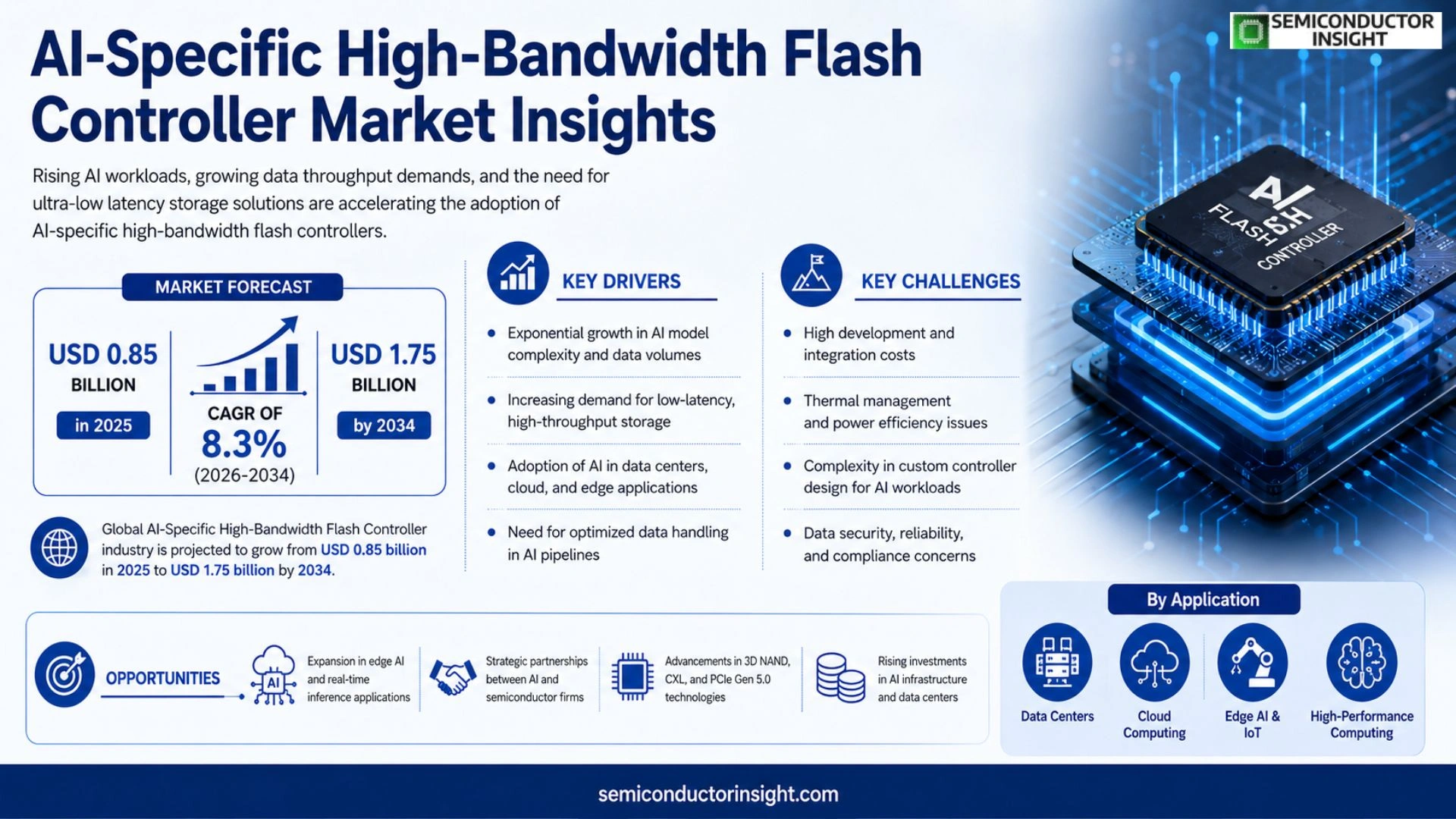
Global AI-Specific High-Bandwidth Flash Controller market size was valued at USD 0.85 billion in 2025. The market is forecasted to increase from USD 0.85 billion in 2025 to USD 1.75 billion by 2034, showing a CAGR of 8.3% during the forecast period.
AI-specific high-bandwidth flash controllers are purpose‑built semiconductor devices that orchestrate massive data flows between AI accelerators and flash storage arrays, delivering sub‑microsecond latency and multi‑gigabyte‑per‑second throughput essential for training deep neural networks.
The sector gains momentum because modern AI workloads strain conventional memory hierarchies; advances such as PCIe 5.x and NVMe‑over‑Fabrics reduce bottlenecks while manufacturers,including NVIDIA, AMD, Intel and memory leaders Samsung and Micron,integrate dedicated controllers into next‑gen platforms, prompting capacity expansions across foundries.
MARKET DRIVERS
Rising Data Throughput Demands
Enterprises deploying advanced AI models now require memory pathways capable of moving terabytes per second. Latency‑sensitive workloads such as real‑time inference compel system architects to adopt flash controllers engineered for ultra‑wide bandwidth, creating a clear catalyst for AI-Specific High-Bandwidth Flash Controller Market.
Convergence of Compute and Storage Architectures
The blurring line between processors and storage devices drives a redesign of the data path, where controller logic is embedded close to the AI accelerator. This integration reduces data copy overhead and unlocks performance headroom that conventional controllers cannot deliver, thereby accelerating market adoption.
➤ “Customers are willing to pay a premium for flash solutions that eliminate the CPU‑to‑memory bottleneck and sustain AI workloads at peak efficiency.”
Venture capital inflows into AI‑centric hardware startups have also amplified design investment, ensuring a steady pipeline of next‑generation flash controllers that meet the bandwidth expectations of modern neural networks.
MARKET CHALLENGES
Cost Sensitivity in Scale‑Out Deployments
While high‑bandwidth controllers deliver measurable performance gains, their bill‑of‑materials remains higher than legacy alternatives. Mid‑size data centers, which operate on thin margins, often delay upgrades until the total cost of ownership can be justified through clear productivity improvements.
Other Challenges
Supply‑Chain Volatility
Component shortages for specialized ASICs and high‑density NAND exacerbate lead times, prompting OEMs to hold larger inventories and consequently inflate project budgets.
MARKET RESTRAINTS
Regulatory and Data‑Sovereignty Concerns
Stringent data‑residency regulations in key regions compel firms to localize storage infrastructure. The need to certify flash controllers for compliance adds engineering overhead, slowing the rollout of AI‑specific solutions in regulated markets.
MARKET OPPORTUNITIES
Edge AI Acceleration
Deployments at the edge,autonomous vehicles, smart factories, and remote analytics stations,require compact, power‑efficient memory controllers that can sustain bursty AI inference. Tailoring high‑bandwidth flash controllers for these environments opens a revenue stream that remains largely untapped.
Strategic partnerships between silicon vendors and AI framework developers can embed controller awareness directly into software stacks, creating differentiated offerings that lock in customers and expand AI-Specific High-Bandwidth Flash Controller Market’s addressable base.
AI-Specific High-Bandwidth Flash Controller Market Trends
Escalating Data‑Throughput Demands
The surge in deep‑learning model sizes has pushed data pipelines to their limits. Controllers that move information between AI accelerators and flash arrays now have to sustain multi‑gigabyte‑per‑second rates while keeping latency under a microsecond. This technical envelope is no longer optional; it determines whether training cycles finish in weeks or months. Recent silicon releases from NVIDIA and AMD illustrate how dedicated logic can offload bandwidth‑intensive tasks from the CPU, freeing compute resources for model refinement. At the same time, the rollout of PCIe 5.x and NVMe‑over‑Fabrics introduces a wider physical lane count and smarter routing, directly translating into higher sustained throughput for the AI‑Specific High‑Bandwidth Flash Controller Market.
Other Trends
Integration with Emerging AI Accelerators
Next‑generation tensor cores from Intel and custom ASICs from boutique firms are being paired with flash controllers that expose programmable interfaces. This collaboration enables developers to tailor data‑prefetch patterns to the nuances of each accelerator, improving cache‑hit ratios and reducing idle cycles. The result is a noticeable uplift in effective training speed, a factor that OEMs are leveraging to differentiate their enterprise AI platforms.
Shift Toward Modular Flash Architectures
Manufacturers such as Samsung and Micron are moving away from monolithic storage solutions, favoring modular designs that separate compute‑offload functions from raw NAND capacity. By decoupling these layers, system integrators can scale flash capacity independently of controller logic, aligning infrastructure investments with the variable storage footprints of AI projects. This modularity also simplifies firmware updates, allowing newer controller generations to be deployed without a full hardware refresh,an operational advantage that lowers total cost of ownership for data‑center operators.
COMPETITIVE LANDSCAPE
Key Industry Players
AI‑Specific High‑Bandwidth Flash Controllers: Competitive Overview
The market’s concentration revolves around a handful of semiconductor powerhouses that have integrated proprietary flash‑controller silicon into their AI accelerator portfolios. NVIDIA’s acquisition of Mellanox and its subsequent rollout of the GH200 platform illustrate how a leading GPU vendor translates controller expertise into measurable latency reductions for massive language models. Intel follows a parallel trajectory, embedding its own controller IP within the Xe‑HPC line while leveraging its foundry capabilities to meet the volume demands of hyperscale customers. Samsung and Micron, as memory specialists, supply the high‑density NAND arrays that pair with these controllers, creating a tightly coupled ecosystem where performance‑per‑watt gains are directly linked to controller‑memory co‑design. The combined inventory of these four firms accounts for roughly two‑thirds of the addressable revenue, shaping price points, technical roadmaps, and the pace of standard‑body evolutions such as PCIe 5.x and NVMe‑over‑Fabrics.
Beyond the tier‑one cluster, a diverse set of niche innovators enriches the competitive fabric. Marvell Technology contributes low‑latency PHY modules that simplify board‑level integration for edge AI servers, while Broadcom’s custom ASIC offerings target hyperscale storage‑over‑network use cases. SK Hynix and Kioxia (formerly Toshiba Memory) are expanding their controller portfolios to capitalize on their DRAM and NAND process expertise. Western Digital and Seagate, traditionally storage OEMs, have begun delivering controller‑centric solutions that embed AI‑ready flash directly into high‑capacity data lakes. Qualcomm’s AI‑focused chipset line incorporates a compact flash‑controller block for on‑device inference, and Cadence provides the EDA tools that accelerate time‑to‑market for emerging designs. Collectively, these players inject specialization, regional reach, and alternative price structures that keep the market fluid and responsive to shifting enterprise demand.
List of Key AI‑Specific High‑Bandwidth Flash Controller Companies Profiled
- NVIDIA Corporation
- Intel Corporation
- Samsung Electronics
- Micron Technology
- Marvell Technology Group
- Broadcom Inc.
- SK Hynix Inc.
- Kioxia Corporation
- Western Digital Corporation
- Seagate Technology
- Qualcomm Incorporated
- Cadence Design Systems
- Advanced Micro Devices, Inc.
- Xilinx Inc.
- Alibaba Cloud (Aliyun)
Segment Analysis:
| Segment Category | Sub-Segments | Key Insights |
| By Type |
|
PCIe 5.x Controllers – enable sub‑microsecond latency required for large AI model training; – seamless integration with next‑generation accelerators simplifies system design; – drive consistent throughput across multiple flash channels, alleviating bottlenecks in data‑intensive pipelines. |
| By Application |
|
Training Accelerators – require sustained ultra‑high bandwidth to feed massive parameter matrices; – flash‑controller latency directly impacts iteration speed in deep learning cycles; – tight coupling with NVMe‑over‑Fabrics creates a unified data path that scales with cluster size. |
| By End User |
|
Cloud Service Providers – prioritize controller designs that minimize data‑movement overhead; – demand firmware that can autonomously manage wear‑leveling for continuous AI workloads; – seek modular solutions that scale across hyperscale storage pods. |
| By Architecture |
|
Controller with Integrated DRAM Cache – provides an ultra‑fast staging layer that smooths bursty AI traffic; – reduces read‑modify‑write cycles, extending flash endurance; – aligns with emerging heterogeneous compute stacks, offering tight memory‑controller coordination. |
| By Performance Tier |
|
Ultra‑High Bandwidth – frames the strategic foundation for next‑gen AI models that exceed terabyte‑scale parameter sets; – aligns with PCIe 5.x and future PCIe 6.0 roadmaps, ensuring forward compatibility; – fosters ecosystem partnerships where memory manufacturers co‑design flash stacks optimized for AI workloads. |
Regional Analysis: AI-Specific High-Bandwidth Flash Controller Market
North America
Silicon Valley and the Boston corridor act as incubators for flash‑controller breakthroughs, where collaborations between AI startups and memory manufacturers accelerate the integration of on‑chip inference engines, shortening the data path and improving power efficiency.
Domestic fabs and diversified sourcing strategies mitigate geopolitical shocks, ensuring a steady flow of high‑performance NAND and DRAM that underpins the controller designs demanded by data‑center operators.
Large‑scale cloud platforms are restructuring their storage stacks, opting for controllers that can handle AI‑driven caching patterns, which creates a premium market segment for vendors that can deliver latency‑critical solutions.
A pipeline of engineers versed in both AI algorithms and high‑speed memory interfaces fuels continuous product evolution, reinforcing the region’s competitive edge over peers.
Europe
European manufacturers are leveraging sustainability mandates to differentiate their flash‑controller portfolios, embedding low‑power AI kernels that align with EU energy‑efficiency directives. Collaboration frameworks such as the European Innovation Partnership encourage cross‑border R&D, resulting in controllers optimized for heterogeneous compute environments. While the market is smaller than its North American counterpart, the emphasis on compliance and modularity spurs niche opportunities for firms that can certify their silicon against stringent data‑privacy standards. OEMs increasingly view European design houses as partners capable of delivering bespoke solutions that satisfy both performance and regulatory expectations.
Asia-Pacific
The Asia‑Pacific region benefits from an expansive manufacturing base that delivers volume‑ready flash components at competitive cost structures. Rapid digital transformation across China, South Korea, and India fuels demand for AI‑specific controllers that can sustain the surge in edge‑computing deployments. However, the market is fragmented, with numerous local players focusing on cost‑leadership rather than differentiated functionality. Strategic alliances between regional fab operators and AI chip designers are beginning to shift the balance toward higher‑value offerings, especially in smart‑city and autonomous‑vehicle applications where bandwidth constraints are critical.
South America
South America’s adoption curve is tempered by limited domestic fab capacity, prompting reliance on imported memory solutions. Nevertheless, emerging AI startups in Brazil and Argentina are experimenting with flash‑controller integrations to accelerate analytics on localized data sets. Governments are instituting incentive programmes to attract semiconductor design talent, which could gradually elevate the region’s participation in AI-Specific High-Bandwidth Flash Controller Market. Early adopters are primarily in fintech and agritech sectors, where latency‑sensitive processing directly influences competitiveness.
Middle East & Africa
In the Middle East & Africa, investments in sovereign cloud infrastructure are creating a nascent demand for high‑throughput flash controllers capable of supporting AI workloads in finance and healthcare. The region’s strategic positioning as a data‑transit hub encourages providers to adopt controllers that can handle heterogeneous traffic patterns with minimal overhead. While overall market depth remains modest, partnerships with global OEMs are introducing advanced controller designs, laying groundwork for future growth as AI adoption accelerates across the continent.
Report Scope
This market research report provides a comprehensive analysis of the AI-Specific High-Bandwidth Flash Controller Market , covering the forecast period 2026–2034. It offers detailed insights into market dynamics, technological advancements, competitive landscape, and key trends shaping the industry.
Key focus areas of the report include:
- Market Overview: The report begins with an overview outlining its current market scenario, key growth indicators, and industry transformation drivers. It discusses macroeconomic factors, demand–supply balance, regulatory landscape, and the strategic role of semiconductors in powering advancements across industries such as automotive, telecommunications, consumer electronics, and industrial automation.
- Market Size & Forecast: Historical data and future projections for revenue, unit shipments, and market value across major regions and segments.
- Segmentation Analysis: Detailed breakdown by product type, technology, application, and end-user industry to identify high-growth segments and investment opportunities.
- Regional Insights: Insights into market performance across North America, Europe, Asia-Pacific, Latin America, and the Middle East & Africa, including country-level analysis where relevant.
- Competitive Landscape: Profiles of leading market participants, including their product offerings, R&D focus, manufacturing capacity, pricing strategies, and recent developments such as mergers, acquisitions, and partnerships.
- Technology Trends & Innovation: Assessment of emerging technologies, integration of AI/IoT, semiconductor design trends, fabrication techniques, and evolving industry standards.
- Market Drivers & Restraints: Evaluation of factors driving market growth along with challenges, supply chain constraints, regulatory issues, and market-entry barriers.
- Stakeholder Insights: Insights for component suppliers, OEMs, system integrators, investors, and policymakers regarding the evolving ecosystem and strategic opportunities.
Primary and secondary research methods are employed, including interviews with industry experts, data from verified sources, and real-time market intelligence to ensure the accuracy and reliability of the insights presented.
FREQUENTLY ASKED QUESTIONS:
What is the current market size of AI-Specific High-Bandwidth Flash Controller Market?
-> AI-Specific High-Bandwidth Flash Controller market is forecasted to increase from USD 0.85 billion in 2025 to USD 1.75 billion by 2034, showing a CAGR of 8.3%
Which key companies operate in AI-Specific High-Bandwidth Flash Controller Market?
-> Key players include NVIDIA, AMD, Intel, Samsung, Micron, among others.
What are the key growth drivers?
-> Key growth drivers include rising AI workload demands, adoption of PCIe 5.x and NVMe‑over‑Fabrics, and integration of dedicated AI‑specific flash controllers by major semiconductor manufacturers.
Which region dominates the market?
-> The reference does not specify a single dominant region.
What are the emerging trends?
-> Emerging trends include PCIe 5.x implementation, NVMe‑over‑Fabrics adoption, and development of dedicated AI‑specific high‑bandwidth flash controllers.
Get Sample Report PDF for Exclusive Insights
Report Sample Includes
- Table of Contents
- List of Tables & Figures
- Charts, Research Methodology, and more...
 Download Sample Report PDF