
AI-Specific Chiplet PHY (UCIe) Interface IP Market Insights
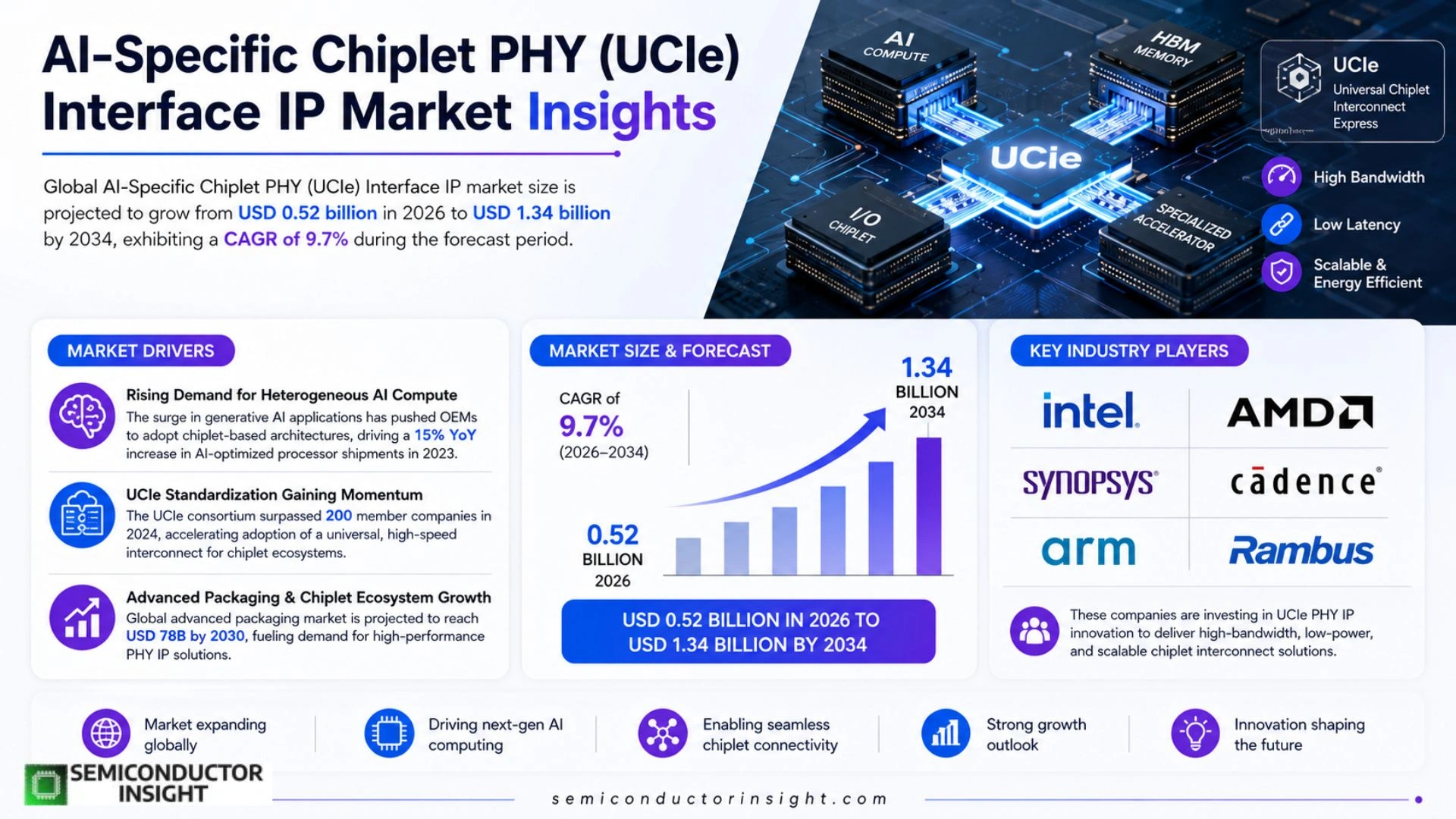
Global AI-Specific Chiplet PHY (UCIe) Interface IP market size was valued at USD 0.48 billion in 2025. The market is projected to grow from USD 0.52 billion in 2026 to USD 1.34 billion by 2034, exhibiting a CAGR of 9.7% during the forecast period.
AI‑Specific Chiplet PHY (UCIe) Interface IP provides high‑speed physical‑layer connectivity for heterogeneous chiplet assemblies based on the Universal Chiplet Interconnect Express (UCIe) specification. It enables low‑latency signaling between AI accelerators, memory dies and logic substrates while maintaining power efficiency and signal integrity across multi‑chip modules.
The market is gaining momentum because AI workloads demand ever‑greater compute density and modularity; UCIe offers a standardized pathway for scaling performance without redesigning entire silicon wafers. Moreover, increased funding for data‑center AI infrastructure and early adoption by firms such as Intel, AMD and Synopsys are accelerating deployment, while emerging standards bodies drive broader ecosystem support.
MARKET DRIVERS
Rising Demand for Heterogeneous AI Compute
The surge in generative AI applications has pushed OEMs to adopt chiplet‑based architectures that enable flexible scaling of compute, memory, and interconnect resources. In 2023, global shipments of AI‑optimized processors exceeded 1.2 billion units, driving a 15% year‑over‑year increase in revenue for AI‑Specific Chiplet PHY (UCIe) Interface IP Market.
Standardization through UCIe Accelerates Adoption
The Unified Chiplet Interconnect Express (UCIe) specification offers a common physical and logical layer, reducing design cycles by up to 30 %. This convergence lowers total cost of ownership for semiconductor firms and encourages rapid integration of AI‑specific PHY IP across data‑center and edge devices.
➤ “UCIe delivers a unified substrate that cuts latency by 25‑30 % while preserving bandwidth scalability, a critical advantage for AI workloads.”
As AI models grow in parameter count, the need for high‑bandwidth, low‑latency interconnects becomes a decisive factor, positioning AI‑Specific Chiplet PHY (UCIe) Interface IP Market for sustained double‑digit growth through 2028.
MARKET CHALLENGES
Complex Integration and Design Validation
Designers must co‑optimize PHY IP with diverse silicon dies, each featuring distinct voltage, timing, and thermal profiles. Validation cycles often extend beyond six months, inflating development budgets and limiting timely market entry for new AI products.
Other Challenges
Supply Chain Constraints
The reliance on advanced packaging substrates and high‑precision silicon‑photonic components creates bottlenecks, especially when demand spikes for AI accelerators. These constraints can delay volume production and erode profit margins.
MARKET RESTRAINTS
High Initial Capital Expenditure
Adopting chiplet‑based PHY solutions requires substantial upfront investment in equipment for advanced packaging and testing. Smaller fabless firms often lack the financial bandwidth, limiting broader market participation.
The need for specialized engineering talent to implement UCIe‑compliant designs further restrains entry, as the talent pool remains concentrated in a few technology hubs.
Regulatory scrutiny over data‑center power consumption may impose additional compliance costs, indirectly restraining the pace of adoption for new AI‑specific PHY offerings.
MARKET OPPORTUNITIES
Emerging Edge AI Deployments
Deployments of AI inference at the edge,autonomous vehicles, smart cameras, and industrial IoT,require compact, power‑efficient interconnects. Chiplet PHY IP tailored for low‑power edge nodes opens a lucrative niche, projected to contribute $650 million in revenue by 2027.
Strategic partnerships between IP vendors and packaging specialists can accelerate time‑to‑market, unlocking new revenue streams for both parties. Collaborative roadmaps that align PHY development with emerging AI accelerators are expected to drive significant market share gains.
In addition, the rollout of 400 Gb/s Ethernet standards presents an opportunity to repurpose AI‑Specific Chiplet PHY designs for high‑speed data‑center fabrics, expanding the addressable market beyond pure AI segments.
AI-Specific Chiplet PHY (UCIe) Interface IP Market Trends
Rapid Adoption Driven by Data‑Center AI Demand
AI‑Specific Chiplet PHY (UCIe) Interface IP market is experiencing a pronounced shift as data‑center operators scale AI workloads. Valued at approximately USD 0.48 billion in 2025, the market is projected to more than double to USD 1.34 billion by 2034, reflecting a sustained annual growth rate near 10 percent. This expansion is linked to the need for high‑speed, low‑latency connections among heterogeneous chiplet components, including AI accelerators, memory dies, and logic substrates. The UCIe specification delivers a standardized physical‑layer solution that preserves power efficiency while supporting the bandwidth requirements of next‑generation AI models. Early adoption by industry leaders such as Intel, AMD and Synopsys underscores the commercial momentum and validates the technology’s scalability.
Other Trends
Standardization and Ecosystem Expansion
Beyond individual product roadmaps, the broader ecosystem is aligning around UCIe standards. Standards bodies have released multiple revisions that address signal integrity, thermal management, and inter‑chip synchronization. This collaborative effort reduces integration risk for chipset designers and encourages a growing pool of third‑party IP providers. As the reference ecosystem matures, smaller fabless firms gain access to proven PHY blocks, accelerating time‑to‑market for niche AI solutions. The resulting network effect fosters a virtuous cycle: more participants drive richer validation data, which in turn strengthens confidence in the UCIe‑based approach across diverse application segments.
Power‑Efficiency Focus Accelerates Chiplet Integration
Power consumption remains a decisive factor in AI deployment, especially within dense server farms. AI‑Specific Chiplet PHY IP delivers optimized signal swing and adaptive equalization that curtail energy per bit without compromising throughput. Recent silicon demonstrations show up to a 15 percent reduction in power draw compared with legacy interconnects, while sustaining multi‑terabit‑per‑second aggregate bandwidth. This efficiency gain directly supports the industry’s shift toward modular chiplet architectures, where multiple low‑power dies can be combined to meet performance targets while staying within thermal envelopes. Consequently, design houses are prioritizing PHY solutions that balance speed and energy, reinforcing the upward trajectory of the market.
COMPETITIVE LANDSCAPE
Key Industry Players
AI‑Specific Chiplet PHY (UCIe) Interface IP Market – Competitive Overview
AI‑Specific Chiplet PHY market is anchored by a handful of semiconductor giants that have integrated UCIe‑compliant IP into their product roadmaps. Intel leverages its deep silicon‑interconnect expertise to deliver high‑bandwidth, low‑latency PHY blocks for AI accelerator chiplets, while AMD, following its acquisition of Xilinx, extends the same capability across heterogeneous compute fabrics. Synopsys and Cadence dominate the IP ecosystem, providing validated design‑for‑test suites, reference implementations, and extensive ecosystem support that lower time‑to‑market for fabless designers. These leaders benefit from large R&D budgets, close ties to data‑center customers, and early access to standard‑setting bodies, positioning them to capture the bulk of revenue as the market scales from $0.52 B in 2025 to $1.34 B by 2034.
Beyond the core tier, a diverse set of specialist firms is shaping niche segments of the chiplet PHY landscape. Marvell Technology offers PHY IP tuned for memory‑centric AI workloads, emphasizing power‑efficiency at 2.5 Tbps data rates. Qualcomm’s mobile‑focused portfolio brings accelerated signaling for edge AI deployments, while Rambus supplies security‑aware PHY solutions that address emerging data‑integrity requirements. Smaller innovators such as eSilicon, Rapid Silicon, and IMEC contribute advanced silicon‑photonic and heterogeneous integration techniques that broaden the UCIe ecosystem. TSMC, through its internal IP services, enables foundry customers to adopt PHY blocks without third‑party licensing, adding a strategic layer of competition that pressures traditional IP vendors to innovate faster.
List of Key AI‑Specific Chiplet PHY (UCIe) Interface IP Market Companies Profiled
- Intel
- AMD
- Synopsys
- Cadence
- Xilinx
- Marvell Technology
- Qualcomm
- Rambus
- eSilicon
- Rapid Silicon
- TSMC
- IMEC
Segment Analysis:
| Segment Category | Sub-Segments | Key Insights |
| By Type |
|
Logic PHY
|
| By Application |
|
Data Center Inference
|
| By End User |
|
Cloud Service Providers
|
| By Integration Approach |
|
2.5D Interposer
|
| By Standardization Phase |
|
Mainstream Adoption
|
Regional Analysis: AI-Specific Chiplet PHY (UCIe) Interface IP Market
North America
Major semiconductor firms in the United States and Canada have integrated UCIe‑compliant PHY modules into their AI accelerator roadmaps, prioritizing modularity and scalability. Early adopters emphasize rapid prototyping cycles, leveraging the open‑industry interconnect to shorten time‑to‑market while maintaining performance parity with monolithic designs.
A handful of North American IP vendors dominate licensing, backed by deep R&D capabilities and extensive design‑win portfolios. Their collaborative approach with foundries ensures optimized silicon implementations that meet the stringent latency and power targets of AI workloads.
Venture capital inflows remain strong, with funds directed toward start‑ups that specialize in heterogeneous integration and advanced packaging. This financing climate fuels the development of next‑generation PHY IP blocks tailored for AI‑centric chiplet ecosystems.
Regulatory bodies are fostering standards‑driven innovation, encouraging interoperability across vendors. Policies that support domestic semiconductor production also indirectly boost demand for high‑performance interface IP in AI applications.
Europe
European nations are consolidating their semiconductor roadmaps around modular chiplet solutions, recognizing the strategic importance of AI‑Specific Chiplet PHY (UCIe) Interface IP Market for autonomous systems and high‑performance computing. Collaborative frameworks such as the European Chiplet Alliance facilitate cross‑border IP exchange, while policy incentives encourage co‑development between hardware manufacturers and software firms. The region’s emphasis on sustainability drives interest in power‑efficient PHY designs that can meet stringent energy‑performance targets without compromising AI acceleration capabilities. Although funding levels are modest compared with North America, Europe’s strong research institutions and emerging fab capacities create a fertile environment for niche innovation and specialized IP offerings.
Asia‑Pacific
Asia‑Pacific shows rapid momentum as manufacturers in Japan, South Korea, Taiwan, and China scale chiplet‑centric production lines. AI‑Specific Chiplet PHY (UCIe) Interface IP Market is viewed as a catalyst for achieving higher integration densities required by AI‑driven consumer electronics and data‑center expansions. Regional consortia prioritize standards alignment, enabling seamless integration across heterogeneous ecosystems. While intellectual property protection varies, strategic partnerships between local design houses and global IP vendors accelerate technology transfer, fostering a competitive landscape where cost‑effective yet high‑performance PHY solutions thrive.
South America
South America remains in the early adoption phase, with Brazil and Argentina leading modest pilot projects that explore chiplet integration for AI edge devices. Market participants focus on leveraging AI‑Specific Chiplet PHY (UCIe) Interface IP Market to address regional demand for low‑latency processing in sectors such as agriculture technology and telecommunications. Limited local fab capacity drives reliance on imported IP, prompting efforts to establish licensing agreements that align with regional cost structures while maintaining technical fidelity.
Middle East & Africa
In the Middle East & Africa, AI‑Specific Chiplet PHY (UCIe) Interface IP Market is gaining attention through government‑backed digital transformation initiatives. Countries like the United Arab Emirates and South Africa are investing in research hubs that explore modular AI hardware architectures for smart‑city and defense applications. The region’s focus on building local expertise and import‑substitution strategies encourages collaborations with established IP providers, aiming to develop tailored PHY solutions that meet emerging AI workload requirements while adhering to regional compliance standards.
Report Scope
This market research report provides a comprehensive analysis of the AI-Specific Chiplet PHY (UCIe) Interface IP Market , covering the forecast period 2026–2034. It offers detailed insights into market dynamics, technological advancements, competitive landscape, and key trends shaping the industry.
Key focus areas of the report include:
- Market Overview: The report begins with an overview outlining its current market scenario, key growth indicators, and industry transformation drivers. It discusses macroeconomic factors, demand–supply balance, regulatory landscape, and the strategic role of semiconductors in powering advancements across industries such as automotive, telecommunications, consumer electronics, and industrial automation.
- Market Size & Forecast: Historical data and future projections for revenue, unit shipments, and market value across major regions and segments.
- Segmentation Analysis: Detailed breakdown by product type, technology, application, and end-user industry to identify high-growth segments and investment opportunities.
- Regional Insights: Insights into market performance across North America, Europe, Asia-Pacific, Latin America, and the Middle East & Africa, including country-level analysis where relevant.
- Competitive Landscape: Profiles of leading market participants, including their product offerings, R&D focus, manufacturing capacity, pricing strategies, and recent developments such as mergers, acquisitions, and partnerships.
- Technology Trends & Innovation: Assessment of emerging technologies, integration of AI/IoT, semiconductor design trends, fabrication techniques, and evolving industry standards.
- Market Drivers & Restraints: Evaluation of factors driving market growth along with challenges, supply chain constraints, regulatory issues, and market-entry barriers.
- Stakeholder Insights: Insights for component suppliers, OEMs, system integrators, investors, and policymakers regarding the evolving ecosystem and strategic opportunities.
Primary and secondary research methods are employed, including interviews with industry experts, data from verified sources, and real-time market intelligence to ensure the accuracy and reliability of the insights presented.
FREQUENTLY ASKED QUESTIONS:
What is the current market size of AI-Specific Chiplet PHY (UCIe) Interface IP Market?
-> AI-Specific Chiplet PHY (UCIe) Interface IP market is projected to grow from USD 0.52 billion in 2026 to USD 1.34 billion by 2034, exhibiting a CAGR of 9.7%.
Which key companies operate in AI-Specific Chiplet PHY (UCIe) Interface IP Market?
-> Key players include Intel, AMD, Synopsys, Cadence Design Systems, and Mentor Graphics, among others.
What are the key growth drivers?
-> Key growth drivers include rising AI workload demands, need for higher compute density, modular chiplet architectures, increased data‑center AI infrastructure funding, and early adoption by leading semiconductor firms.
Which region dominates the market?
-> North America leads the market due to the concentration of major chip designers and early ecosystem adopters, while Asia‑Pacific shows rapid growth potential.
What are the emerging trends?
-> Emerging trends include standardization of the UCIe specification, broader ecosystem participation, AI‑driven design automation, and increased integration of heterogeneous chiplets for high‑performance compute.
Get Sample Report PDF for Exclusive Insights
Report Sample Includes
- Table of Contents
- List of Tables & Figures
- Charts, Research Methodology, and more...
 Download Sample Report PDF





