AI-Specific Burn-in Board Design Market Insights
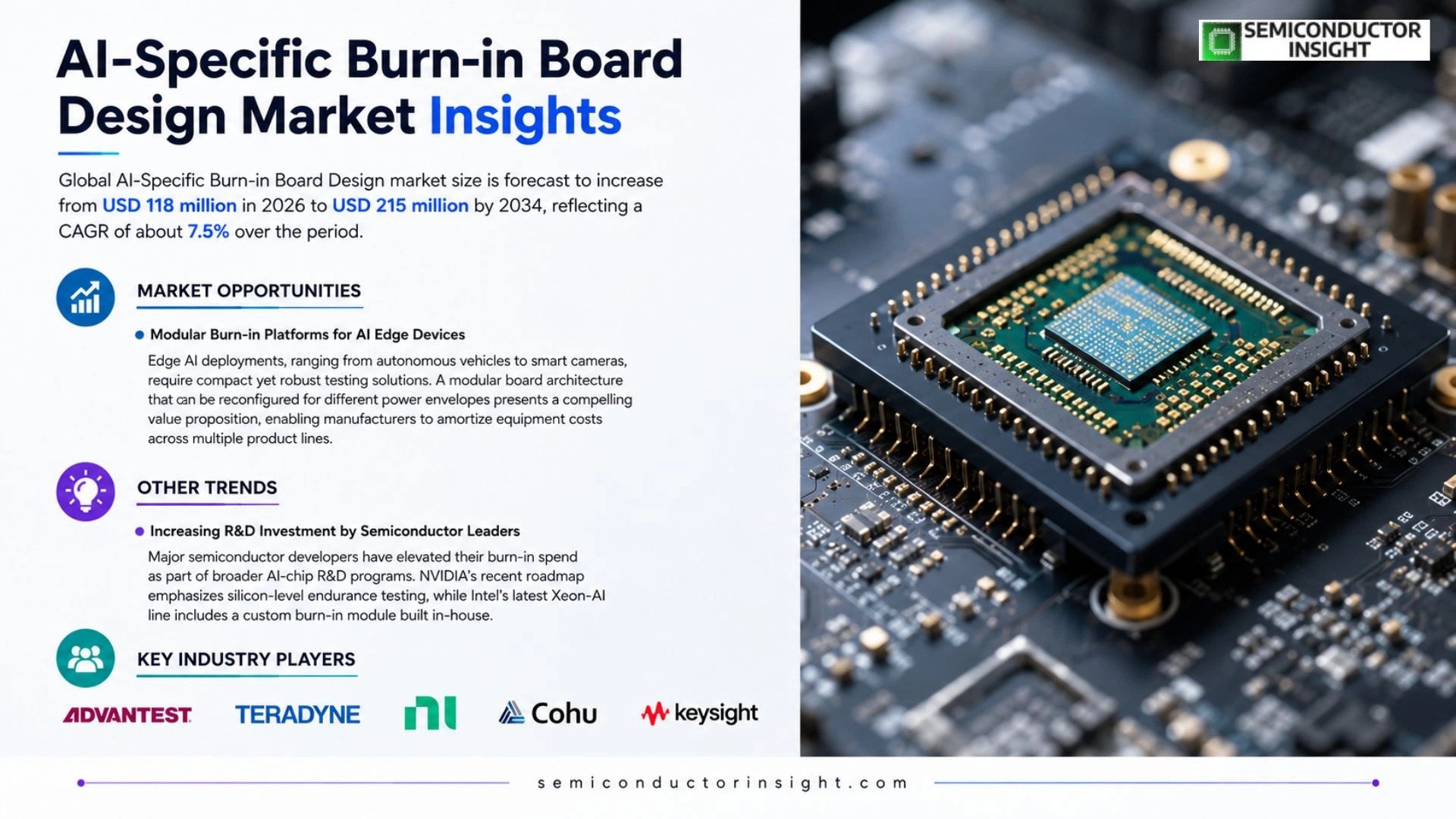
Global AI‑Specific Burn‑in Board Design market size was valued at USD 112 million in 2025. The market is forecast to increase from USD 118 million in 2026 to USD 215 million by 2034, reflecting a CAGR of about 7.5% over the period.
AI‑Specific Burn‑in Boards are custom test platforms that subject artificial‑intelligence processors and accelerators to prolonged electrical stress at elevated temperatures. Their purpose is to uncover latent defects, verify thermal stability, and ensure long‑term reliability before volume production.
The upward trajectory stems from expanding deployment of AI chips in data centers and edge devices, which raises the demand for rigorous qualification cycles. Moreover, heightened R&D budgets among semiconductor leaders such as NVIDIA, Intel and AMD have spurred investment in dedicated burn‑in infrastructure. Collaborative projects between foundries and test equipment manufacturers further accelerate adoption of specialized burn‑in solutions.
MARKET DRIVERS
Rising Demand for AI Compute Reliability
Manufacturers of AI accelerators are tightening quality‑control loops to meet the stringent uptime requirements of data‑center operators. Failure‑point reduction on high‑density ASICs translates directly into lower total‑cost‑of‑ownership, prompting system integrators to prioritize burn‑in solutions that can expose latent defects before field deployment. Consequently, AI‑Specific Burn‑in Board Design Market experiences amplified interest from OEMs seeking predictable performance throughout the product lifecycle.
Advancements in Thermal Management Technologies
Recent breakthroughs in micro‑fluidic cooling and high‑efficiency temperature sensors enable burn‑in boards to operate at tighter thermal envelopes without compromising component longevity. By delivering uniform heat distribution, these designs reduce stress gradients that traditionally trigger early failures in AI chips. The ability to simulate real‑world load conditions more faithfully has become a decisive factor for customers evaluating board providers.
➤ “A reliable burn‑in platform now acts as a strategic differentiator, allowing AI hardware vendors to guarantee SLA commitments with confidence.”
Beyond hardware, the integration of AI‑driven analytics into the burn‑in process empowers manufacturers to predict degradation pathways with unprecedented accuracy. Predictive models fed by sensor streams can flag outliers in seconds, shortening test cycles while preserving diagnostic depth. This synergy between AI and burn‑in engineering fuels a virtuous cycle that reinforces market expansion.
MARKET CHALLENGES
Escalating Component Cost Structures
The premium pricing of next‑generation AI processors inflates the bill of materials for burn‑in systems. Clients must balance the cost of dedicated test boards against the financial risks of field failures, a trade‑off that can delay procurement decisions. When budget constraints tighten, firms may revert to legacy equipment, slowing adoption of specialized solutions.
Other Challenges
Standardization Gaps
Industry‑wide test standards for AI‑specific workloads remain fragmented. Divergent temperature profiles, voltage ramps, and duration criteria create compatibility hurdles, forcing board designers to support multiple test regimes and increasing engineering overhead.
MARKET RESTRAINTS
Limited Availability of Skilled Engineers
Designing reliable burn‑in boards for AI chips demands deep expertise in high‑frequency signal integrity, thermal flow, and failure analysis. The talent pool capable of integrating these domains is narrow, leading to longer lead times for custom solutions and higher hourly rates for consultancy services.
Regulatory Compliance Pressures
Environmental regulations governing hazardous substances and energy consumption impose additional design constraints. Engineers must certify that board materials meet RoHS and REACH standards while still delivering the thermal performance required for aggressive burn‑in cycles, a balance that adds complexity to product development.
Supply‑chain volatility, especially for specialty substrates and high‑precision connectors, can cause delays in scaling production. When critical components are sourced from a limited number of suppliers, any disruption ripples through the burn‑in board market, limiting its ability to respond swiftly to spikes in demand.
MARKET OPPORTUNITIES
Modular Burn‑in Platforms for AI Edge Devices
Edge AI deployments,ranging from autonomous vehicles to smart cameras,require compact yet robust testing solutions. A modular board architecture that can be reconfigured for different power envelopes presents a compelling value proposition, enabling manufacturers to amortize equipment costs across multiple product lines.
Integration of Real‑Time Analytics
Embedding AI‑based anomaly detection directly on the burn‑in board allows operators to intervene mid‑test, reducing waste from batch failures. Companies that offer turnkey analytics dashboards create a differentiated service layer, opening recurring‑revenue streams beyond hardware sales.
Strategic Partnerships with Chip Foundries
Collaborations that align burn‑in board development with silicon roadmap timelines can accelerate time‑to‑market for new AI processors. Foundries seeking to certify their latest nodes benefit from early access to tailored test platforms, while board vendors secure long‑term contracts anchored to next‑generation product launches.
AI-Specific Burn-in Board Design Market Trends
Rising Adoption in Data‑Center AI Chip Qualification
AI-Specific Burn-in Board Design Market has moved from a niche segment in 2025, when revenue reached USD 112 million, to a growth phase that sees the figure climbing to USD 118 million in 2026 and nearly USD 215 million by 2034. This trajectory reflects the pressing need to validate AI accelerators that operate under higher power densities and tighter thermal envelopes than legacy silicon. Data‑center operators and edge‑device manufacturers are now subject to longer qualification cycles; any latent defect can translate into costly field failures. By subjecting chips to extended electrical stress at elevated temperatures, burn‑in boards expose weaknesses that standard functional tests miss, thereby safeguarding brand reputation and reducing warranty claims. Because qualification now occurs earlier in the product lifecycle, OEMs are allocating discrete line‑item funding for dedicated burn‑in stations, which in turn pushes equipment vendors to expand capacity and integrate advanced thermal control. The market shift also encourages design houses to embed burn‑in considerations early, influencing board layout and material selection.
Other Trends
Increasing R&D Investment by Semiconductor Leaders
Major semiconductor developers have elevated their burn‑in spend as part of broader AI‑chip R&D programs. NVIDIA’s recent roadmap emphasizes silicon‑level endurance testing, while Intel’s latest Xeon‑AI line includes a custom burn‑in module built in‑house. AMD’s acquisition of a niche test‑equipment supplier underscores the strategic importance of having direct control over stress‑testing hardware. These moves reflect a willingness to absorb higher upfront costs in order to shorten development windows and achieve higher yield rates once volume production begins. For smaller fabless firms, the trend translates into a reliance on third‑party burn‑in service providers, creating a tiered ecosystem where specialized test houses can monetize expertise across multiple design houses.
Collaborative Ecosystem Between Foundries and Test Equipment Makers
A notable development is the increasing number of joint projects linking foundries such as TSMC with test‑equipment manufacturers like Advantest. By co‑engineering burn‑in fixtures that fit directly into wafer‑probe stations, the combined solution reduces handling steps and improves throughput. Customers benefit from a more streamlined qualification flow, which can shave weeks off the time‑to‑market for AI accelerators. This collaborative model also spreads the risk of equipment obsolescence, as updates are rolled out jointly rather than through isolated product cycles. For service‑oriented players, the partnership opens avenues for recurring revenue through maintenance contracts and upgrade paths, reinforcing the overall resilience of the AI‑specific burn‑in value chain.
COMPETITIVE LANDSCAPE
Key Industry Players
AI‑Specific Burn‑in Board Design Market – Competitive Overview
The sector is anchored by a handful of large test‑equipment manufacturers that couple deep silicon‑testing expertise with dedicated burn‑in board engineering. Teradyne commands a substantial share thanks to its end‑to‑end platform that integrates thermal chambers, power delivery modules and automated data‑capture software, allowing AI‑chip makers to validate reliability at volume. Its ability to bundle hardware with proprietary test algorithms has created a barrier to entry for smaller outfits. Parallel to Teradyne, NVIDIA’s internal design team shapes specifications that downstream vendors must accommodate, effectively steering the market toward solutions that can support emerging high‑density AI accelerators. This concentration of capability in a few global players forces semiconductor firms to align their qualification roadmaps with the timelines and feature sets offered by these established suppliers.
Beyond the tier‑one group, a diverse set of niche specialists fuels innovation in board material selection, micro‑climate control and AI‑focused test analytics. Advantest leverages its high‑speed signal integrity heritage to embed precision timing references on burn‑in boards, enhancing defect detection for edge AI devices. Keysight provides modular RF‑compatible boards that address the growing need for mixed‑signal stress testing, while National Instruments supplies customizable LabVIEW‑based control environments that shorten integration cycles for start‑ups. Regional players such as Moser Electronics, Veeco Instruments, and AMETEK contribute proprietary heating technologies, whereas firms like Chroma, GigaTech and QualiSystems focus on scalable software platforms that aggregate burn‑in data across multiple fabs. This constellation of smaller innovators ensures that the market remains responsive to rapid shifts in AI processor architectures and accelerating adoption cycles.
List of Key AI‑Specific Burn‑in Board Design Companies Profiled
- Teradyne
- Advantest
- Keysight Technologies
- National Instruments
- Moser Electronics
- Veeco Instruments
- AMETEK
- Chroma
- GigaTech
- QualiSystems
- NVIDIA Internal Design Team
- Intel Test Solutions
- AMD Validation Labs
- TDK
- Hynix Semiconductor Test Division
Segment Analysis:
| Segment Category | Sub-Segments | Key Insights |
| By Type |
|
High‑Density Boards
|
| By Application |
|
Data Center AI Accelerators
|
| By End User |
|
Semiconductor Manufacturers
|
| By Test Methodology |
|
Thermal Stress Testing
|
| By Integration Level |
|
Standalone Burn‑in Boards
|
Regional Analysis: AI-Specific Burn-in Board Design Market
North America
Silicon Valley and the Toronto corridor host a concentration of start‑ups specializing in AI‑centric thermal management. Their iterative prototyping cycles shorten development loops for burn‑in boards, allowing customers to validate new AI ASICs within weeks rather than months. This rapid feedback loop fuels the region’s reputation as a crucible for next‑generation board architecture.
North American manufacturers have diversified their component sourcing, integrating domestic semiconductor fabs with established test equipment providers. This vertical integration reduces lead times for high‑precision burn‑in fixtures and buffers the market against overseas disruptions, ensuring that design firms can meet escalating AI‑chip rollout schedules without bottlenecks.
Enterprise AI deployments in cloud hyperscalers and edge computing firms demand boards that guarantee longevity under continuous compute loads. The willingness of these customers to fund premium burn‑in testing translates into higher margin opportunities for niche design houses, reinforcing a virtuous cycle of investment and capability expansion.
While federal standards focus on safety and electromagnetic compliance, emerging guidelines for AI hardware reliability are prompting manufacturers to embed more rigorous burn‑in criteria. Companies that align early with these expectations gain credibility, facilitating smoother approvals for mission‑critical AI applications.
Europe
European stakeholders approach AI-Specific Burn-in Board Design Market through a lens of sustainability and standards harmonisation. Research institutions in Germany and France collaborate closely with automotive OEMs, embedding burn‑in verification into the development of AI‑driven driver‑assist systems. The region’s strong emphasis on circular‑economy principles pushes suppliers to design modular fixtures that can be refurbished, extending equipment lifecycles while lowering total cost of ownership. Moreover, the European Union’s forthcoming reliability directives are shaping procurement policies, nudging manufacturers toward boards that demonstrate consistent performance across extended thermal cycles. These dynamics create a competitive environment where technical excellence is leveraged as a differentiator in a market that values both resilience and regulatory compliance.
Asia‑Pacific
In the Asia‑Pacific arena, AI-Specific Burn-in Board Design Market is propelled by rapid adoption of AI chips in consumer electronics and telecom infrastructure. Nations such as South Korea, Japan, and Taiwan invest heavily in semiconductor fabrication, fostering a local ecosystem that seeks customized burn‑in solutions to match aggressive product launch calendars. Manufacturers are experimenting with high‑throughput burn‑in chambers that can accommodate the dense packaging trends of AI accelerators, while regional design houses adapt to diverse climatic conditions by integrating adaptive thermal control algorithms. The competitive pressure to achieve cost‑effective scaling drives collaborations between board designers and contract test services, ensuring that performance validation keeps pace with the region’s brisk innovation cycle.
South America
South American participation in AI-Specific Burn-in Board Design Market remains nascent but is gaining momentum as AI initiatives emerge in Brazil’s fintech sector and Argentina’s agritech ventures. Local distributors are beginning to import specialized burn‑in equipment, and regional integrators are establishing training programs to upskill engineers on AI‑hardware reliability testing. Although the market size is modest, the willingness of early adopters to demonstrate robust board performance for mission‑critical AI deployments signals a potential foothold for niche vendors willing to provide tailored support and financing options.
Middle East & Africa
The Middle East & Africa region exhibits a measured entry into AI-Specific Burn-in Board Design Market, driven largely by sovereign‑wealth‑funded data‑center projects and defense‑related AI research. In the United Arab Emirates, government‑backed test labs are commissioning burn‑in platforms that can validate high‑density AI processors under extreme ambient temperatures. Meanwhile, African tech hubs are exploring partnerships with global OEMs to access reliable board testing services, recognizing that durability is a prerequisite for deploying AI solutions in remote or infrastructure‑limited environments. These early‑stage activities lay the groundwork for a market segment that prioritises ruggedness and long‑term support.
Report Scope
This market research report provides a comprehensive analysis of the AI-Specific Burn-in Board Design Market , covering the forecast period 2026–2034. It offers detailed insights into market dynamics, technological advancements, competitive landscape, and key trends shaping the industry.
Key focus areas of the report include:
- Market Overview: The report begins with an overview outlining its current market scenario, key growth indicators, and industry transformation drivers. It discusses macroeconomic factors, demand–supply balance, regulatory landscape, and the strategic role of semiconductors in powering advancements across industries such as automotive, telecommunications, consumer electronics, and industrial automation.
- Market Size & Forecast: Historical data and future projections for revenue, unit shipments, and market value across major regions and segments.
- Segmentation Analysis: Detailed breakdown by product type, technology, application, and end-user industry to identify high-growth segments and investment opportunities.
- Regional Insights: Insights into market performance across North America, Europe, Asia-Pacific, Latin America, and the Middle East & Africa, including country-level analysis where relevant.
- Competitive Landscape: Profiles of leading market participants, including their product offerings, R&D focus, manufacturing capacity, pricing strategies, and recent developments such as mergers, acquisitions, and partnerships.
- Technology Trends & Innovation: Assessment of emerging technologies, integration of AI/IoT, semiconductor design trends, fabrication techniques, and evolving industry standards.
- Market Drivers & Restraints: Evaluation of factors driving market growth along with challenges, supply chain constraints, regulatory issues, and market-entry barriers.
- Stakeholder Insights: Insights for component suppliers, OEMs, system integrators, investors, and policymakers regarding the evolving ecosystem and strategic opportunities.
Primary and secondary research methods are employed, including interviews with industry experts, data from verified sources, and real-time market intelligence to ensure the accuracy and reliability of the insights presented.
FREQUENTLY ASKED QUESTIONS:
What is the current market size of AI-Specific Burn-in Board Design Market?
-> AI‑Specific Burn‑in Board Design market is forecast to increase from USD 118 million in 2026 to USD 215 million by 2034, reflecting a CAGR of about 7.5%
Which key companies operate in AI-Specific Burn-in Board Design Market?
-> Key players include NVIDIA, Intel, and AMD, among other leading semiconductor and test‑equipment manufacturers.
What are the key growth drivers?
-> Key growth drivers include expanding deployment of AI chips in data centers and edge devices, rising R&D budgets among semiconductor leaders, and the need for rigorous qualification cycles to ensure reliability of AI processors.
Which region dominates the market?
-> The reference does not specify a dominant region.
What are the emerging trends?
-> Emerging trends include collaborative burn‑in projects between foundries and test‑equipment suppliers, advanced thermal‑management techniques, and integration of AI/IoT testing capabilities into burn‑in platforms.
Get Sample Report PDF for Exclusive Insights
Report Sample Includes
- Table of Contents
- List of Tables & Figures
- Charts, Research Methodology, and more...
 Download Sample Report PDF