
AI Smart Tractor Vision Processing Unit Market Insights
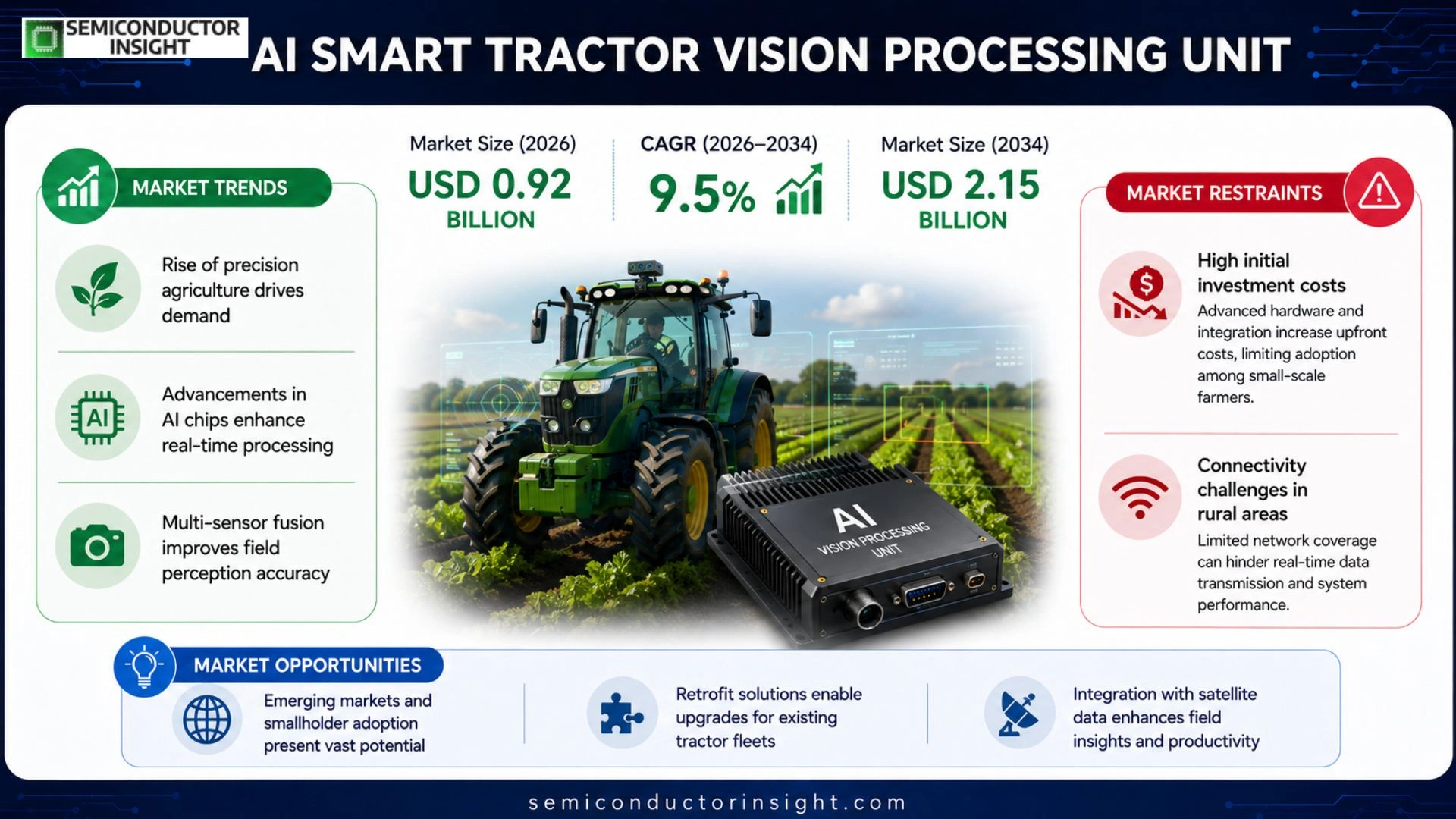
Global AI Smart Tractor Vision Processing Unit market size was valued at USD 0.85 billion in 2025. The market is projected to grow from USD 0.92 billion in 2026 to USD 2.15 billion by 2034, exhibiting a CAGR of 9.5% during the forecast period.
AI Smart Tractor Vision Processing Units are specialized embedded processors that enable real‑time image analysis, object detection, and autonomous navigation for modern tractors. They combine high‑performance GPUs or NPUs with sensor‑fusion algorithms to interpret field conditions, crop rows, and obstacles.
The market is experiencing rapid growth because of rising adoption of precision agriculture, increasing investments in autonomous farming equipment, and government incentives for digital farming solutions. Furthermore, advancements in low‑power AI chips and the demand for higher yield efficiency are driving adoption.
MARKET DRIVERS
Technological Advancements in On‑Board Vision
The integration of high‑resolution cameras with edge‑AI chips has dramatically reduced latency in field operations. Manufacturers are deploying vision processing units that can recognize crop rows, obstacles, and soil conditions in real time, enabling precision interventions that improve yield and lower input costs.
Policy Support and Sustainability Goals
Governments in North America and Europe are offering subsidies for equipment that reduces chemical usage and fuel consumption. Vision‑enabled tractors meet these criteria, prompting farmers to upgrade their fleets ahead of regulatory deadlines.
➤ “Adoption rates are projected to exceed 35 % among large‑scale farms by 2028, driven primarily by cost‑benefit analyses of AI‑assisted vision systems.”
Consolidation among agritech providers is also creating bundled solutions that combine data analytics platforms with the processing unit, further accelerating market penetration as operators seek end‑to‑end intelligence.
MARKET CHALLENGES
High Capital Expenditure
Despite clear operational benefits, the upfront price of an AI Smart Tractor Vision Processing Unit remains a barrier for small‑to‑medium farms, where equipment budgets are tightly constrained. Financing options are limited, leading to slower rollout in regions with fragmented land ownership.
Other Challenges
Data Integration Complexity
Farmers must merge vision data with existing farm‑management systems, often requiring custom middleware. The lack of standardized data protocols increases implementation time and raises the risk of incompatibility.
MARKET RESTRAINTS
Ruggedness and Environmental Reliability
Vision hardware must endure dust, vibration, and temperature extremes common in agricultural settings. Current generation units still face failure rates when exposed to prolonged mud and rain, limiting confidence among risk‑averse operators.
Supply‑chain constraints for semiconductor components have also introduced lead times that can exceed six months, creating inventory bottlenecks for OEMs and delaying field deployments.
Regulatory uncertainty around data privacy in some jurisdictions may require additional compliance measures, adding to the total cost of ownership and deterring adoption in certain markets.
MARKET OPPORTUNITIES
Emerging Markets and Smallholder Adoption
Rapid mechanization in Latin America and Africa is opening a new customer base for cost‑effective vision modules. Partnerships with local distributors can tailor pricing and service models, unlocking growth beyond traditional ultra‑large farms.
Advances in low‑power AI accelerators are enabling retrofit kits for existing tractors, allowing operators to upgrade without purchasing entirely new machinery. This modular approach can capture a sizable share of the upgrade market.
Integration with satellite‑derived field data creates a hybrid perception layer, offering farmers a more comprehensive view of crop health. Companies that provide seamless APIs stand to benefit from cross‑selling opportunities in the broader ag‑tech ecosystem.
AI Smart Tractor Vision Processing Unit Market Trends
Rise of Precision Agriculture Drives Demand
AI Smart Tractor Vision Processing Unit Market is being reshaped by the accelerating adoption of precision‑agriculture practices. Farmers are increasingly relying on real‑time image analysis to optimize planting patterns, monitor crop health, and reduce input waste. Vision processing units, which fuse high‑performance GPUs or NPUs with advanced sensor‑fusion algorithms, deliver the necessary computational power to interpret field conditions instantly. This capability enables autonomous navigation and dynamic obstacle avoidance, directly supporting higher yield efficiency and lower operational costs. As governments introduce incentives for digital farming solutions, investment in autonomous equipment has surged, creating a clear pathway for wider deployment of vision‑enabled tractors across diverse agricultural regions.
Other Trends
Low‑Power AI Chip Innovations
Another critical trend in AI Smart Tractor Vision Processing Unit Market is the rapid improvement of low‑power AI chips. Manufacturers are engineering processors that maintain high inference speeds while consuming minimal energy, a combination that aligns with the extended duty cycles of field equipment. These chips reduce thermal footprints, allowing tractors to operate longer without cooling interruptions. The transition to energy‑efficient silicon also eases integration with existing tractor power systems, eliminating the need for extensive hardware redesigns. Consequently, original equipment manufacturers are incorporating these chips into new tractor lines to meet farmer expectations for both performance and sustainability.
Strategic Partnerships Expand Product Portfolios
Strategic collaborations are amplifying the reach of AI Smart Tractor Vision Processing Unit Market. Leading agritech firms such as John Deere and Trimble are partnering with semiconductor leaders, including NVIDIA and Bosch, to co‑develop integrated solutions that combine domain‑specific algorithms with robust hardware platforms. These alliances accelerate time‑to‑market for next‑generation vision systems, as partners share research, testing facilities, and distribution channels. The combined expertise also fosters standardized interfaces, simplifying the adoption process for end users. As a result, the market is witnessing a broader array of offerings that cater to varied farm sizes and operational models, reinforcing the overall momentum toward fully autonomous agricultural operations.
COMPETITIVE LANDSCAPE
Key Industry Players
AI Smart Tractor Vision Processing Unit Market Competitive Overview
John Deere continues to dominate AI Smart Tractor Vision Processing Unit market, leveraging its extensive tractor portfolio and deep field‑data repositories to integrate vision processors directly into new machine generations. The company’s vertically integrated approach,combining hardware design, software algorithms, and farm‑management services,creates a high barrier to entry for new entrants. Alongside Deere, a dual‑layer market structure has emerged: large agricultural equipment manufacturers (e.g., AGCO, CNH Industrial) that source vision chips from semiconductor specialists, and pure‑play AI chip firms that partner with equipment makers to embed processors in OEM tractors.
Beyond the marquee players, niche innovators such as Trimble Inc., NVIDIA Corporation, Bosch, Qualcomm, Intel, Texas Instruments, AMD, Huawei, Samsung, and STMicroelectronics are shaping the competitive landscape through strategic alliances, rapid‑release AI‑optimized silicon, and customized sensor‑fusion stacks. These firms differentiate themselves by focusing on low‑power architectures, edge‑AI acceleration, or specialized vision libraries for crop‑row detection and obstacle avoidance. Their presence expands choice for tractor OEMs and encourages a faster diffusion of autonomous capabilities across mid‑size and specialty tractor segments.
List of Key AI Smart Tractor Vision Processing Unit Companies Profiled
- John Deere
- Trimble Inc.
- NVIDIA Corporation
- Bosch
- AGCO Corporation
- CNH Industrial
- Qualcomm
- Intel Corporation
- Texas Instruments
- AMD
- Huawei Technologies
- Samsung Electronics
- STMicroelectronics
- Sony Semiconductor
Segment Analysis:
| Segment Category | Sub-Segments | Key Insights |
| By Type |
|
GPU‑Based Vision Processing Units
|
| By Application |
|
Obstacle Detection & Avoidance
|
| By End User |
|
Large‑Scale Commercial Farms
|
| By Technology |
|
Low‑Power AI Chips
|
| By Deployment Mode |
|
OEM Integrated Units
|
Regional Analysis: AI Smart Tractor Vision Processing Unit Market
North America
Early adopters in the U.S. Midwest have deployed high‑resolution cameras and edge‑AI chips, enabling real‑time crop health assessment. The rapid rollout of 5G connectivity further accelerates data processing speeds, allowing tractors to execute complex maneuvers without latency concerns.
Federal agencies provide clear guidelines for autonomous equipment, balancing innovation with safety standards. Pilot programs backed by state agriculture departments facilitate field testing, creating a predictable path for commercialization of vision processing units.
Established OEMs partner with silicon innovators to embed customized processors within tractor platforms. Joint ventures between agritech firms and cloud providers enhance algorithm training, delivering robust perception models tailored to North American crop cycles.
Labor shortages and rising input costs push producers toward automation. Vision‑based systems promise yield gains by optimizing seed placement, pesticide application, and harvest timing, driving sustained demand across large‑scale farms.
Europe
European nations exhibit strong environmental stewardship, prompting adoption of vision processing technology to minimize chemical usage. Collaborative research hubs in Germany and France focus on integrating AI-driven perception with existing tractor fleets, emphasizing sustainability. While regulatory frameworks are stringent, they provide a clear roadmap for safety certification, encouraging manufacturers to develop region‑specific solutions that respect diverse field conditions across the continent.
Asia‑Pacific
The Asia‑Pacific region leverages its extensive agricultural base and rapidly growing mechanisation rates. Countries such as China, India, and Australia invest heavily in smart farming initiatives, recognizing that vision processing units can compensate for labor constraints and fragmented land holdings. Market growth is further supported by government subsidies aimed at digital transformation of agriculture, fostering a fertile environment for both domestic innovators and multinational entrants.
South America
South American producers, particularly in Brazil and Argentina, are beginning to explore AI‑enhanced tractors to address large‑scale soybean and corn operations. The region’s focus on yield optimisation and export competitiveness fuels interest in vision‑based guidance systems, despite challenges related to infrastructure and connectivity. Partnerships with local equipment makers are emerging to customize hardware for tropical climates and varied terrain.
Middle East & Africa
In the Middle East and Africa, the market is in an early adoption phase, driven by water‑efficient farming and the need to maximize limited arable land. Vision processing units are valued for their ability to support precision irrigation and reduce waste. International agritech firms are establishing pilot projects in countries such as the United Arab Emirates and South Africa, aligning technology rollout with government initiatives to modernise agriculture.
Report Scope
This market research report provides a comprehensive analysis of the AI Smart Tractor Vision Processing Unit Market , covering the forecast period 2026–2034. It offers detailed insights into market dynamics, technological advancements, competitive landscape, and key trends shaping the industry.
Key focus areas of the report include:
- Market Overview: The report begins with an overview outlining its current market scenario, key growth indicators, and industry transformation drivers. It discusses macroeconomic factors, demand–supply balance, regulatory landscape, and the strategic role of semiconductors in powering advancements across industries such as automotive, telecommunications, consumer electronics, and industrial automation.
- Market Size & Forecast: Historical data and future projections for revenue, unit shipments, and market value across major regions and segments.
- Segmentation Analysis: Detailed breakdown by product type, technology, application, and end-user industry to identify high-growth segments and investment opportunities.
- Regional Insights: Insights into market performance across North America, Europe, Asia-Pacific, Latin America, and the Middle East & Africa, including country-level analysis where relevant.
- Competitive Landscape: Profiles of leading market participants, including their product offerings, R&D focus, manufacturing capacity, pricing strategies, and recent developments such as mergers, acquisitions, and partnerships.
- Technology Trends & Innovation: Assessment of emerging technologies, integration of AI/IoT, semiconductor design trends, fabrication techniques, and evolving industry standards.
- Market Drivers & Restraints: Evaluation of factors driving market growth along with challenges, supply chain constraints, regulatory issues, and market-entry barriers.
- Stakeholder Insights: Insights for component suppliers, OEMs, system integrators, investors, and policymakers regarding the evolving ecosystem and strategic opportunities.
Primary and secondary research methods are employed, including interviews with industry experts, data from verified sources, and real-time market intelligence to ensure the accuracy and reliability of the insights presented.
FREQUENTLY ASKED QUESTIONS:
What is the current market size of AI Smart Tractor Vision Processing Unit Market?
-> AI Smart Tractor Vision Processing Unit market size is projected to grow from USD 0.92 billion in 2026 to USD 2.15 billion by 2034, exhibiting a CAGR of 9.5% .
Which key companies operate in AI Smart Tractor Vision Processing Unit Market?
-> Key players include John Deere, Trimble Inc., NVIDIA Corporation, and Bosch, among others.
What are the key growth drivers?
-> Key growth drivers include rising adoption of precision agriculture, increasing investments in autonomous farming equipment, government incentives for digital farming solutions, advancements in low‑power AI chips, and demand for higher yield efficiency.
Which region dominates the market?
-> North America holds a dominant position due to the presence of major OEMs and early adoption of autonomous tractor technologies, while Asia‑Pacific is emerging as a fast‑growing region.
What are the emerging trends?
-> Emerging trends include integration of AI/IoT for precision farming, low‑power AI chip development, advanced sensor‑fusion algorithms, and real‑time image analytics for autonomous navigation.

Get Sample Report PDF for Exclusive Insights
Report Sample Includes
- Table of Contents
- List of Tables & Figures
- Charts, Research Methodology, and more...
 Download Sample Report PDF


