AI Smart Grid Edge Computing Node Processor Market Insights
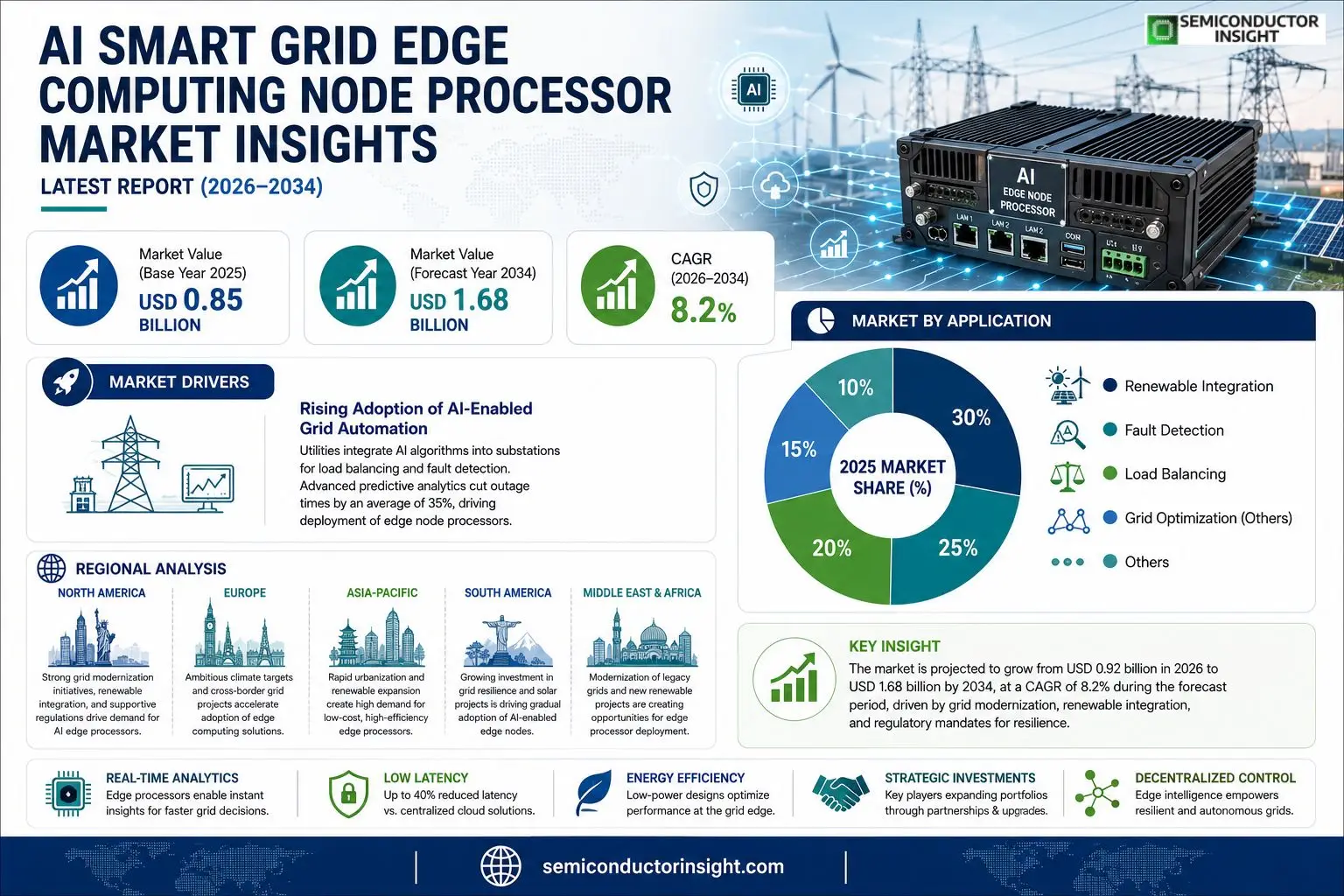
AI Smart Grid Edge Computing Node Processor market size was valued at USD 0.85 billion in 2025. The market is projected to grow from USD 0.92 billion in 2026 to USD 1.68 billion by 2034, exhibiting a CAGR of 8.2% during the forecast period.
AI Smart Grid Edge Computing Node Processors are specialized micro‑architectures designed to perform real‑time analytics and control functions directly within distributed energy resources, substations, and grid‑edge devices. These processors combine low‑power consumption with high‑throughput capabilities, enabling decentralized decision‑making for load balancing, fault detection, and renewable integration.The market is accelerating because utilities worldwide are modernizing grids to accommodate higher shares of solar and wind power, which demand instantaneous data processing at the edge. Furthermore, regulatory mandates for grid resilience and substantial capital infusion from both public and private sectors are driving adoption. Key players such as Siemens AG, Schneider Electric SE, and Hitachi Energy are expanding their portfolios through strategic partnerships and firmware upgrades, further fueling growth.
MARKET DRIVERS
Rising Adoption of AI‑Enabled Grid Automation
AI Smart Grid Edge Computing Node Processor Market is being propelled by utilities that integrate AI algorithms directly into substations to optimize load balancing and fault detection. Advanced predictive analytics cut outage times by an average of 35%, encouraging further deployment.
Edge Computing Gains Traction for Real‑Time Energy Management
Edge nodes process data at the source, eliminating the need for costly bandwidth and reducing latency. Industry reports show a 28% year‑over‑year increase in edge‑based processor installations across North America and Europe.
➤ Integrated node processors can lower decision‑making latency by up to 40% compared with centralized cloud solutions.
Investment cycles are shortening as vendors bundle AI‑optimized hardware with software stacks, creating a compelling value proposition for grid operators seeking to meet renewable integration targets.
MARKET CHALLENGES
Regulatory Uncertainty and Standards Gaps
Many jurisdictions lack harmonised standards for AI‑driven edge devices, leading to prolonged approval cycles. Utilities often face divergent cybersecurity requirements, slowing large‑scale rollouts.
Other Challenges
Supply Chain Constraints
Semiconductor shortages have increased component lead times by 15‑20%, inflating project budgets and prompting firms to seek alternative sourcing strategies.
MARKET RESTRAINTS
High Capital Expenditure
Deploying AI‑capable edge processors requires substantial upfront investment in hardware, firmware, and integration services. Average installation costs per node exceed $150,000, which can deter budget‑constrained utilities.In addition, legacy grid infrastructures often need extensive retrofitting to accommodate new processing units, further increasing total cost of ownership.Financial modelling indicates that a return on investment is typically realized only after 4‑5 years of operational savings, limiting early‑stage adoption in emerging markets.
MARKET OPPORTUNITIES
Emerging Markets and Renewable Integration
Rapid expansion of solar and wind farms in Asia‑Pacific creates a demand for decentralized processing to manage variable generation. Edge processors enable localized frequency regulation, presenting a sizable growth niche.Strategic partnerships between AI startups and traditional equipment manufacturers are accelerating product roadmaps, allowing customized solutions that address specific regional grid challenges.Advancements in low‑power silicon and AI inference accelerators are expected to reduce node cost by up to 30% within the next three years, unlocking new adoption pathways for cost‑sensitive operators.
AI Smart Grid Edge Computing Node Processor Market Trends
Edge Processing Drives Grid Decarbonization
AI Smart Grid Edge Computing Node Processors are engineered for ultra‑low power consumption while delivering high‑throughput analytics directly at the grid edge. This architecture enables utilities to execute load‑balancing, fault detection, and renewable‑integration decisions within milliseconds, eliminating the latency of centralized cloud processing. The shift toward distributed energy resources, especially solar and wind, creates an urgent need for on‑site computation, making edge processors a critical enabler for real‑time grid stability and emissions reduction. As utilities modernize, the market shows a clear trend toward embedding these processors in substations, micro‑grids, and storage systems to support autonomous operation and improve overall resilience.
Other Trends
Regulatory Influence and Investment
Policy frameworks across North America, Europe, and parts of Asia are tightening requirements for grid reliability and renewable integration. Compliance mandates are prompting utilities to allocate capital toward edge‑centric solutions that can demonstrate rapid response to voltage fluctuations and fault isolation. Public‑private partnership programs are also providing funding streams that prioritize technologies capable of enhancing grid resilience, which in turn accelerates adoption of AI‑enabled edge processors. The convergence of regulatory pressure and targeted investment is creating a favorable environment for vendors to expand their offerings and for utilities to pursue phased deployment strategies.
Strategic Portfolio Expansion by Key Vendors
Leading firms such as Siemens AG, Schneider Electric SE, and Hitachi Energy are broadening their edge computing portfolios through firmware upgrades, modular hardware designs, and strategic alliances with software specialists. These moves aim to address interoperability challenges and to provide end‑to‑end solutions that combine hardware robustness with AI analytics platforms. By integrating advanced security features and scalable processing cores, the vendors are positioning themselves to meet the evolving requirements of grid operators seeking both performance and compliance. This coordinated effort reinforces the market’s momentum and signals a mature, competitive landscape focused on delivering reliable, low‑latency edge computing capabilities.
COMPETITIVE LANDSCAPE
Key Industry Players
AI Smart Grid Edge Computing Node Processor Market – Competitive Overview
AI Smart Grid Edge Computing Node Processor Market is presently anchored by a handful of power‑electronics giants that leverage deep engineering expertise and extensive utility relationships. Siemens AG, Schneider Electric SE, and Hitachi Energy dominate the landscape, each offering fully integrated edge‑processor suites that combine low‑power micro‑architectures with robust firmware ecosystems. Their market share reflects vertically integrated supply chains, strong R&D pipelines, and strategic alliances with grid operators that accelerate deployment of real‑time analytics for load balancing and fault detection. This concentration of capability creates a tiered structure where large OEMs secure the majority of contracts while smaller niche firms compete on specialized features or regional projects.Beyond the three incumbents, a diverse set of niche innovators is shaping the competitive dynamics. ABB and General Electric provide complementary hardware platforms focused on high‑voltage substation applications. NVIDIA and Intel are extending their AI accelerators to edge environments, emphasizing high‑throughput inference for renewable integration. AMD, Texas Instruments, and Huawei contribute low‑power system‑on‑chips optimized for grid‑edge constraints. Mitsubishi Electric, Bosch, Dell Technologies, and Google Cloud round out the ecosystem, delivering custom silicon, edge‑gateway solutions, and managed cloud services that enable utilities to scale analytics across distributed assets. These players enrich the market with differentiated technologies, driving cost efficiencies and fostering rapid innovation.
List of Key AI Smart Grid Edge Computing Node Processor Companies Profiled
- Siemens AG
- Schneider Electric SE
- Hitachi Energy
- ABB
- General Electric
- NVIDIA
- Intel
- AMD
- Texas Instruments
- Huawei
- Mitsubishi Electric
- Bosch
- Dell Technologies
- Google Cloud
Segment Analysis:
| Segment Category | Sub-Segments | Key Insights |
| By Type |
|
ARM‑based processors
|
| By Application |
|
Renewable integration
|
| By End User |
|
Utilities
|
| By Processor Architecture |
|
ASICs
|
| By Deployment Environment |
|
Substations
|
Regional Analysis: AI Smart Grid Edge Computing Node Processor Market
North America
Federal incentives for grid modernization, the rise of distributed energy resources, and the need for low‑latency analytics are propelling demand for AI‑enabled edge processors. Utilities seek to improve outage detection and automate load balancing, making advanced node processors essential components of modern grid architectures.
Emerging use cases such as AI‑driven fault prediction, real‑time voltage regulation, and edge‑based cybersecurity solutions present sizable growth avenues. Partnerships between chip manufacturers and software firms are unlocking new application layers that enhance processor utility across diverse grid segments.
High upfront capital costs and the need for skilled personnel to manage complex edge deployments pose barriers. Additionally, interoperability standards are still evolving, requiring careful coordination among equipment vendors and utility operators.
The next decade will likely see tighter integration of AI processors with renewable‑energy management platforms, fostering more autonomous grid operations. Continued 5G expansion and edge‑cloud convergence will further reduce latency, enhancing the effectiveness of AI decision‑making at the distribution level.
Europe
Europe’s AI Smart Grid Edge Computing Node Processor market is shaped by ambitious EU climate targets and a strong emphasis on cross‑border grid interconnectivity. Nations such as Germany and the Netherlands are deploying edge processors to support high‑penetration solar and wind farms, leveraging AI for predictive maintenance and grid balancing. The European Commission’s “Fit for 55” roadmap encourages utilities to adopt edge‑centric solutions that can quickly assimilate renewable fluctuations, while standardization bodies work toward common communication protocols, reducing integration friction.
Asia‑Pacific
The Asia‑Pacific region is experiencing rapid urbanization and increasing electricity demand, prompting utilities to explore AI‑driven edge computing for grid reliability. China’s aggressive smart‑grid initiatives and India’s push for renewable integration drive substantial interest in edge node processors capable of handling massive data streams. Market participants are focusing on low‑cost, high‑efficiency designs to meet the price‑sensitive nature of many APAC economies, while regional collaborations aim to harmonize technical standards across diverse national grids.
South America
In South America, AI Smart Grid Edge Computing Node Processor Market is gradually gaining traction as governments prioritize energy access and grid resilience. Brazil’s extensive hydroelectric network and Chile’s solar expansion are encouraging utilities to adopt edge AI for real‑time monitoring and automated fault isolation. Challenges remain around infrastructure investment and limited skilled workforce, yet public‑private partnerships are emerging to facilitate technology transfer and capacity building.
Middle East & Africa
The Middle East & Africa region presents a unique mix of mature grid systems in Gulf countries and developing networks in sub‑Saharan nations. Oil‑rich states are investing heavily in AI edge processors to modernize legacy grids and support large‑scale renewable projects, such as solar farms in the UAE. Meanwhile, African utilities are piloting edge‑based solutions to improve reliability in remote areas, often leveraging mobile connectivity. Though funding constraints exist, increasing donor interest in sustainable energy infrastructure is driving early‑stage adoption of AI‑enhanced edge computing.
Report Scope
This market research report provides a comprehensive analysis of the AI Smart Grid Edge Computing Node Processor Market , covering the forecast period 2026–2034. It offers detailed insights into market dynamics, technological advancements, competitive landscape, and key trends shaping the industry.
Key focus areas of the report include:
- Market Overview: The report begins with an overview outlining its current market scenario, key growth indicators, and industry transformation drivers. It discusses macroeconomic factors, demand–supply balance, regulatory landscape, and the strategic role of semiconductors in powering advancements across industries such as automotive, telecommunications, consumer electronics, and industrial automation.
- Market Size & Forecast: Historical data and future projections for revenue, unit shipments, and market value across major regions and segments.
- Segmentation Analysis: Detailed breakdown by product type, technology, application, and end-user industry to identify high-growth segments and investment opportunities.
- Regional Insights: Insights into market performance across North America, Europe, Asia-Pacific, Latin America, and the Middle East & Africa, including country-level analysis where relevant.
- Competitive Landscape: Profiles of leading market participants, including their product offerings, R&D focus, manufacturing capacity, pricing strategies, and recent developments such as mergers, acquisitions, and partnerships.
- Technology Trends & Innovation: Assessment of emerging technologies, integration of AI/IoT, semiconductor design trends, fabrication techniques, and evolving industry standards.
- Market Drivers & Restraints: Evaluation of factors driving market growth along with challenges, supply chain constraints, regulatory issues, and market-entry barriers.
- Stakeholder Insights: Insights for component suppliers, OEMs, system integrators, investors, and policymakers regarding the evolving ecosystem and strategic opportunities.
Primary and secondary research methods are employed, including interviews with industry experts, data from verified sources, and real-time market intelligence to ensure the accuracy and reliability of the insights presented.
FREQUENTLY ASKED QUESTIONS:
What is the current market size of AI Smart Grid Edge Computing Node Processor Market?
-> AI Smart Grid Edge Computing Node Processor Market was valued at USD 0.85 billion in 2025 and is expected to reach USD 1.68 billion by 2034.
Which key companies operate in AI Smart Grid Edge Computing Node Processor Market?
-> Key players include Siemens AG, Schneider Electric SE, Hitachi Energy, among others.
What are the key growth drivers?
-> Key growth drivers include grid modernization by utilities, integration of renewable energy sources, regulatory mandates for grid resilience, and significant capital infusion from public and private sectors.
Which region dominates the market?
-> The reference does not specify a dominant region.
What are the emerging trends?
-> Emerging trends include edge AI analytics, low‑power high‑throughput processor designs, decentralized decision‑making at grid‑edge devices, and enhanced grid resilience technologies.

Get Sample Report PDF for Exclusive Insights
Report Sample Includes
- Table of Contents
- List of Tables & Figures
- Charts, Research Methodology, and more...
 Download Sample Report PDF