AI Server Power Supply Market Insights
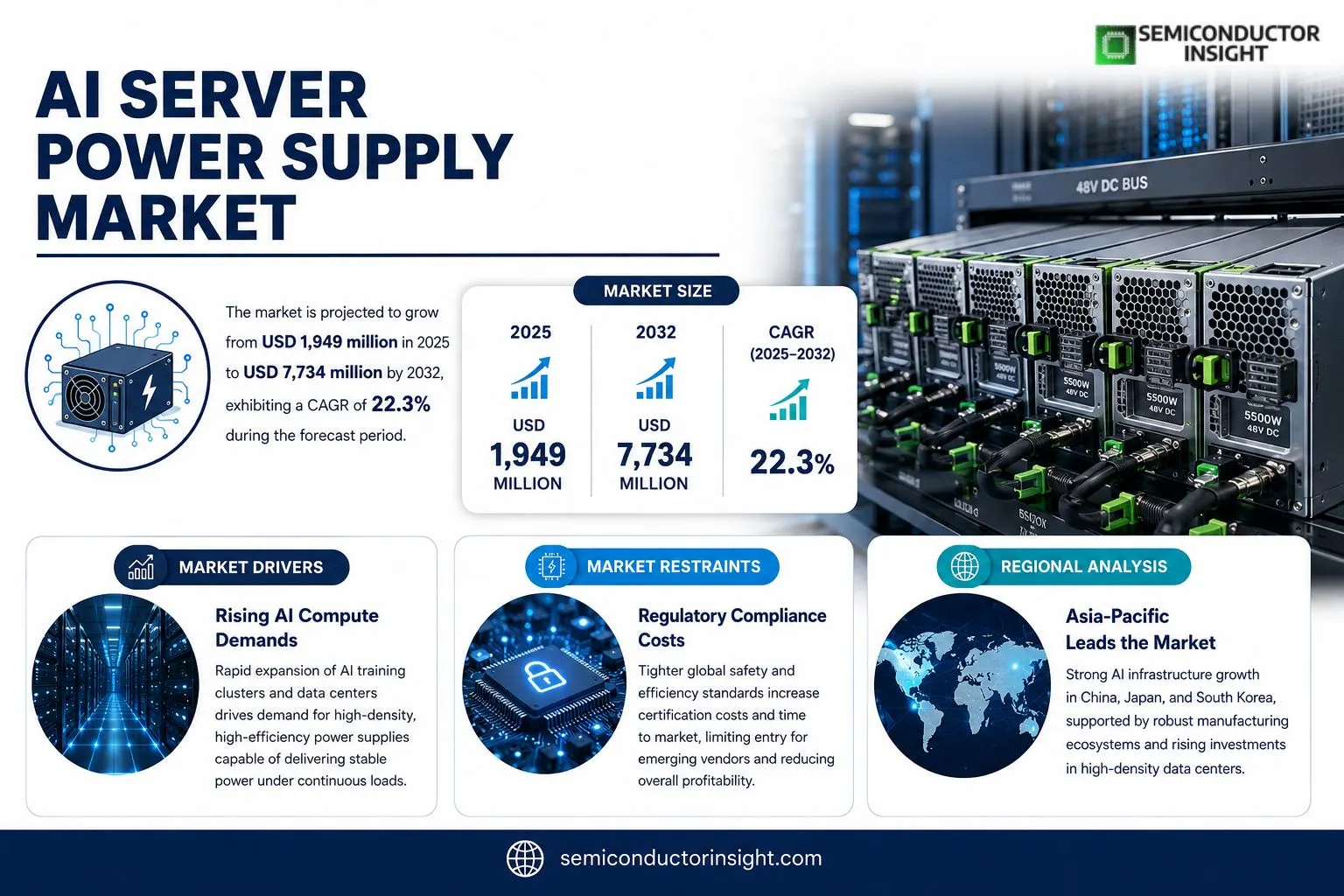
AI Server Power Supply market size was valued at USD 1,949 million in 2025. The market is projected to grow from USD 1,949 million in 2025 to USD 7,734 million by 2032, exhibiting a CAGR of 22.3% during the forecast period.
AI Server Power Supplies are high‑efficiency AC‑DC converters built for AI‑centric data centers. They provide power densities above 100 W/in³, support highly dynamic GPU workloads, meet OCP ORV3 standards, and typically deliver 48‑54 V DC outputs with ratings ranging from 3 kW up to beyond 12 kW.The market is experiencing rapid expansion because AI workloads demand ever‑higher rack power and tighter energy efficiency targets. Adoption of SiC and GaN devices pushes efficiencies toward titanium grades (~97½ %). Competitive pressure from Taiwanese ODMsDelta, Lite‑On, AcBeland emerging Chinese vendors fuels innovation around modular CRPS/ORV3 units and integrated rack‑level power shelves.
MARKET DRIVERS
Rising AI Compute Demands
Enterprises are scaling deep‑learning clusters to train ever‑larger models. This escalation pushes AI Server Power Supply Market toward units that can sustain continuous high‑density loads without voltage sag. Operators value power tiers that can deliver stable 12 V and 48 V rails, because even minor fluctuations can corrupt training epochs and increase time‑to‑insight.
Energy‑Efficient Design Imperatives
Data‑center operators are trimming operational expenditures by targeting Power Usage Effectiveness (PUE) below 1.4. Modern AI‑oriented power supplies now incorporate active‑power factor correction and GaN switching devices, shaving up to 15 % of ancillary power draw. Such efficiency gains translate directly into lower cooling loads and extended hardware refresh cycles.
➤ “A 10 % improvement in supply efficiency can reduce a 5 MW AI cluster’s annual electricity cost by roughly $600,000.”
When combined, heightened performance expectations and stringent cost‑control measures create a fertile environment for vendors that can blend high output, modular form factors, and exceptional conversion efficiency. Companies that master this balance are poised to capture a larger share of AI Server Power Supply Market.
MARKET CHALLENGES
Thermal Management Constraints
AI accelerators concentrate compute in compact enclosures, generating hotspot temperatures that exceed 85 °C under peak load. Power supplies must therefore dissipate heat while maintaining isolation standards, a requirement that often forces designers to increase copper weight and reduce form‑factor density, limiting overall system compactness.
Other Challenges
Supply Chain Volatility
Component shortages for silicon carbide and gallium‑nitride devices have elongated lead times to 12‑18 months. Manufacturers that lack diversified sourcing face production bottlenecks, which directly curtails the ability to meet rapid spikes in AI infrastructure demand.
MARKET RESTRAINTS
Regulatory Compliance Costs
Power‑supply certifications such as IEC 62368‑1 and ENERGY STAR have tightened, imposing additional testing cycles and redesign expenses. For startups and mid‑size firms, the investment needed to certify every new power tier can erode profit margins, discouraging entry into AI Server Power Supply Market.
MARKET OPPORTUNITIES
Modular Power Architecture
Adopting a plug‑in modular PSU framework allows data‑center operators to upsize power capacity in line with AI workload growth, without over‑hauling the entire rack. Vendors that expose hot‑swap capability and standardized control interfaces enable seamless scaling, positioning themselves to benefit from a pronounced shift toward adaptable infrastructure.
AI Server Power Supply Market Trends
Consolidation of Power Architecture Around 48 V
AI Server Power Supply Market is witnessing a decisive migration to 48 V rack‑level distribution, a move that reshapes the electrical backbone of modern AI data centers. By halving the current required for the same power throughput, 48 V systems slash copper I²R losses, shrink conduit diameters, and liberate valuable cable and connector real‑estate for higher compute density. This engineering advantage translates into lower capital outlay for cabling infrastructure while simultaneously improving power‑quality metrics that matter to hyperscale operators seeking tighter latency budgets. Vendors that offer integrated 48 V busbars within modular power shelves are now securing multi‑year contracts because their solutions promise both higher uptime and easier scalability. Moreover, the 48 V standard dovetails with emerging liquid‑cooling manifolds, allowing the power train to be marketed as a holistic solution rather than a standalone component. The shift also nudges upstream semiconductor suppliers toward broader SiC and GaN production, reinforcing a feedback loop where component availability fuels further adoption of the 48 V architecture across AI Server Power Supply Market.
Other Trends
Escalating Unit Power and Efficiency
Unit power ratings are accelerating from the historic 3–5.5 kW envelope to the 8–12 kW bracket, with a growing cadre of designs pushing beyond 12 kW as AI workloads demand ever‑greater electrical throughput. The efficiency frontier is being redrawn by SiC and GaN devices that enable switching frequencies in the multi‑megahertz range, compressing magnetics and driving overall power conversion efficiencies to 97.5‑98 % at peak load. Higher efficiency directly reduces auxiliary fan power and lowers rack‑level heat dissipation, an outcome that resonates with data‑center managers focused on reducing PUE (Power Usage Effectiveness). Manufacturers that have achieved titanium‑grade efficiency certification are now positioned to command a price premium, while also differentiating their product portfolios through advanced digital control, PMBus telemetry, and N+1 redundancy. The market implication is clear: operators that invest in these high‑efficiency, high‑power modules can defer incremental cooling infrastructure upgrades, thereby improving total cost of ownership and freeing capital for additional compute resources.
Emergence of Grid‑to‑Rack 800 V DC Architectures
A third structural shift is the adoption of 800 V DC “grid‑to‑rack” architectures, which redistribute the conversion workload between central UPS units and rack‑level power shelves. By elevating the primary DC voltage, data‑center designers can reduce the number of conversion stages, cutting cumulative loss and improving overall energy quality. This architecture aligns naturally with the 48 V downstream bus, creating a tiered voltage hierarchy that optimizes both transmission efficiency and rack‑level safety. The result is a more resilient power ecosystem that can accommodate large, bursty AI training jobs without overtaxing the UPS fleet. For AI Server Power Supply Market, this trend opens new revenue channels for suppliers of high‑voltage DC distribution hardware and for system integrators that can bundle power, cooling, and energy‑storage assets into a single turnkey offering. The long‑term business implication is a tighter coupling between power‑semiconductor manufacturers, mid‑stream power‑module producers, and hyperscale customers seeking to meet aggressive sustainability and reliability targets.
COMPETITIVE LANDSCAPE
Key Industry Players
AI Server Power Supply Competitive Dynamics, 2025‑2032
The segment is dominated by a handful of Taiwanese original design manufacturers that leverage high‑volume assembly capabilities and deep relationships with data‑center builders. Delta Electronics, Lite‑On Technology and AcBel (operating the OmniOn Power brand after the ABB Power Conversion acquisition) command the bulk of the 3‑5.5 kW CRPS/ORV3 module market, supplying both hyperscale operators and OEMs that integrate their shafts into rack‑level power shelves. Their advantage stems from mature supply‑chain networks for SiC and GaN switches, coupled with certification pathways that meet emerging titanium‑grade efficiency targets. Because these ODMs can scale output while preserving tight cost structures, they set the price reference for most downstream contracts.Beyond the Taiwanese core, a diverse set of specialty firms and fast‑growing Chinese manufacturers adds depth to the competitive set. Advanced Energy brings precision‑grade DC conversion expertise that appeals to finance‑heavy workloads, while Shenzhen‑based Megmeet Electrical and Honor Electronic focus on ultra‑high‑density 8‑12 kW modules tuned for 48 V rack architectures. Companies such as FSP Group, Phihong and Mean Well supply a broader portfolio of lower‑power units that still meet the new efficiency standards, providing a bridge for customers transitioning from legacy 3 kW designs. European and Japanese players, including Murata and Salcomp, concentrate on components and miniaturized converters that enable the next wave of silicon‑carbide integration. The overall ecosystem reflects a shift from pure volume manufacturers toward a mix of niche innovators that differentiate on topology, digital telemetry and system‑level integration.
List of Key AI Server Power Supply Companies Profiled
- Delta Electronics
- Lite‑On Technology
- AcBel Polytech (OmniOn Power)
- Advanced Energy
- Shenzhen Megmeet Electrical
- Shenzhen Honor Electronic
- Aohai Technology
- FSP Group
- Phihong
- Murata
- Mean Well
- SilverStone
- Huawei
- Salcomp
Segment Analysis:
| Segment Category | Sub-Segments | Key Insights |
| By Type |
|
High‑Efficiency Titanium PSU
|
| By Application |
|
GPU Server
|
| By End User |
|
Hyperscale Data Centers
|
| By Power Rating |
|
Above 5.5 kW
|
| By Architecture |
|
48 V Rack Bus
|
Regional Analysis: AI Server Power Supply Market
North America
Silicon Valley and Toronto host clusters where power‑supply engineers experiment with novel magnetic‑core technologies, aiming to shave watts from each AI compute node. These hubs attract venture capital that specifically earmarks funds for efficiency‑first designs, nudging the market toward lighter, cooler solutions.
The region’s logistics networks have adapted to recent component shortages by diversifying sourcing across the continent, reducing lead times for critical capacitors and inductors. This flexibility mitigates the risk of production bottlenecks for AI server power units.
Enterprises deploying AI workloads cite power‑efficiency as a decisive factor when scaling clusters, leading vendors to offer modular, plug‑and‑play units that integrate seamlessly with existing rack designs, thereby accelerating procurement cycles.
Federal energy‑efficiency standards have been tightened, compelling manufacturers to document power‑loss metrics with greater granularity. Compliance has become a market differentiator, prompting firms to certify their solutions under the latest green‑tech frameworks.
Europe
European nations, anchored by Germany, France and the Nordic region, exhibit a distinct emphasis on sustainability within AI Server Power Supply Market. Policy frameworks encourage circular‑economy practices, prompting manufacturers to design for disassembly and component reuse. This regulatory pressure, coupled with a strong industrial heritage in precision engineering, yields power modules that prioritize longevity and minimal environmental impact. Moreover, collaborative research initiatives across EU research institutions foster standards that harmonize interoperability, easing cross‑border deployments for multinational data‑center operators.
Asia‑Pacific
The Asia‑Pacific corridor, led by Japan, South Korea and Singapore, blends rapid manufacturing capacity with aggressive cost optimisation. Vendors capitalize on high‑volume production lines to deliver competitive pricing, yet they also invest heavily in next‑generation silicon to meet the performance demands of regional AI startups. The proximity to emerging AI talent pools accelerates feedback loops, ensuring that power‑supply solutions evolve in step with algorithmic advances. Trade agreements within the region further smooth component flow, reinforcing the market’s agility.
South America
In South America, Brazil and Chile are carving niches by tailoring power‑supply offerings to the continent’s expanding cloud footprint. Operators seek equipment that can sustain high‑temperature environments typical of many data centres located near equatorial zones. Consequently, manufacturers stress robust thermal management and adaptive voltage regulation. While the market remains smaller than its northern counterparts, growing digital transformation initiatives create a fertile ground for specialized solutions that address both cost and resilience concerns.
Middle East & Africa
The Middle East & Africa region demonstrates a growing appetite for AI‑driven services, prompting early‑stage investments in data‑center infrastructure. In the Gulf, sovereign wealth funds back projects that demand power‑supply units capable of handling both high power density and strict reliability criteria under desert conditions. African markets, meanwhile, focus on modular designs that can be deployed quickly in remote locations, supporting emerging AI applications in fintech and agritech. The divergent climate and economic contexts shape a market that values flexibility as much as efficiency.
Report Scope
This market research report provides a comprehensive analysis of the AI Server Power Supply Market , covering the forecast period 2026–2034. It offers detailed insights into market dynamics, technological advancements, competitive landscape, and key trends shaping the industry.
Key focus areas of the report include:
- Market Overview: The report begins with an overview outlining its current market scenario, key growth indicators, and industry transformation drivers. It discusses macroeconomic factors, demand–supply balance, regulatory landscape, and the strategic role of semiconductors in powering advancements across industries such as automotive, telecommunications, consumer electronics, and industrial automation.
- Market Size & Forecast: Historical data and future projections for revenue, unit shipments, and market value across major regions and segments.
- Segmentation Analysis: Detailed breakdown by product type, technology, application, and end-user industry to identify high-growth segments and investment opportunities.
- Regional Insights: Insights into market performance across North America, Europe, Asia-Pacific, Latin America, and the Middle East & Africa, including country-level analysis where relevant.
- Competitive Landscape: Profiles of leading market participants, including their product offerings, R&D focus, manufacturing capacity, pricing strategies, and recent developments such as mergers, acquisitions, and partnerships.
- Technology Trends & Innovation: Assessment of emerging technologies, integration of AI/IoT, semiconductor design trends, fabrication techniques, and evolving industry standards.
- Market Drivers & Restraints: Evaluation of factors driving market growth along with challenges, supply chain constraints, regulatory issues, and market-entry barriers.
- Stakeholder Insights: Insights for component suppliers, OEMs, system integrators, investors, and policymakers regarding the evolving ecosystem and strategic opportunities.
Primary and secondary research methods are employed, including interviews with industry experts, data from verified sources, and real-time market intelligence to ensure the accuracy and reliability of the insights presented.
FREQUENTLY ASKED QUESTIONS:
What is the current market size of AI Server Power Supply Market?
-> AI Server Power Supply Market was valued at USD 1,949 million in 2025 and is expected to reach USD 7,734 million by 2032 at a CAGR of 22.3%.
Which key companies operate in AI Server Power Supply Market?
-> Key players include Delta Electronics, LITEON Technology, Acbel Polytech, OmniOn Power, Advanced Energy, and emerging Chinese vendors.
What are the key growth drivers?
-> Key growth drivers include rising AI data center deployments, need for higher rack power density, adoption of 48 V architectures, and efficiency improvements toward titanium grade.
Which region dominates the market?
-> Asia dominates the market, driven by strong demand in China, Japan, and South Korea, while North America and Europe also show significant growth.
What are the emerging trends?
-> Emerging trends include integration of SiC and GaN devices for higher power density, 800 V DC grid‑to‑rack architectures, and modular rack‑level power shelves with hot‑swap and N+1 redundancy.
Get Sample Report PDF for Exclusive Insights
Report Sample Includes
- Table of Contents
- List of Tables & Figures
- Charts, Research Methodology, and more...
 Download Sample Report PDF