AI Precision Livestock Health Monitor Chip Market Insights
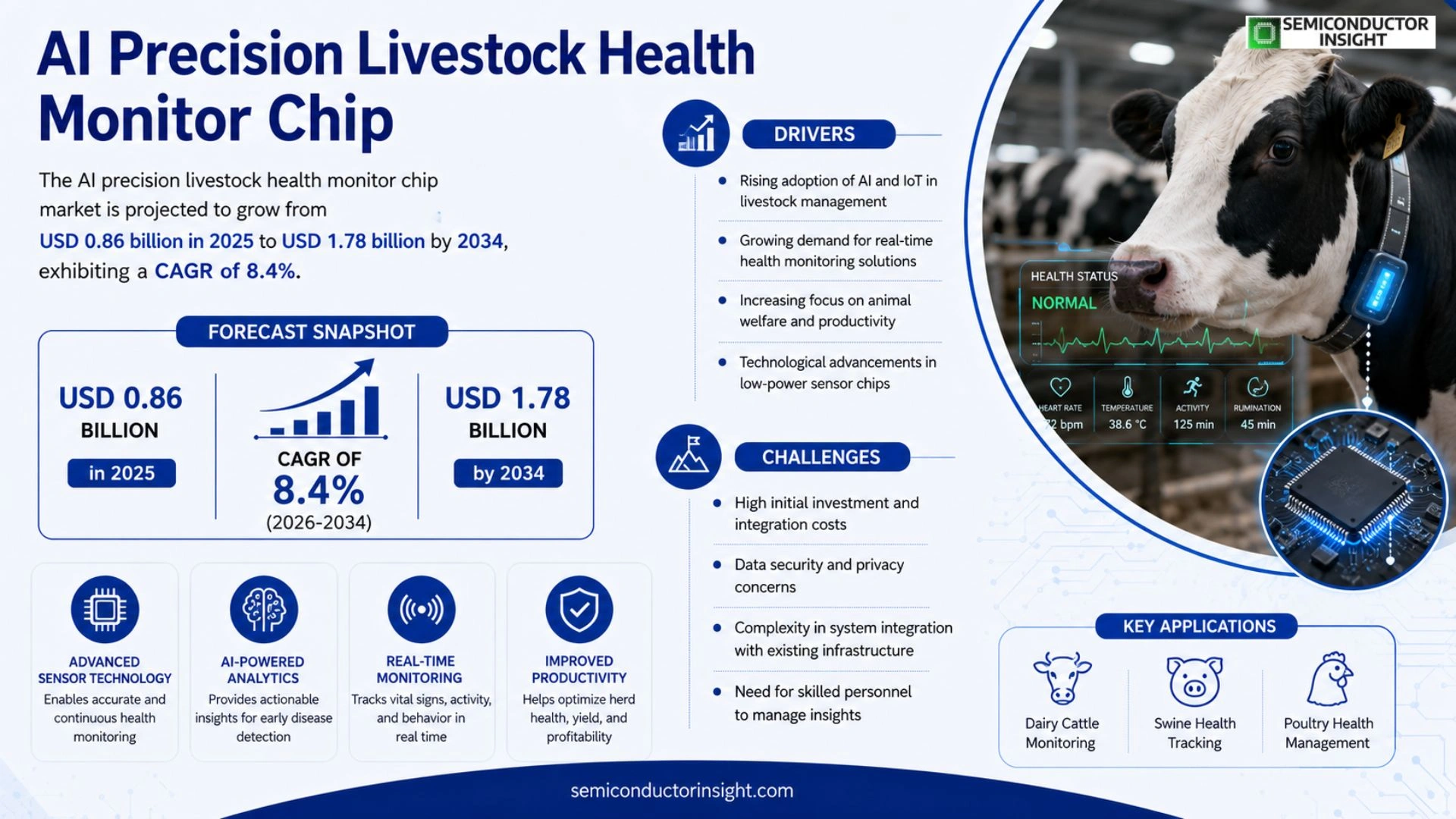
Global AI Precision Livestock Health Monitor Chip market is projected to grow from USD 0.86 billion in 2025 to USD 1.78 billion by 2034, exhibiting a CAGR of 8.4% during the forecast period.
AI Precision Livestock Health Monitor Chips are miniature implantable devices that combine biosensors, low‑power microprocessors and wireless telemetry to continuously track physiological parameters such as temperature, heart rate variability and rumination patterns.
The chips employ machine‑learning algorithms on edge processors to translate raw signals into actionable health alerts, enabling farmers to intervene before clinical disease manifests.
The market is accelerating because livestock producers are seeking data‑driven solutions to improve animal welfare and reduce antibiotic usage.
Rising capital investment in agritech startups, coupled with regulatory incentives for sustainable farming practices, fuels adoption.Furthermore, advancements in ultra‑low‑power ASIC design and cloud‑based analytics platforms lower total cost of ownership.
MARKET DRIVERS
Rapid Adoption of AI‑Driven Monitoring
AI Precision Livestock Health Monitor Chip Market is being propelled by the convergence of low‑power sensors and cloud‑based analytics. Farmers can now receive real‑time alerts on temperature, heart rate, and activity patterns, which reduces mortality by up to 15 % in intensive operations. This level of granularity enables proactive disease management and aligns with precision‑farming goals.
Regulatory Support for Animal Welfare
Legislative frameworks in North America and the European Union increasingly require biometric monitoring to verify humane treatment. Compliance incentives have accelerated investments in chip‑based platforms, creating a clear pathway for scaling deployments across dairy, swine, and poultry sectors.
➤ “Continuous biometric data transforms herd management from reactive to predictive, delivering measurable economic and ethical benefits.”
As integration costs decline and ecosystem partners expand, the market is positioned to grow double‑digit rates through 2035, driven by both productivity gains and heightened consumer expectations for traceability.
MARKET CHALLENGES
Technical Integration Barriers
Despite rapid sensor miniaturization, many livestock operations still rely on legacy equipment that lacks compatible communication protocols. Retrofitting farms with end‑to‑end AI solutions often requires extensive rewiring of data pipelines, which can delay rollout and increase project risk.
Other Challenges
Data Interoperability Issues
Fragmented data standards limit the ability to aggregate insights across different breeds and geographic regions. Without a unified schema, analytics models struggle to deliver consistent recommendations, reducing the perceived value of the technology.
MARKET RESTRAINTS
High Initial Capital Expenditure
Deploying AI‑enabled health monitor chips involves upfront costs for hardware, network infrastructure, and training. Small‑scale producers often lack the financing capacity to absorb these expenses, which restrains broader market penetration until cost‑share models become mainstream.
MARKET OPPORTUNITIES
Expansion into Emerging Markets
Rapid urbanization and rising protein demand in regions such as Southeast Asia and Sub‑Saharan Africa create a fertile environment for AI precision livestock solutions. Local partnerships and government subsidies aimed at modernizing agriculture present a sizable growth runway for AI Precision Livestock Health Monitor Chip Market.
AI Precision Livestock Health Monitor Chip Market Trends
Data-Driven Health Monitoring Surge
AI Precision Livestock Health Monitor Chip technology is accelerating as producers seek continuous, real‑time insight into animal physiology. Miniature implantable chips combine biosensors, ultra‑low‑power microprocessors and wireless telemetry to capture temperature, heart‑rate variability and rumination patterns without disrupting normal behavior. Edge‑located machine‑learning algorithms translate raw signals into actionable alerts, allowing farmers to intervene before clinical disease becomes evident. This capability addresses two core industry pressures: improving animal welfare and curbing routine antibiotic use. By embedding analytics at the point of data capture, the chips reduce latency and reliance on external diagnostic services, delivering a clear efficiency advantage for large‑scale operations.
Other Trends
Edge AI Integration
Recent advances in ASIC design have lowered power consumption to the microwatt range, extending chip lifespan to several years and reducing replacement cycles. Cloud‑based analytics platforms now accept streamed telemetry directly from the devices, enabling herd‑level dashboards that synthesize individual health signals into predictive models. The convergence of edge processing and cloud analytics is creating a feedback loop where on‑farm decisions inform algorithm refinement, further enhancing detection accuracy for early‑stage conditions such as mastitis or metabolic stress.
Strategic Collaborations and Platform Expansion
Key players,including Allflex™, Zoetis™ and Bayer Animal Health,are broadening their portfolios through joint ventures that pair sensor hardware with proprietary AI services. These partnerships leverage regulatory incentives for sustainable farming and channel capital from agritech investors into scalable production lines. The result is a growing ecosystem of compatible devices, data standards and support services that lower total cost of ownership for end users. As the platform matures, AI Precision Livestock Health Monitor Chip Market is poised to become a cornerstone of precision livestock management, delivering measurable gains in productivity and animal health without relying on speculative growth figures.
COMPETITIVE LANDSCAPE
Key Industry Players
AI Precision Livestock Health Monitor Chip Market Competitive Landscape
The market is currently dominated by a few well‑capitalized agritech groups that have leveraged existing animal‑health portfolios to introduce AI‑enabled sensor chips. Allflex™ leads with its extensive RFID heritage, pairing proven ear‑tag technology with edge‑ML processors that generate real‑time health alerts. Zoetis™ follows closely, integrating its veterinary‑diagnostics expertise into a chipset that streams data to cloud‑based analytics, thereby shortening the detection window for respiratory and metabolic disorders. Bayer Animal Health, now part of a broader life‑sciences conglomerate, differentiates through its focus on precision dosing algorithms that couple biometric inputs with antimicrobial‑use reduction targets. Together, these three firms command the majority of revenue, shape pricing dynamics, and set interoperability standards that smaller entrants must adhere to, creating a tiered structure where scale and regulatory lock‑in reinforce market concentration.
Beyond the tier‑one leaders, a vibrant ecosystem of niche innovators expands the functional envelope of the chip market. Idexx Laboratories provides a modular platform that emphasizes diagnostic accuracy for dairy cattle, while Vetsense offers a low‑power ASIC optimized for rumination pattern analysis. Anicom and Cowlar target small‑holder farms with cost‑effective, Bluetooth‑enabled devices that integrate directly with farm‑management apps. Smartbow focuses on behavioral analytics for beef cattle, and Quantified Ag supplies a cloud‑centric dashboard for multi‑species operations. Emerging players such as AgriWebb, FarmWizard and Bolthouse are building end‑to‑end data pipelines that combine sensor inputs with feed‑efficiency models, positioning themselves as strategic partners for precision‑farming initiatives.
List of Key AI Precision Livestock Health Monitor Chip Companies Profiled
- Allflex™
- Zoetis™
- Bayer Animal Health
- Idexx Laboratories
- Vetsense
- Anicom
- Cowlar
- Smartbow
- Quantified Ag
- AgriWebb
- FarmWizard
- Bolthouse
Segment Analysis:
| Segment Category | Sub-Segments | Key Insights |
| By Type |
|
Biosensor Chip has become the leading segment because it delivers continuous physiological monitoring with ultra‑low‑power consumption, enabling long‑term implantation without frequent battery replacement.
|
| By Application |
|
Disease Early Detection is the dominant application as it directly addresses producer priorities of animal welfare and antibiotic reduction.
|
| By End User |
|
Commercial Dairy Farms lead adoption because they operate at scale and benefit most from precision health data to maintain milk quality and animal longevity.
|
| By Integration Level |
|
Integrated Farm Management Platform emerges as the key driver, offering end‑to‑end data capture, analytics, and actionable recommendations within a single interface.
|
| By Data Analytics Capability |
|
Predictive Modeling is the premium offering, leveraging machine‑learning to forecast health events days before symptoms emerge.
|
Regional Analysis: AI Precision Livestock Health Monitor Chip Market
Europe
European Union animal‑health directives mandate traceability and proactive disease management, creating a regulatory environment that favors chip‑based monitoring. Recent amendments to the Veterinary Medicines Regulation encourage adoption of predictive tools that can limit antibiotic interventions. Member states also offer subsidy schemes for precision farming technologies, further accelerating deployment across dairy and swine farms. Manufacturers align product certification with EU standards, streamlining market entry for devices that meet stringent data‑privacy and safety criteria.
Key drivers in Europe include high labor costs, which make automated health surveillance economically attractive, and strong consumer demand for traceable, responsibly raised meat. The region’s extensive broadband coverage enables reliable transmission of sensor data to cloud platforms, allowing farm managers to act on early warning signals. Together, these factors push AI Precision Livestock Health Monitor Chip Market toward rapid diffusion across mixed‑species operations.
European players such as AgriTech GmbH and BioSense Ltd. dominate through deep integration with local veterinary networks and partnerships with agribusiness software providers. International firms entering the market often pursue joint ventures to leverage established distribution channels and local regulatory expertise. This collaborative competitive landscape fosters continuous innovation while maintaining high standards of data integrity for AI Precision Livestock Health Monitor Chip Market.
Looking ahead, Europe is likely to see broader chip adoption in mixed‑species operations as interoperability standards mature. Emerging AI algorithms that combine sensor inputs with environmental data will refine predictive health models, expanding the value proposition beyond disease detection to performance optimization. The region’s commitment to sustainable livestock production positions it as a long‑term growth engine for AI Precision Livestock Health Monitor Chip Market.
North America
North America presents a sizable opportunity for AI Precision Livestock Health Monitor Chip Market, driven by large‑scale cattle operations and a culture of technology investment. While the United States lacks a unified federal mandate for implantable health sensors, the USDA’s emphasis on animal welfare and the growing prevalence of precision‑farming showcases create a receptive environment. Private venture capital funds are increasingly backing startups that deliver cloud‑based analytics for chip data, enabling producers to monitor stress, temperature, and metabolic indicators remotely. Canadian provinces such as Alberta and Quebec support pilot projects through agri‑innovation grants, helping demonstrate cost‑effectiveness for medium‑size farms. Collectively, these dynamics encourage gradual but steady integration of chip technology across the continent.
Asia-Pacific
AI Precision Livestock Health Monitor Chip Market is gaining attention in Asia‑Pacific, where rapid intensification of livestock sectors in China, India, and Vietnam fuels demand for safe, high‑quality protein. Governments are rolling out digital agriculture strategies that incorporate sensor technologies to improve biosecurity and reduce antibiotic reliance. Although regulatory pathways differ, many countries are drafting guidelines that recognize implantable monitoring as a tool for early disease detection. Local manufacturers are developing low‑cost chip solutions tailored to smallholder contexts, while multinational firms leverage partnerships with regional veterinary chains to provide end‑to‑end services. This blend of policy support, market scale, and emerging supply chains positions the region as a fast‑growing arena for precision livestock health monitoring.
South America
South America offers a diverse landscape for AI Precision Livestock Health Monitor Chip Market, with Brazil and Argentina leading large‑scale beef and dairy production. The region’s focus on export‑oriented livestock has spurred interest in technologies that can certify animal health status and meet stringent import requirements. National initiatives in Brazil, such as the Digital Agriculture Program, encourage adoption of IoT devices to enhance traceability and reduce disease outbreaks. Argentine research institutes are evaluating chip performance under extensive grazing conditions, highlighting the technology’s resilience to harsh environments. Although financial constraints limit rapid rollout, collaborative projects between agribusiness conglomerates and technology providers are gradually expanding chip deployment among progressive farms.
Middle East & Africa
The Middle East & Africa region is beginning to explore AI Precision Livestock Health Monitor Chip Market as part of broader efforts to modernize animal agriculture and improve food security. In the Gulf Cooperation Council states, high‑value dairy farms are investing in precision tools to maximize productivity under water‑scarce conditions. African nations such as Kenya and South Africa are piloting chip‑based health monitoring in small‑holder cattle programs, supported by development agencies emphasizing disease surveillance and market access. Limited broadband infrastructure remains a challenge, but emerging satellite connectivity solutions are closing the gap, allowing real‑time data transmission from remote farms. These early adoption steps suggest a nascent but promising trajectory for the technology across the region.
Report Scope
This market research report provides a comprehensive analysis of the AI Precision Livestock Health Monitor Chip Market , covering the forecast period 2026–2034. It offers detailed insights into market dynamics, technological advancements, competitive landscape, and key trends shaping the industry.
Key focus areas of the report include:
- Market Overview: The report begins with an overview outlining its current market scenario, key growth indicators, and industry transformation drivers. It discusses macroeconomic factors, demand–supply balance, regulatory landscape, and the strategic role of semiconductors in powering advancements across industries such as automotive, telecommunications, consumer electronics, and industrial automation.
- Market Size & Forecast: Historical data and future projections for revenue, unit shipments, and market value across major regions and segments.
- Segmentation Analysis: Detailed breakdown by product type, technology, application, and end-user industry to identify high-growth segments and investment opportunities.
- Regional Insights: Insights into market performance across North America, Europe, Asia-Pacific, Latin America, and the Middle East & Africa, including country-level analysis where relevant.
- Competitive Landscape: Profiles of leading market participants, including their product offerings, R&D focus, manufacturing capacity, pricing strategies, and recent developments such as mergers, acquisitions, and partnerships.
- Technology Trends & Innovation: Assessment of emerging technologies, integration of AI/IoT, semiconductor design trends, fabrication techniques, and evolving industry standards.
- Market Drivers & Restraints: Evaluation of factors driving market growth along with challenges, supply chain constraints, regulatory issues, and market-entry barriers.
- Stakeholder Insights: Insights for component suppliers, OEMs, system integrators, investors, and policymakers regarding the evolving ecosystem and strategic opportunities.
Primary and secondary research methods are employed, including interviews with industry experts, data from verified sources, and real-time market intelligence to ensure the accuracy and reliability of the insights presented.
FREQUENTLY ASKED QUESTIONS:
What is the current market size of AI Precision Livestock Health Monitor Chip Market?
-> AI Precision Livestock Health Monitor Chip Market was valued at USD 0.86 billion in 2025 and is expected to reach USD 1.78 billion by 2034, exhibiting a CAGR of 8.4% during the forecast period.
Which key companies operate in AI Precision Livestock Health Monitor Chip Market?
-> Key players include Allflex™, Zoetis™ and Bayer Animal Health, among others.
What are the key growth drivers?
-> Key growth drivers include data‑driven livestock management solutions, reduction of antibiotic usage, rising capital investment in agritech startups, regulatory incentives for sustainable farming, and advancements in ultra‑low‑power ASIC design coupled with cloud‑based analytics platforms.
Which region dominates the market?
-> The reference material does not specify a single dominant region for this market.
What are the emerging trends?
-> Emerging trends include integration of edge AI analytics with implantable biosensors, ultra‑low‑power ASIC innovations, and cloud‑enabled real‑time health monitoring platforms for livestock.

Get Sample Report PDF for Exclusive Insights
Report Sample Includes
- Table of Contents
- List of Tables & Figures
- Charts, Research Methodology, and more...
 Download Sample Report PDF