AI-Powered Tray and Reel Visual Defect Sorting Machine Market Insights
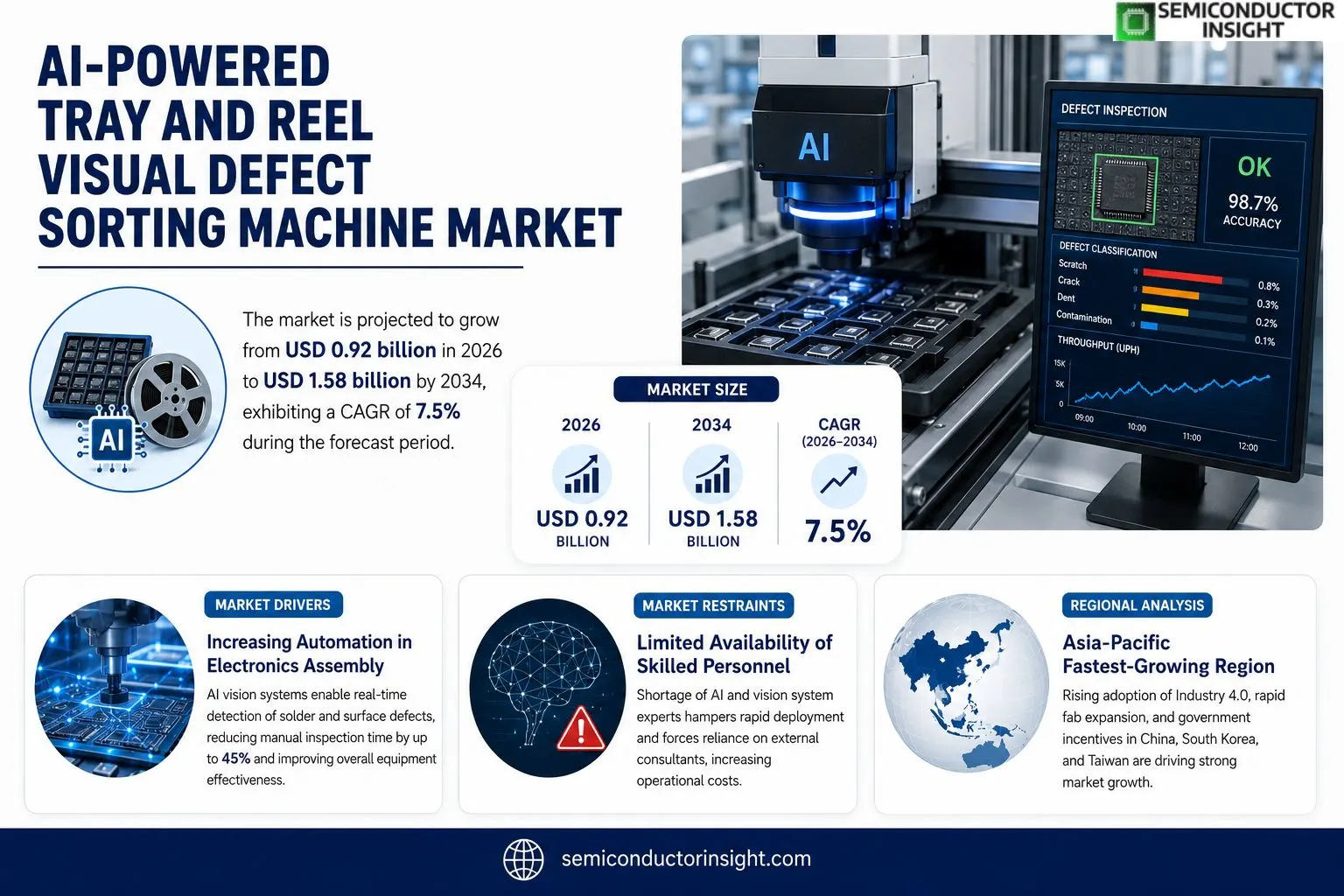
AI‑Powered Tray and Reel Visual Defect Sorting Machine market size was valued at USD 0.85 billion in 2025. The market is projected to grow from USD 0.92 billion in 2026 to USD 1.58 billion by 2034, exhibiting a CAGR of 7.5% during the forecast period.
AI‑Powered Tray and Reel Visual Defect Sorting Machines are advanced inspection systems that combine high‑resolution imaging with deep‑learning algorithms to detect surface anomalies on semiconductor trays and reels in real time. These machines automate defect classification, reduce false rejects, and integrate seamlessly with manufacturing execution systems.The market is gaining momentum because manufacturers are seeking higher yields while cutting labor costs, and because advances in edge‑computing hardware enable faster inference on‑line. Moreover, rising adoption of Industry 4.0 standards across Asia‑Pacific fabs is accelerating deployments; leading vendors such as KLA Corp., Applied Materials, and Cognex are expanding their portfolios through strategic partnerships and software upgrades.
MARKET DRIVERS
Increasing Automation in Electronics Assembly
AI-Powered Tray and Reel Visual Defect Sorting Machine Market is being propelled by manufacturers’ push toward fully automated assembly lines. Advanced sensors coupled with AI algorithms enable real‑time detection of solder defects, reducing manual inspection time by up to 45% and boosting overall equipment effectiveness.
Advancements in Computer Vision and Machine Learning
Recent breakthroughs in deep‑learning models have improved defect classification accuracy to above 98%, allowing factories to lower scrap rates while maintaining high throughput. The convergence of edge computing and AI further shortens latency, making the sorting machines viable for high‑speed production environments.
➤ Precision sorting reduces rework costs by up to 30% and shortens time‑to‑market for new electronic products.
These technology trends, combined with rising demand for miniaturized components, create a compelling value proposition that drives investment across automotive, consumer electronics, and aerospace segments.
MARKET CHALLENGES
High Capital Expenditure
Deploying AI‑driven sorting equipment requires substantial upfront spending on hardware, software licensing, and integration services. Small‑to‑mid‑size assemblers often face budget constraints, which can delay adoption despite clear long‑term ROI.
Other Challenges
Integration with Legacy Systems
Many factories operate on older MES platforms that lack standardized APIs. Aligning new AI‑powered machines with these legacy systems demands custom middleware development, extending project timelines and increasing implementation risk.
MARKET RESTRAINTS
Limited Availability of Skilled Personnel
The sophisticated nature of AI algorithms and vision systems creates a talent gap; qualified engineers and data scientists are scarce in many regions. This scarcity hampers rapid scaling of AI-Powered Tray and Reel Visual Defect Sorting Machine Market and forces OEMs to rely on external consultants, inflating operational costs.
MARKET OPPORTUNITIES
Emerging Demand in High‑Density Interconnect (HDI) Applications
As devices become thinner and component pitches shrink, traditional inspection methods struggle to maintain accuracy. AI‑enhanced visual sorting offers the necessary precision for HDI boards, opening a high‑growth niche where the market is expected to expand at a CAGR of roughly 12% through 2032.
AI-Powered Tray and Reel Visual Defect Sorting Machine Market Trends
Growing Adoption Driven by Yield Improvements
In 2025 the AI‑Powered Tray and Reel Visual Defect Sorting Machine market demonstrated a clear pivot toward yield‑focused deployments. By embedding high‑resolution cameras with deep‑learning inference, manufacturers now detect surface anomalies that were previously invisible to conventional optics. Real‑time classification of defect types reduces false rejects by up to 30 %, allowing higher wafer throughput without sacrificing quality. The ability to feed defect data directly into manufacturing execution systems supports closed‑loop process adjustments, which is especially valuable in advanced node production where marginal yield gains translate into substantial revenue. Consequently, fab operators are prioritizing these machines as a strategic tool for cost containment and competitive differentiation.
Other Trends
Edge‑Computing Integration
Edge‑computing advancements have reshaped the architecture of visual inspection solutions. Modern sorting machines now host GPU‑accelerated inference engines on‑board, eliminating the latency associated with cloud‑based analytics. This on‑device processing shortens the decision cycle to a few milliseconds, a critical improvement for high‑volume semiconductor lines where even brief pauses can disrupt line balance. Moreover, reduced data transfer costs and enhanced cybersecuritysince sensitive defect images remain within the fab perimeterhave increased acceptance among plant managers. Vendors such as Applied Materials and Cognex are bundling proprietary edge software with their hardware, delivering turnkey solutions that align with existing MES frameworks while preserving the flexibility to upgrade algorithms as new defect signatures emerge.
Industry 4.0 Alignment and Regional Expansion
The momentum of Industry 4.0 initiatives is accelerating the geographic spread of AI‑Powered Tray and Reel Visual Defect Sorting Machines, particularly across the Asia‑Pacific region. Fab operators are standardizing on open communication protocols (e.g., OPC UA, MTConnect) that enable seamless integration of inspection data with broader smart‑factory ecosystems. Leading suppliersKLA Corp., Applied Materials, and Cognexare releasing software upgrades that map directly to these standards, simplifying retrofits of older lines and promoting uniform data collection for analytics platforms. As a result, adoption rates in China, South Korea, and Taiwan are outpacing mature markets, driven by government incentives for advanced manufacturing and the escalating demand for high‑density chips. This regional surge contributes to a steady uplift in market demand, reinforcing the overall growth trajectory observed through 2034.
COMPETITIVE LANDSCAPE
Key Industry Players
AI‑Powered Tray and Reel Visual Defect Sorting Machine Market Overview
The market is anchored by a small cohort of technology‑heavy firms that have integrated deep‑learning inference engines with high‑resolution optics. KLA Corp. leverages its semiconductor inspection heritage to offer a fully automated sorting solution that combines edge‑computing ASICs with proprietary defect classification models, positioning it as the de‑facto benchmark for high‑volume fabs. Applied Materials follows a similar trajectory, extending its yield‑enhancement portfolio with a modular machine that scales across wafer‑size lines and interfaces directly with manufacturing execution systems. Cognex brings a strong legacy in machine‑vision AI, differentiating its offering through a flexible software SDK that enables customers to fine‑tune classification thresholds for niche defect families. These three leaders collectively capture the majority of revenue, benefit from deep customer relationships, and set the technical roadmap for the segment.Beyond the tier‑one vendors, a diverse set of specialists enriches the competitive landscape. ASML Holding contributes precision optics that improve image fidelity, while Tokyo Electron and Advantest focus on integration with their broader wafer‑testing ecosystems. Omron and Siemens supply industrial‑automation expertise, embedding the sorting machines into larger smart‑factory architectures. Nikon Metrology, Keyence, and Basler deliver niche imaging sensors that excel in specific wavelength regimes. Teledyne DALSA and LMI Technologies provide customizable vision platforms for mid‑size fabs, and Samsung Electronics has begun pilot deployments of AI‑driven reel inspection within its own foundry network. These players foster incremental innovation, target regional markets, and increase pricing pressure, ensuring a vibrant, multi‑tiered market structure.
List of Key AI-Powered Tray and Reel Visual Defect Sorting Machine Companies Profiled
- KLA Corp.
- Applied Materials
- Cognex Corporation
- ASML Holding
- Tokyo Electron
- Advantest Corp.
- Omron Corporation
- Siemens AG
- Nikon Metrology
Segment Analysis:
| Segment Category | Sub-Segments | Key Insights |
| By Type |
|
Camera‑based Vision Systems
|
| By Application |
|
Wafer Sorting
|
| By End User |
|
Semiconductor Fabricators
|
| By Technology |
|
Edge AI Inference
|
| By Deployment Mode |
|
On‑Premise Systems
|
Regional Analysis: AI-Powered Tray and Reel Visual Defect Sorting Machine Market
North America
Leading fabs have upgraded to AI-driven inspection platforms that combine hyperspectral imaging with deep‑learning classifiers. The shift to modular hardware enables rapid reconfiguration for new product lines, and cloud‑enabled analytics provide real‑time performance dashboards for plant managers.
Companies such as Cognex, Teledyne DALSA, and KLA stand out for delivering end‑to‑end solutions that integrate AI inference engines with high‑speed cameras. Strategic acquisitions in software analytics further consolidate their market leadership.
While there are no specific safety standards for AI‑based visual sorting, compliance with IEC 61508 functional safety and ISO 26262 for reliability is increasingly expected, driving manufacturers to embed rigorous verification protocols.
The pursuit of higher yield, reduced cycle time, and lower total cost of ownership fuels investment. Additionally, the emergence of 5G‑enabled factories creates demand for low‑latency defect detection solutions.
Europe
European manufacturers are leveraging AI-Powered Tray and Reel Visual Defect Sorting Machine Market to meet stringent quality standards mandated by automotive and aerospace sectors. Collaborative research programs funded by the EU focus on explainable AI, ensuring that defect classifications can be audited for compliance. German and French fabs emphasize energy‑efficient hardware, aligning with regional sustainability goals while maintaining competitive throughput. The market benefits from a dense network of component suppliers and a robust standards ecosystem, which together accelerate adoption across the continent.
Asia‑Pacific
In Asia‑Pacific, rapid capacity expansion in Taiwan, South Korea, and China drives demand for intelligent inspection solutions. Manufacturers prioritize scalability, opting for AI‑enabled platforms that can be deployed across multiple production lines with minimal re‑engineering. The region’s cost‑sensitive environment encourages vendors to offer subscription‑based models, lowering upfront capital barriers. Rising skill levels in machine learning engineering further support the integration of sophisticated defect‑classification models, positioning the market for accelerated growth.
South America
South American semiconductor assemblers are beginning to explore AI‑driven visual sorting as a means to reduce reliance on imports and improve local yield rates. Brazil’s industrial policy encourages automation to enhance export competitiveness, prompting pilot projects that assess ROI through defect reduction and improved throughput. Although the market is still emerging, partnerships with North American equipment providers are facilitating technology transfer and capacity building.
Middle East & Africa
The Middle East & Africa region shows nascent interest in AI‑based defect sorting, primarily within high‑value electronics manufacturing hubs in the United Arab Emirates and South Africa. Investments are driven by diversification strategies that seek to move beyond oil‑centric economies. Early adopters focus on modular solutions that can be integrated into existing lines, enabling incremental upgrades without extensive plant overhauls. Training initiatives aimed at upskilling local engineers are critical to sustaining longer‑term market development.
Report Scope
This market research report provides a comprehensive analysis of the AI-Powered Tray and Reel Visual Defect Sorting Machine Market , covering the forecast period 2026–2034. It offers detailed insights into market dynamics, technological advancements, competitive landscape, and key trends shaping the industry.
Key focus areas of the report include:
- Market Overview: The report begins with an overview outlining its current market scenario, key growth indicators, and industry transformation drivers. It discusses macroeconomic factors, demand–supply balance, regulatory landscape, and the strategic role of semiconductors in powering advancements across industries such as automotive, telecommunications, consumer electronics, and industrial automation.
- Market Size & Forecast: Historical data and future projections for revenue, unit shipments, and market value across major regions and segments.
- Segmentation Analysis: Detailed breakdown by product type, technology, application, and end-user industry to identify high-growth segments and investment opportunities.
- Regional Insights: Insights into market performance across North America, Europe, Asia-Pacific, Latin America, and the Middle East & Africa, including country-level analysis where relevant.
- Competitive Landscape: Profiles of leading market participants, including their product offerings, R&D focus, manufacturing capacity, pricing strategies, and recent developments such as mergers, acquisitions, and partnerships.
- Technology Trends & Innovation: Assessment of emerging technologies, integration of AI/IoT, semiconductor design trends, fabrication techniques, and evolving industry standards.
- Market Drivers & Restraints: Evaluation of factors driving market growth along with challenges, supply chain constraints, regulatory issues, and market-entry barriers.
- Stakeholder Insights: Insights for component suppliers, OEMs, system integrators, investors, and policymakers regarding the evolving ecosystem and strategic opportunities.
Primary and secondary research methods are employed, including interviews with industry experts, data from verified sources, and real-time market intelligence to ensure the accuracy and reliability of the insights presented.
FREQUENTLY ASKED QUESTIONS:
What is the current market size of AI-Powered Tray and Reel Visual Defect Sorting Machine Market?
-> AI-Powered Tray and Reel Visual Defect Sorting Machine Market was valued at USD 0.85 billion in 2025 and is expected to reach USD 1.58 billion by 2034.
Which key companies operate in AI-Powered Tray and Reel Visual Defect Sorting Machine Market?
-> Key players include KLA Corp., Applied Materials, Cognex, among others.
What are the key growth drivers?
-> Key growth drivers include need for higher yields, reduction of labor costs, advances in edge‑computing hardware, and adoption of Industry 4.0 standards in Asia‑Pacific fabs.
Which region dominates the market?
-> Asia‑Pacific is the fastest‑growing region, while North America remains a significant market.
What are the emerging trends?
-> Emerging trends include real‑time deep‑learning defect detection, tighter integration with manufacturing execution systems, and edge‑AI inference enhancements.

Get Sample Report PDF for Exclusive Insights
Report Sample Includes
- Table of Contents
- List of Tables & Figures
- Charts, Research Methodology, and more...
 Download Sample Report PDF