AI-Powered Static Timing Analysis Market Insights
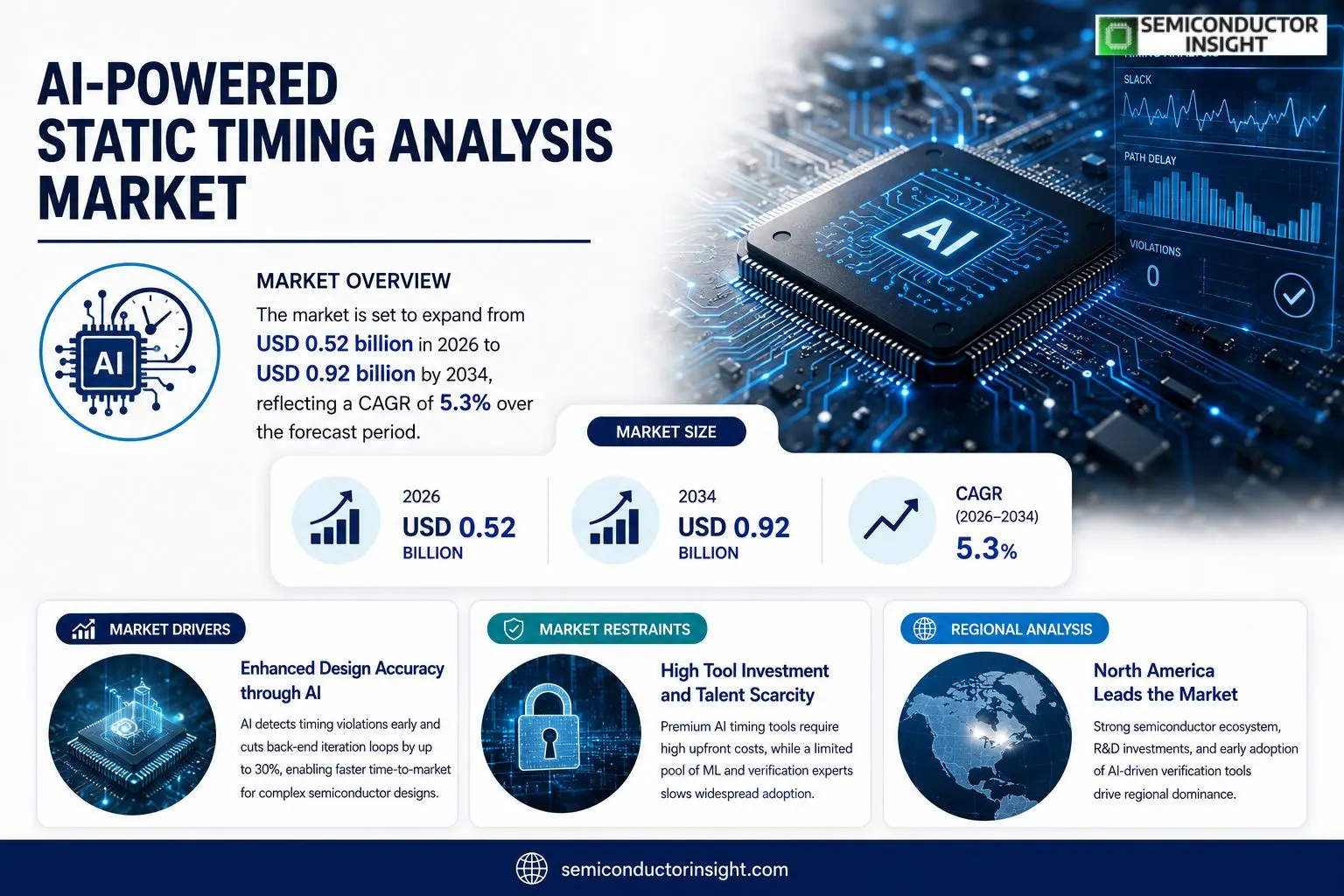
AI-Powered Static Timing Analysis market size was valued at USD 0.48 billion in 2025. The market is set to expand from USD 0.52 billion in 2026 to USD 0.92 billion by 2034, reflecting a compound annual growth rate of roughly 5.3 % over the forecast horizon.
AI‑Powered static timing analysis applies machine‑learning algorithms to evaluate signal propagation delays across semiconductor designs, automating tasks that traditionally required manual rule‑checking. By integrating predictive models with conventional timing engines, it shortens verification cycles and improves accuracy for advanced nodes such as 7 nm and below.The upward trajectory originates from mounting pressure on chip manufacturers to shorten time‑to‑market while maintaining reliability, especially as design complexity escalates with heterogeneous integration. Moreover, rising adoption of edge‑computing devices fuels demand for faster verification tools that can handle higher transistor counts without proportionally increasing engineering effort.
MARKET DRIVERS
Enhanced Design Accuracy through AI
AI algorithms now scrutinize timing paths with a granularity that traditional heuristics cannot match. By flagging marginal violations early, design teams cut back‑end iteration loops by up to 30 %, translating into faster time‑to‑market. This precision is especially valuable as manufacturers race to certify chips for high‑performance computing and automotive domains.
Rising Complexity of Advanced Process Nodes
Sub‑nanometer geometries introduce pronounced signal‑integrity challenges, forcing verification engineers to adopt smarter analysis tools. AI‑driven timing engines can assimilate thousands of layout variations, delivering statistically robust slack estimates that manual methods miss. The result is a tighter correlation between simulated and silicon performance, a decisive advantage for fabs operating at 3 nm and below.
➤ “The shift from rule‑based checks to learning‑based timing prediction is reshaping how silicon teams allocate resources,” notes a senior EDA analyst.
Collectively, these forces are reshaping AI-Powered Static Timing Analysis Market, compelling OEMs and foundries to prioritize AI‑enabled verification in their roadmaps.
MARKET CHALLENGES
Algorithmic Transparency Concerns
Design engineers often demand clear causal explanations for timing violations. Black‑box AI models can obscure the underlying reasoning, prompting resistance from validation teams that must certify safety‑critical systems. The lack of interpretability hampers broader adoption in sectors where regulatory scrutiny is intense.
Other Challenges
Data Dependency
AI timing engines rely on large, high‑quality training datasets derived from previous silicon runs. Companies with limited historical data struggle to achieve the same prediction accuracy, creating a competitive gap that favours long‑standing players with extensive design archives.
MARKET RESTRAINTS
High Upfront Tool Investment
Premium AI‑enabled timing suites command substantial license fees and integration costs. For small‑to‑mid‑size design houses, the ROI horizon can exceed three years, prompting a cautious procurement stance.
Scarcity of Skilled Talent
The convergence of semiconductor verification and machine‑learning expertise is rare. Organizations must either up‑skill existing staff or compete for a narrow pool of specialists, both of which inflate project budgets and delay deployment timelines.
MARKET OPPORTUNITIES
Integration with Cloud‑Based EDA Platforms
Cloud infrastructures now offer scalable compute resources that can host AI timing kernels on demand. This model reduces capital outlay and enables design teams to experiment with cutting‑edge algorithms without overhauling on‑premise hardware.
Emergence of Domain‑Specific AI Accelerators
Specialized inference chips designed for silicon‑design workloads can accelerate timing‑prediction models by an order of magnitude. Early adopters stand to shrink verification cycles dramatically, opening a pathway for differentiated product releases.
Regulatory Momentum Toward Functional Safety
Standards bodies are progressively embedding verification rigor into safety certifications. Companies that embed AI‑driven timing analysis into their compliance workflows will find a smoother path to market, especially in automotive and aerospace segments.
AI-Powered Static Timing Analysis Market Trends
Increasing Adoption Driven by Design Complexity
AI-Powered Static Timing Analysis Market moved from a valuation of roughly USD 0.48 billion in 2025 to USD 0.52 billion in 2026, and forecasts point to a level near USD 0.92 billion by 2034. This trajectory reflects a compound annual growth rate of about 5.3 percent. The upward pressure stems from semiconductor designers confronting ever‑greater signal‑integrity challenges as they push nodes below 7 nm and adopt heterogeneous integration. Engineers are forced to compress verification windows while preserving reliability, prompting a shift toward tools that can automate rule checking without sacrificing precision. The resulting demand for AI‑enhanced timing solutions creates a clear revenue corridor for vendors that can marry machine‑learning insight with existing timing engines.
Other Trends
Machine Learning Integration Enhances Accuracy
When predictive models are layered onto conventional timing analysis, the combined system learns from historical design data and flags anomalous delay paths that would escape manual review. This capability shortens the verification cycle by up to 30 percent in typical projects, freeing senior staff to focus on architectural trade‑offs rather than repetitive rule checks. For chip makers, the reduction in re‑spin cycles translates directly into lower tape‑out costs and a tighter alignment between design intent and silicon reality. Vendors that expose configurable ML pipelines stand to capture a premium segment of customers seeking both speed and confidence in their timing closure.
Edge Computing and Heterogeneous Integration Fuel Demand
The proliferation of edge‑computing devices intensifies the need for silicon that delivers high performance within constrained power envelopes. Such designs typically incorporate a mix of logic, memory, and analog blocks, inflating transistor counts without a proportional increase in engineering headcount. AI‑driven static timing analysis tools can evaluate these heterogeneous blocks in parallel, delivering insights that help designers meet stringent latency targets while avoiding costly over‑design. As OEMs accelerate product cycles to capture market share in the edge segment, the ability to verify timing integrity quickly becomes a competitive differentiator, reinforcing the long‑term expansion of the AI‑Powered Static Timing Analysis Market.
COMPETITIVE LANDSCAPEKey Industry Players
AI‑Powered Static Timing Analysis Market: Competitive Overview
Synopsys, Cadence and Siemens EDA dominate the AI‑enhanced timing verification space, each leveraging deep‑learning extensions to their legacy timing sign‑off suites. Synopsys’ PrimeTime AI fuses predictive modeling with traditional graph‑based analysis, allowing large‑scale 7 nm designs to close verification loops within weeks rather than months. Cadence’s Tempus AI operates on a similar premise but emphasizes a cloud‑first deployment model that scales with the bursting workloads typical of leading‑edge chip projects. Siemens EDA, through its Calibre Intelligent platform, differentiates itself with a tighter integration of AI‑driven rule extraction, which appeals to manufacturers seeking to automate rule‑based sign‑off across heterogeneous integration stacks. The trio commands the bulk of market revenue, and their strategic partnerships with foundries such as TSMC and Foundries cement their position as the primary vendors for enterprise‑grade verification pipelines.Beyond the three market leaders, a constellation of specialized firms injects competitive pressure by addressing niche use‑cases or by offering complementary analytical capabilities. ANSYS has introduced a physics‑aware AI engine that targets high‑frequency analog blocks, while Keysight Technologies supplies AI‑augmented signal‑integrity modules that integrate directly with existing test‑equipment workflows. IBM Research contributes open‑source AI models that accelerate early‑stage architectural exploration, and Arm leverages its extensive IP portfolio to embed AI‑based timing checks within its core design kits. Smaller yet agile startups such as DeepSilicon and Vektor Labs focus on predictive power‑grid analysis for emerging 3‑nm nodes, positioning themselves as valuable partners for fabless innovators seeking to reduce silicon‑iteration cycles.
List of Key AI‑Powered Static Timing Analysis Companies Profiled
- Synopsys Inc.
- Cadence Design Systems, Inc.
- Siemens EDA (formerly Mentor Graphics)
- ANSYS, Inc.
- Keysight Technologies, Inc.
- IBM Research
- Arm Ltd.
- Toshiba Corporation
- Qualcomm Technologies, Inc.
- Intel Corporation
- Samsung Electronics Co., Ltd.
- Texas Instruments Incorporated
- DeepSilicon LLC
- Vektor Labs
- Foundries Inc.
Segment Analysis:
| Segment Category | Sub-Segments | Key Insights |
| By Type |
|
Machine‑Learning‑Enhanced Timing Engines
|
| By Application |
|
Advanced Node Design Verification
|
| By End User |
|
Semiconductor Foundries
|
| By Design Complexity |
|
Heterogeneous Multi‑Die Assemblies
|
| By Verification Workflow |
|
Continuous Regression Analysis
|
Regional Analysis: AI-Powered Static Timing Analysis Market
Leading silicon manufacturers are selecting AI‑enhanced timing solutions for flagship nodes, citing the ability to predict worst‑case paths earlier in the flow. These wins generate reference designs that catalyze broader adoption among tier‑2 and boutique firms.
Major EDA platforms are embedding AI timing modules directly into their suites, fostering cross‑tool interoperability. Such partnerships reduce integration friction and encourage design teams to experiment with AI features without extensive re‑training.
U.S. semiconductor firms allocate sizable portions of their R&D budgets to AI research, often co‑funding university labs. This pipeline of talent and patents sustains a competitive advantage that ripples through the timing analysis segment.
Export‑control regimes shape technology transfer, encouraging domestic development of AI timing tools. Companies respond by localizing critical IP, which inadvertently strengthens the regional market’s resilience.
Europe
European chip designers are leveraging AI‑driven timing analysis to maintain competitiveness against Asian manufacturers. A blend of mature fabs and a strong emphasis on energy‑efficient designs creates pressure for tools that can quickly iterate on power‑timing trade‑offs. Government initiatives, such as the European Chips Act, inject funding into collaborative projects that bring AI capabilities to traditional timing workflows. Consequently, a growing cohort of mid‑size EDA firms in Germany and the Benelux region are emerging as niche providers, offering localized support and compliance expertise that larger U.S. vendors sometimes overlook.
Asia‑Pacific
The Asia‑Pacific enclave, anchored by Taiwan, South Korea, and China, exhibits a rapid escalation in demand for AI‑powered timing solutions as manufacturers chase sub‑5 nm processes. While the region benefits from massive production capacity, the integration of AI into timing analysis is still uneven; large foundries have begun internalizing AI models, whereas many fabless companies rely on external toolkits. Cultural preferences for cost‑effective licensing and the presence of a vibrant start‑up ecosystem generate a fertile environment for innovative, price‑competitive offerings. However, the fragmented regulatory environment across national borders can impede seamless tool deployment across the entire region.
South America
South American semiconductor activity remains nascent, yet the market is gradually attracting interest due to growing investments in local assembly and testing facilities. Companies in Brazil and Colombia view AI‑enhanced timing analysis as a way to shorten design cycles without the need for extensive in‑house expertise. Partnerships with North American EDA vendors provide access to cloud‑based AI services, allowing regional players to bypass heavy capital expenditures while still gaining analytical depth. The primary challenge lies in limited broadband reliability, which drives a shift toward hybrid on‑premise/off‑cloud solutions.
Middle East & Africa
In the Middle East & Africa, emerging semiconductor design hubs are primarily focused on defense and aerospace applications, where timing precision is mission‑critical. Local governments are allocating resources toward AI research centers that target timing analysis as a strategic capability. African nations, notably South Africa and Kenya, are cultivating talent pipelines through university‑industry collaborations, aiming to supply the market with AI‑savvy engineers. The region’s modest market size is offset by a willingness to adopt cutting‑edge tools as a differentiator for high‑value, low‑volume projects.
Report Scope
This market research report provides a comprehensive analysis of the AI-Powered Static Timing Analysis Market , covering the forecast period 2026–2034. It offers detailed insights into market dynamics, technological advancements, competitive landscape, and key trends shaping the industry.
Key focus areas of the report include:
- Market Overview: The report begins with an overview outlining its current market scenario, key growth indicators, and industry transformation drivers. It discusses macroeconomic factors, demand–supply balance, regulatory landscape, and the strategic role of semiconductors in powering advancements across industries such as automotive, telecommunications, consumer electronics, and industrial automation.
- Market Size & Forecast: Historical data and future projections for revenue, unit shipments, and market value across major regions and segments.
- Segmentation Analysis: Detailed breakdown by product type, technology, application, and end-user industry to identify high-growth segments and investment opportunities.
- Regional Insights: Insights into market performance across North America, Europe, Asia-Pacific, Latin America, and the Middle East & Africa, including country-level analysis where relevant.
- Competitive Landscape: Profiles of leading market participants, including their product offerings, R&D focus, manufacturing capacity, pricing strategies, and recent developments such as mergers, acquisitions, and partnerships.
- Technology Trends & Innovation: Assessment of emerging technologies, integration of AI/IoT, semiconductor design trends, fabrication techniques, and evolving industry standards.
- Market Drivers & Restraints: Evaluation of factors driving market growth along with challenges, supply chain constraints, regulatory issues, and market-entry barriers.
- Stakeholder Insights: Insights for component suppliers, OEMs, system integrators, investors, and policymakers regarding the evolving ecosystem and strategic opportunities.
Primary and secondary research methods are employed, including interviews with industry experts, data from verified sources, and real-time market intelligence to ensure the accuracy and reliability of the insights presented.
FREQUENTLY ASKED QUESTIONS:
What is the current market size of AI-Powered Static Timing Analysis Market?
-> AI-Powered Static Timing Analysis Market was valued at USD 0.48 billion in 2025 and is expected to reach USD 0.92 billion by 2034.
Which key companies operate in AI-Powered Static Timing Analysis Market?
-> Key players include Cadence Design Systems, Synopsys, Mentor Graphics, and ANSYS, among others.
What are the key growth drivers?
-> Key growth drivers include rising design complexity, pressure to shorten time‑to‑market, and increasing demand for edge‑computing devices.
Which region dominates the market?
-> The source does not specify a dominant region; however, North America and Asia‑Pacific are typically major contributors in semiconductor verification tools.
What are the emerging trends?
-> Emerging trends include integration of AI/ML models with conventional timing engines, support for advanced nodes (7 nm and below), and heterogeneous integration workflows.
Get Sample Report PDF for Exclusive Insights
Report Sample Includes
- Table of Contents
- List of Tables & Figures
- Charts, Research Methodology, and more...
 Download Sample Report PDF