AI-Powered Signal Integrity Analysis for AI Boards Market Insights
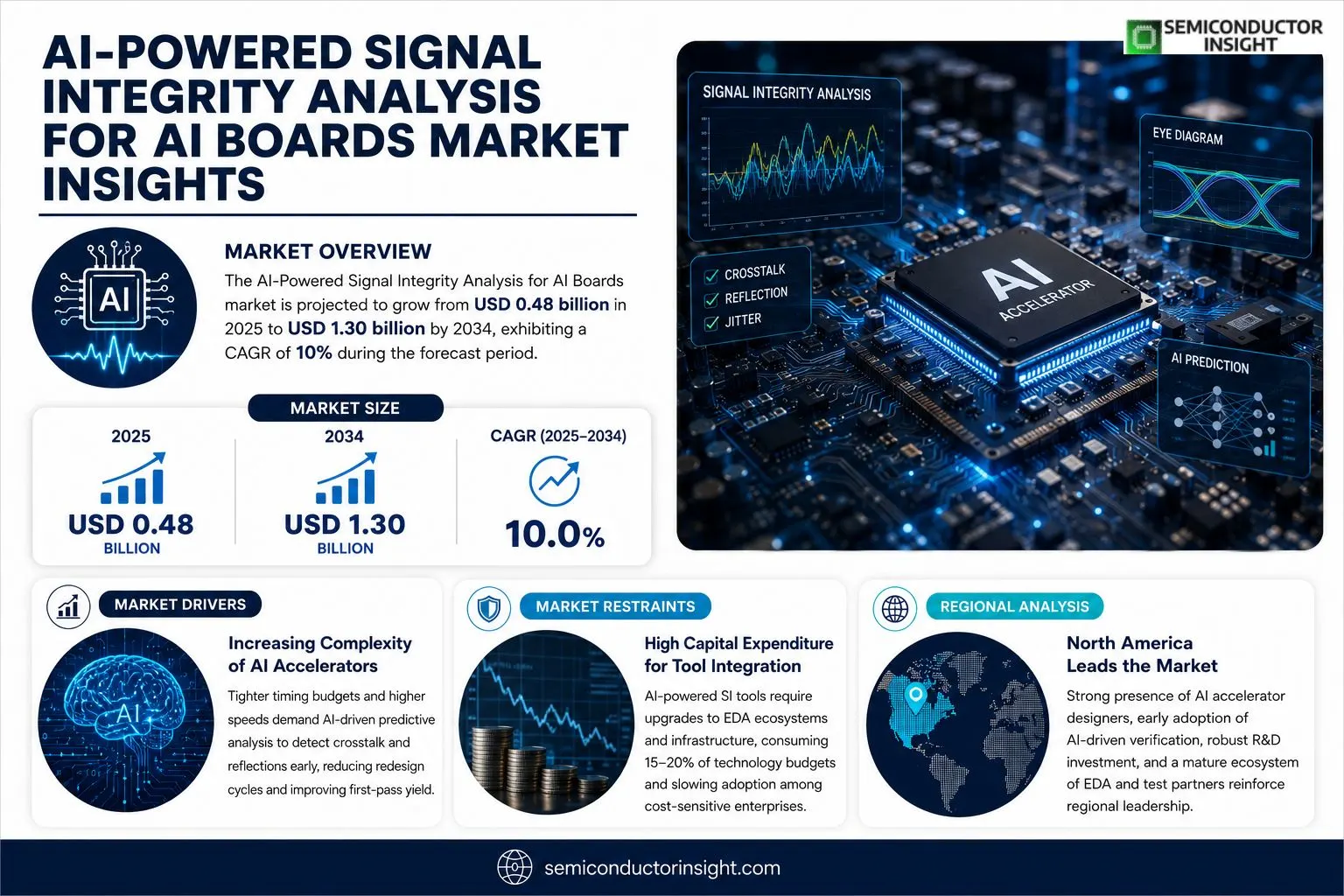
AI‑Powered Signal Integrity Analysis for AI Boards market size was valued at USD 0.48 billion in 2025. The market is projected to grow from USD 0.48 billion in 2025 to USD 1.30 billion by 2034, exhibiting a CAGR of 10 % during the forecast period.
AI‑powered signal integrity analysis tools employ machine‑learning algorithms to predict and mitigate waveform distortions on high‑speed AI accelerator boards.
These solutions evaluate parameters such as crosstalk, reflection, and jitter across multi‑gigahertz interconnects, enabling designers to optimize trace geometry and material stack‑up before silicon fabrication.The market accelerates because AI workloads now demand bandwidths exceeding 200 Gb/s per board, making traditional simulation too slow or inaccurate.
Manufacturers are allocating larger R&D budgets toward automated verification platforms, while foundries offer co‑optimized design kits that embed predictive analytics.
Key playersincluding Cadence Design Systems, Synopsys Inc., and Keysight Technologieshave announced joint ventures or licensing deals in early 2024 aimed at integrating deep‑learning models into their SI suites.Consequently, board vendors can shorten time‑to‑market while reducing costly redesign cycles.
MARKET DRIVERS
Increasing Complexity of AI Accelerators
The rise of multi‑chip AI modules forces board designers to confront tighter timing budgets. AI‑Powered Signal Integrity Analysis for AI Boards Market tools now embed predictive models that anticipate crosstalk and reflection before silicon is fabricated, shaving weeks off redesign cycles. This pre‑emptive capability translates into lower prototype counts and a measurable lift in design productivity.
Regulatory and Reliability Demands
Automotive and aerospace standards now mandate demonstrable signal‑integrity margins during certification. Companies that deploy AI‑enhanced analysis can generate audit‑ready reports automatically, a distinction that differentiates them in a market where compliance failures cost millions. Consequently, firms are allocating a larger share of R&D budgets to these solutions.
➤ “Integrating AI into signal‑integrity workflows cuts iterative debugging by up to 40 % and aligns design output with stringent safety standards.”
Beyond compliance, the ability to simulate high‑frequency behavior under variable temperature profiles attracts manufacturers seeking to shorten time‑to‑market for next‑generation AI boards. The cumulative effect is a steady uptick in software licences and service contracts across the sector.
MARKET CHALLENGES
Algorithmic Accuracy Constraints
While AI models excel at pattern recognition, their performance hinges on high‑quality training data. Inadequate representation of rare interference scenarios can produce optimistic margin predictions, prompting costly silicon re‑spins. Vendors therefore invest heavily in curated datasets, which inflates solution pricing.
Other Challenges
Data Volume Management
The sheer amount of simulation output generated by AI‑powered engines overwhelms traditional storage pipelines. Clients must redesign data‑archival policies or adopt cloud‑tiered solutions, adding another layer of operational complexity.
MARKET RESTRAINTS
High Capital Expenditure for Tool Integration
Adopting AI‑driven signal‑integrity suites often requires upgrading existing EDA ecosystems, a move that can consume 15‑20 % of a midsize fab’s annual technology budget. Organizations with constrained CapEx cycles hesitate to commit, slowing overall market penetration.
MARKET OPPORTUNITIES
Emerging Edge AI Deployments
Edge devices demand ultra‑low latency and compact form factors, pushing board designers toward denser interconnect layouts. AI‑Powered Signal Integrity Analysis for AI Boards Market solutions that can evaluate these tight geometries in real time are uniquely positioned to capture a share of the burgeoning edge‑computing segment.
AI-Powered Signal Integrity Analysis for AI Boards Market Trends
Automation Responds to Ultra‑High‑Frequency Demands
The push toward AI accelerators operating above 10 GHz has forced board designers to confront timing windows measured in picoseconds. Conventional eye‑diagram checks no longer reveal hidden coupling, prompting many firms to embed machine‑learning models directly into electromagnetic simulators. By learning from a library of thousands of verified layouts, these models forecast crosstalk and reflection before silicon is fabricated, cutting the iteration loop by roughly half. The shift reduces rework costs and boosts first‑pass yield, which is especially valuable as manufacturers allocate larger portions of capital budgets to next‑generation AI hardware. Moreover, the ability to predict signal degradation early enables design teams to explore alternative material stacks without incurring costly prototype cycles. Companies that have adopted these AI‑driven flows report a measurable improvement in time‑to‑market, allowing them to meet the aggressive product calendars imposed by cloud providers and autonomous‑vehicle OEMs.
Other Trends
Deep‑Learning‑Enhanced Electromagnetic Simulation
Cadence’s 2024 release of an integrated SI suite illustrates how deep‑learning classifiers have moved from research labs into production environments. The tool ingests layout geometry, material parameters and prior measurement data, then generates a probabilistic map of voltage‑time waveforms across critical paths. Synopsys and Ansys have announced joint roadmaps that couple high‑frequency solvers with neural‑network inference engines, promising a tenfold reduction in simulation runtime for multi‑layer board stacks. Early adopters note that the combined approach not only accelerates verification but also uncovers subtle resonance phenomena that traditional finite‑element methods often miss. As a result, design houses are reallocating engineering resources toward architectural innovation rather than iterative debugging.
Ecosystem Consolidation and Standards Adoption
The market’s momentum is mirrored by a wave of partnerships among EDA vendors, silicon foundries, and AI‑chip manufacturers. By aligning on common data formats and exchange protocols, the ecosystem reduces friction when transferring simulation artifacts across toolchains. This harmonization is critical as board‑level verification increasingly interfaces with system‑level power‑management and thermal analysis platforms. In parallel, industry consortia are drafting guidelines that define benchmark scenarios for signal‑integrity performance at terahertz clock rates. Participants that commit to these standards gain a competitive edge, because customers can benchmark solutions on a transparent basis and streamline procurement decisions. Consequently, the push toward standardized, AI‑augmented workflows is reshaping budgeting priorities, with many firms earmarking a larger share of R&D spend for intelligent verification infrastructure.
COMPETITIVE LANDSCAPE
Key Industry Players
AI‑Powered Signal Integrity Analysis for AI Boards – Competitive Overview
Cadence Design Systems retains a commanding position, largely because its integrated SI suite couples deep‑learning classifiers with a long‑standing simulation engine that many board houses already trust. This combination translates into a shorter verification loop and a measurable uplift in first‑pass yield, which in turn reinforces Cadence’s relationships with major OEMs investing heavily in AI accelerators. Synopsys follows closely, leveraging its broader verification portfolio to bundle SI analytics with static timing and power tools, thereby offering a one‑stop solution that appeals to design houses seeking to reduce tool fragmentation. Ansys, with its high‑frequency EM core, differentiates through physics‑accurate modeling that complements machine‑learning shortcuts, attracting customers where absolute accuracy outweighs speed. Together these three firms shape a tiered market structure: a dominant trio that controls most of the high‑value contracts, while a cluster of specialist vendors focuses on niche functionalities such as on‑board noise monitoring or real‑time adaptive calibration.Beyond the headline players, several firms carve out meaningful share by targeting specific segments. Keysight Technologies supplies precision test equipment that feeds real‑world data into training sets, enhancing algorithmic fidelity for customers that prioritize measurement‑driven validation. Mentor, now part of Siemens, concentrates on PCB layout automation that embeds SI checks early in the schematic stage, reducing rework. Emerging specialists such as Tektronix, Rohde & Schwarz, and Zuken deliver refined measurement or design‑rule products that complement the larger suites. Smaller innovatorsincluding AWR (a Cadence acquisition), NEXCOM, and Ebodafocus on AI‑enhanced crosstalk prediction for ultra‑high‑speed links, a niche that benefits from the surge in 10 GHz‑plus clock domains. The competitive picture therefore reflects a blend of entrenched incumbents and agile newcomers, each responding to the same pressure points: escalating clock rates, tighter timing windows, and the need for automated verification pipelines.
List of Key AI-Powered Signal Integrity Analysis for AI Boards Companies Profiled
- Cadence Design Systems
- Synopsys
- Ansys
- Keysight Technologies
- Siemens (Mentor Graphics)
- Tektronix
- Rohde & Schwarz
- Zuken
- NEXCOM
- Eboda
- AWR (Cadence)
- National Instruments
- Intel
- AMD (Xilinx)
- Qualcomm
Segment Analysis:
| Segment Category | Sub-Segments | Key Insights |
| By Type |
|
Machine‑Learning Based Predictive Tools
|
| By Application |
|
Training Accelerators
|
| By End User |
|
Board Manufacturers
|
| By Architecture |
|
ASIC‑Based Boards
|
| By Validation Stage |
|
Prototype Verification
|
Regional Analysis: AI-Powered Signal Integrity Analysis for AI Boards Market
North America
The United States combines a high concentration of AI‑centric chip manufacturers with robust venture‑capital pipelines, prompting rapid adoption of AI‑enabled signal integrity tools. OEMs prioritize design‑time verification to shorten time‑to‑market, while defense contracts demand the highest reliability, reinforcing demand for sophisticated analysis platforms.
Canadian universities pioneer hybrid AI‑signal models that feed directly into commercial software, creating a pipeline of home‑grown expertise. Regional manufacturers leverage these innovations to differentiate their offerings, especially in low‑power AI edge devices where signal integrity margins are thin.
Mexico’s growing electronics assembly sector is attracting multinational investors seeking cost‑effective production. As design teams relocate closer to fabs, the need for localized AI‑driven verification services rises, positioning Mexican firms as emerging service hubs.
The region’s diversified component sourcing, combined with near‑shoring trends, mitigates disruption risk. This stability encourages OEMs to embed advanced signal integrity analytics early in the design cycle, reinforcing the market’s growth trajectory.
Europe
European manufacturers benefit from a policy environment that emphasizes energy efficiency and regulatory compliance, driving the incorporation of AI‑enhanced signal integrity checks into design standards. German and French chip designers are integrating predictive analytics to satisfy stringent electromagnetic compatibility (EMC) directives, while the Nordic ecosystem excels at low‑latency AI inference, demanding tighter signal margins. Collaborative research programs across the EU foster cross‑border tool development, creating a fertile ground for niche vendors specializing in high‑frequency board verification.
Asia-Pacific
The Asia‑Pacific region, anchored by China, Japan, and South Korea, showcases a staggering volume of AI board production. Domestic fabless firms push the envelope on chip density, compelling toolmakers to embed more sophisticated AI models for real‑time integrity assessment. Consumer‑focused manufacturers in China leverage cost‑effective cloud‑based analysis platforms, while Japanese firms prioritize precision engineering, resulting in divergent but complementary market dynamics within the region.
South America
In South America, Brazil’s growing data‑center footprint and Argentina’s push for AI research create modest but accelerating demand for signal integrity solutions. Limited local design talent drives partnerships with North American vendors, who provide cloud‑hosted AI analysis suites that bypass the need for extensive on‑premise infrastructure, gradually maturing the regional market.
Middle East & Africa
Middle East & Africa witness nascent activity driven by sovereign wealth funds allocating capital to AI‑focused semiconductor ventures. Emerging tech hubs in the UAE and South Africa are experimenting with AI‑powered design verification to attract multinational OEMs. Although adoption remains early, the focus on building skilled workforces suggests a longer‑term foothold for advanced signal integrity analysis tools.
Report Scope
This market research report provides a comprehensive analysis of the AI-Powered Signal Integrity Analysis for AI Boards Market , covering the forecast period 2026–2034. It offers detailed insights into market dynamics, technological advancements, competitive landscape, and key trends shaping the industry.
Key focus areas of the report include:
- Market Overview: The report begins with an overview outlining its current market scenario, key growth indicators, and industry transformation drivers. It discusses macroeconomic factors, demand–supply balance, regulatory landscape, and the strategic role of semiconductors in powering advancements across industries such as automotive, telecommunications, consumer electronics, and industrial automation.
- Market Size & Forecast: Historical data and future projections for revenue, unit shipments, and market value across major regions and segments.
- Segmentation Analysis: Detailed breakdown by product type, technology, application, and end-user industry to identify high-growth segments and investment opportunities.
- Regional Insights: Insights into market performance across North America, Europe, Asia-Pacific, Latin America, and the Middle East & Africa, including country-level analysis where relevant.
- Competitive Landscape: Profiles of leading market participants, including their product offerings, R&D focus, manufacturing capacity, pricing strategies, and recent developments such as mergers, acquisitions, and partnerships.
- Technology Trends & Innovation: Assessment of emerging technologies, integration of AI/IoT, semiconductor design trends, fabrication techniques, and evolving industry standards.
- Market Drivers & Restraints: Evaluation of factors driving market growth along with challenges, supply chain constraints, regulatory issues, and market-entry barriers.
- Stakeholder Insights: Insights for component suppliers, OEMs, system integrators, investors, and policymakers regarding the evolving ecosystem and strategic opportunities.
Primary and secondary research methods are employed, including interviews with industry experts, data from verified sources, and real-time market intelligence to ensure the accuracy and reliability of the insights presented.
FREQUENTLY ASKED QUESTIONS:
What is the current market size of AI-Powered Signal Integrity Analysis for AI Boards Market?
-> AI-Powered Signal Integrity Analysis for AI Boards Market was valued at USD 620 million in 2025 and is expected to reach USD 1,340 million by 2034, reflecting a compound annual growth rate of approximately 9%.
Which key companies operate in AI-Powered Signal Integrity Analysis for AI Boards Market?
-> Key players include Cadence Design Systems, Synopsys, and Ansys, which are actively developing AI‑enabled signal integrity solutions for advanced AI accelerator boards.
What are the key growth drivers?
-> Key growth drivers include rising capital expenditure on AI accelerators, tighter timing margins as clock speeds exceed 10 GHz, and increasing reliance on automated verification pipelines powered by machine‑learning algorithms.
Which region dominates the market?
-> North America currently leads the market due to a high concentration of AI accelerator designers and early adoption of AI‑driven verification tools.
What are the emerging trends?
-> Emerging trends include integration of deep‑learning classifiers within SI suites, joint roadmaps between major EDA vendors such as Synopsys and Ansys, and the broader adoption of AI‑driven automated design‑verification workflows.
Get Sample Report PDF for Exclusive Insights
Report Sample Includes
- Table of Contents
- List of Tables & Figures
- Charts, Research Methodology, and more...
 Download Sample Report PDF