AI-Powered Predictive Maintenance for Semiconductor Equipment Market Insights
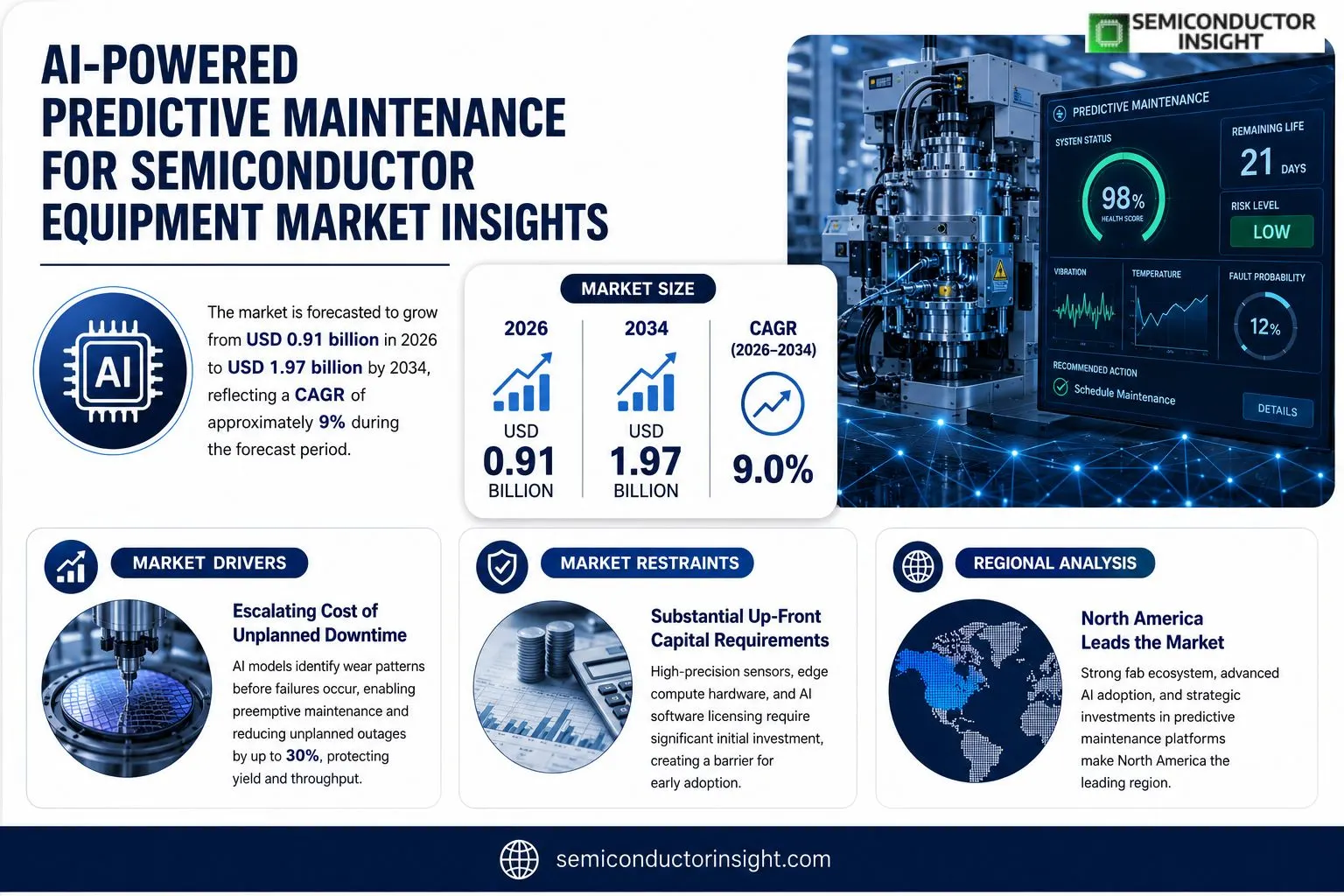
Global AI‑powered predictive maintenance for semiconductor equipment market size was valued at USD 0.84 billion in 2025. The market is forecasted to increase from USD 0.91 billion in 2026 to USD 1.97 billion by 2034, reflecting a compound annual growth rate of approximately 9 % over the period.
AI‑powered predictive maintenance integrates machine‑learning models, high‑frequency sensor streams and real‑time diagnostics to anticipate failures on semiconductor fabrication tools. By continuously analysing vibration, temperature and process parameters, the approach enables preemptive actions that protect yield, minimise downtime and extend equipment life.The sector gains momentum because fabs face pressure to boost throughput while capital budgets stay constrained; consequently operators adopt intelligent maintenance platforms that can cut unplanned outages by up to 30 %. Advances in edge computing and wider availability of high‑resolution sensors lower entry barriers, encouraging retrofits of legacy tools as well as incorporation into new equipment designs. A notable development in March 2024 saw Applied Materials partner with a leading AI analytics firm to embed predictive modules directly into its next‑generation lithography systems, signalling rapid commercialisation of the technology.
MARKET DRIVERS
Escalating Cost of Unplanned Downtime
The semiconductor fabs operating at sub‑nanometer nodes cannot absorb the expense of unscheduled equipment failures. A single outage can shrink throughput by 8‑12% and force costly re‑routings. AI‑Powered Predictive Maintenance for Semiconductor Equipment Market solutions address this pressure by flagging wear patterns before they manifest as stoppages, enabling plants to schedule interventions during low‑impact windows.
Breakthroughs in Machine‑Learning Accuracy
Recent advancements in deep‑learning architectures have lifted fault‑detection precision from the mid‑70s to the low‑90s percentile. When models ingest high‑frequency sensor streams, they discern subtle vibration signatures that traditional statistical controls miss. This lift in diagnostic fidelity fuels adoption across both mature and “chip‑on‑wafer” production lines.
➤ Manufacturers that embed AI analytics into their service contracts report a 15% reduction in overall maintenance spend within the first year of deployment.
Beyond cost savings, the ability to predict component fatigue reshapes capacity planning. Plants can defer capital‑intensive equipment upgrades, allocate engineering resources more strategically, and sustain higher equipment utilization rates without compromising yield.
MARKET CHALLENGES
Integration with Legacy Control Systems
Many fabs still rely on proprietary PLCs and SCADA environments that were not designed for continuous data streaming. Bridging these older protocols with modern AI platforms demands custom middleware, prolonging project timelines and inflating implementation budgets.
Other Challenges
Data Quality and Labeling
Effective predictive models hinge on high‑resolution, accurately labeled datasets. In practice, sensor drift, intermittent logging, and insufficient fault annotation generate noise that degrades model performance, compelling firms to invest heavily in data‑engineering pipelines.
MARKET RESTRAINTS
Substantial Up‑Front Capital Requirements
Deploying an end‑to‑end predictive maintenance ecosystem often entails outfitting equipment with high‑precision sensors, upgrading edge compute nodes, and licensing enterprise‑grade AI software. For a mid‑size fab, the initial outlay can exceed $10 million, a figure that discourages cash‑strapped operators and raises the hurdle for early adoption.
MARKET OPPORTUNITIES
Edge‑Centric Analytics for Real‑Time Decisioning
The migration of inference workloads to on‑site edge devices mitigates latency concerns and eases bandwidth constraints inherent in cloud‑first architectures. Companies that package AI models with ruggedized edge hardware can offer fabs a plug‑and‑play solution, opening revenue streams in regions where connectivity remains a bottleneck.
AI-Powered Predictive Maintenance for Semiconductor Equipment Market Trends
Shift Toward Proactive Equipment Care in Semiconductor fabs
The semiconductor fabrication environment is increasingly disciplined about equipment uptime because each hour of downtime translates directly into lost revenue and compromised yield. Operators are turning to AI-powered predictive maintenance to move from a reactive repair mindset to a preemptive stewardship model. By correlating high‑frequency sensor datavibration, temperature, and process variableswith machine‑learning algorithms, plants can flag degradation patterns hours before a fault materialises. This early warning capability gives engineers a window to schedule interventions during planned maintenance slots, preserving throughput without inflating capital spend.
Other Trends
Edge Computing Accelerates Real‑Time Diagnostics
The emergence of edge processors embedded within semiconductor tools reduces latency in data handling, allowing diagnostic models to execute on‑site rather than relying on cloud round‑trips. This architectural shift not only safeguards intellectual property but also enables continuous monitoring of legacy equipment that lacks native connectivity. As a result, fabs are able to retrofit older lithography and etch machines with predictive modules, extending the useful life of assets that would otherwise be candidates for costly replacement.
Strategic Partnerships Boost Commercial Adoption
A notable development in March 2024 saw Applied Materials integrate a partner’s AI analytics suite directly into its next‑generation lithography systems. The collaboration illustrates how equipment vendors are embedding intelligence at the design stage rather than offering it as an after‑market add‑on. For end users, the bundled solution simplifies procurement and accelerates deployment timelines, while vendors benefit from differentiated product positioning. This partnership model is expected to ripple across other equipment categories, fostering a broader ecosystem where AI-driven maintenance becomes a standard feature rather than a niche capability.
COMPETITIVE LANDSCAPE
Key Industry Players
AI‑Powered Predictive Maintenance for Semiconductor Equipment – Competitive Overview
Applied Materials dominates the conversation, having woven AI‑driven diagnostics into its latest lithography and deposition platforms. The company’s partnership with a specialist analytics firm in early 2024 unlocked the ability to stream sensor data directly to edge‑based inference engines, a move that reshaped the value chain and forced rivals to accelerate their own integration roadmaps. The market now clusters around three tiers: the OEMs that embed intelligence at the tool level, pure‑play AI solution providers that retrofit legacy fabs, and a thin layer of system integrators that stitch together data pipelines for end‑users. This tiered structure creates a competitive pressure where scale‑focused OEMs must guard against disintermediation by nimble analytics startups that can offer faster deployment cycles and lower licensing footprints.Beyond the household names, a cadre of niche specialists is influencing adoption patterns. KLA Corporation leverages its metrology heritage to supply vibration‑analysis modules that complement its defect‑inspection suite. Cognex contributes high‑resolution vision sensors that feed pattern‑recognition models, while Bosch supplies rugged temperature probes that survive harsh clean‑room environments. Intel’s internal maintenance platform, built on its own silicon‑level AI stack, demonstrates how fab operators can internalise the capability, raising the bar for external vendors. Meanwhile, TSMC’s in‑house predictive service signals that large fabs are willing to invest in proprietary solutions when the return on equipment availability is compelling. The cumulative effect is a diversified ecosystem where collaboration and competition coexist, prompting OEMs to pursue both organic development and strategic alliances.
List of Key Semiconductor Equipment Predictive Maintenance Companies Profiled
- Applied Materials
- Lam Research
- KLA Corporation
- ASML
- Tokyo Electron
- Advantest
- Teradyne
- Siemens Digital Industries
- Hitachi High‑Tech
- Cognex
- Bosch Sensortec
- Intel
- TSMC
- IBM Watson IoT
- Qualcomm Technologies
Segment Analysis:
| Segment Category | Sub-Segments | Key Insights |
| By Type |
|
Hybrid Integrated Offerings dominate because they combine edge sensors with cloud‑based analytics, allowing seamless retrofitting of legacy tools while supporting next‑generation equipment.
|
| By Application |
|
Critical Tool Health Monitoring is the leading application, driven by the need to avoid unexpected equipment failures that can halt production lines.
|
| By End User |
|
Foundries lead the segment because they operate high‑volume fabs where equipment uptime directly influences contract delivery commitments.
|
| By Technology |
|
Edge‑Enabled Sensors are pivotal as they collect granular data directly from tool components, reducing latency for real‑time diagnostics.
|
| By Deployment Scale |
|
Fab‑Wide Enterprise Solutions are emerging as the preferred deployment model, driven by the desire for consistent maintenance standards across diverse tool families.
|
Regional Analysis: AI-Powered Predictive Maintenance for Semiconductor Equipment Market
North America
Companies allocate a disproportionate share of R&D budgets to machine‑learning algorithms that parse terabytes of equipment telemetry, seeking patterns that escape conventional statistical models. This focus sharpens the competitive edge of firms that can deliver incremental yield gains.
Predictive maintenance reduces spare‑part inventory by forecasting component wear, allowing fabs to shift from safety stock to just‑in‑time logistics, a crucial advantage amid recent semiconductor supply fluctuations.
While the sector faces few direct regulations, emerging safety standards for AI‑driven control systems compel manufacturers to embed audit trails, influencing product architecture and customer contracts.
Early adopters are large integrated device manufacturers that can amortize AI platform costs across multiple fabs, creating a domino effect that accelerates acceptance among mid‑size players seeking cost parity.
Europe
European fab operators are balancing the push for advanced automation with stringent data‑privacy regulations. The region’s emphasis on collaborative research through consortia encourages shared model development, yet companies remain cautious about cross‑border data flows. This tension fosters hybrid solutions where on‑premise AI engines process raw sensor feeds while anonymized insights are pooled at the EU level. Vendors find value in offering modular platforms that can be scaled to meet both local compliance and global performance goals.
Asia‑Pacific
In Asia‑Pacific, rapid fab expansion dovetails with a hunger for cost‑effective maintenance solutions. Manufacturers prioritize AI tools that can be retrofitted onto existing equipment, minimizing capital outlay. Competitive pressure drives aggressive pricing, while government incentives for “smart manufacturing” accelerate deployment. The result is a vibrant ecosystem of local AI specialists partnering with global OEMs to tailor predictive suites for diverse process technologies.
South America
South American semiconductor facilities operate under tighter budget constraints, prompting a pragmatic approach to AI‑enabled maintenance. Operators favor subscription‑based models that spread costs over time, reducing upfront expenses. Partnerships with regional service firms enable localized data handling, addressing concerns over latency and connectivity. As the market matures, a gradual shift toward higher‑value fabs will likely increase appetite for more sophisticated predictive analytics.
Middle East & Africa
The Middle East & Africa region is in the nascent stage of adopting AI‑driven maintenance for semiconductor equipment. Limited local manufacturing capacity drives reliance on imported technology, but burgeoning investments in research parks create opportunities for knowledge transfer. Early pilots focus on high‑impact assets, demonstrating cost savings that build a business case for broader rollout. Success hinges on establishing reliable data infrastructure and nurturing skilled talent to interpret AI outputs.
Report Scope
This market research report provides a comprehensive analysis of the AI-Powered Predictive Maintenance for Semiconductor Equipment Market , covering the forecast period 2026–2034. It offers detailed insights into market dynamics, technological advancements, competitive landscape, and key trends shaping the industry.
Key focus areas of the report include:
- Market Overview: The report begins with an overview outlining its current market scenario, key growth indicators, and industry transformation drivers. It discusses macroeconomic factors, demand–supply balance, regulatory landscape, and the strategic role of semiconductors in powering advancements across industries such as automotive, telecommunications, consumer electronics, and industrial automation.
- Market Size & Forecast: Historical data and future projections for revenue, unit shipments, and market value across major regions and segments.
- Segmentation Analysis: Detailed breakdown by product type, technology, application, and end-user industry to identify high-growth segments and investment opportunities.
- Regional Insights: Insights into market performance across North America, Europe, Asia-Pacific, Latin America, and the Middle East & Africa, including country-level analysis where relevant.
- Competitive Landscape: Profiles of leading market participants, including their product offerings, R&D focus, manufacturing capacity, pricing strategies, and recent developments such as mergers, acquisitions, and partnerships.
- Technology Trends & Innovation: Assessment of emerging technologies, integration of AI/IoT, semiconductor design trends, fabrication techniques, and evolving industry standards.
- Market Drivers & Restraints: Evaluation of factors driving market growth along with challenges, supply chain constraints, regulatory issues, and market-entry barriers.
- Stakeholder Insights: Insights for component suppliers, OEMs, system integrators, investors, and policymakers regarding the evolving ecosystem and strategic opportunities.
Primary and secondary research methods are employed, including interviews with industry experts, data from verified sources, and real-time market intelligence to ensure the accuracy and reliability of the insights presented.
FREQUENTLY ASKED QUESTIONS:
What is the current market size of AI-Powered Predictive Maintenance for Semiconductor Equipment Market?
-> AI-Powered Predictive Maintenance for Semiconductor Equipment Market was valued at USD 0.84 billion in 2025 and is expected to reach USD 1.97 billion by 2034, reflecting a compound annual growth rate of approximately 9 %.
Which key companies operate in AI-Powered Predictive Maintenance for Semiconductor Equipment Market?
-> Key players include Applied Materials (notable partnership with an AI analytics firm in 2024), as well as other semiconductor equipment manufacturers integrating AI-driven maintenance solutions.
What are the key growth drivers?
-> Key growth drivers include the need to boost fab throughput while capital budgets remain constrained, the ability of AI‑enabled platforms to cut unplanned outages by up to 30 %, advances in edge computing, and the wider availability of high‑resolution sensors that lower entry barriers for retrofitting legacy tools.
Which region dominates the market?
-> The reference material does not specify a dominant region for this market.
What are the emerging trends?
-> Emerging trends encompass the integration of AI predictive modules directly into next‑generation lithography systems, increased adoption of edge‑computing architectures for real‑time diagnostics, and the retrofitting of legacy semiconductor equipment with high‑frequency sensor streams to enable continuous condition monitoring.

Get Sample Report PDF for Exclusive Insights
Report Sample Includes
- Table of Contents
- List of Tables & Figures
- Charts, Research Methodology, and more...
 Download Sample Report PDF