AI-Powered Optical Proximity Correction Software Market Insights
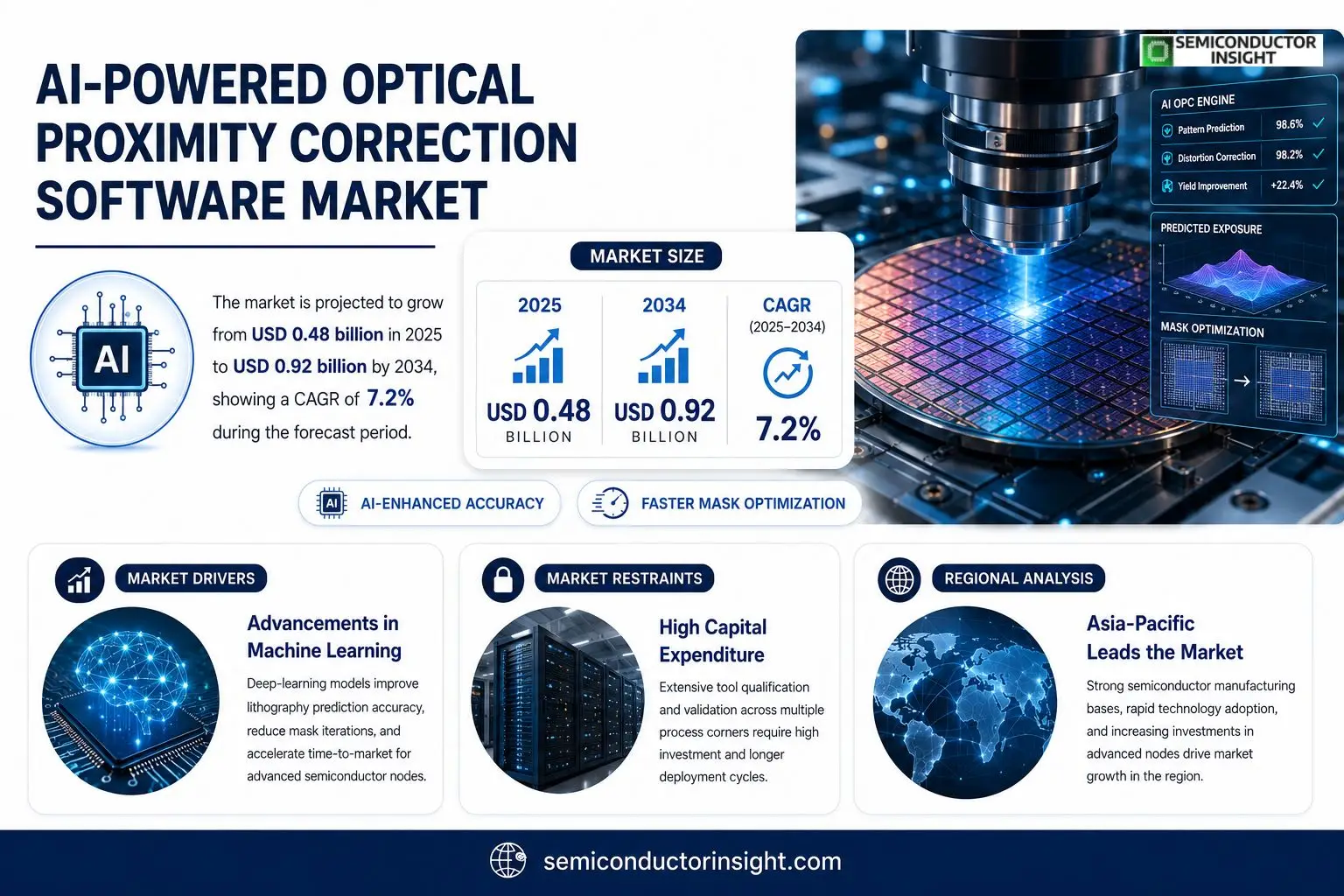
AI‑Powered Optical Proximity Correction Software market size was valued at USD 0.45 billion in 2025. The market will increase from USD 0.48 billion in 2025 to USD 0.92 billion by 2034, showing a CAGR of 7.2% during the forecast period.
Optical proximity correction (OPC) software refines mask patterns so that printed features match intended designs despite diffraction effects inherent in photolithography. AI‑enhanced OPC tools employ machine‑learning models to predict exposure outcomes faster and more accurately than conventional rule‑based engines, thereby reducing iteration cycles for sub‑10 nm nodes.The sector is gaining momentum because semiconductor manufacturers face escalating patterning complexity and tighter design windows at advanced nodes. Moreover, the integration of AI accelerators into EDA suitesexemplified by Synopsys’s launch of an AI‑driven OPC module in March 2024has lowered compute costs while improving yield predictions.
MARKET DRIVERS
Advancements in Machine Learning Algorithms
Recent breakthroughs in deep‑learning architectures have enabled pattern‑recognition engines to predict lithographic distortions with unprecedented accuracy. As designers integrate these models directly into the photomask creation workflow, the AI‑Powered Optical Proximity Correction Software Market experiences a tangible uplift in adoption rates. Companies that invest early gain a competitive edge by reducing re‑work cycles.
Escalating Complexity of Semiconductor Nodes
The shift toward sub‑3‑nanometer process nodes intensifies the demand for finer correction granularity. Traditional rule‑based OPC tools struggle to keep pace, prompting fabs to migrate toward solutions that leverage artificial intelligence for real‑time adjustment. This migration fuels higher margin contracts for software vendors.
➤ “Clients that replace legacy OPC stacks with AI‑driven platforms report up to a 30% reduction in mask‑error rates.”
Beyond technical merit, the economic incentive is clear: fewer mask iterations translate into lower material spend and shorter time‑to‑volume, reinforcing the strategic value of AI‑enhanced correction suites.
MARKET CHALLENGES
Integration with Existing Design‑for‑Manufacturing (DFM) Flows
Many semiconductor manufacturers operate legacy EDA ecosystems that were not built for AI plug‑ins. Aligning data formats, simulation checkpoints, and version control across disparate tools creates friction that can stall deployment timelines.
Other Challenges
Skill Gap in AI Model Management
The scarcity of engineers who understand both lithography physics and machine‑learning lifecycle management forces firms to either up‑skill existing staff or rely on specialist consultants, adding to project overhead.
MARKET RESTRAINTS
High Capital Expenditure for Tool Qualification
Before a new correction engine can be approved for production, it must undergo exhaustive qualification across multiple process corners. The associated testing costs and extended validation cycles act as a financial brake, especially for mid‑size foundries with tighter budget constraints.
MARKET OPPORTUNITIES
Emergence of Hybrid Cloud‑Edge Deployment Models
Hybrid architectures that blend on‑premise compute with cloud‑based inference engines allow fabs to scale AI workloads without massive upfront hardware purchases. This model opens a pathway for smaller players to access cutting‑edge OPC capabilities, broadening the addressable market for vendors.
AI-Powered Optical Proximity Correction Software Market Trends
AI Integration Accelerates OPC Efficiency
The infusion of machine‑learning algorithms into OPC workflows is shortening the feedback loop between layout design and mask verification. By learning from historic exposure data, AI‑enhanced engines generate pattern adjustments in minutes rather than hours, allowing fabs to compress development cycles for sub‑10 nm technologies. This speed gain is not merely a technical convenience; it translates into higher wafer throughput and reduced time‑to‑market for advanced nodes, a competitive edge that increasingly influences procurement decisions across the semiconductor supply chain.
Other Trends
Edge Node Complexity Fuels Demand
As process nodes shrink, diffraction and stochastic effects amplify, squeezing design windows to the point where conventional rule‑based OPC struggles to meet yield targets. Engineers now rely on predictive AI models to anticipate lithographic distortions before they manifest on silicon. The resulting precision enables pattern fidelity that sustains performance scaling, prompting leading EDA providers to bundle AI‑driven OPC as a standard offering for 7 nm and beyond.
Hardware Acceleration Shapes Future Deployments
Recent introductions of AI accelerators within EDA suitesexemplified by a major vendor’s AI‑driven OPC module launched in early 2024have lowered compute overhead while preserving prediction accuracy. By offloading neural‑network inference to dedicated silicon, companies can run extensive design‑space explorations without incurring prohibitive cloud costs. This hardware synergy is prompting fabs to reevaluate capital allocation, favouring platforms that support AI‑enhanced OPC as a core capability, thereby reshaping investment strategies across the industry.
COMPETITIVE LANDSCAPEKey Industry Players
AI‑Powered OPC Solutions: Competitive Overview
Synopsys dominates the AI‑enabled OPC segment, leveraging its extensive design‑automation portfolio to embed machine‑learning models directly into the flagship Custom Designer and Fusion Compiler suites. The company’s AI‑driven OPC engine, launched in early 2024, cuts prediction latency by roughly half compared with legacy rule‑based approaches, a benefit that has convinced leading foundries to adopt it for sub‑7 nm production. Cadence Design Systems follows closely, offering a complementary AI OPC option through its Innovus platform, which emphasizes tight integration with digital back‑end sign‑off flows. Siemens EDA (formerly Mentor Graphics) rounds out the top tier by providing a cloud‑native AI OPC service that scales on major public‑cloud providers, thereby reducing capital expenditure for midsize chip makers. Collectively, these three firms shape a market structure where large EDA vendors control the majority of licensing revenue while smaller specialist firms vie for niche niches.Beyond the flagship trio, a range of specialized and in‑house providers contributes to a diversified competitive picture. Intel and Samsung Electronics operate internal AI OPC solutions optimized for their own process nodes, granting them greater flexibility on cost and roadmap timing. TSMC and GlobalFoundries run proprietary AI‑assisted OPC pipelines that are not publicly disclosed but are critical to maintaining yield at advanced nodes. Research organizations such as IMEC and CEA‑Leti supply algorithmic breakthroughs that often become the foundation for commercial tools. KLA Corporation and ASML have introduced AI‑augmented inspection and verification modules that complement OPC workflows, creating cross‑functional value chains. Smaller software firms like Ansys and Sagitar are experimenting with generative‑model techniques to predict lithographic outcomes, positioning themselves as potential disruptors if their prototypes scale.
List of Key AI‑Powered Optical Proximity Correction Companies Profiled
- Synopsys
- Cadence Design Systems
- Siemens EDA
- Intel Corporation
- Samsung Electronics
- TSMC
- GlobalFoundries
- IMEC
- CEA‑Leti
- KLA Corporation
- ASML
- Ansys
- Sagitar
Segment Analysis:
| Segment Category | Sub-Segments | Key Insights |
| By Type |
|
Rule‑Based AI‑Enhanced OPC is emerging as the leading type because it builds on existing rule frameworks while integrating machine‑learning inference to accelerate mask correction.
|
| By Application |
|
Logic Device Mask Generation commands the spotlight due to the relentless scaling pressure on digital processors.
|
| By End User |
|
Foundries are the dominant end‑user segment because they serve a broad customer base and must continuously improve yield across diverse process nodes.
|
| By Technology Integration |
|
Embedded AI Accelerators lead this dimension because they enable real‑time inference directly within the design environment.
|
| By Market Adoption Phase |
|
Growth Acceleration is the pivotal phase as vendors move from pilot projects to broader rollout.
|
Regional Analysis: AI-Powered Optical Proximity Correction Software Market
North America
The pace of AI integration within OPC tools accelerates as design cycles shrink. Vendors are releasing modular AI kernels that can be swapped between lithography processes, letting foundries experiment without extensive re‑qualification. This modularity reduces time‑to‑value, encouraging mid‑tier manufacturers to leapfrog legacy rule‑based OPC methods.
Export controls on advanced semiconductor software shape cross‑border collaboration. While the United States imposes licensing requirements on certain AI‑enhanced design tools, the regulatory framework still permits joint research ventures, prompting firms to establish offshore R&D hubs that comply with both trade statutes and intellectual‑property safeguards.
Legacy EPC vendors are defending market share by bundling AI plugins with existing design suites, whereas pure‑play AI startups differentiate themselves through hyper‑specialized neural architectures. Recent acquisitions signal a consolidation trend, yet niche players retain relevance by offering bespoke training datasets for emerging process nodes.
Fab managers prioritize predictive accuracy over raw processing speed, because a single mask defect can cascade into costly re‑runs. Accordingly, they evaluate vendors on model transparency, the ability to audit decision pathways, and the flexibility to incorporate proprietary defect libraries into the AI workflow.
Europe
European semiconductor designers are balancing cost efficiency with the continent’s strong emphasis on data privacy. The AI‑Powered Optical Proximity Correction Software Market in Europe therefore leans toward on‑premise deployments, where firms retain full control over training data. Collaborative initiatives such as the European Chip Alliance nurture shared AI models that respect regional data‑sovereignty rules while still benefiting from pooled expertise. This approach slows the shift to pure cloud solutions but encourages a hybrid architecture, where inference may run locally and model updates are synchronized across trusted nodes.
Asia‑Pacific
In Asia‑Pacific, rapid capacity expansion drives a pragmatic attitude toward AI OPC tools. Foundries in Taiwan, South Korea, and Singapore are integrating AI to compress mask iteration cycles, a necessity given the high volume of advanced‑node production. Local software firms benefit from close proximity to fab management, enabling rapid feedback loops that refine AI models on the fly. However, talent scarcity in AI‑focused lithography engineering creates a competitive premium for firms capable of up‑skilling existing staff through intensive apprenticeship programs.
South America
South American markets, while still early in the adoption curve, are experiencing a modest influx of AI OPC capabilities through technology transfer agreements with North American and European partners. Domestic chip design houses view AI‑enhanced OPC as a strategic lever to improve yield on limited production lines. The primary challenge remains the cost of high‑performance computing infrastructure, prompting a gradual migration toward managed AI services hosted on regional data centers.
Middle East & Africa
The Middle East & Africa region exhibits a fragmented landscape, with a handful of research institutions experimenting with AI‑based OPC in collaboration with global vendors. Investment in semiconductor fabs is accelerating, particularly in the United Arab Emirates, where sovereign wealth funds allocate capital to next‑generation manufacturing. Stakeholders emphasize modular AI solutions that can be calibrated to diverse process technologies, allowing nascent fabs to adopt sophisticated OPC without replicating the full R&D spend of established players.
Report Scope
This market research report provides a comprehensive analysis of the AI-Powered Optical Proximity Correction Software Market , covering the forecast period 2026–2034. It offers detailed insights into market dynamics, technological advancements, competitive landscape, and key trends shaping the industry.
Key focus areas of the report include:
- Market Overview: The report begins with an overview outlining its current market scenario, key growth indicators, and industry transformation drivers. It discusses macroeconomic factors, demand–supply balance, regulatory landscape, and the strategic role of semiconductors in powering advancements across industries such as automotive, telecommunications, consumer electronics, and industrial automation.
- Market Size & Forecast: Historical data and future projections for revenue, unit shipments, and market value across major regions and segments.
- Segmentation Analysis: Detailed breakdown by product type, technology, application, and end-user industry to identify high-growth segments and investment opportunities.
- Regional Insights: Insights into market performance across North America, Europe, Asia-Pacific, Latin America, and the Middle East & Africa, including country-level analysis where relevant.
- Competitive Landscape: Profiles of leading market participants, including their product offerings, R&D focus, manufacturing capacity, pricing strategies, and recent developments such as mergers, acquisitions, and partnerships.
- Technology Trends & Innovation: Assessment of emerging technologies, integration of AI/IoT, semiconductor design trends, fabrication techniques, and evolving industry standards.
- Market Drivers & Restraints: Evaluation of factors driving market growth along with challenges, supply chain constraints, regulatory issues, and market-entry barriers.
- Stakeholder Insights: Insights for component suppliers, OEMs, system integrators, investors, and policymakers regarding the evolving ecosystem and strategic opportunities.
Primary and secondary research methods are employed, including interviews with industry experts, data from verified sources, and real-time market intelligence to ensure the accuracy and reliability of the insights presented.
FREQUENTLY ASKED QUESTIONS:
What is the current market size of AI-Powered Optical Proximity Correction Software Market?
-> AI-Powered Optical Proximity Correction Software Market was valued at USD 0.45 billion in 2025 and is expected to reach USD 0.92 billion by 2034, reflecting a CAGR of 7.2% during the forecast period.
Which key companies operate in AI-Powered Optical Proximity Correction Software Market?
-> Key players include leading EDA vendors such as Synopsys, Cadence Design Systems, Mentor Graphics (Siemens), and Ansys, among others.
What are the key growth drivers?
-> Key growth drivers include escalating patterning complexity at sub‑10 nm nodes, tighter design windows, and the integration of AI accelerators into EDA suites that lower compute costs and improve yield predictions.
Which region dominates the market?
-> Asia-Pacific shows rapid adoption due to strong semiconductor manufacturing bases, while North America and Europe also contribute significant market share.
What are the emerging trends?
-> Emerging trends include AI‑driven OPC modules, cloud‑based OPC services, and the use of machine‑learning models to accelerate mask optimization for advanced nodes.

Get Sample Report PDF for Exclusive Insights
Report Sample Includes
- Table of Contents
- List of Tables & Figures
- Charts, Research Methodology, and more...
 Download Sample Report PDF