AI-Powered LiDAR Processing Chip Market Insights
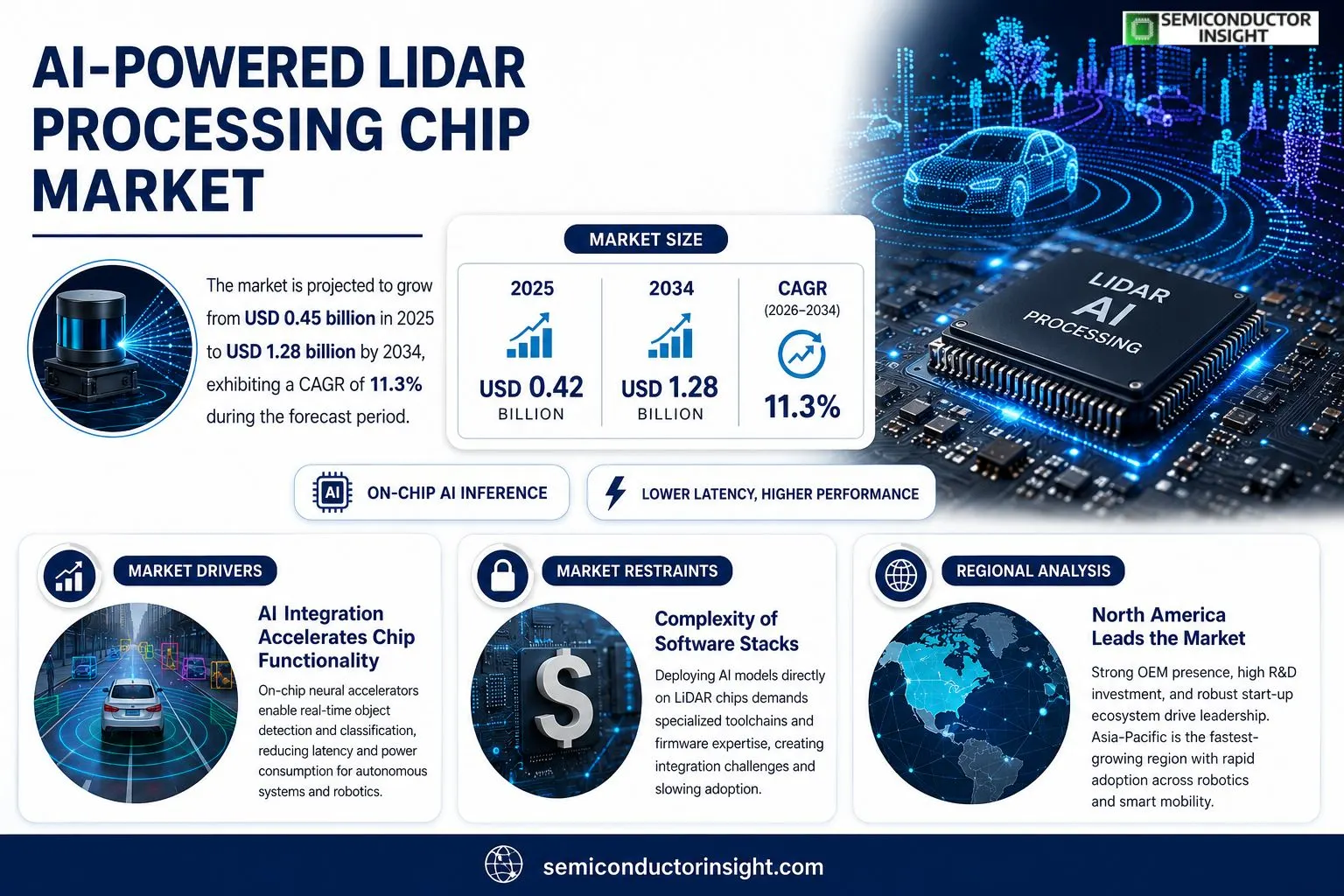
AI-Powered LiDAR Processing Chip market size was valued at USD 0.42 billion in 2025. The market is projected to grow from USD 0.45 billion in 2025 to USD 1.28 billion by 2034, exhibiting a CAGR of 11.3% during the forecast period.
AI-Powered LiDAR processing chips integrate advanced neural accelerators with lidar sensor front‑ends, enabling real‑time point‑cloud generation and object classification directly on the device. These chips combine high‑resolution depth sensing with on‑chip AI inference, reducing latency and power consumption compared with traditional CPU/GPU pipelines.The market is experiencing rapid growth due to several factors, including increased investment in autonomous vehicle platforms, rising demand for high‑definition mapping in robotics, and expanding applications in advanced driver‑assistance systems (ADAS). Moreover, breakthroughs in semiconductor miniaturization and edge‑AI frameworks are accelerating adoption. Initiatives by leading players such as Velodyne Lidar, Luminar Technologies, NVIDIA’s Drive AGX series, and new entrants like Ouster are expected to shape competitive dynamics.
MARKET DRIVERS
AI Integration Accelerates Chip Functionality
The convergence of deep‑learning algorithms with LiDAR sensor data is reshaping perception stacks in autonomous platforms. Engineers are exploiting on‑chip neural accelerators to trim latency from milliseconds to microseconds, a shift that directly improves object‑detection reliability. This technical edge fuels demand among OEMs seeking to differentiate their driver‑assistance suites.
Regulatory Momentum in Safety‑Critical Sectors
Legislation across North America and Europe is tightening performance thresholds for advanced driver‑assistance systems (ADAS). Manufacturers must meet stricter detection ranges and false‑positive limits, prompting them to adopt AI‑powered LiDAR processing chips that can satisfy these criteria without inflating system cost.
➤ “The ability to run AI inference at the sensor level reduces bandwidth pressures on vehicle networks, unlocking new design flexibility for high‑density sensor arrays.”
Beyond automotive, logistics firms are piloting autonomous forklifts and warehouse robots that rely on real‑time 3‑D mapping. The chip’s compact power envelope makes it viable for battery‑operated equipment, expanding the addressable market beyond traditional vehicle applications.
MARKET CHALLENGES
Cost Sensitivity in High‑Volume Production
While the performance premium of AI‑enabled chips is clear, manufacturers face pressure to keep per‑unit pricing competitive. Scaling silicon‑fabrication lines without compromising yield remains a hurdle, especially for smaller suppliers lacking deep‑pocket financing.
Other Challenges
Supply‑Chain Volatility
Component shortages in advanced packaging materials and semiconductor wafers can delay product roll‑outs, eroding confidence among downstream customers who operate on tight development timelines.
MARKET RESTRAINTS
Complexity of Software Stacks
Deploying AI models directly on LiDAR chips demands specialized toolchains and firmware expertise. Many system integrators lack in‑house capabilities to optimize algorithms for the constrained compute environment, creating a barrier to swift adoption.The learning curve associated with new programming paradigms can deter firms that already have mature pipelines built around traditional DSP solutions.
MARKET OPPORTUNITIES
Emerging Edge‑AI Platforms for Robotics
The rise of collaborative robots in manufacturing showcases a niche where low‑latency perception is critical. AI‑Powered LiDAR Processing Chip Market participants can capture this space by offering modular SDKs that accelerate integration and reduce time‑to‑value for robot makers.Additionally, the expansion of smart‑city initiativessuch as real‑time traffic monitoring and infrastructure inspectioncreates a fertile ground for chips that blend sensing and inference at the edge, opening revenue streams beyond automotive.
AI-Powered LiDAR Processing Chip Market Trends
Edge‑AI Integration Enables Real‑Time Point Cloud Processing
AI‑Powered LiDAR Processing Chip Market is being reshaped by the convergence of neural‑accelerator designs and lidar front‑ends. By embedding inference engines directly on the sensor die, manufacturers eliminate the need for off‑board CPUs or GPUs, which translates into millisecond‑level latency reductions and a noticeable dip in power draw. This technical shift matters because autonomous vehicle systems and high‑definition mapping platforms can now run perception pipelines locally, improving reliability in environments with limited connectivity. The trend is not accidental; semiconductor miniaturization breakthroughs and the maturation of edge‑AI libraries have lowered the cost barrier for integrating sophisticated AI blocks into compact chips. For vendors, the implication is a race to differentiate through on‑chip AI capabilities rather than raw sensor resolution alone, prompting increased R&D spend on co‑design of optics, signal processing, and machine‑learning models.
Other Trends
Automotive Adoption Accelerates Chip Demand
Within the automotive segment, advanced driver‑assistance systems (ADAS) and Level‑3‑plus autonomy projects are seeking chips that can classify objects while the vehicle is in motion. AI‑Powered LiDAR Processing Chip Market sees heightened interest from OEMs because on‑chip classification shortens the perception‑to‑actuation loop, a critical safety parameter. Companies such as Velodyne Lidar and Luminar Technologies have announced platform roadmaps that bundle their sensors with proprietary processing silicon, reducing integration effort for car makers. Meanwhile, NVIDIA’s Drive AGX series demonstrates how a unified hardware stack can serve both imaging and lidar workloads, encouraging system integrators to standardize on a single provider. This consolidation pressures traditional sensor suppliers to either partner with chip designers or develop in‑house processing solutions, altering competitive dynamics across the supply chain.
Emerging Robotics Applications Expand Market Reach
Beyond vehicles, AI‑Powered LiDAR Processing Chip Market is gaining traction in logistics robots, warehouse automation, and outdoor inspection drones. These use cases demand high‑resolution depth data combined with instantaneous object recognition to navigate cluttered spaces without human oversight. Edge‑AI capabilities embedded in lidar chips satisfy this requirement by delivering perception results locally, which mitigates reliance on cloud inference that can be throttled by bandwidth constraints. As robotics firms scale deployments, the volume of chips ordered is expected to rise, prompting manufacturers to offer tiered product families tailored to low‑power indoor robots and high‑throughput outdoor platforms alike. The business implication is a diversification of revenue streams for chip makers, driving them to develop modular SDKs that expedite integration across varied robot operating systems.
COMPETITIVE LANDSCAPE
Key Industry Players
Competitive Dynamics in AI‑Powered LiDAR Processing Chip Market
The sector is anchored by a handful of firms that have combined deep sensor expertise with on‑chip AI capability. Velodyne Lidar, leveraging its legacy in high‑performance scanning, introduced an integrated processing core that delivers sub‑millisecond latency for autonomous‑driving workloads, compelling OEMs to source complete sensor‑plus‑compute modules rather than disparate components. Luminar’s recent chip‑scale accelerator, paired with its proprietary 155‑micron laser architecture, positions the company as a preferred partner for premium vehicle platforms seeking range‑extended perception. NVIDIA, traditionally a GPU powerhouse, has repurposed its Drive AGX family to include dedicated LiDAR inference blocks, enabling developers to run sophisticated point‑cloud classification pipelines on a single board. Ouster, a relative newcomer, differentiates itself through a modular design that lets system integrators swap optical arrays while retaining a common AI processor, accelerating time‑to‑market for niche robotics and logistics applications. These leaders dominate the top‑tier market, command the bulk of R&D spend, and shape ecosystem standards through joint programs with automotive tier‑1s and chip foundries.Beyond the headline names, a vibrant cohort of specialists is carving out value in niche verticals and emerging geographies. Hesai Technology focuses on cost‑effective solutions for Chinese autonomous‑taxi fleets, coupling its low‑power chip with localized mapping services. Innoviz supplies lightweight modules to European electric‑vehicle startups, emphasizing power‑efficiency to meet strict range targets. RoboSense prioritizes high‑resolution solid‑state arrays for industrial inspection robots, while LeddarTech pursues a diversification strategy that pairs its processing IP with automotive radar units for sensor‑fusion architectures. Aeva’s frequency‑modulated continuous‑wave (FMCW) approach offers simultaneous velocity and distance measurement, attracting defense contractors looking for precise target tracking. Cepton and Quanergy continue to refine their silicon‑photonic designs for indoor navigation, and Blackmore (now part of Aurora) supplies aerospace‑grade chips to unmanned aerial vehicles. Smaller players such as Panasonic and Valeo are experimenting with vertically integrated silicon, signalling that the competitive field will broaden as more system integrators demand bespoke AI‑accelerated LiDAR solutions.
List of Key AI‑Powered LiDAR Processing Chip Companies Profiled
- Velodyne Lidar
- Luminar Technologies
- NVIDIA Corporation
- Ouster
- Hesai Technology
- Innoviz Technologies
- RoboSense
- LeddarTech
- Aeva
- Cepton Technologies
- Quanergy Systems
- Blackmore (Aurora)
- Panasonic Automotive
- Valeo
Segment Analysis:
| Segment Category | Sub-Segments | Key Insights |
| By Type |
|
Neural Accelerator Chips are emerging as the dominant technology due to their ability to embed AI inference directly within the LiDAR pipeline.
|
| By Application |
|
Autonomous Vehicles drive the most intensive demand for AI‑powered LiDAR chips.
|
| By End User |
|
Automotive OEMs prioritize AI‑powered LiDAR chips for next‑generation vehicle platforms.
|
| By Technology |
|
On‑chip AI inference is the cornerstone technology enabling end‑to‑end perception.
|
| By Market Trend |
|
Semiconductor miniaturization fuels broader deployment of AI‑powered LiDAR chips.
|
Regional Analysis: AI-Powered LiDAR Processing Chip Market
North America
OEMs in the United States prioritize chips that fuse AI inference with LiDAR signal conditioning, shortening sensor‑to‑actuation loops. This drives collaborations that align silicon roadmaps with vehicle‑level safety standards, prompting early‑stage pilots to evolve into full‑scale production runs across major sedan and truck platforms.
Department of Defense contracts target ruggedized processing units capable of real‑time 3‑D mapping in contested environments. Contractors integrate these chips into autonomous reconnaissance drones, establishing a procurement pipeline that sustains demand beyond the commercial auto cycle.
Warehouse robotics firms adopt edge‑centric LiDAR chips to improve navigation accuracy while reducing power draw. The resulting efficiency gains encourage wider deployment in logistics hubs, where tight margins make every millisecond of processing critical.
Silicon Valley incubators nurture start‑ups that pair AI accelerators with compact LiDAR arrays, positioning them for acquisition by larger chipmakers seeking to broaden their portfolio of perception solutions.
Europe
European manufacturers benefit from a regulatory environment that rewards safety‑critical perception technologies. The EU’s push for unified autonomous‑driving standards compels car makers to source chips that meet stringent functional‑safety certifications, prompting a shift toward locally produced silicon. Moreover, cooperation between automotive clusters in Germany and emerging photonics hubs in the Netherlands accelerates co‑development of chips optimized for both highway and urban scenarios. Defense ministries across the continent also allocate budgets to next‑generation reconnaissance platforms, offering a parallel revenue stream that balances cyclical automotive demand. The combined pressure of policy, industrial collaboration, and defense spend creates a fertile ground for differentiated AI‑Powered LiDAR processing solutions.
Asia‑Pacific
In Asia‑Pacific, the market is propelled by aggressive rollout plans for driverless taxis and delivery robots in densely populated cities. Chinese and Indian semiconductor firms are rapidly scaling production capacities, leveraging government incentives to lower entry costs for AI‑enhanced LiDAR chips. Simultaneously, Japanese OEMs focus on integrating chips that can handle high‑resolution mapping under adverse weather, a critical requirement for coastal and mountainous regions. The convergence of manufacturing scale, urban mobility initiatives, and a growing focus on environmental robustness positions the region as a burgeoning arena for diversified chip applications.
South America
South American interest centers on adapting AI‑Powered LiDAR processing to agricultural automation and mining operations. Companies in Brazil and Chile experiment with rugged chips that can process point clouds in real time, enabling precise crop monitoring and ore‑body mapping. Limited local fab capabilities mean the region relies heavily on imports, but strategic partnerships with North American vendors are fostering technology transfer that shortens the adoption curve. The emphasis on resource‑intensive sectors creates a niche demand that, while modest in volume, is highly specialized.
Middle East & Africa
The Middle East & Africa region showcases a distinctive use‑case focus on infrastructure inspection and border security. Oil‑rich nations invest in autonomous inspection drones equipped with AI‑enabled LiDAR chips to monitor pipelines and offshore platforms, demanding chips that can operate under extreme temperature swings. African nations, meanwhile, explore low‑cost LiDAR solutions for wildlife tracking and remote‑area mapping, driving interest in energy‑efficient designs. Although the market size remains limited, the specialized requirements encourage bespoke chip development that could later inform broader product lines.
Report Scope
This market research report provides a comprehensive analysis of the AI-Powered LiDAR Processing Chip Market , covering the forecast period 2026–2034. It offers detailed insights into market dynamics, technological advancements, competitive landscape, and key trends shaping the industry.
Key focus areas of the report include:
- Market Overview: The report begins with an overview outlining its current market scenario, key growth indicators, and industry transformation drivers. It discusses macroeconomic factors, demand–supply balance, regulatory landscape, and the strategic role of semiconductors in powering advancements across industries such as automotive, telecommunications, consumer electronics, and industrial automation.
- Market Size & Forecast: Historical data and future projections for revenue, unit shipments, and market value across major regions and segments.
- Segmentation Analysis: Detailed breakdown by product type, technology, application, and end-user industry to identify high-growth segments and investment opportunities.
- Regional Insights: Insights into market performance across North America, Europe, Asia-Pacific, Latin America, and the Middle East & Africa, including country-level analysis where relevant.
- Competitive Landscape: Profiles of leading market participants, including their product offerings, R&D focus, manufacturing capacity, pricing strategies, and recent developments such as mergers, acquisitions, and partnerships.
- Technology Trends & Innovation: Assessment of emerging technologies, integration of AI/IoT, semiconductor design trends, fabrication techniques, and evolving industry standards.
- Market Drivers & Restraints: Evaluation of factors driving market growth along with challenges, supply chain constraints, regulatory issues, and market-entry barriers.
- Stakeholder Insights: Insights for component suppliers, OEMs, system integrators, investors, and policymakers regarding the evolving ecosystem and strategic opportunities.
Primary and secondary research methods are employed, including interviews with industry experts, data from verified sources, and real-time market intelligence to ensure the accuracy and reliability of the insights presented.
FREQUENTLY ASKED QUESTIONS:
What is the current market size of AI-Powered LiDAR Processing Chip Market?
-> AI-Powered LiDAR Processing Chip Market was valued at USD 0.42 billion in 2025 and is expected to reach USD 1.28 billion by 2034, representing a CAGR of 11.3% during the forecast period.
Which key companies operate in AI-Powered LiDAR Processing Chip Market?
-> Key players include Velodyne Lidar, Luminar Technologies, NVIDIA, Ouster, among others.
What are the key growth drivers?
-> Key growth drivers include increased investment in autonomous vehicle platforms, rising demand for high‑definition mapping in robotics, expansion of advanced driver‑assistance systems (ADAS), and breakthroughs in semiconductor miniaturization and edge‑AI frameworks.
Which region dominates the market?
-> North America remains the dominant region, while Asia‑Pacific is the fastest‑growing market.
What are the emerging trends?
-> Emerging trends include on‑chip AI inference, edge‑AI integration, and continued semiconductor miniaturization delivering more power‑efficient LiDAR processing solutions.

Get Sample Report PDF for Exclusive Insights
Report Sample Includes
- Table of Contents
- List of Tables & Figures
- Charts, Research Methodology, and more...
 Download Sample Report PDF