AI-Powered In-Orbit Reconfigurable FPGA Market Insights
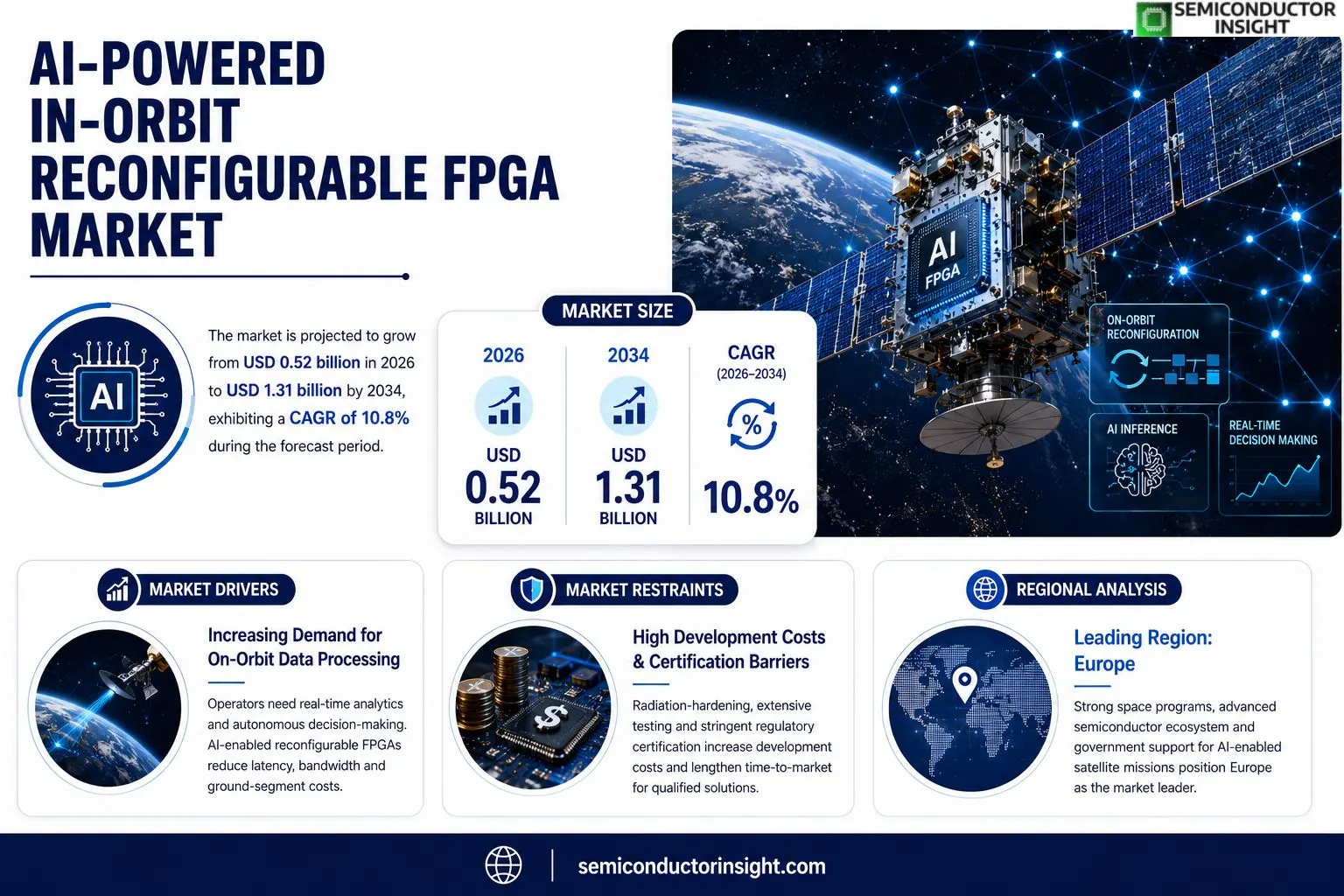
AI‑Powered In‑Orbit Reconfigurable FPGA market size was valued at USD 0.45 billion in 2025. The market is projected to grow from USD 0.52 billion in 2025 to USD 1 31 billion by 2034, exhibiting a CAGR of 10.8 % during the forecast period.
AI‑powered reconfigurable field‑programmable gate arrays (FPGAs) are semiconductor devices that merge high‑throughput parallel processing with embedded machine‑learning inference engines, allowing satellite payloads to modify logic functions after deployment.The market is accelerating because launch costs have fallen dramatically since reusable rockets became routine, while mission architects seek autonomous decision‑making far beyond conventional processors.
Furthermore, expanding constellations such as Starlink and OneWeb are allocating significant budgets toward radiation‑hardened, AI‑enabled FPGAs.
Key playersincluding AMD/Xilinx, Intel (Altera), BAE Systems, Airbus Defence & Space and Lockheed Martinare broadening their space‑qualified portfolios through joint programs with agencies like NASA and ESA, which have recently demonstrated on‑orbit reconfiguration of payloads using AI‐driven FPGA cores.
MARKET DRIVERS
Increasing Demand for On‑Orbit Data Processing
AI-Powered In‑Orbit Reconfigurable FPGA Market is being propelled by satellite operators seeking real‑time analytics. By embedding AI inference directly on reconfigurable hardware, missions can reduce downlink bandwidth requirements and achieve sub‑second decision latency, which is critical for Earth‑observation and cyber‑security constellations.
Advancements in Radiation‑Hardening Technologies
Recent breakthroughs in radiation‑tolerant silicon and error‑correction architectures have lowered the risk profile of deploying programmable logic in harsh space environments. This technical confidence encourages OEMs to integrate reconfigurable FPGA fabrics, enabling on‑the‑fly algorithm updates without costly hardware redesigns.
➤ Operators are prioritizing autonomous decision‑making capabilities to lower ground‑segment costs.
Collectively, these forces create a compelling value proposition: higher payload efficiency, extended mission lifetimes, and the ability to launch with software‑defined capabilities that evolve as AI models mature.
MARKET CHALLENGES
High Development Costs and Qualification Timelines
Designing AI‑ready FPGA architectures for space demands extensive verification under radiation, thermal, and vibration regimes. The upfront investment often exceeds $10 million per qualification cycle, limiting participation to a handful of well‑capitalized firms.
Other Challenges
Supply Chain Constraints
Limited availability of radiation‑qualified silicon wafers and the reliance on a narrow set of foundries increase lead times, making it difficult for new entrants to secure timely production slots.
MARKET RESTRAINTS
Regulatory Certification Barriers
Space‑grade components must satisfy strict standards set by agencies such as ESA and NASA. The certification process for AI‑enabled reconfigurable FPGAs often adds additional documentation and testing to demonstrate algorithmic reliability under radiation, slowing market entry.Furthermore, export control regulations on high‑performance computing hardware can restrict cross‑border collaboration, especially for defense‑related satellite programs, thereby narrowing the pool of potential customers.
MARKET OPPORTUNITIES
Emerging Small‑Satellite Constellations
The proliferation of nanosat‑and microsat platforms creates a sizable addressable market for flexible, AI‑driven processing. These constellations benefit from reconfigurable FPGA cores that can be updated post‑launch to support new mission objectives without additional hardware.Investment in open‑source AI toolchains and cloud‑based design automation is lowering the barrier for developers to prototype and validate space‑qualified FPGA designs. This trend is expected to accelerate adoption across commercial, scientific, and defense sectors, driving the next phase of growth for the AI‑Powered In‑Orbit Reconfigurable FPGA Market.
AI-Powered In-Orbit Reconfigurable FPGA Market Trends
Reduced Launch Costs Accelerate Market Adoption
The decline in launch expenses, driven by the routine use of reusable rockets, has removed a historic barrier for satellite payload upgrades. Operators now evaluate on‑orbit reconfigurable FPGA solutions not merely as contingency options but as strategic assets that enhance mission profitability. By enabling post‑deployment logic changes, AI‑powered reconfigurable devices extend the functional life of constellations and reduce the need for costly replacement missions. This cost environment, combined with the projected growth from a $0.45 billion valuation in 2025 to an estimated $1.31 billion by 2034, creates a compelling business case for investment in the AI‑Powered In‑Orbit Reconfigurable FPGA Market.
Other Trends
Radiation‑Hardening and AI‑Enabled Inference
Space‑grade FPGAs are benefiting from advances in radiation‑hardening techniques that preserve AI inference accuracy under high‑energy particle exposure. Recent demonstrations by NASA and ESA show that AI‑driven cores can be reprogrammed on orbit while maintaining error‑corrected operation, a capability essential for autonomous navigation and real‑time payload optimization. Leading suppliers such as AMD/Xilinx and Intel (Altera) are integrating hardened memory structures with embedded machine‑learning engines, allowing constellations like Starlink and OneWeb to allocate on‑board resources dynamically. This convergence of AI processing and hardened silicon reduces reliance on ground‑segment commands and improves overall system resilience.
Strategic Partnerships Expand Qualified Portfolios
Key industry players are forging joint programs with space agencies to certify AI‑enabled reconfigurable FPGAs for orbital use. Collaborative efforts between BAE Systems, Airbus Defence & Space, and Lockheed Martin have resulted in multiple flight‑qualified silicon variants that meet both performance and reliability standards demanded by long‑duration missions. These partnerships accelerate the delivery of pre‑validated AI‑Powered In‑Orbit Reconfigurable FPGA Market offerings, shorten development cycles, and lower entry costs for emerging satellite operators. As the ecosystem matures, the market is expected to see a steady influx of mission‑specific AI modules, reinforcing the trend toward higher autonomy and on‑demand payload reconfiguration.
COMPETITIVE LANDSCAPE
Key Industry Players
AI‑Powered In‑Orbit Reconfigurable FPGA Market – Competitive Overview
The AI‑powered in‑orbit reconfigurable FPGA segment is dominated by a small number of silicon giants that have successfully migrated legacy FPGA portfolios into radiation‑hardened, space‑qualified product lines. AMD/Xilinx and Intel (Altera) lead the market, leveraging extensive design‑tool ecosystems and deep relationships with launch providers to secure multi‑year contracts for large constellations such as Starlink and OneWeb. Their offerings combine high‑throughput parallel compute with embedded machine‑learning inference blocks, enabling on‑orbit logic updates that reduce mission‑critical latency and extend payload lifespan. Both firms have partnered with NASA and ESA on demonstrator missions that showcase AI‑driven reconfiguration of payloads, cementing their position as the primary suppliers for next‑generation satellite platforms.Beyond the dominant duo, a cohort of aerospace and defense organizations contributes specialist capabilities that address niche but strategically important market segments. BAE Systems, Airbus Defence & Space, and Lockheed Martin integrate FPGA modules into advanced radar and communications payloads, while Northrop Grumman and Thales Alenia Space focus on secure, radiation‑tolerant designs for government‑grade missions. Raytheon Technologies, Maxar Technologies, and Sierra Nevada Corporation add value through systems integration and on‑orbit servicing expertise. Microchip (formerly Microsemi), STMicroelectronics, and GMV provide cost‑effective, low‑power radiation‑hardening solutions for small‑satellite constellations. L3Harris Technologies and Cobham round out the ecosystem by supplying custom ASIC‑FPGA hybrids for bespoke defense applications. Collectively, these players diversify the supply chain, foster competition on reliability and price, and accelerate the adoption of AI‑enabled reconfigurable hardware across the emerging space‑based compute market.
List of Key AI-Powered In-Orbit Reconfigurable FPGA Companies Profiled
- AMD/Xilinx
- Intel (Altera)
- BAE Systems
- Airbus Defence & Space
- Lockheed Martin
- Northrop Grumman
- Thales Alenia Space
- Raytheon Technologies
- Maxar Technologies
- Sierra Nevada Corporation
- Microchip (Microsemi)
- STMicroelectronics
- GMV
- L3Harris Technologies
- Cobham
Segment Analysis:
| Segment Category | Sub-Segments | Key Insights |
| By Type |
|
AI‑Enabled Reconfigurable FPGA
|
| By Application |
|
On‑Orbit Reconfiguration
|
| By End User |
|
Satellite Operators
|
| By Mission Profile |
|
LEO Earth‑Observation Constellations
|
| By Integration Strategy |
|
Embedded AI Core
|
Regional Analysis: AI-Powered In-Orbit Reconfigurable FPGA Market
Europe
Robust funding for defense and commercial satellite programs fuels demand for adaptable processing. The need for real‑time AI inference on‑board drives adoption of reconfigurable FPGA architectures that can be retuned as mission requirements evolve.
European space directives emphasize debris mitigation and mission longevity. These policies indirectly promote hardware that can be reprogrammed in orbit, aligning with the market’s emphasis on reconfigurability and AI integration.
Leading chipset manufacturers have qualified radiation‑hardened FPGA families for AI workloads, allowing developers to port terrestrial machine‑learning models to space platforms with minimal redesign effort.
A handful of European firms dominate the niche, while partnerships with US and Asian players enable cross‑regional technology transfer, fostering a competitive yet collaborative market dynamic.
North America
North America remains a significant contributor, leveraging its deep pool of AI talent and a robust aerospace sector. Major satellite operators in the United States are piloting in‑orbit reconfiguration trials to reduce launch costs and improve mission agility. While the region does not enjoy the same coordinated governmental funding as Europe, private investmentparticularly from venture capital focused on space‑techdrives rapid prototype development. The market benefits from close proximity to leading FPGA foundries, which accelerates the qualification of new devices for radiation‑prone environments. Analysts observe a growing interest in integrating AI‑enhanced payloads for Earth observation and communications, where on‑board decision making can markedly improve data throughput and service reliability.
Asia‑Pacific
In the Asia‑Pacific, rapid growth in satellite constellations for broadband and remote sensing fuels interest in reconfigurable FPGA solutions. Countries such as Japan, South Korea, and India are expanding their space capabilities, emphasizing AI‑driven payload flexibility to address diverse mission profiles. Regional manufacturers are increasingly collaborating with foundries to develop radiation‑tolerant components, while local research institutes focus on low‑power AI inference techniques suitable for small satellite platforms. Although the market is still maturing, government incentives aimed at building sovereign space capabilities encourage early adoption of reconfigurable hardware, positioning the region for accelerated market share gains in the near term.
South America
South America’s market is characterized by emerging satellite programs seeking cost‑effective solutions for remote communication and environmental monitoring. Nations such as Brazil and Argentina are exploring AI‑powered on‑board processing to enhance data analysis capabilities without relying on extensive ground infrastructure. The region’s limited domestic semiconductor manufacturing capacity leads to reliance on imports, yet strategic partnerships with European firms provide access to qualified FPGA technologies. Stakeholders view reconfigurable hardware as a pathway to extend satellite lifespans and adapt to evolving regional needs, especially in areas where rapid response to environmental events is critical.
Middle East & Africa
The Middle East & Africa region is beginning to recognize the strategic value of AI‑enabled satellite systems for both commercial and defense applications. Investment in space infrastructure, particularly from United Arab Emirates and Saudi Arabia, includes plans for AI‑driven Earth observation assets that require flexible processing capabilities. While the local supply chain for advanced semiconductors remains nascent, collaborations with European and North American vendors are facilitating technology transfer. Market participants anticipate that reconfigurable FPGA platforms will enable rapid updates to mission software, aligning with regional objectives of technological sovereignty and long‑term asset utilization.
Report Scope
This market research report provides a comprehensive analysis of the AI-Powered In-Orbit Reconfigurable FPGA Market , covering the forecast period 2026–2034. It offers detailed insights into market dynamics, technological advancements, competitive landscape, and key trends shaping the industry.
Key focus areas of the report include:
- Market Overview: The report begins with an overview outlining its current market scenario, key growth indicators, and industry transformation drivers. It discusses macroeconomic factors, demand–supply balance, regulatory landscape, and the strategic role of semiconductors in powering advancements across industries such as automotive, telecommunications, consumer electronics, and industrial automation.
- Market Size & Forecast: Historical data and future projections for revenue, unit shipments, and market value across major regions and segments.
- Segmentation Analysis: Detailed breakdown by product type, technology, application, and end-user industry to identify high-growth segments and investment opportunities.
- Regional Insights: Insights into market performance across North America, Europe, Asia-Pacific, Latin America, and the Middle East & Africa, including country-level analysis where relevant.
- Competitive Landscape: Profiles of leading market participants, including their product offerings, R&D focus, manufacturing capacity, pricing strategies, and recent developments such as mergers, acquisitions, and partnerships.
- Technology Trends & Innovation: Assessment of emerging technologies, integration of AI/IoT, semiconductor design trends, fabrication techniques, and evolving industry standards.
- Market Drivers & Restraints: Evaluation of factors driving market growth along with challenges, supply chain constraints, regulatory issues, and market-entry barriers.
- Stakeholder Insights: Insights for component suppliers, OEMs, system integrators, investors, and policymakers regarding the evolving ecosystem and strategic opportunities.
Primary and secondary research methods are employed, including interviews with industry experts, data from verified sources, and real-time market intelligence to ensure the accuracy and reliability of the insights presented.
FREQUENTLY ASKED QUESTIONS:
What is the current market size of AI-Powered In-Orbit Reconfigurable FPGA Market?
-> AI-Powered In-Orbit Reconfigurable FPGA Market was valued at USD 0.45 billion in 2025 and is expected to reach USD 1.31 billion by 2034.
Which key companies operate in AI-Powered In-Orbit Reconfigurable FPGA Market?
-> Key players include AMD/Xilinx, Intel (Altera), BAE Systems, Airbus Defence & Space, and Lockheed Martin, among others.
What are the key growth drivers?
-> Key growth drivers include reduced launch costs, autonomous on‑orbit decision‑making, and expanding satellite constellations such as Starlink and OneWeb.
Which region dominates the market?
-> North America holds a leading position due to the presence of major semiconductor manufacturers and space agencies, while Asia‑Pacific is the fastest‑growing region.
What are the emerging trends?
-> Emerging trends include radiation‑hardened AI‑enabled FPGAs, on‑orbit reconfigurable payloads, and integration of AI inference engines for autonomous satellite operations.
Get Sample Report PDF for Exclusive Insights
Report Sample Includes
- Table of Contents
- List of Tables & Figures
- Charts, Research Methodology, and more...
 Download Sample Report PDF