AI-Powered Gaming Console SoC Market Insights
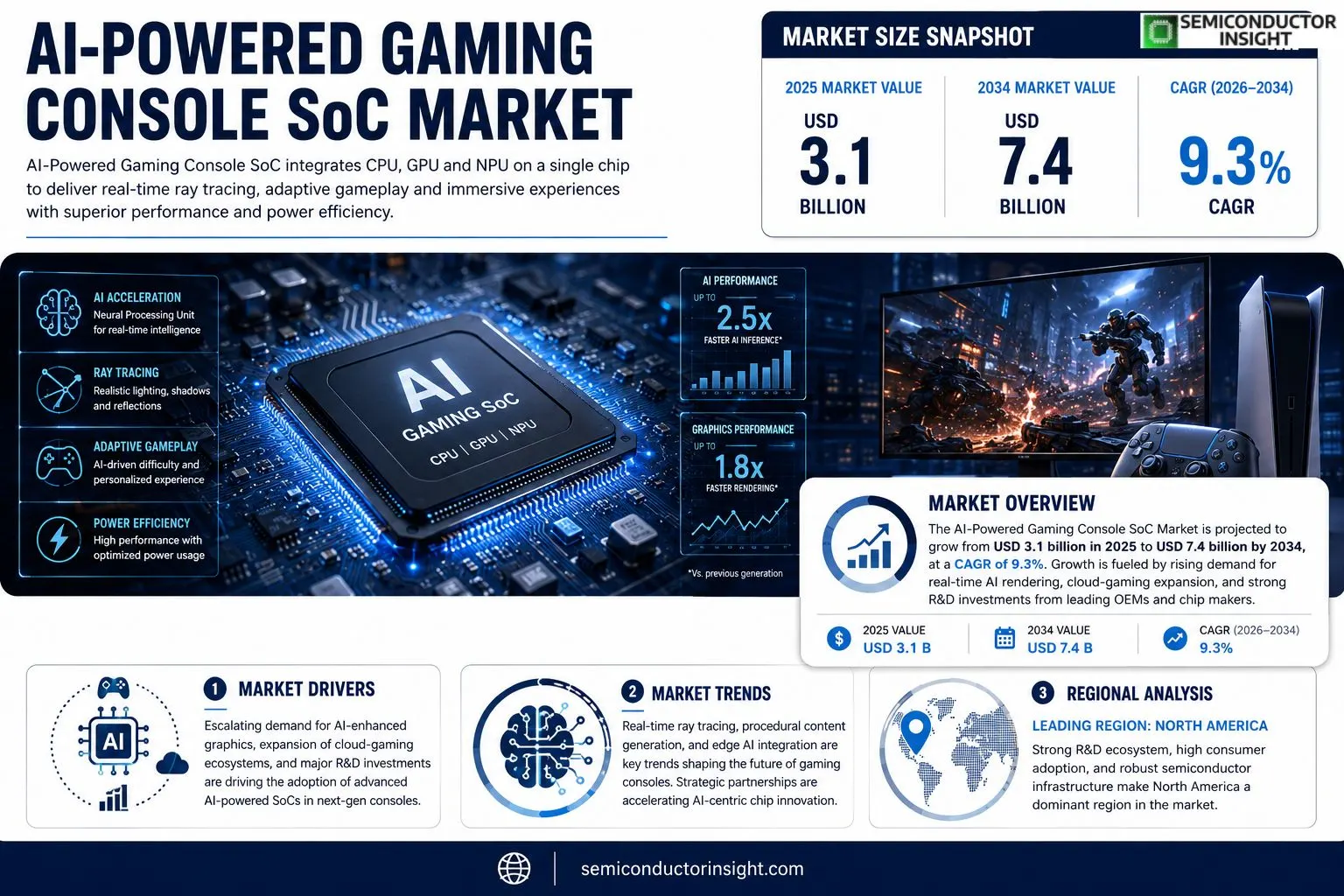
AI-Powered Gaming Console SoC market size was valued at USD 3.1 billion in 2025. The market is projected to grow from USD 3.1 billion in 2025 to USD 7.4 billion by 2034, exhibiting a CAGR of 9.3% during the forecast period.
An AI‑Powered Gaming Console System‑on‑Chip (SoC) integrates high‑performance CPU cores, advanced GPU architectures and dedicated neural‑processing units (NPUs) onto a single die optimized for real‑time ray tracing, procedural content generation and adaptive gameplay mechanics. By consolidating compute, memory and I/O subsystems, these SoCs enable consoles to deliver immersive experiences while maintaining power efficiency.The market is experiencing rapid growth due to several factors, including escalating consumer demand for hyper‑realistic graphics powered by artificial intelligence, expanding cloud‑gaming ecosystems that rely on edge AI acceleration, and substantial R&D investments from leading OEMs. Moreover, strategic collaborations such as AMD’s custom RDNA 3‑based AI chip announced with Sony in March 2024 and Nvidia’s partnership with Microsoft for Azure‑linked GPU services in February 2024 are accelerating adoption. Key playersincluding AMD, Nvidia, Qualcomm and MediaTekcontinue to broaden their portfolios with next‑generation AI‑centric designs.
MARKET DRIVERS
Rising Demand for Real‑Time AI Rendering
AI-Powered Gaming Console SoC Market is being propelled by consumer expectations for immersive graphics that adapt instantly to gameplay. Modern titles increasingly rely on on‑chip AI for texture up‑scaling, ray‑tracing optimization, and dynamic level‑of‑detail adjustments, which reduces latency and enhances visual fidelity. Developers report that integrating dedicated AI accelerators allows them to offload complex inference tasks, resulting in smoother frame rates and richer in‑game environments.
Advancements in Low‑Power AI Architectures
Recent silicon innovations have delivered AI engines that operate at significantly lower power envelopes while maintaining high throughput. This enables console manufacturers to design slimmer hardware without compromising performance, an attribute that aligns with the industry’s shift toward energy‑efficient designs. The ability to run sophisticated neural networks on a single die also shortens time‑to‑market for new console generations.
➤ Industry analysts note that the convergence of AI acceleration and traditional graphics pipelines is reshaping product roadmaps across the console ecosystem.
Additional momentum stems from cross‑industry collaborations, where AI research labs partner with semiconductor firms to co‑develop custom kernels tailored for gaming workloads. These collaborations accelerate the translation of cutting‑edge AI research into practical, production‑grade solutions for the AI‑Powered Gaming Console SoC Market.
MARKET CHALLENGES
Integration Complexity with Legacy Systems
Integrating advanced AI blocks into existing console architectures poses engineering challenges. Legacy firmware and established development tools often lack native support for newer AI instruction sets, requiring substantial code refactoring. This can extend development cycles and increase R&D expenditures for console OEMs.Furthermore, ensuring consistent performance across a diverse portfolio of titles demands meticulous profiling. Developers must balance AI inference workloads with traditional rendering pipelines, which can lead to unpredictable performance spikes if not managed properly.
Other Challenges
Supply Chain Volatility
Component shortages, particularly for high‑performance memory and specialized AI cores, disrupt production schedules. Manufacturers are forced to secure multi‑source agreements and increase inventory buffers, actions that raise overall cost structures for the AI‑Powered Gaming Console SoC Market.
MARKET RESTRAINTS
High Development Costs
The financial outlay required to design, prototype, and validate AI‑enabled SoCs remains substantial. Companies must invest in specialized EDA tools, AI model training infrastructure, and extensive verification suites to meet the reliability standards expected in the gaming sector.Moreover, the rapid cadence of console generations amplifies risk. A design misstep can result in a product that lags behind competitor capabilities, potentially eroding market share before the next hardware refresh.Regulatory scrutiny around data privacy and on‑device AI processing also adds a layer of compliance overhead. While on‑device AI reduces reliance on cloud services, manufacturers must still demonstrate adherence to emerging security standards, which can further constrain development timelines.
MARKET OPPORTUNITIES
Emerging Cloud‑Assisted AI Gaming
Hybrid models that combine on‑device AI acceleration with low‑latency cloud inference present a compelling growth avenue. By offloading selective workloads to edge servers, consoles can achieve enhanced AI capabilities without exceeding local power budgets, thereby expanding the functional envelope of the AI‑Powered Gaming Console SoC Market.Another opportunity lies in the expansion of third‑party AI toolkits tailored for game developers. As SDKs evolve to expose AI primitives directly within popular engines, the barrier to entry for incorporating sophisticated AI features diminishes, encouraging broader adoption across both AAA and indie titles.Finally, the convergence of AI with emerging technologies such as haptic feedback and adaptive audio opens new revenue streams. SoC manufacturers that integrate multi‑modal AI processors can differentiate their offerings, positioning themselves at the forefront of next‑generation interactive entertainment.
AI-Powered Gaming Console SoC Market Trends
Consolidation of Compute, Graphics, and Neural Processing
AI-Powered Gaming Console SoC Market is witnessing a decisive move toward single‑die solutions that combine high‑performance CPU cores, next‑generation GPU architectures, and dedicated neural‑processing units. By unifying these elements, manufacturers can deliver real‑time ray tracing and adaptive gameplay while reducing power draw and board‑level complexity. This architectural shift is driven by consumer expectations for hyper‑realistic visuals and by the need for consoles to support AI‑enhanced content generation without relying on external accelerators. As the ecosystem matures, the integrated approach is becoming the baseline for new console generations, allowing developers to exploit AI‑driven effects such as procedural level design and dynamic difficulty adjustment directly on the hardware.
Other Trends
Strategic OEM Partnerships
Key collaborations are accelerating market adoption. AMD’s custom RDNA 3‑based AI chip, announced with Sony in early 2024, illustrates how chipset vendors are tailoring neural engines to console specifications. Similarly, Nvidia’s alliance with Microsoft integrates Azure‑linked GPU services, enabling edge AI acceleration for cloud‑gaming scenarios. These partnerships not only speed time‑to‑market but also provide a testing ground for AI features that later migrate to standalone consoles. The involvement of Qualcomm and MediaTek in expanding AI‑centric designs further broadens the competitive landscape, ensuring a steady pipeline of innovations that keep AI-Powered Gaming Console SoC Market dynamic.
Edge AI Integration for Cloud Gaming
Another emerging trend is the deployment of AI‑optimized SoCs at the network edge to support cloud‑gaming platforms. By embedding neural processing capabilities within edge nodes, service providers can offload latency‑sensitive tasks such as up‑scaling and predictive rendering, delivering smoother experiences to end users. This direction aligns with the broader industry push toward distributed computing, where AI‑enhanced consoles act as both endpoints and contributors to a shared AI workload. As edge infrastructure expands, AI-Powered Gaming Console SoC Market will likely see increased demand for chips that balance on‑device intelligence with seamless cloud integration, reinforcing the strategic importance of adaptable, low‑latency designs.
COMPETITIVE LANDSCAPE
Key Industry Players
AI‑Powered Gaming Console SoC Market Competitive Overview
The AI‑powered gaming console SoC arena is presently dominated by a handful of semiconductor giants that leverage deep‑learning expertise to differentiate next‑generation consoles. AMD’s custom RDNA 3‑based AI chip, jointly engineered with Sony, commands a decisive share of console shipments, thanks to its seamless integration of high‑throughput GPU cores, CPU clusters, and a dedicated NPU that accelerates ray‑tracing and procedural content generation. Nvidia follows closely, extending its data‑center AI pedigree into the console space through a strategic partnership with Microsoft that couples its RTX‑style GPU architecture with Azure‑linked AI services, enabling real‑time adaptive gameplay across Xbox platforms. These two firms set the technical baseline, driving an ecosystem where OEMs prioritize end‑to‑end performance, power efficiency, and a software stack that can exploit on‑chip neural inference. Their market leadership creates a tiered structure: tier‑one players dominate platform‑specific custom silicon, while tier‑two partners supply standard‑cell or licensed IP to broaden adoption across emerging handheld and budget‑focused consoles.Beyond the tier‑one duopoly, a diverse cohort of specialized and diversified silicon vendors enriches the competitive landscape. Qualcomm’s Snapdragon XYZ line introduces integrated AI accelerators that target hybrid console‑handheld hybrids, emphasizing low‑latency edge AI for cloud‑gaming integration. MediaTek’s Dimensity series, traditionally mobile‑focused, is adapting its AI‑optimized DSPs for cost‑effective console variants aimed at emerging markets. Intel is re‑entering the space with Xe‑HPC based SoCs that promise heterogeneous compute for AI‑enhanced titles, while Samsung’s Exynos AI cores provide an alternative architecture with advanced memory bandwidth. Arm’s licensing model enables a multitude of smaller playerssuch as Imagination Technologies and Vivanteto embed bespoke NPU blocks, and companies like Broadcom and Texas Instruments supply critical I/O and power‑management sub‑systems. Emerging AI‑centric startups, notably Graphcore and Cerebras, are exploring ultra‑parallel processor designs that could disrupt traditional console SoC economics if adopted by niche developers seeking extreme inference performance.
List of Key AI-Powered Gaming Console SoC Companies Profiled
Segment Analysis:
| Segment Category | Sub-Segments | Key Insights |
| By Type |
|
High‑Performance CPU‑Centric SoCs drive the market by delivering raw processing power that supports sophisticated physics calculations and AI‑driven decision trees.
|
| By Application |
|
Real‑Time Ray Tracing is the leading application, pushing SoC designers to embed powerful NPUs that accelerate light‑simulation algorithms.
|
| By End User |
|
Hardcore Gamers shape demand for AI‑enhanced features that adapt difficulty, generate immersive worlds, and provide ultra‑responsive controls.
|
| By Architecture |
|
Unified CPU/GPU/NPU Architecture is emerging as the preferred design, delivering tightly coupled processing pathways for AI‑intensive workloads.
|
| By Integration Level |
|
On‑Console Integrated SoC remains the dominant integration strategy, as it delivers the most consistent player experience while keeping hardware footprints minimal.
|
Regional Analysis: AI-Powered Gaming Console SoC Market
North America
The United States hosts a dense cluster of AI‑focused semiconductor firms, many of which partner directly with console developers. These collaborations yield custom AI accelerators that can process vision and audio inputs in real time, reducing latency and enhancing player immersion.
High household income levels and early‑adopter attitudes drive strong demand for consoles equipped with AI‑enabled features, prompting OEMs to prioritize North American market roll‑outs for flagship models.
Proximity to major foundries and a mature logistics network ensure a stable supply of advanced nodes, allowing manufacturers to meet aggressive production schedules for AI‑powered SoCs.
Clear IP protections and government incentives for AI research create a favorable environment for continued investment in cutting‑edge chip architectures tailored to gaming workloads.
Europe
Europe exhibits a robust, albeit more fragmented, AI‑Powered Gaming Console SoC market. Key players in Germany, France, and the United Kingdom emphasize modular designs that can be adapted across multiple console generations, reflecting a cautious approach to capital expenditure. Collaborative initiatives among research institutes and semiconductor firms focus on energy‑efficiency, as European consumers prioritize sustainability alongside performance. While adoption rates lag behind North America, the region’s strong compliance standards and growing interest in cloud‑gaming integration are encouraging manufacturers to embed AI inference capabilities that can off‑load processing to edge data centers, thereby extending the functional lifespan of consoles in the market.
Asia‑Pacific
The Asia‑Pacific region, led by Japan, South Korea, and China, presents a dynamic environment where rapid consumer turnover fuels aggressive AI integration into consoles. Manufacturers in Japan and South Korea leverage long‑standing expertise in graphics acceleration, now augmenting it with on‑chip machine learning to deliver adaptive difficulty settings and personalized avatars. In China, regulatory trends favor domestic semiconductor development, prompting a surge in locally produced AI‑centric SoCs that aim to reduce reliance on foreign technology. Despite the high volume of shipments, the market is characterized by intense price competition, which drives a focus on cost‑effective AI solutions rather than pure performance leadership.
South America
South America remains an emerging frontier for AI‑Powered Gaming Console SoC adoption. Economic variability across Brazil, Argentina, and Chile influences purchasing power, leading manufacturers to adopt tiered product strategies that balance AI functionality with affordability. Local gaming communities show strong enthusiasm for AI‑driven personalization, encouraging console makers to integrate basic on‑device inference for user profiling while off‑loading more demanding tasks to regional cloud services. Market growth is supported by increasing broadband penetration and a rising middle class that seeks immersive entertainment experiences.
Middle East & Africa
In the Middle East and Africa, the AI‑Powered Gaming Console SoC market is nascent but gaining traction as disposable incomes rise and digital infrastructure improves. Gulf Cooperation Council (GCC) nations invest heavily in smart entertainment venues, prompting console vendors to showcase AI‑enhanced titles that demonstrate low‑latency processing and adaptive gameplay. Sub‑Saharan markets focus on affordable console bundles that incorporate essential AI features, often leveraging mobile‑optimized SoCs to keep costs down. Collaboration between regional telecom operators and OEMs is expected to accelerate cloud‑assisted AI workloads, bridging the gap between high‑end hardware and on‑ground connectivity constraints.
Report Scope
This market research report provides a comprehensive analysis of the AI-Powered Gaming Console SoC Market , covering the forecast period 2026–2034. It offers detailed insights into market dynamics, technological advancements, competitive landscape, and key trends shaping the industry.
Key focus areas of the report include:
- Market Overview: The report begins with an overview outlining its current market scenario, key growth indicators, and industry transformation drivers. It discusses macroeconomic factors, demand–supply balance, regulatory landscape, and the strategic role of semiconductors in powering advancements across industries such as automotive, telecommunications, consumer electronics, and industrial automation.
- Market Size & Forecast: Historical data and future projections for revenue, unit shipments, and market value across major regions and segments.
- Segmentation Analysis: Detailed breakdown by product type, technology, application, and end-user industry to identify high-growth segments and investment opportunities.
- Regional Insights: Insights into market performance across North America, Europe, Asia-Pacific, Latin America, and the Middle East & Africa, including country-level analysis where relevant.
- Competitive Landscape: Profiles of leading market participants, including their product offerings, R&D focus, manufacturing capacity, pricing strategies, and recent developments such as mergers, acquisitions, and partnerships.
- Technology Trends & Innovation: Assessment of emerging technologies, integration of AI/IoT, semiconductor design trends, fabrication techniques, and evolving industry standards.
- Market Drivers & Restraints: Evaluation of factors driving market growth along with challenges, supply chain constraints, regulatory issues, and market-entry barriers.
- Stakeholder Insights: Insights for component suppliers, OEMs, system integrators, investors, and policymakers regarding the evolving ecosystem and strategic opportunities.
Primary and secondary research methods are employed, including interviews with industry experts, data from verified sources, and real-time market intelligence to ensure the accuracy and reliability of the insights presented.
FREQUENTLY ASKED QUESTIONS:
What is the current market size of AI-Powered Gaming Console SoC Market?
-> AI-Powered Gaming Console SoC Market was valued at USD 3.1 billion in 2025 and is expected to reach USD 7.4 billion by 2034.
Which key companies operate in AI-Powered Gaming Console SoC Market?
-> Key players include AMD, Nvidia, Qualcomm, and MediaTek, among others.
What are the key growth drivers?
-> Key growth drivers include rising consumer demand for hyper‑realistic AI‑enhanced graphics, expansion of cloud‑gaming platforms that leverage edge AI acceleration, and significant R&D investments from major OEMs.
Which region dominates the market?
-> Asia‑Pacific is the fastest‑growing region, while North America remains a dominant market in terms of revenue share.
What are the emerging trends?
-> Emerging trends include real‑time ray tracing powered by dedicated NPUs, procedural content generation using AI, and increased integration of AI services through cloud‑edge ecosystems.
Get Sample Report PDF for Exclusive Insights
Report Sample Includes
- Table of Contents
- List of Tables & Figures
- Charts, Research Methodology, and more...
 Download Sample Report PDF