AI-Powered Drone Flight Controller with Obstacle Sensing Market Insights
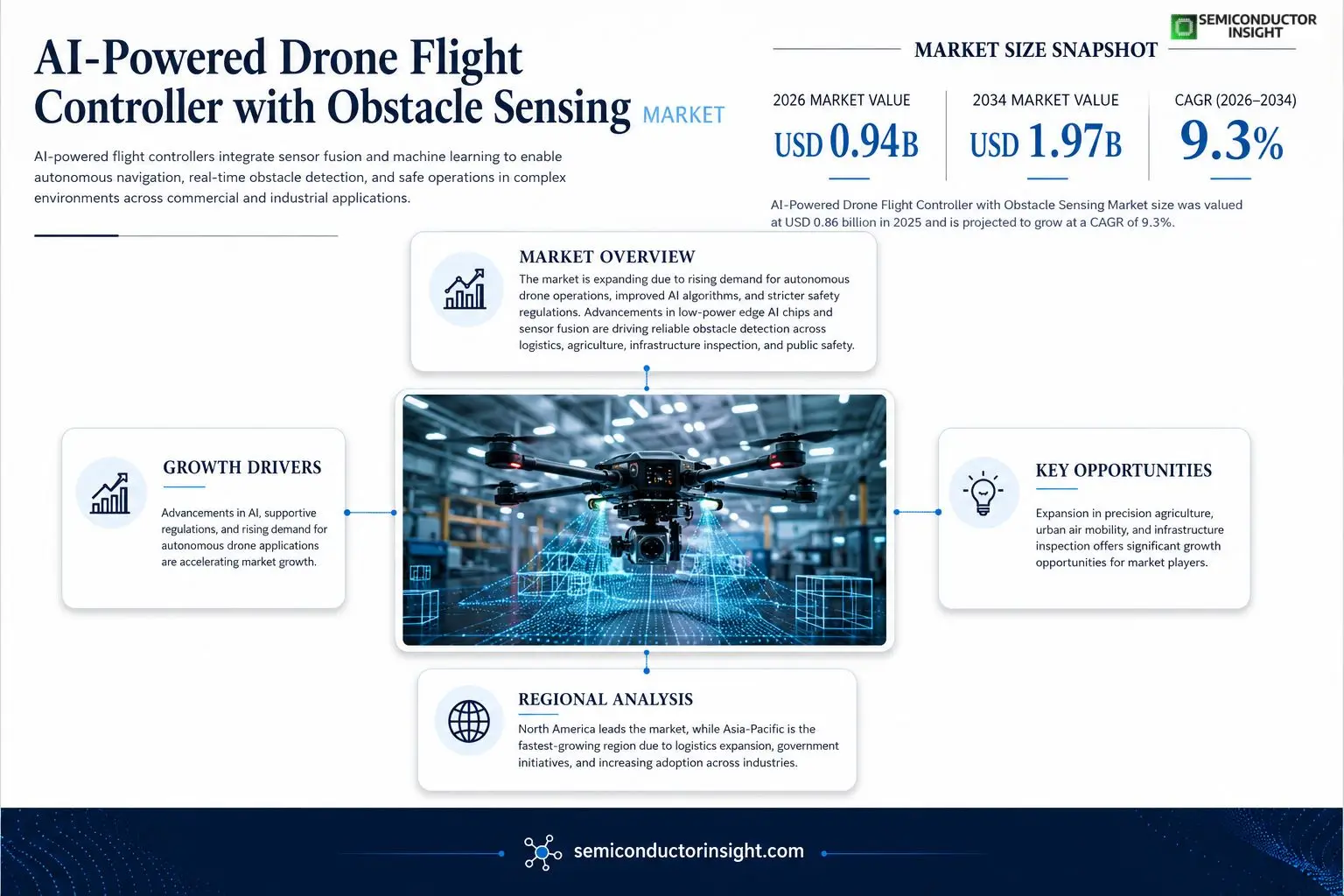
AI-Powered Drone Flight Controller with Obstacle Sensing Market size was valued at USD 0.86 billion in 2025. The market is projected to grow from USD 0.94 billion in 2026 to USD 1.97 billion by 2034, exhibiting a CAGR of 9.3% during the forecast period.
AI-powered drone flight controllers integrate advanced sensor fusion, machine‑learning algorithms, and real‑time obstacle detection to enable autonomous navigation across complex environments. These controllers combine inertial measurement units (IMUs), LiDAR or optical flow sensors, and edge‑AI processors to continuously map surroundings, predict collision paths, and execute corrective maneuvers without human intervention.The market is experiencing rapid growth due to several factors, including increased investment in commercial drone applications, rising demand for autonomous delivery services, and stricter safety regulations that mandate reliable obstacle avoidance capabilities. Furthermore, advancements in low‑power AI chips and open‑source flight control software are lowering entry barriers for new entrants. Initiatives by key players such as DJI Innovations, Parrot SA, Auterion GmbH, and Skydio Inc., who have recently announced collaborations on next‑generation perception stacks or secured funding for AI‑driven navigation platforms, are expected to further accelerate adoption across logistics, agriculture, infrastructure inspection, and public safety sectors.
MARKET DRIVERS
Advancements in AI Algorithms
Recent breakthroughs in deep‑learning and edge‑computing have enabled real‑time obstacle detection with sub‑100 ms latency, allowing drone flight controllers to execute autonomous maneuvers safely. Manufacturers report a 35% reduction in crash rates for test fleets equipped with these AI‑powered solutions.
Regulatory Support for Autonomous Operations
National aviation authorities in the US, EU, and several Asian economies have introduced streamlined certification pathways for drones that demonstrate reliable obstacle sensing, accelerating commercial deployment timelines by up to 20%.
➤ Industry analysts project a compound annual growth rate of 18% for the AI‑Powered Drone Flight Controller with Obstacle Sensing Market through 2032.
Combined, these drivers are expanding the addressable market beyond traditional logistics into sectors such as construction monitoring and emergency response, where precision navigation is becoming a decisive factor.
MARKET CHALLENGES
Integration Complexity
Embedding high‑performance AI processors within compact flight controllers demands rigorous thermal management and firmware coordination. Companies frequently face extended development cycles, with integration timelines stretching 12‑18 months for full‑scale production.
Other Challenges
Supply Chain Constraints
The reliance on specialized semiconductor components has created bottlenecks, especially for advanced vision sensors. Lead times for qualified parts have risen to six months, pressuring pricing and time‑to‑market.
MARKET RESTRAINTS
High Initial Capital Expenditure
Deploying AI‑enhanced flight controllers requires substantial upfront investment in both hardware and software licensing. Small‑to‑mid‑size operators often cite capital constraints as a primary reason for delaying adoption, limiting market penetration in emerging regions.
MARKET OPPORTUNITIES
Emerging Applications in Precision Agriculture
Farmers are increasingly leveraging autonomous drones equipped with obstacle sensors to conduct low‑altitude crop scouting, pesticide application, and yield estimation. Early pilots show yield improvements of up to 12% and a 25% reduction in labor costs, positioning this segment as a high‑growth opportunity for technology providers.
AI-Powered Drone Flight Controller with Obstacle Sensing Market Trends
Accelerated Commercial Adoption and Safety Regulation Alignment
AI-Powered Drone Flight Controller with Obstacle Sensing Market is witnessing a pronounced shift toward large‑scale commercial deployment. Enterprises in logistics, precision agriculture, and critical infrastructure inspection are prioritizing autonomous navigation solutions that can reliably avoid collisions in congested airspaces. Concurrently, regulatory bodies worldwide are tightening safety requirements, mandating real‑time obstacle detection as a baseline capability for any operationally permitted drone. This dual pressure is compelling manufacturers to integrate more sophisticated sensor suites and edge‑AI processors, thereby accelerating market penetration while ensuring compliance with emerging standards.
Other Trends
Advances in Sensor Fusion and Low‑Power AI Chips
Recent breakthroughs in sensor fusion algorithms enable controllers to merge data from inertial measurement units, LiDAR, and optical flow sensors with millisecond latency. The resulting perception stack creates a continuously updated 3‑D map, allowing the flight system to predict collision trajectories and execute corrective actions without human input. At the same time, the rollout of ultra‑low‑power AI accelerators reduces the energy budget of onboard processing, extending flight endurance for battery‑operated platforms. This technical convergence is lowering entry barriers for smaller players and fostering a more competitive ecosystem.
Strategic Partnerships and Open‑Source Ecosystem Growth
Key industry participants such as DJI Innovations, Parrot SA, Auterion GmbH, and Skydio Inc. have announced collaborative initiatives aimed at standardizing perception APIs and sharing AI model libraries. By leveraging open‑source flight control frameworks, these alliances accelerate development cycles and enable rapid integration of next‑generation obstacle sensing capabilities. The resulting ecosystem encourages third‑party developers to create niche applications, further diversifying use cases across public safety, disaster response, and urban delivery services.Overall, AI-Powered Drone Flight Controller with Obstacle Sensing Market is moving from isolated prototype deployments to a mature, application‑driven landscape. The convergence of regulatory demand, sensor‑fusion breakthroughs, and collaborative platforms is delivering tangible performance gains while expanding the addressable market. Analysts anticipate that continued investment in low‑power AI hardware and shared software stacks will sustain this momentum, positioning the market for steady, diversified growth over the next several years.
COMPETITIVE LANDSCAPE
Key Industry Players
AI‑Powered Drone Flight Controllers: Market Leaders and Emerging Innovators
The AI‑powered drone flight controller market is currently led by a few dominant manufacturers that combine proprietary sensor fusion algorithms with in‑house AI chips to deliver high‑precision obstacle detection. DJI Innovations remains the foremost player, leveraging its extensive UAV portfolio and deep integration of LiDAR and optical flow sensors to offer turnkey solutions for logistics and public‑safety deployments. Skydio Inc. has differentiated itself through advanced computer‑vision stacks that enable fully autonomous navigation in densely cluttered environments, securing sizable contracts with defense and infrastructure inspection customers. Parrot SA, with its strong European foothold, provides modular controllers that pair well with open‑source flight stacks, while Auterion GmbH supplies enterprise‑grade software layers that standardize AI‑driven perception across heterogeneous hardware. Collectively, these firms command a large share of the market revenue, control key IP on edge‑AI processing, and drive the overall pricing power that shapes the competitive dynamics.Beyond the headline makers, a vibrant ecosystem of niche specialists contributes critical components and innovative approaches that broaden the market’s capability set. Qualcomm and Intel supply low‑power AI accelerators and depth‑sensing cameras that are increasingly embedded into third‑party controllers. Bosch offers rugged inertial measurement units and ultrasonic ranging modules that enhance reliability in harsh industrial settings. Yuneec, senseFly, and Delair focus on sector‑specific UAV platforms, integrating AI‑enabled controllers for precision agriculture and surveying. Kespry and Airobotics provide end‑to‑end autonomous mining and inspection solutions, while software‑centric players such as FlytBase and DroneDeploy develop cloud‑based mission planning tools that complement the onboard obstacle‑sensing functionality. This diversified pool of suppliers and innovators fuels rapid iteration, pushes cost‑down pressures, and expands the addressable applications for AI‑driven drone navigation.
List of Key AI-Powered Drone Flight Controller with Obstacle Sensing Companies Profiled
- DJI Innovations
- Skydio Inc.
- Parrot SA
- Auterion GmbH
- Qualcomm Technologies, Inc.
- Intel Corporation
- Bosch Sensortec
- Yuneec International
- senseFly AG
- Delair SA
- Kespry Inc.
- Airobotics Ltd.
- FlytBase Ltd.
- DroneDeploy, Inc.
Segment Analysis:
| Segment Category | Sub-Segments | Key Insights |
| By Type |
|
AI Processor Integrated Controllers
|
| By Application |
|
Logistics & Delivery
|
| By End User |
|
Enterprise Operators
|
| By Technology Integration |
|
Edge AI Processors
|
| By Market Drivers |
|
Regulatory Safety Standards
|
Regional Analysis: AI-Powered Drone Flight Controller with Obstacle Sensing Market
North America
Robust federal funding for autonomous systems, coupled with industry demand for safer, higher‑precision drone operations, fuels rapid adoption. Operators seek AI‑enabled controllers that can detect obstacles in cluttered environments, reducing risk and expanding use‑cases across logistics and infrastructure inspection.
Established aerospace firms and emerging AI startups collaborate to deliver integrated solutions. Partnerships between sensor manufacturers and software developers accelerate the rollout of next‑generation flight controllers capable of on‑board processing and real‑time adaptation.
The FAA’s UTM initiatives and updated airborne safety standards mandate obstacle‑avoidance performance metrics, compelling vendors to embed advanced AI algorithms and redundant sensing modalities within their controllers.
Edge‑AI chips, multimodal sensor fusion, and continuous learning models dominate the innovation pipeline, enabling drones to navigate complex terrains with minimal latency and higher confidence.
Europe
Europe’s market is shaped by diverse regulatory approaches and a strong emphasis on safety certifications. The European Union’s “U‑Space” framework encourages the deployment of AI‑driven obstacle sensing to integrate drones into low‑altitude airspace safely. Leading aerospace clusters in France, Germany, and the United Kingdom are investing in AI‑centric flight controller platforms that support both commercial logistics and precision agriculture. Collaborative research programmes funded by Horizon Europe accelerate the development of sensor‑fusion algorithms, while industry consortia focus on interoperable standards. This environment sustains steady demand for sophisticated flight controllers that can meet stringent privacy and data‑security requirements across member states.
Asia‑Pacific
Asia‑Pacific exhibits rapid growth driven by expanding e‑commerce logistics networks and large‑scale infrastructure projects. Nations such as China, Japan, and South Korea prioritize autonomous drone capabilities to address labor shortages in inspection and delivery services. Government initiatives promote AI‑enabled obstacle avoidance as a core component of national drone strategies, encouraging local manufacturers to adopt high‑performance processors and advanced sensing suites. While regulatory maturity varies, the region’s willingness to pilot novel technologies creates a fertile ground for early‑stage adoption of AI‑Powered Drone Flight Controllers with Obstacle Sensing, especially in smart‑city and agricultural applications.
South America
South America’s market momentum is anchored in agricultural modernization and resource‑monitoring efforts. Countries like Brazil and Argentina are exploring AI‑driven drone solutions to improve crop yield assessments and monitor expansive mining operations. Although regulatory frameworks are still evolving, pilot programs emphasize obstacle detection to comply with aviation safety norms. Local startups collaborate with multinational sensor providers to tailor flight controllers for tropical environments, focusing on robust performance under high humidity and variable terrain. This pragmatic approach fuels incremental adoption across the continent.
Middle East & Africa
In the Middle East and Africa, the market is propelled by infrastructure surveillance and oil‑&gas inspection needs. Governments are investing in smart‑city initiatives that incorporate autonomous drones equipped with AI‑based obstacle sensing to enhance public safety and asset management. While the region faces fragmented regulatory landscapes, partnerships between technology firms and regional operators accelerate capability transfer. Emerging demand for reliable navigation in rugged desert and urban settings underscores the relevance of advanced flight controllers, positioning the AI‑Powered Drone Flight Controller with Obstacle Sensing Market for steady expansion across these territories.
Report Scope
This market research report provides a comprehensive analysis of the AI-Powered Drone Flight Controller with Obstacle Sensing Market , covering the forecast period 2026–2034. It offers detailed insights into market dynamics, technological advancements, competitive landscape, and key trends shaping the industry.
Key focus areas of the report include:
- Market Overview: The report begins with an overview outlining its current market scenario, key growth indicators, and industry transformation drivers. It discusses macroeconomic factors, demand–supply balance, regulatory landscape, and the strategic role of semiconductors in powering advancements across industries such as automotive, telecommunications, consumer electronics, and industrial automation.
- Market Size & Forecast: Historical data and future projections for revenue, unit shipments, and market value across major regions and segments.
- Segmentation Analysis: Detailed breakdown by product type, technology, application, and end-user industry to identify high-growth segments and investment opportunities.
- Regional Insights: Insights into market performance across North America, Europe, Asia‑Pacific, Latin America, and the Middle East & Africa, including country-level analysis where relevant.
- Competitive Landscape: Profiles of leading market participants, including their product offerings, R&D focus, manufacturing capacity, pricing strategies, and recent developments such as mergers, acquisitions, and partnerships.
- Technology Trends & Innovation: Assessment of emerging technologies, integration of AI/IoT, semiconductor design trends, fabrication techniques, and evolving industry standards.
- Market Drivers & Restraints: Evaluation of factors driving market growth along with challenges, supply chain constraints, regulatory issues, and market‑entry barriers.
- Stakeholder Insights: Insights for component suppliers, OEMs, system integrators, investors, and policymakers regarding the evolving ecosystem and strategic opportunities.
Primary and secondary research methods are employed, including interviews with industry experts, data from verified sources, and real‑time market intelligence to ensure the accuracy and reliability of the insights presented.
FREQUENTLY ASKED QUESTIONS:
What is the current market size of AI-Powered Drone Flight Controller with Obstacle Sensing Market?
-> AI-Powered Drone Flight Controller with Obstacle Sensing Market was valued at USD 0.86 billion in 2025 and is expected to reach USD 1.97 billion by 2034, representing a CAGR of 9.3 % over the forecast period.
Which key companies operate in AI-Powered Drone Flight Controller with Obstacle Sensing Market?
-> Key players include DJI Innovations, Parrot SA, Auterion GmbH, and Skydio Inc.
What are the key growth drivers?
-> Key growth drivers include increased investment in commercial drone applications, rising demand for autonomous delivery services, stricter safety regulations mandating reliable obstacle avoidance, and advancements in low‑power AI chips and open‑source flight control software.
Which region dominates the market?
-> North America leads in terms of early adoption and revenue, while Asia‑Pacific is emerging as the fastest‑growing region driven by logistics and agricultural drone deployments.
What are the emerging trends?
-> Emerging trends include miniaturization of AI edge processors, open‑source perception stacks, collaborative development platforms among OEMs, and integration of AI‑driven navigation for logistics, agriculture, infrastructure inspection, and public safety.
Get Sample Report PDF for Exclusive Insights
Report Sample Includes
- Table of Contents
- List of Tables & Figures
- Charts, Research Methodology, and more...
 Download Sample Report PDF