AI-Powered Deposition Uniformity Control Market Insights
Global AI‑Powered Deposition Uniformity Control market size was valued at USD 0.45 billion in 2025. It will rise from this base to USD 0.78 billion by 2034, delivering a compound annual growth rate of approximately 6 % over the forecast horizon.
This technology applies machine‑learning algorithms to real‑time sensor data during chemical vapor deposition (CVD) or atomic layer deposition (ALD) processes, continuously adjusting gas flow, temperature and plasma power so that film thickness remains consistent across large‑diameter wafers.
The upward trajectory reflects several dynamics: semiconductor manufacturers are scaling toward sub‑5 nm nodes where even minor thickness variance can impair yield; fab capital expenditures reached USD 115 billion in 2023 according to SEMI, prompting spend on advanced process control solutions; and major equipment suppliers have announced AI‑centric releases,Applied Materials disclosed an Nvidia‑powered analytics platform in March 2024, while Lam Research
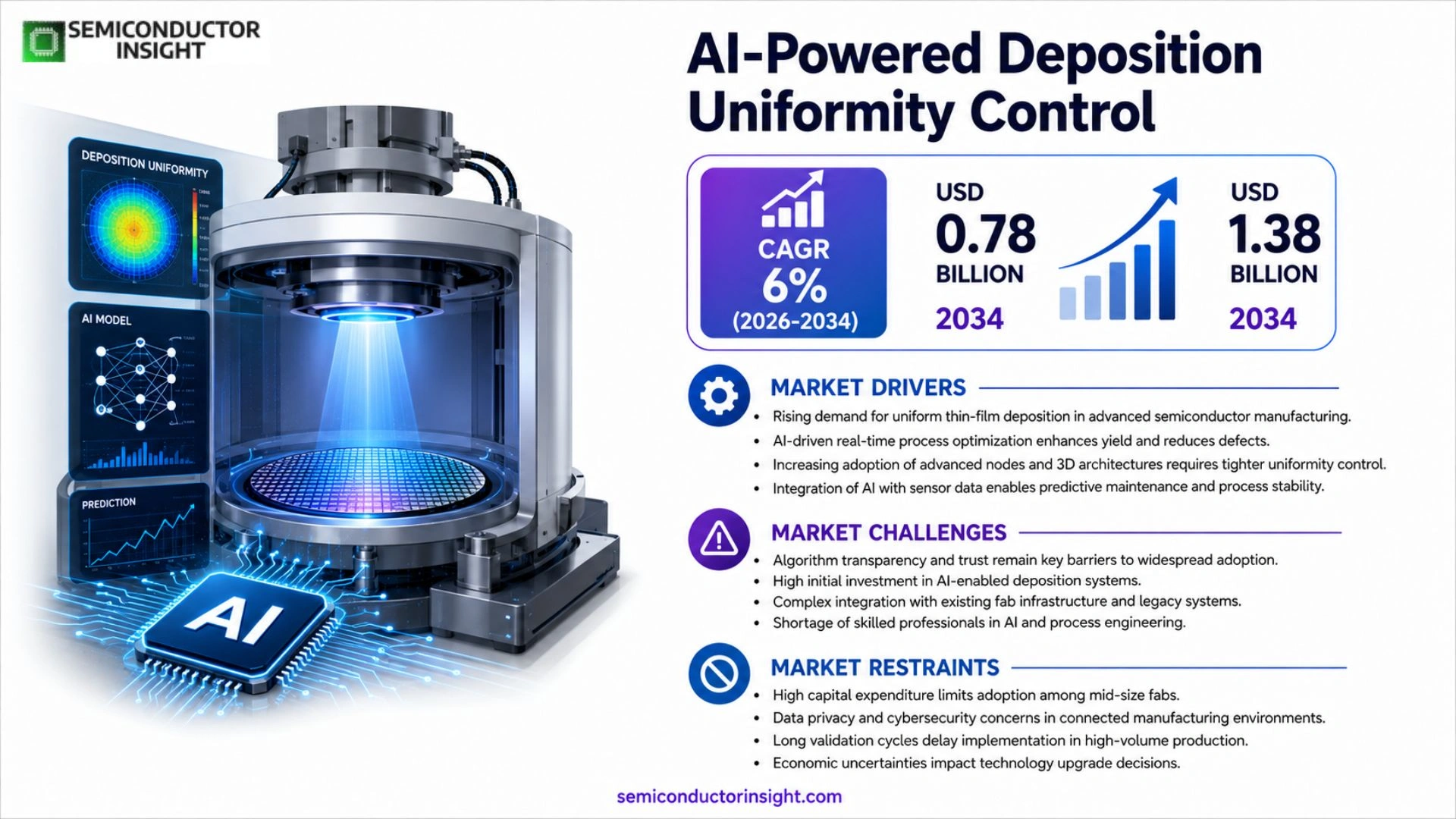
MARKET DRIVERS
Advanced Process Optimization
Semiconductor fabs are intensifying their pursuit of tighter critical dimension control. By embedding machine‑learning models directly into deposition tools, operators obtain real‑time corrective inputs that trim variability without manual intervention. This capability reduces scrap rates and shortens cycle times, delivering a measurable edge in high‑mix, low‑volume production environments.
Data‑Driven Quality Assurance
Large volumes of sensor data now flow from plasma generators to edge‑computing units. Algorithms sift through this stream to flag drift before it manifests as a defect. The proactive stance transforms quality assurance from a reactive checkpoint to a continuous safeguard, aligning well with the increasing regulatory scrutiny on yield reporting.
➤ “Integrating AI into deposition workflows turns every run into a learning opportunity, accelerating the feedback loop between design and manufacture.”
Collectively, these forces encourage equipment vendors to bundle AI modules with next‑generation tools, cementing the AI‑Powered Deposition Uniformity Control Market as a strategic growth arena for both OEMs and end users.
MARKET CHALLENGES
Algorithm Transparency and Trust
Operators accustomed to deterministic recipes often question black‑box decisions generated by neural networks. Without clear audit trails, troubleshooting becomes opaque, and adoption stalls in risk‑averse fabs. Building explainable AI layers is essential to bridge the confidence gap.
Other Challenges
Talent Shortage
The scarcity of engineers fluent in both semiconductor process physics and machine‑learning engineering creates bottlenecks in deploying and maintaining AI solutions. Companies must invest in cross‑disciplinary training or seek external specialists, adding to project overhead.
MARKET RESTRAINTS
High Capital Expenditure
Embedding sophisticated AI hardware within deposition equipment drives up upfront costs. Mid‑size fabs, which operate on tighter margins, may defer upgrades until clear ROI evidence emerges, tempering market acceleration.
Integration Complexity
Legacy control architectures were not designed for seamless data exchange with external analytics platforms. Retrofitting older lines often requires extensive rewiring and software re‑qualification, posing a practical barrier for widespread rollout.
MARKET OPPORTUNITIES
Edge‑AI for Real‑Time Compensation
Deploying inference engines at the tool edge eliminates latency associated with cloud processing, enabling sub‑second adjustments to plasma parameters. This real‑time responsiveness unlocks new process windows, especially for emerging materials where tolerances are razor‑thin.
Service‑Based Business Models
Vendors can package AI capabilities as subscription services, aligning cost structures with fab cash flows. Such models lower the entry barrier, encourage iterative algorithm updates, and generate recurring revenue streams that fuel further innovation.
AI-Powered Deposition Uniformity Control Market Trends
AI Integration in Process Control Equipment
Migration of machine‑learning frameworks into chemical vapor deposition (CVD) and atomic‑layer deposition (ALD) platforms is no longer a pilot exercise; it has become a decisive lever for yield improvement. As wafer diameters expand and feature sizes shrink below 5 nm, the tolerance window for film thickness tightens dramatically. Real‑time sensor streams combined with predictive algorithms now allow equipment to self‑adjust gas flow, temperature gradients and plasma power within milliseconds. This capability reduces defect density without requiring additional human intervention, thereby unlocking cost efficiencies that are immediately reflected in fab profitability.
Other Trends
Capital Allocation Toward Advanced Control Solutions
Industry‑wide capital expenditures reached roughly USD 115 billion in 2023, according to SEMI data. A sizable portion of that spend is directed toward smart tooling that can be retrofitted onto existing CVD/ALD lines. The financial rationale is clear: upgrading to AI‑enabled control modules postpones expensive equipment replacement cycles while delivering measurable yield gains. Consequently, equipment vendors are bundling analytics licences with hardware sales, turning what was once a separate software purchase into a standard component of the procurement package.
Strategic Partnerships and Ecosystem Expansion
Major players such as Applied Materials and Lam Research have announced collaborative releases that embed Nvidia‑accelerated inference engines directly into deposition controllers. These partnerships signal a broader ecosystem shift, where semiconductor fabs rely on a tightly coupled stack of sensors, edge compute, and cloud‑based model management. The ripple effect encourages third‑party developers to create niche analytics plugins, fostering a marketplace that accelerates innovation cycles. For AI-Powered Deposition Uniformity Control Market, this translates into a competitive landscape where differentiation increasingly depends on software agility rather than sheer equipment throughput.
COMPETITIVE LANDSCAPE
Key Industry Players
AI‑Powered Deposition Uniformity Control Market – Competitive Overview
The forefront of the market is anchored by Applied Materials, which has leveraged an Nvidia‑accelerated analytics platform to embed real‑time machine‑learning feedback into its CVD and ALD product lines. This capability allows wafer‑scale thickness deviations to be corrected within seconds, turning a traditionally static process into a dynamic, self‑optimizing operation. The company’s extensive fab customer base and deep integration with upstream design tools give it a defensible position that shapes the overall market structure: a handful of vertically integrated equipment manufacturers command the majority of spend, while specialized AI software firms occupy niche corridors focused on algorithmic refinement and data‑pipeline orchestration.
Beyond the leader, a constellation of firms contributes substantive depth. Lam Research has introduced AI‑driven plasma‑power modulation across its ALD portfolio, targeting high‑volume manufacturing at sub‑5 nm nodes. Tokyo Electron and Hitachi High‑Tech supply complementary sensor suites that enrich the data pool available for model training. KLA Corporation and Siemens provide metrology and process‑control analytics that tighten feedback loops. Intel and Samsung are pursuing in‑house solutions to safeguard proprietary process secrets, while Nvidia supplies the GPU backbone that underpins most training workloads. Consulting powerhouses such as Accenture help fabs translate raw sensor streams into actionable insights, and Bosch’s precision sensors further improve signal fidelity. Collectively, these players raise the technical ceiling of deposition uniformity and incentivize capital allocation toward integrated AI ecosystems.
List of Key AI-Powered Deposition Uniformity Control Companies Profiled
- Applied Materials
- Lam Research
- Tokyo Electron (TEL)
- KLA Corporation
- Hitachi High‑Tech
- Intel Corporation
- Samsung Electronics
- Nvidia
- Siemens AG
- Accenture plc
- Bosch Sensortec
- Canon Tokki Corporation
Segment Analysis:
| Segment Category | Sub-Segments | Key Insights |
| By Type |
|
Machine‑Learning Algorithms drive the most advanced control capabilities:
|
| By Application |
|
Semiconductor Wafer Fabrication remains the primary demand driver:
|
| By End User |
|
Foundries drive adoption through scale:
|
| By Process Technology |
|
Atomic Layer Deposition (ALD) emerges as a leading niche:
|
| By Integration Mode |
|
Embedded Firmware Solutions are gaining traction:
|
Regional Analysis: AI-Powered Deposition Uniformity Control Market
North America
Semiconductor giants are co‑funding AI start‑ups that specialize in real‑time uniformity analytics, creating a pipeline where bespoke algorithms are swiftly migrated from lab to fab. These alliances shorten development cycles and provide early access to proprietary data sets.
The concentration of AI talent in hubs such as Silicon Valley fuels continuous innovation, allowing firms to iterate on deposition control models at a pace that outstrips competitors in other continents.
Venture capital and corporate R&D budgets in the region are disproportionately allocated to high‑precision manufacturing solutions, ensuring a steady stream of funding for next‑generation control platforms.
Federal programs that reward defect reduction and energy efficiency indirectly promote adoption of AI‑driven uniformity tools, creating a virtuous cycle of compliance and cost savings.
Europe
European manufacturers are leveraging the continent’s strong standards‑driven culture to embed AI‑based uniformity checks into legacy equipment. The focus on sustainability has driven a preference for solutions that minimize material waste, while collaborative research clusters in Germany and the Netherlands provide a fertile ground for cross‑industry pilots. The resulting ecosystem encourages incremental upgrades rather than wholesale replacements, allowing firms to manage capex while still achieving measurable yield improvement.
Asia‑Pacific
In the Asia‑Pacific, rapid fab expansion is coupled with a talent surge in machine learning, especially in Singapore, Taiwan, and South Korea. Companies are experimenting with edge‑computing architectures that process sensor data locally, reducing latency in deposition adjustments. Although cost pressures remain high, the appetite for AI integration is driven by the region’s ambition to host cutting‑edge node production, prompting a wave of joint ventures between equipment makers and local AI specialists.
South America
South American players are still in an exploratory phase, with pilot projects concentrated in Brazil’s emerging semiconductor parks. The primary hurdle is limited access to high‑volume data, which hampers model training. Nevertheless, partnerships with North American firms are introducing cloud‑based analytics platforms that sidestep the need for extensive on‑site infrastructure, offering a pragmatic path toward adoption.
Middle East & Africa
The Middle East & Africa region is witnessing modest interest, largely driven by government‑backed initiatives that aim to diversify economies through advanced manufacturing. Pilot programs in the United Arab Emirates focus on integrating AI sensors into thin‑film deposition lines, seeking to prove the economic case for scaling. Africa’s contribution remains nascent, with academic collaborations in South Africa exploring low‑cost sensor solutions that could later feed into the broader market.
Report Scope
This market research report provides a comprehensive analysis of the AI-Powered Deposition Uniformity Control Market , covering the forecast period 2026–2034. It offers detailed insights into market dynamics, technological advancements, competitive landscape, and key trends shaping the industry.
Key focus areas of the report include:
- Market Overview: The report begins with an overview outlining its current market scenario, key growth indicators, and industry transformation drivers. It discusses macroeconomic factors, demand–supply balance, regulatory landscape, and the strategic role of semiconductors in powering advancements across industries such as automotive, telecommunications, consumer electronics, and industrial automation.
- Market Size & Forecast: Historical data and future projections for revenue, unit shipments, and market value across major regions and segments.
- Segmentation Analysis: Detailed breakdown by product type, technology, application, and end-user industry to identify high-growth segments and investment opportunities.
- Regional Insights: Insights into market performance across North America, Europe, Asia-Pacific, Latin America, and the Middle East & Africa, including country-level analysis where relevant.
- Competitive Landscape: Profiles of leading market participants, including their product offerings, R&D focus, manufacturing capacity, pricing strategies, and recent developments such as mergers, acquisitions, and partnerships.
- Technology Trends & Innovation: Assessment of emerging technologies, integration of AI/IoT, semiconductor design trends, fabrication techniques, and evolving industry standards.
- Market Drivers & Restraints: Evaluation of factors driving market growth along with challenges, supply chain constraints, regulatory issues, and market-entry barriers.
- Stakeholder Insights: Insights for component suppliers, OEMs, system integrators, investors, and policymakers regarding the evolving ecosystem and strategic opportunities.
Primary and secondary research methods are employed, including interviews with industry experts, data from verified sources, and real-time market intelligence to ensure the accuracy and reliability of the insights presented.
FREQUENTLY ASKED QUESTIONS:
What is the current market size of AI-Powered Deposition Uniformity Control Market?
-> AI-Powered Deposition Uniformity Control Market was valued at USD 0.45 billion in 2025 and is expected to reach USD 0.78 billion by 2034, representing a compound annual growth rate of approximately 6 %.
Which key companies operate in AI-Powered Deposition Uniformity Control Market?
-> Key players include Applied Materials, Lam Research, and other major semiconductor equipment providers that are integrating AI-driven process‑control solutions.
What are the key growth drivers?
-> Key growth drivers include the push toward sub‑5 nm semiconductor nodes, rising fab capital expenditures, and the need for tighter film‑thickness control to improve yield.
Which region dominates the market?
-> Asia‑Pacific leads the market, driven by dense semiconductor manufacturing clusters in Taiwan, South Korea, China and Japan.
What are the emerging trends?
-> Emerging trends include real‑time AI analytics, digital‑twin integration for deposition processes, and edge‑AI sensor networks that enable predictive adjustments during CVD/ALD operations.

Get Sample Report PDF for Exclusive Insights
Report Sample Includes
- Table of Contents
- List of Tables & Figures
- Charts, Research Methodology, and more...
 Download Sample Report PDF