AI PC Semiconductor Market Insights
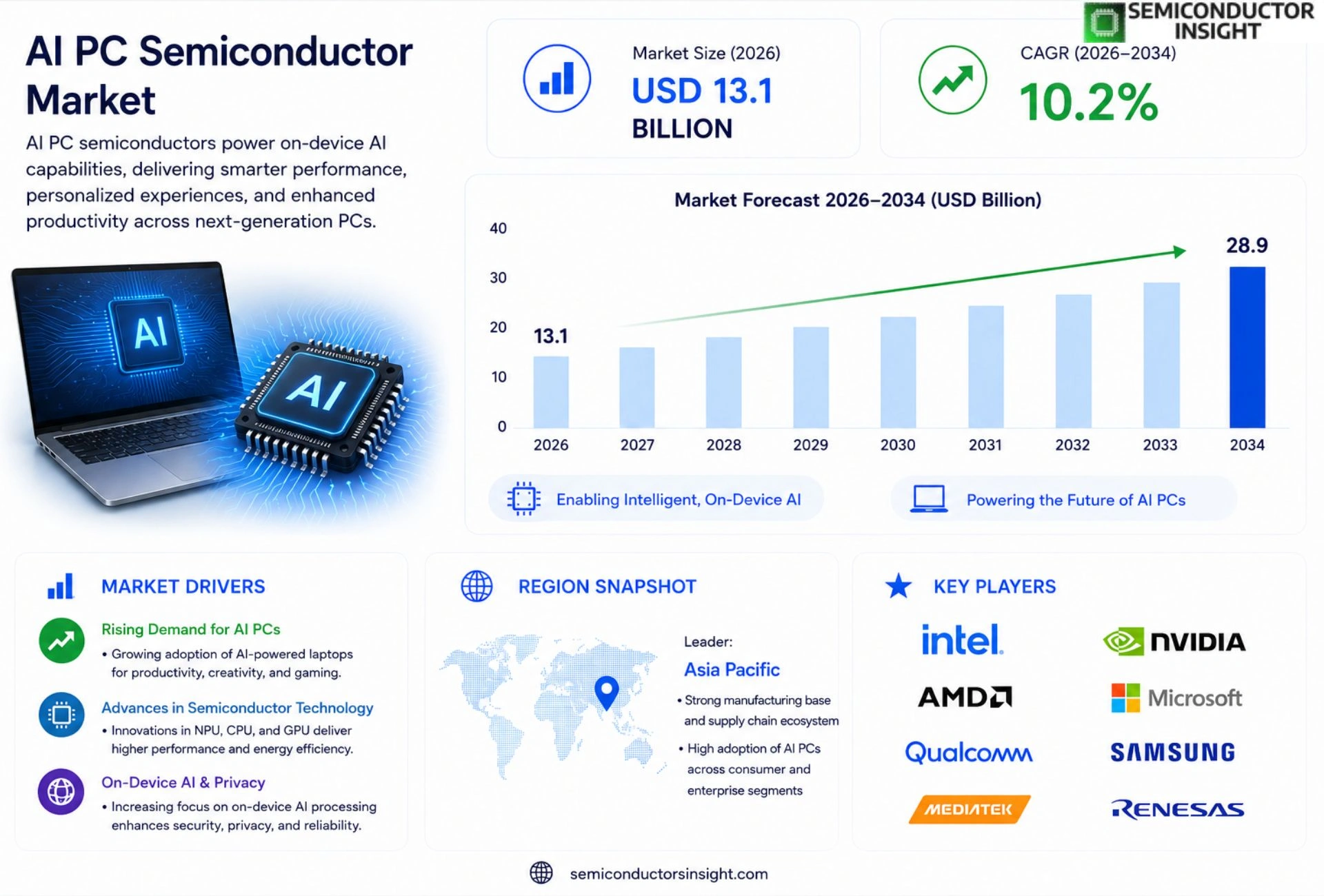
Global AI PC Semiconductor Market size was valued at USD 12.4 billion in 2025. The market is projected to grow from USD 13.1 billion in 2026 to USD 28.9 billion by 2034, exhibiting a CAGR of 10.2% during the forecast period.
AI PC semiconductors are specialized integrated circuits designed for personal computers that enable on‑device artificial‑intelligence workloads such as neural‑network inference, computer‑vision processing, and natural‑language tasks. These components typically combine high‑performance GPUs, dedicated neural‑processing units (NPUs), and advanced power‑management logic to deliver responsive AI features while maintaining desktop‑class efficiency.
The market is experiencing rapid growth because enterprise adoption of AI‑enhanced productivity tools is accelerating, consumer demand for intelligent gaming and creative applications is rising, and manufacturers are investing heavily in next‑generation silicon nodes that reduce latency and power consumption. Furthermore, strategic collaborations, such as Intel’s partnership with Dell on “Project Aurora” PCs and NVIDIA’s integration of its RTX 40 series GPUs into premium laptops, are expanding the ecosystem. Key players including AMD, MediaTek, Qualcomm Snapdragon Compute Platform, and Samsung Electronics continue to broaden their portfolios, reinforcing the momentum of AI PC semiconductor Market.
MARKET DRIVERS
Increasing Demand for Edge AI Computing
The proliferation of AI‑enabled applications on personal computers is driving a surge in demand for on‑device inference capabilities. Enterprises are adopting AI‑enhanced desktops for design, simulation, and data‑analytics tasks, pushing semiconductor manufacturers to integrate dedicated neural‑processing units directly into PC chips. This shift reduces latency and bandwidth costs, positioning AI PC semiconductor Market for rapid growth.
Advancements in Process Technology
Continued scaling of silicon‑photonic interconnects and the rollout of 5‑nanometer nodes enable higher transistor density while maintaining power efficiency. These technological gains allow chip designers to embed larger AI accelerators without compromising thermal envelopes, opening new performance tiers for gaming and professional workstations.
➤ “Integrating AI cores at the silicon level is becoming the default architecture for next‑generation PCs, not an optional add‑on.”
Beyond hardware, software ecosystems such as AI‑optimized compilers and open‑source frameworks are maturing, reducing development overhead and accelerating time‑to‑market for AI‑centric PC solutions.
MARKET CHALLENGES
Supply Chain Volatility
Recent geopolitical tensions and pandemic‑related disruptions have highlighted the fragility of semiconductor supply chains. Lead times for advanced wafers frequently exceed six months, creating inventory bottlenecks that can delay product launches for AI‑focused PC manufacturers.
Other Challenges
Regulatory Compliance
Data‑privacy regulations increasingly mandate on‑device processing for sensitive AI workloads. Ensuring that PC chips meet regional certification standards adds design complexity and may increase time‑to‑revenue.
MARKET RESTRAINTS
High Development Costs
Designing AI accelerators that coexist with traditional CPU/GPU units requires sizable R&D investments, often exceeding $500 million per generation. Smaller fabless firms may lack the capital to compete, consolidating market power among a few large players.
Additionally, the need for extensive verification and validation of AI inference accuracy under diverse workloads extends development cycles, further inflating costs.
These financial barriers can limit the entry of innovative startups, slowing the diversification of solutions within AI PC semiconductor Market.
MARKET OPPORTUNITIES
Emerging AI‑Accelerated Workstations
Professional creators in fields such as video editing, 3D rendering, and scientific visualization are increasingly seeking PCs that can handle real‑time AI inference. Vendors that ship integrated AI cores with high‑bandwidth memory can capture premium pricing and market share.
Another growth vector lies in the gaming sector, where AI‑driven upscaling and ray‑tracing technologies demand dedicated on‑chip inference engines. Early adopters are already reporting performance gains of 30 % while maintaining lower power envelopes.
Finally, the rise of modular AI expansion cards for mainstream desktops offers a retrofit path for older systems, expanding the addressable market and creating recurring revenue streams for component manufacturers.
AI PC Semiconductor Market Trends
AI‑Driven Performance Gains in Desktop Computing
AI PC semiconductor segment is defined by integrated circuits that bring on‑device artificial‑intelligence capabilities to personal computers. These chips blend high‑throughput GPUs, dedicated neural‑processing units (NPUs), and advanced power‑management logic to support inference workloads such as image recognition, speech processing, and real‑time recommendation engines. By moving inference from cloud to the desktop, manufacturers can reduce latency, improve data privacy, and deliver responsive user experiences without compromising the power envelope typical of consumer PCs.
Other Trends
Integration of Neural Processing Units
NPUs have moved from niche accelerator cards to standard silicon blocks embedded alongside graphics cores. Their inclusion enables low‑latency matrix multiplication, which is the computational backbone of modern transformer models. Recent product cycles show NPUs delivering up to 1.8 TFLOPs of AI throughput while consuming less than 15 watts, a figure that aligns with the power budgets of mainstream notebooks and compact desktops. This integration is prompting OEMs to market “AI‑ready” PCs that can run sophisticated vision and language models locally.
Strategic Partnerships Expanding the Ecosystem
Collaboration between silicon designers and system builders is accelerating adoption. Intel’s partnership with Dell on “Project Aurora” delivers AI‑enhanced workstations that leverage custom ASICs to accelerate productivity suites. NVIDIA’s integration of RTX 40‑series GPUs into premium laptops demonstrates how graphics leaders are embedding deep‑learning cores to support creative workflows and AI‑assisted gaming. Simultaneously, AMD, MediaTek, Qualcomm’s Snapdragon Compute Platform, and Samsung Electronics are broadening their portfolios with AI‑focused silicon, ensuring a competitive landscape that drives rapid innovation and price‑performance improvements.
These dynamics collectively shape a market where performance, efficiency, and ecosystem readiness are the primary value drivers. Enterprises are deploying AI‑augmented productivity tools that require on‑device inference, while consumers seek intelligent gaming experiences and creative applications that benefit from real‑time AI assistance. The convergence of hardware advancements, strategic alliances, and rising demand forecasts a sustained upward trajectory for AI PC semiconductors, reinforcing their role as a cornerstone of next‑generation personal computing.
COMPETITIVE LANDSCAPE
Key Industry Players
AI PC semiconductor Market is characterized by intense competition among vertically integrated chipmakers, fabless design firms, and diversified semiconductor conglomerates racing to capture leadership in on-device AI computing.
AI PC Semiconductor Market is dominated by a concentrated group of high-capability players possessing deep R&D investments, advanced silicon node access, and established original equipment manufacturer relationships. Intel Corporation maintains a commanding presence through its Core Ultra processor family, which embeds dedicated Neural Processing Units (NPUs) specifically engineered for on-device AI inference workloads. The company’s strategic collaboration with Dell on “Project Aurora” PCs further cements its position as a frontline enabler of AI PC adoption across enterprise segments. NVIDIA Corporation continues to exert significant influence through its RTX 40 Series GPU architecture, which is deeply integrated into premium laptop and workstation platforms, delivering high-throughput AI acceleration for creative, gaming, and professional productivity applications. AMD has aggressively expanded its Ryzen AI portfolio, combining high-performance CPU cores, RDNA graphics, and dedicated XDNA NPU fabric within a unified chiplet architecture, positioning itself as a formidable challenger across both consumer and commercial AI PC segments. Qualcomm has leveraged its Snapdragon X Elite and Snapdragon X Plus compute platforms to introduce Arm-based AI PC silicon that delivers class-leading NPU performance-per-watt, attracting major OEM partnerships with Microsoft, HP, Lenovo, and Samsung for Copilot+ PC initiatives. Apple, while operating within its proprietary ecosystem, has set industry benchmarks with its M-series chips featuring a unified memory architecture and tightly integrated Neural Engine, indirectly shaping competitive expectations across the broader AI PC semiconductor landscape.
Beyond the leading players, several specialized and emerging semiconductor companies are carving out meaningful positions within defined niches of AI PC semiconductor ecosystem. MediaTek has steadily broadened its Dimensity compute portfolio to address AI-capable thin-and-light PC platforms, particularly targeting cost-sensitive consumer segments in Asia-Pacific markets. Samsung Electronics contributes both as a semiconductor designer through its Exynos compute division and as a critical manufacturing partner, supplying advanced LPDDR5X and GDDR7 memory solutions that underpin AI workload performance in PC platforms. SK Hynix and Micron Technology play indispensable roles as providers of high-bandwidth memory and next-generation DRAM architectures that are essential companions to AI accelerator silicon. Taiwan Semiconductor Manufacturing Company (TSMC) serves as the foundational manufacturing backbone for fabless leaders including NVIDIA, AMD, Qualcomm, and Apple, with its 3nm and upcoming 2nm process nodes enabling the performance and efficiency gains central to AI PC semiconductor advancement. Additionally, companies such as Arm Holdings, whose processor IP underpins Qualcomm and MediaTek designs, and Cadence Design Systems and Synopsys, which provide critical EDA tooling for AI chip development, represent strategically important participants shaping the competitive and technological trajectory of the market.
List of Key AI PC Semiconductor Companies Profiled
- Intel Corporation
- NVIDIA Corporation
- Advanced Micro Devices, Inc. (AMD)
- Qualcomm Technologies, Inc.
- Apple Inc.
- MediaTek Inc.
- Samsung Electronics Co., Ltd.
- SK Hynix Inc.
- Micron Technology, Inc.
- Taiwan Semiconductor Manufacturing Company (TSMC)
- Arm Holdings plc
- Cadence Design Systems, Inc.
- Synopsys, Inc.
- Broadcom Inc.
- Texas Instruments Incorporated
Segment Analysis:
| Segment Category | Sub-Segments | Key Insights |
| By Type |
|
Integrated GPU Solutions
|
| By Application |
|
Business Productivity AI
|
| By End User |
|
Enterprise Workstations
|
| By Performance Tier |
|
Mid‑Range AI PCs
|
| By Power Management Strategy |
|
Adaptive Power Scaling Solutions
|
Regional Analysis: North America
North America
The increasing adoption of AI-powered applications such as natural language processing, computer vision, and machine learning is a primary driver. Growing demand for edge computing and the need for lower latency further fuel the need for powerful and energy-efficient AI PC semiconductors. Government initiatives supporting domestic semiconductor manufacturing also contribute to market growth.
The North American AI PC semiconductor market is characterized by intense competition among established players and emerging startups. Key players are focused on developing customized solutions, forging strategic partnerships, and expanding their production capacity to meet the growing demand. Innovation in chip architecture and materials is a key differentiator in this competitive environment.
Significant advancements in chiplet design, heterogeneous integration, and specialized processing units are driving performance improvements. Neuromorphic computing and other emerging AI hardware architectures are also gaining traction. The focus on power efficiency is critical to enable longer battery life in AI PCs.
The integration of AI accelerators directly onto the CPU die is expected to become more prevalent. Increased emphasis on security features and privacy-preserving AI processing will also shape the market’s trajectory. The rise of AI-optimized memory solutions will further enhance the performance of AI PCs.
Europe
European nations are actively investing in strengthening their semiconductor capabilities, positioning themselves as significant players in AI PC semiconductor Market. Government support, particularly through initiatives like the European Chips Act, aims to boost domestic production and reduce reliance on foreign suppliers. The region exhibits strong capabilities in automotive and industrial applications, creating opportunities for AI PC semiconductor solutions tailored to these sectors.
Asia-Pacific
Asia-Pacific, led by China, Japan, and South Korea, represents a massive and rapidly growing market for AI PC semiconductors. The region’s large consumer base, robust manufacturing infrastructure, and strong government backing for technological innovation are key drivers. The demand for AI PCs in various sectors, including consumer electronics, enterprise computing, and automotive, is accelerating, creating substantial opportunities for semiconductor suppliers.
South America
South America is an emerging market for AI PC semiconductors, driven by increasing digitalization across various sectors. While the market is currently smaller compared to North America and Asia-Pacific, it presents significant growth potential. The demand for AI PCs in education, healthcare, and finance is expected to rise in the coming years.
Middle East & Africa
The Middle East and Africa represent a comparatively nascent market for AI PC semiconductors. However, with increasing investments in technology and digitalization across these regions, the market is expected to witness considerable growth in the long term. The focus on smart cities, e-governance, and industrial automation is driving demand for AI-powered solutions, creating a favorable environment for AI PC semiconductors.
Report Scope
This market research report provides a comprehensive analysis of the AI PC Semiconductor Market , covering the forecast period 2026–2034. It offers detailed insights into market dynamics, technological advancements, competitive landscape, and key trends shaping the industry.
Key focus areas of the report include:
- Market Overview: The report begins with an overview outlining its current market scenario, key growth indicators, and industry transformation drivers. It discusses macroeconomic factors, demand–supply balance, regulatory landscape, and the strategic role of semiconductors in powering advancements across industries such as automotive, telecommunications, consumer electronics, and industrial automation.
- Market Size & Forecast: Historical data and future projections for revenue, unit shipments, and market value across major regions and segments.
- Segmentation Analysis: Detailed breakdown by product type, technology, application, and end-user industry to identify high-growth segments and investment opportunities.
- Regional Insights: Insights into market performance across North America, Europe, Asia-Pacific, Latin America, and the Middle East & Africa, including country-level analysis where relevant.
- Competitive Landscape: Profiles of leading market participants, including their product offerings, R&D focus, manufacturing capacity, pricing strategies, and recent developments such as mergers, acquisitions, and partnerships.
- Technology Trends & Innovation: Assessment of emerging technologies, integration of AI/IoT, semiconductor design trends, fabrication techniques, and evolving industry standards.
- Market Drivers & Restraints: Evaluation of factors driving market growth along with challenges, supply chain constraints, regulatory issues, and market-entry barriers.
- Stakeholder Insights: Insights for component suppliers, OEMs, system integrators, investors, and policymakers regarding the evolving ecosystem and strategic opportunities.
Primary and secondary research methods are employed, including interviews with industry experts, data from verified sources, and real-time market intelligence to ensure the accuracy and reliability of the insights presented.
FREQUENTLY ASKED QUESTIONS:
What is the current market size of AI PC Semiconductor Market?
-> AI PC semiconductor Market was valued at USD 12.4 billion in 2025 and is expected to reach USD 28.9 billion by 2034, exhibiting a CAGR of 10.2% during the forecast period.
Which key companies operate in AI PC Semiconductor Market?
-> Key players include AMD, MediaTek, Qualcomm Snapdragon Compute Platform, Samsung Electronics, Intel, NVIDIA.
What are the key growth drivers?
-> Key growth drivers include enterprise adoption of AI‑enhanced productivity tools, rising consumer demand for intelligent gaming and creative applications, heavy investment in next‑generation silicon nodes, and strategic collaborations such as Intel‑Dell and NVIDIA‑RTX 40 series integration.
Which region dominates the market?
-> North America remains a dominant market, while Asia‑Pacific is the fastest‑growing region.
What are the emerging trends?
-> Emerging trends include integration of high‑performance GPUs with dedicated NPUs, advanced power‑management designs, adoption of next‑gen silicon nodes, and expanding AI‑on‑PC ecosystem collaborations.

Get Sample Report PDF for Exclusive Insights
Report Sample Includes
- Table of Contents
- List of Tables & Figures
- Charts, Research Methodology, and more...
 Download Sample Report PDF