AI PC Neural Processing Unit Market Insights
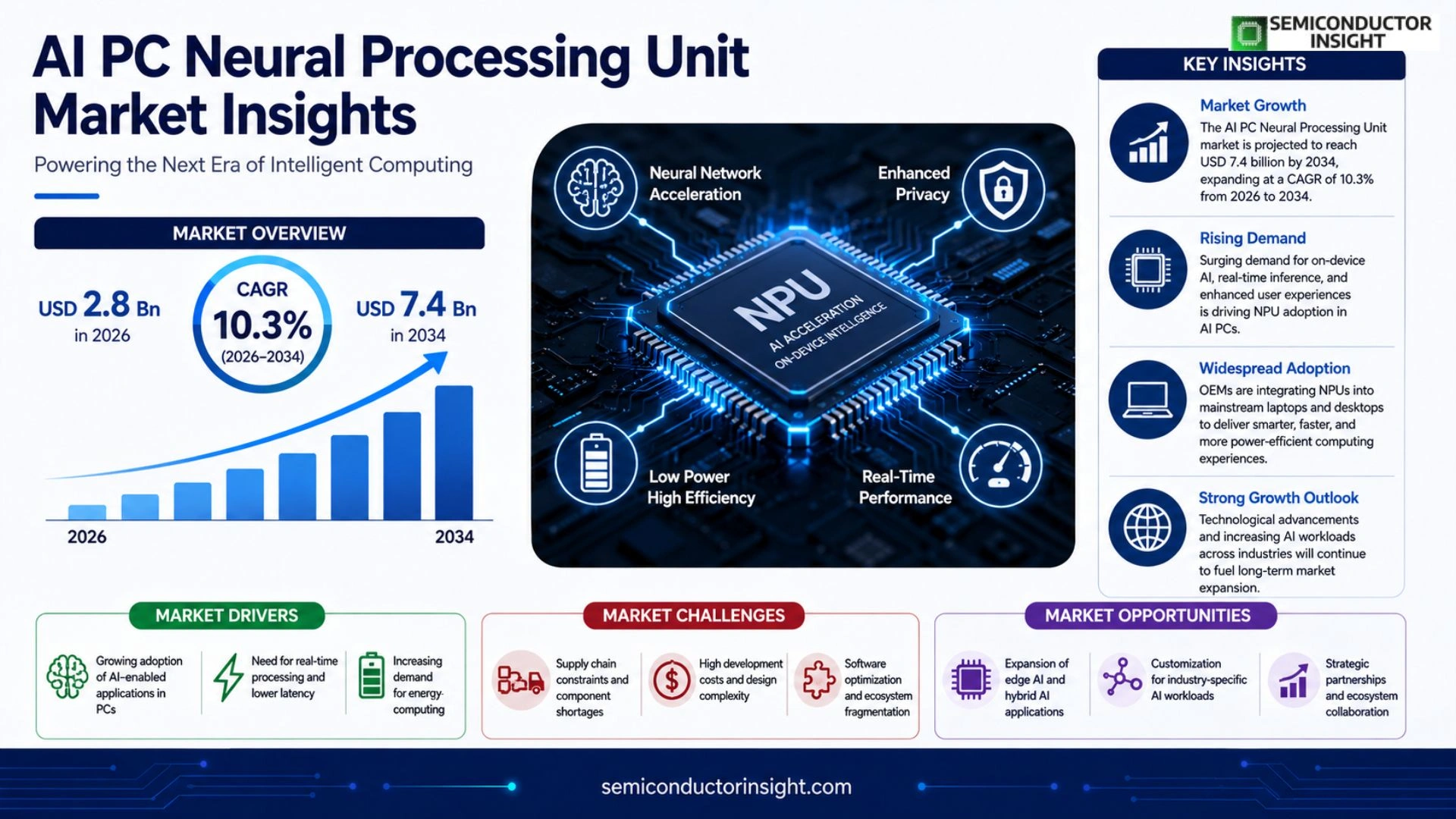
Global AI PC Neural Processing Unit Market size was valued at USD 2.6 billion in 2025. The market expands from USD 2.8 billion in 2026 to USD 7.4 billion by 2034, reflecting a CAGR of roughly 10.3 % over the period.
AI PC Neural Processing Units are dedicated silicon blocks integrated into desktop and laptop platforms that accelerate inference and training of deep‑learning models directly on the device. They differ from general‑purpose CPUs and GPUs by offering tensor‑optimized pipelines, lower latency, and power‑efficient execution for tasks such as image upscaling, voice assistants, and real‑time translation.
The upward trajectory stems from growing consumer demand for on‑device AI features, heightened privacy concerns that favor local processing, and expanding software ecosystems like OpenAI’s APIs that target personal computers. Hardware vendors such as Intel (Meteor Lake NPU), AMD (Ryzen AI), and Apple (Neural Engine) have announced new generations this year, reinforcing supply‑side momentum while developers release toolkits that simplify integration.
MARKET DRIVERS
Surge in Edge‑AI Deployments
Enterprises are moving AI inference from cloud data‑centers to the desktop, demanding processors that handle neural workloads locally. This shift reduces latency, safeguards proprietary data, and cuts bandwidth costs. Manufacturers that embed dedicated neural engines into PCs are capturing this emerging preference, resulting in a noticeable uplift in unit shipments.
Breakthroughs in Chip Architecture
Recent silicon‑design breakthroughs,such as tensor‑core acceleration and mixed‑precision arithmetic,allow neural units to execute deep‑learning models with markedly lower power draw. Design firms that leverage these efficiencies can price their solutions competitively while delivering performance comparable to traditional GPUs.
➤ AI PC Neural Processing Unit Market is reshaping how desktop applications handle intelligence, turning laptops into self‑learning platforms.
The convergence of high‑resolution displays, immersive VR/AR experiences, and real‑time language translation creates a fertile environment for on‑device AI. Companies that align product roadmaps with these user expectations are positioning themselves at the forefront of the emerging ecosystem.
MARKET CHALLENGES
Software Ecosystem Fragmentation
Developers confront a scattered landscape of SDKs, frameworks, and optimization tools. The absence of a unified programming model forces teams to invest additional time in porting models, which can delay time‑to‑market and inflate R&D budgets.
Other Challenges
Cost and Skill Gaps
The capital required to design, validate, and mass‑produce a neural processing unit remains substantial. Coupled with a shortage of engineers proficient in both hardware design and AI model optimization, many firms hesitate to commit resources, slowing broader adoption.
MARKET RESTRAINTS
Supply‑Chain Bottlenecks
Advanced lithography equipment and high‑purity materials are concentrated among a limited set of suppliers. Disruptions,whether from geopolitical tensions or unexpected demand spikes,cascade through the production line, inflating lead times and limiting the ability of vendors to scale rapidly.
MARKET OPPORTUNITIES
Custom AI Solutions for Creative Professionals
Content creators increasingly rely on generative AI for video editing, 3D rendering, and real‑time visual effects. Tailored neural processing units that accelerate these specific workloads can unlock premium pricing tiers, encouraging OEMs to bundle differentiated AI capabilities into high‑end workstations.
AI PC Neural Processing Unit Market Trends
On‑Device AI Demand Fuels NPU Adoption
The surge in consumer appetite for real‑time AI capabilities,such as AI‑enhanced photography, voice assistants that run locally, and instant language translation,has turned desktop and laptop platforms into prime targets for dedicated neural processing units. By moving inference workloads away from cloud services, manufacturers address latency concerns and the growing emphasis on data privacy. This shift is reflected in the market’s expansion from a valuation of USD 2.6 billion in 2025 to an estimated USD 7.4 billion by 2034. The underlying economics are compelling: tensor‑optimized silicon delivers higher throughput per watt, allowing midsize PCs to support sophisticated models without overheating or draining batteries. Consequently, OEMs see a clear incentive to integrate NPUs as standard components rather than optional upgrades.
Other Trends
Hardware Vendor Initiatives
Major silicon players have accelerated product cycles to capture the emerging opportunity. Intel’s Meteor Lake NPU line, AMD’s Ryzen AI series, and Apple’s Neural Engine each introduced a new generation within the past twelve months, underscoring competitive pressure on performance, power envelope, and development tools. The accelerated cadence is not merely a race for spec sheets; it translates into richer software stacks that lower the barrier for application developers. By supplying integrated drivers and compiler support, these vendors enable third‑party developers to tap the hardware with minimal code changes, fostering a virtuous cycle where more applications drive further hardware adoption.
Software Ecosystem Expansion and Developer Enablement
The hardware momentum is being amplified by a parallel growth in software ecosystems tailored to personal computers. OpenAI’s APIs, now featuring PC‑focused SDKs, exemplify a broader trend where cloud‑originated models are being distilled for on‑device execution. Toolkits that abstract tensor operations and automate quantization reduce the time‑to‑market for AI‑enhanced features. For enterprises, this means faster deployment of customized analytics tools that run locally, preserving proprietary data while still leveraging cutting‑edge model performance. As the ecosystem matures, firms that invest early in NPU‑ready software stand to differentiate their product lines and capture premium pricing.
COMPETITIVE LANDSCAPE
Key Industry Players
AI PC Neural Processing Units: Competitive Overview
AI PC NPU segment is largely anchored by three silicon giants whose product cycles set the tempo for the entire ecosystem. Intel’s Meteor Lake NPU family delivers a tightly integrated tensor engine that leverages the company’s process‑lead advantage, allowing OEMs to differentiate laptops with on‑device inference at modest power envelopes. AMD’s Ryzen AI chips, embedded within its recent APUs, push the architecture toward a unified compute model where CPU cores share memory with the neural engine, reducing data movement latency. Apple’s Neural Engine, now embedded in the latest MacBook line‑up, showcases a software‑first approach that compels developers to adopt Apple‑centric frameworks, thereby reinforcing a closed but high‑performance loop. Collectively, these leaders dictate silicon roadmaps, standards for model quantization, and pricing tiers that downstream manufacturers must accommodate.
Beyond the tier‑one group, a diverse set of contenders enriches the market with specialized capabilities. Qualcomm’s Snapdragon X series introduces an on‑chip AI accelerator aimed at thin‑and‑light notebooks, capitalising on its mobile‑centric power optimisations. MediaTek’s Dimensity AI modules target cost‑sensitive consumer PCs, while Nvidia’s Jetson‑derived cores are being repurposed for desktop AI workloads that require higher throughput. Samsung’s Exynos AI block, Google’s Tensor processor for Chromebooks, and Huawei’s Ascend Lite illustrate how ecosystem players are leveraging existing mobile AI IP for the PC form factor. Meanwhile, niche firms such as Graphcore, Habana Labs (now part of Intel), and Cerebras offer high‑density compute tiles that appeal to workstation users needing extreme model training capabilities. This breadth of options forces traditional PC makers,Lenovo, Dell, HP, and ASUS,to negotiate multiple supply streams, each with distinct SDKs and performance trade‑offs, thereby shaping product differentiation strategies across the segment.
List of Key AI PC Neural Processing Unit Companies Profiled
- Intel
- AMD
- Apple
- Qualcomm
- MediaTek
- Nvidia
- Samsung
- Huawei
- Graphcore
- Habana Labs
- Lenovo
- Dell
- HP
- ASUS
Segment Analysis:
| Segment Category | Sub-Segments | Key Insights |
| By Type |
|
Dedicated NPU
|
| By Application |
|
Creative Content Creation
|
| By End User |
|
Professional Creators
|
| By Integration Model |
|
On‑Die Integration
|
| By Software Ecosystem |
|
Open‑source Frameworks
|
Regional Analysis: AI PC Neural Processing Unit Market
Startup incubators across Boston and Seattle nurture niche designs that marry low‑power ASICs with programmable logic, targeting AI‑enhanced graphics pipelines. Partnerships with academic labs ensure that emerging training algorithms influence silicon architecture before they reach commercial maturity.
Tier‑1 foundries benefit from long‑standing contracts with major chipmakers, providing a stable throughput for neural processing wafers. However, recent geopolitical moves have prompted manufacturers to diversify fab locations, adding a layer of resilience to the supply chain.
Federal agencies are drafting guidelines that address data‑privacy implications of on‑device AI, encouraging vendors to embed encryption modules directly within neural processors, thereby creating a compliance‑first design ethos.
Enterprises in finance and biotech have begun substituting traditional CPUs with hybrid units that embed neural cores, reporting noticeable reductions in batch‑processing times while preserving existing software stacks.
Europe
European manufacturers rely on a collaborative ecosystem that blends hardware ingenuity with strong standards bodies. The region’s emphasis on energy‑efficiency standards pushes vendors to optimize neural processing units for lower thermal envelopes, a factor that resonates with OEMs targeting compact workstation form factors. Cross‑border research consortia in Germany and France are pioneering quantization techniques that shrink model footprints, making them viable for PC‑level deployments without sacrificing inference accuracy. This technical focus aligns with procurement trends in the automotive and aerospace sectors, where on‑board analysis must coexist with stringent power budgets. Consequently, European firms are positioning themselves as providers of sustainable, high‑performance AI acceleration for desktop platforms.
Asia‑Pacific
The Asia‑Pacific corridor exhibits a blend of rapid prototyping capability and cost‑effective production. Manufacturers in Taiwan and South Korea excel at integrating dense neural arrays into consumer‑grade motherboards, benefiting from economies of scale that keep price points attractive for mass‑market PCs. Meanwhile, markets like India are seeing a surge in software startups that require on‑device AI for language processing, prompting local OEMs to embed specialized neural units that handle multilingual inference efficiently. The regional focus on localization drives a nuanced product roadmap, where hardware vendors must accommodate diverse language models and region‑specific compliance requirements, encouraging a more modular approach to chip design.
South America
In South America, adoption is anchored by a growing contingent of research institutions that leverage AI PC Neural Processing Unit Market solutions for climate‑modeling and agricultural analytics. The region’s limited data‑center bandwidth makes edge‑focused processing particularly valuable, motivating enterprises to embed neural cores within standard workstations to offload compute‑intensive tasks locally. Local distributors are increasingly offering configurable reference designs that allow end‑users to tailor neural capacity to specific workload profiles, a strategy that mitigates upfront capital outlay while preserving scalability for future upgrades.
Middle East & Africa
The Middle East & Africa landscape is characterized by strategic investments in smart‑city initiatives that demand real‑time video analytics on conventional PC infrastructure. Vendors are tailoring neural processing units to operate under harsh environmental conditions, incorporating enhanced thermal management features that sustain performance in high‑temperature settings. Partnerships with governmental agencies focus on deploying AI‑enabled security cameras and traffic monitoring systems that process data at the edge, reducing reliance on centralized cloud resources. This approach fuels a demand for PCs equipped with dedicated neural accelerators, prompting regional manufacturers to align product lines with these public‑sector priorities.
Report Scope
This market research report provides a comprehensive analysis of the AI PC Neural Processing Unit Market , covering the forecast period 2026–2034. It offers detailed insights into market dynamics, technological advancements, competitive landscape, and key trends shaping the industry.
Key focus areas of the report include:
- Market Overview: The report begins with an overview outlining its current market scenario, key growth indicators, and industry transformation drivers. It discusses macroeconomic factors, demand–supply balance, regulatory landscape, and the strategic role of semiconductors in powering advancements across industries such as automotive, telecommunications, consumer electronics, and industrial automation.
- Market Size & Forecast: Historical data and future projections for revenue, unit shipments, and market value across major regions and segments.
- Segmentation Analysis: Detailed breakdown by product type, technology, application, and end-user industry to identify high-growth segments and investment opportunities.
- Regional Insights: Insights into market performance across North America, Europe, Asia-Pacific, Latin America, and the Middle East & Africa, including country-level analysis where relevant.
- Competitive Landscape: Profiles of leading market participants, including their product offerings, R&D focus, manufacturing capacity, pricing strategies, and recent developments such as mergers, acquisitions, and partnerships.
- Technology Trends & Innovation: Assessment of emerging technologies, integration of AI/IoT, semiconductor design trends, fabrication techniques, and evolving industry standards.
- Market Drivers & Restraints: Evaluation of factors driving market growth along with challenges, supply chain constraints, regulatory issues, and market-entry barriers.
- Stakeholder Insights: Insights for component suppliers, OEMs, system integrators, investors, and policymakers regarding the evolving ecosystem and strategic opportunities.
Primary and secondary research methods are employed, including interviews with industry experts, data from verified sources, and real-time market intelligence to ensure the accuracy and reliability of the insights presented.
FREQUENTLY ASKED QUESTIONS:
What is the current market size of AI PC Neural Processing Unit Market?
-> Global AI PC Neural Processing Unit Market was valued at USD 2.6 billion in 2025 and is expected to reach USD 7.4 billion by 2034.
Which key companies operate in AI PC Neural Processing Unit Market?
-> Key players include Intel (Meteor Lake NPU), AMD (Ryzen AI), and Apple (Neural Engine).
What are the key growth drivers?
-> Key growth drivers include rising consumer demand for on‑device AI features, heightened privacy concerns that favor local processing, and expanding software ecosystems such as OpenAI’s APIs targeting personal computers.
Which region dominates the market?
-> Regional dominance information is not disclosed in the provided data.
What are the emerging trends?
-> Emerging trends include deployment of dedicated NPUs in desktops and laptops, development of developer toolkits that simplify integration, and continuous hardware enhancements from major vendors.
Get Sample Report PDF for Exclusive Insights
Report Sample Includes
- Table of Contents
- List of Tables & Figures
- Charts, Research Methodology, and more...
 Download Sample Report PDF