AI-Optimized Wafer Cleaning Chemistry Formulation Market Insights
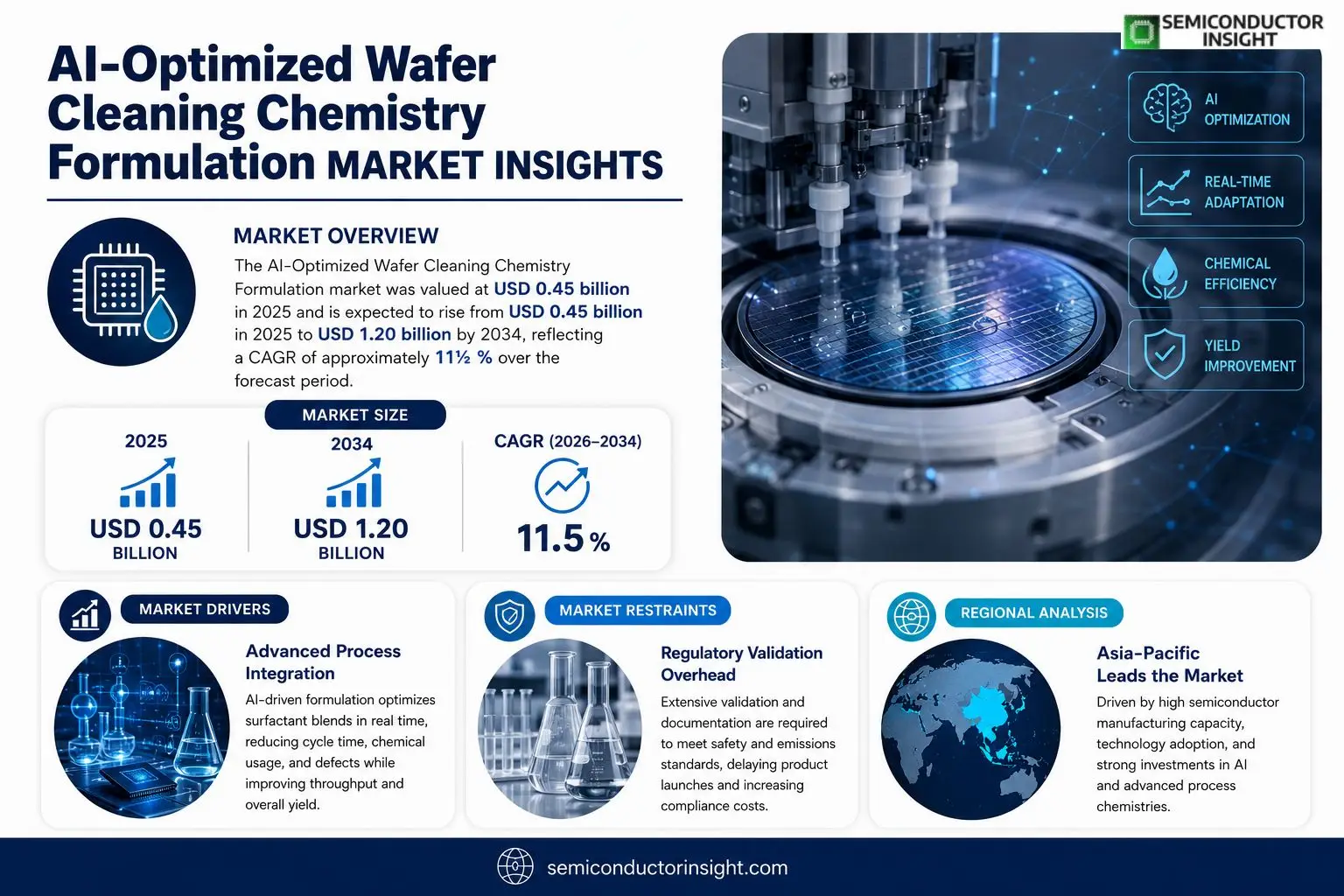
AI-Optimized Wafer Cleaning Chemistry Formulation market size was valued at USD 0.45 billion in 2025. The market is expected to rise from USD 0.45 billion in 2025 to USD 1.20 billion by 2034, reflecting a CAGR of approximately 11½ % over the forecast period.
AI‑optimized wafer cleaning chemistry formulations are advanced liquid solutions engineered through machine‑learning algorithms that predict optimal surfactant blends, pH balances, and additive concentrations for semiconductor substrates. By continuously analyzing defect density data, particle counts, and surface energy measurements, these formulations adapt in real time to achieve superior contaminant removal while minimizing material consumption.The market gains momentum because semiconductor manufacturers face tighter node requirements and stricter yield targets, prompting them to adopt intelligent chemical design that cuts cycle time and waste generation. Moreover, recent collaborations between leading equipment suppliers such as Lam Research and artificial‑intelligence specialists have accelerated commercialization of self‑tuning cleaning processes. As fab capacity expands worldwide, demand for chemically efficient, AI‑driven solutions continues to rise.
MARKET DRIVERS
Advanced Process Integration
AI-Optimized Wafer Cleaning Chemistry Formulation Market benefits from tighter coupling between semiconductor fab lines and machine‑learning platforms. By feeding real‑time defect‑mapping data into adaptive algorithms, manufacturers can fine‑tune surfactant blends on‑the‑fly, reducing cycle time without sacrificing cleanliness. This level of responsiveness translates into higher throughput and lower rework costs, a competitive edge that only AI‑enhanced chemistries can deliver.
Environmental Compliance Pressure
Regulators worldwide are tightening discharge limits for volatile organic compounds used in wafer cleaning. Companies that deploy AI to model solvent‑solubility interactions can formulate low‑emission cleansers that meet stricter standards while maintaining removal efficiency. The ability to certify environmentally friendly batches quickly gives firms a clear market advantage and protects them from costly compliance retrofits.
➤ AI‑driven formulation reduces trial‑and‑error cycles by up to 40 %, delivering faster time‑to‑market for new cleaning agents.
These forces converge to make intelligent chemistry a strategic priority, compelling fabs to allocate capital toward AI‑ready tools and data pipelines. As a result, adoption rates are accelerating across both leading and emerging semiconductor hubs.
MARKET CHALLENGES
Data Quality and Model Transferability
High‑precision cleaning models rely on extensive sensor datasets that must be both accurate and representative of diverse wafer families. In practice, variations in metrology calibration can introduce noise, deteriorating model fidelity when the same algorithm is applied across multiple fabs. Companies therefore face the ongoing task of standardizing data capture protocols to safeguard predictive performance.
Other Challenges
Supply Chain Complexity
Sourcing specialty reagents with consistent purity levels becomes more intricate when AI demands exact formulation parameters. Any deviation in raw‑material quality can ripple through the optimization loop, forcing manufacturers to renegotiate supplier contracts or maintain larger safety stocks, both of which erode cost advantages.
MARKET RESTRAINTS
Regulatory Validation Overhead
Introducing AI‑tuned chemistries into production requires extensive validation to satisfy safety and emissions standards. Regulatory bodies often demand documented evidence that algorithmic adjustments do not compromise wafer integrity, a process that can extend product launch timelines. This procedural burden tempers the speed at which firms can fully exploit AI‑enabled formulations.
MARKET OPPORTUNITIES
Custom Formulation‑as‑a‑Service
Emerging business models that offer on‑demand, AI‑guided chemistry design present a lucrative avenue for equipment vendors and specialty chemical firms. By hosting a cloud‑based optimization engine, providers can deliver bespoke cleaning recipes to multiple customers without the need for each fab to maintain its own AI infrastructure. This service model opens recurring‑revenue streams while lowering the entry barrier for mid‑size manufacturers.
AI-Optimized Wafer Cleaning Chemistry Formulation Market Trends
Real‑Time Adaptive Chemistry
The introduction of machine‑learning driven formulation engines has shifted wafer cleaning from a static recipe set to an agile process that reshapes surfactant blends, pH levels and additive ratios on the fly. By ingesting defect density, particle count and surface energy data for each lot, the chemistry self‑optimizes, delivering higher contaminant removal while cutting chemical usage. This capability aligns tightly with the push toward finer node geometries, where even sub‑nanometer residues can impair device performance. Manufacturers that integrate adaptive chemistry report shorter cycle times on critical cleaning steps, translating into higher overall fab throughput. The shift also eases the burden on process engineers, who can rely on algorithmic guidance rather than manual trial‑and‑error, freeing expertise for higher‑value activities such as yield analysis.
Other Trends
Strategic Partnerships Between Equipment Makers and AI Specialists
Recent joint ventures between leading wafer‑processing equipment providers and AI firms have accelerated the rollout of self‑tuning cleaning modules. These collaborations blend deep domain knowledge of chemical interaction with cutting‑edge data‑science platforms, enabling turnkey solutions that plug directly into existing scrubbers. The resulting systems not only adjust formulation parameters but also provide predictive maintenance alerts based on chemistry degradation patterns. Clients benefit from a reduced need for separate software licenses and from a clearer roadmap for technology upgrades, which helps stabilize long‑term capital planning. As more fabs adopt such bundled offerings, the ecosystem around AI‑optimized formulations is coalescing into a more coherent value chain.
Environmental and Cost Efficiency Pressures
Regulatory scrutiny on chemical discharge and corporate sustainability goals are prompting fabs to scrutinize every gram of solvent used. AI‑driven formulation tools pinpoint the minimal effective concentration of each component, often achieving the same cleanliness level with 20‑30% less material. The downstream effect includes lower waste treatment costs and a smaller carbon footprint for the chemical supply chain. From a commercial perspective, the reduced inventory turnover and longer shelf life of precisely calibrated blends improve cash‑flow dynamics for both suppliers and end users. As environmental compliance budgets tighten, the economic incentive to adopt intelligent chemistry becomes a decisive factor in procurement decisions.
COMPETITIVE LANDSCAPEKey Industry Players
AI‑Optimized Wafer Cleaning Chemistry Formulation Competitive Overview
The market is anchored by a handful of vertically integrated equipment manufacturers that have leveraged deep semiconductor know‑how to embed machine‑learning engines directly into their chemical delivery platforms. Lam Research, for instance, combines its extensive wet‑process portfolio with an AI layer that continuously refines surfactant ratios based on real‑time defect feedback; this capability has secured it a leadership position in high‑volume fabs targeting sub‑5 nm nodes. Applied Materials follows a similar trajectory, deploying a cloud‑native analytics suite that aggregates wafer‑level contamination metrics across multiple sites, thereby offering customers a unified, predictive cleaning solution. Their dominance is reinforced by long‑standing OEM relationships, which translate into preferential access to the most advanced process modules and a de‑facto standard for AI‑driven chemistry in the western semiconductor corridor.Beyond the tier‑one giants, a cluster of specialized chemical firms and niche technology providers is carving out defensible market slices. Merck KGaA (MilliporeSigma) supplies high‑purity precursors that feed the AI algorithms, while BASF and Dow focus on proprietary additive libraries that enhance formulation stability under AI‑guided pH adjustments. Smaller innovators such as Screen Holdings and Nanochem have introduced boutique surfactant blends expressly tuned for AI‑based defect prediction, positioning themselves as preferred partners for fab fabs pursuing cost‑effective yield improvements. Japanese stalwarts Tokyo Electron and Hitachi High‑Technologies contribute advanced metrology that feeds the learning loops, whereas companies like IPC and 3M provide complementary surface‑treatment technologies that extend the value chain beyond the cleaning step itself.
List of Key AI‑Optimized Wafer Cleaning Chemistry Formulation Companies Profiled
- Lam Research
- Applied Materials
- Merck KGaA (MilliporeSigma)
- BASF
- Dow
- Screen Holdings
- Nanochem
- Tokyo Electron
- Hitachi High‑Technologies
- 3M
- IPC
- Entegris
Segment Analysis:
| Segment Category | Sub-Segments | Key Insights |
| By Type |
|
Surfactant‑based formulations
|
| By Application |
|
Advanced node cleaning
|
| By End User |
|
Foundries
|
| By Technology |
|
Machine‑learning driven formulation design
|
| By Process Stage |
|
CMP cleaning
|
Regional Analysis: AI-Optimized Wafer Cleaning Chemistry Formulation Market
North America
The concentration of specialty chemical manufacturers in the United States and Canada enables tight collaboration on formulation tweaks, yet it also creates a dependency on a limited set of raw‑material sources. Companies are responding by diversifying feedstock origins and establishing dual‑sourcing strategies to mitigate disruption risk.
Federal and state environmental guidelines impose strict limits on volatile organic compounds, prompting developers to embed AI‑driven solvent substitution algorithms into their product pipelines. This regulatory pressure accelerates adoption of greener chemistries without sacrificing throughput.
Major fabs are moving away from volume‑based purchases toward outcome‑oriented contracts, where rebate structures are tied to yield gains demonstrated by AI analytics. This model incentivizes suppliers to continuously refine their formulations.
Silicon Valley’s convergence of semiconductor OEMs, AI research labs, and venture capital creates a fertile ground for cross‑disciplinary teams that can rapidly prototype and field‑test new cleaning chemistries.
Europe
European fabs are leveraging the continent’s strong tradition of precision engineering to integrate AI‑enhanced cleaning chemistries into mature process nodes. A cluster of research institutes in Germany and the Netherlands supplies a pipeline of patents focused on catalyst‑free solvent systems, which aligns with the EU’s stringent environmental directives. Companies are forming consortia that pool data from multiple sites, allowing machine‑learning models to be trained on a broader spectrum of wafer types. This collaborative approach reduces the time required to validate new formulations and provides a competitive edge to participants when competing for high‑value contracts with automotive and aerospace suppliers. The market therefore rewards firms that can navigate regulatory compliance while delivering demonstrable cost savings through predictive chemistry adjustments.
Asia‑Pacific
The Asia‑Pacific region, anchored by Taiwan, South Korea, and China, exhibits the highest installation density of advanced lithography equipment, creating a strong incentive to adopt AI‑Optimized Wafer Cleaning Chemistry Formulation solutions. Local manufacturers are integrating edge‑computing nodes directly into fab floor controllers, enabling on‑site optimization of cleaning cycles without relying on external cloud latency. Government initiatives that fund AI research in semiconductor manufacturing further accelerate the development of region‑specific chemistries tailored to the unique defect profiles of sub‑10 nm processes. As capacity expands, the pressure to improve yield while containing chemical spend drives a shift toward subscription‑style access to formulation algorithms rather than outright product sales.
South America
South American semiconductor activities remain modest, but the region is witnessing a nascent wave of investment in specialty chemical production facilities aimed at serving the automotive electronics market. Companies are eyeing AI‑driven formulation platforms as a way to quickly upscale capabilities without the capital outlay associated with traditional pilot lines. Partnerships with North American and European technology providers are facilitating knowledge transfer, allowing local firms to customize cleaning chemistries for the region’s climate‑driven wafer handling challenges. This emerging ecosystem suggests a gradual move from import‑reliant procurement toward domestically engineered solutions that can be fine‑tuned through cloud‑based AI services.
Middle East & Africa
In the Middle East and Africa, semiconductor assembly and testing hubs are expanding, spurred by strategic diversification agendas. While the market share for AI‑Optimized Wafer Cleaning Chemistry Formulation remains limited, early adopters are attracted by the promise of reducing water consumption and chemical waste—critical considerations in water‑scarce environments. Regional players are experimenting with hybrid AI platforms that combine on‑premise analytics with remote expertise, a model that balances data sovereignty concerns with the need for cutting‑edge optimization. The trajectory points toward incremental adoption as local talent pools develop expertise in both chemistry and machine learning.
Report Scope
This market research report provides a comprehensive analysis of the AI-Optimized Wafer Cleaning Chemistry Formulation Market , covering the forecast period 2026–2034. It offers detailed insights into market dynamics, technological advancements, competitive landscape, and key trends shaping the industry.
Key focus areas of the report include:
- Market Overview: The report begins with an overview outlining its current market scenario, key growth indicators, and industry transformation drivers. It discusses macroeconomic factors, demand–supply balance, regulatory landscape, and the strategic role of semiconductors in powering advancements across industries such as automotive, telecommunications, consumer electronics, and industrial automation.
- Market Size & Forecast: Historical data and future projections for revenue, unit shipments, and market value across major regions and segments.
- Segmentation Analysis: Detailed breakdown by product type, technology, application, and end-user industry to identify high-growth segments and investment opportunities.
- Regional Insights: Insights into market performance across North America, Europe, Asia-Pacific, Latin America, and the Middle East & Africa, including country-level analysis where relevant.
- Competitive Landscape: Profiles of leading market participants, including their product offerings, R&D focus, manufacturing capacity, pricing strategies, and recent developments such as mergers, acquisitions, and partnerships.
- Technology Trends & Innovation: Assessment of emerging technologies, integration of AI/IoT, semiconductor design trends, fabrication techniques, and evolving industry standards.
- Market Drivers & Restraints: Evaluation of factors driving market growth along with challenges, supply chain constraints, regulatory issues, and market-entry barriers.
- Stakeholder Insights: Insights for component suppliers, OEMs, system integrators, investors, and policymakers regarding the evolving ecosystem and strategic opportunities.
Primary and secondary research methods are employed, including interviews with industry experts, data from verified sources, and real-time market intelligence to ensure the accuracy and reliability of the insights presented.
FREQUENTLY ASKED QUESTIONS:
What is the current market size of AI-Optimized Wafer Cleaning Chemistry Formulation Market?
-> AI-Optimized Wafer Cleaning Chemistry Formulation Market was valued at USD 0.45 billion in 2025 and is expected to reach USD 1.20 billion by 2034.
Which key companies operate in AI-Optimized Wafer Cleaning Chemistry Formulation Market?
-> Key players include Axalta Coating Systems, AkzoNobel, BASF SE, PPG, Sherwin-Williams, and 3M, among others.
What are the key growth drivers?
-> Key growth drivers include railway infrastructure investments, urbanization, and demand for durable coatings.
Which region dominates the market?
-> Asia-Pacific is the fastest-growing region, while Europe remains a dominant market.
What are the emerging trends?
-> Emerging trends include bio-based coatings, smart coatings, and sustainable rail solutions.
Get Sample Report PDF for Exclusive Insights
Report Sample Includes
- Table of Contents
- List of Tables & Figures
- Charts, Research Methodology, and more...
 Download Sample Report PDF