AI-Optimized Standard Cell Library Market Insights
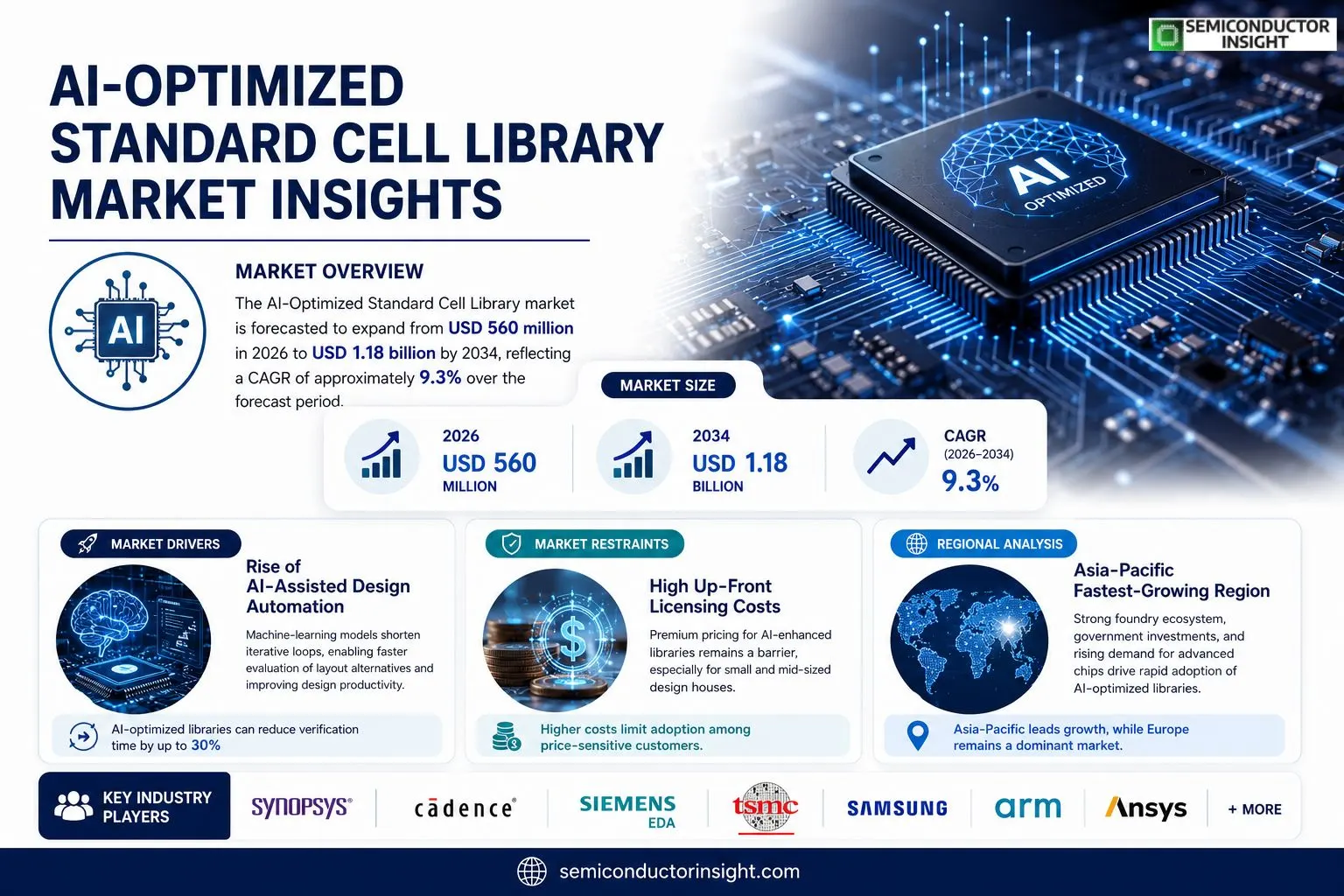
AI‑Optimized Standard Cell Library market size was valued at USD 520 million in 2025. The market is forecasted to expand from USD 560 million in 2026 to USD 1.18 billion by 2034, reflecting a CAGR of approximately 9.3 % over the period.
AI‑Optimized Standard Cell Libraries comprise pre‑characterized logic cells whose timing, power and routing attributes are refined through machine‑learning algorithms. By predicting silicon behavior early in the design flow, these libraries shorten verification cycles and support sub‑10 nm process nodes where traditional characterization becomes prohibitively costly.The upward trend stems from heightened adoption of advanced technology nodes and the pressure on semiconductor firms to shorten time‑to‑market. Partnerships such as Synopsys collaborating with NVIDIA on GPU‑accelerated library generation, Cadence’s integration of generative‑AI models for cell placement, and Siemens EDA’s rollout of an AI‑driven verification suite illustrate how leading vendors are embedding intelligence into their portfolios. Major foundries including TSMC and Samsung are also investing in these solutions to meet escalating design complexity.
MARKET DRIVERS
Rise of AI‑Assisted Design Automation
The infusion of machine‑learning models into standard‑cell generation shortens iterative loops that traditionally consumed months. Designers can now evaluate layout alternatives in hours, allowing silicon teams to reallocate effort toward architecture innovation. This efficiency boost directly strengthens AI-Optimized Standard Cell Library Market as customers seek tangible productivity gains.
Demand for Faster Time‑to‑Market
Competitive pressure in high‑performance computing and mobile SoCs forces manufacturers to compress product cycles. AI‑enhanced libraries deliver tighter timing margins without manual hand‑tuning, translating into earlier tape‑out dates. Companies that adopt these solutions gain a scheduling advantage, prompting broader procurement of AI‑driven cell assets.
➤ Benchmark studies show AI‑optimized libraries can reduce verification time by up to 30 %
Beyond speed, the predictive quality of AI models improves yield forecasts, allowing fab planners to align capacity with realistic performance targets. The combined effect of cost containment and schedule certainty fuels sustained interest across the semiconductor supply chain.
MARKET CHALLENGES
Integration with Legacy Toolchains
Many design houses still rely on entrenched EDA suites that lack native hooks for AI‑generated cell data. Bridging the format gap often requires custom adapters, which can introduce verification blind spots and erode the anticipated efficiency gains.
Other Challenges
Skill Gap
Engineers accustomed to rule‑based flows must acquire competence in interpreting AI‑derived suggestions. Training programs are still nascent, and the learning curve hampers rapid rollout in organizations with tight staffing budgets.
MARKET RESTRAINTS
High Up‑Front Licensing Costs
Licensing fees for AI‑enhanced libraries remain substantially higher than for conventional collections. Smaller design firms, which constitute a large portion of the customer base, often defer adoption until the cost curve eases.The premium is partly justified by the underlying computational infrastructure and model‑training investments, yet it creates a price barrier that limits market penetration in price‑sensitive segments.
MARKET OPPORTUNITIES
Customization for Emerging Nodes
As sub‑10 nm processes become mainstream, foundries demand cell libraries that account for novel lithography effects. AI‑based synthesis can tailor standard cells to these constraints faster than manual rule creation, presenting a clear revenue stream for vendors willing to invest in node‑specific models.Cloud‑based AI optimization services are emerging as an attractive delivery model, allowing customers to pay per usage rather than committing to costly upfront licenses. This pay‑as‑you‑go approach lowers the entry threshold and aligns costs with project scale.Strategic alliances between AI specialists and established EDA firms are forming to embed intelligent cell generation directly into design suites. Such partnerships promise seamless workflow integration, reducing the friction highlighted in the challenges section and accelerating market acceptance.
AI-Optimized Standard Cell Library Market Trends
AI‑driven acceleration of library characterization
The shift toward machine‑learning‑enhanced standard cell libraries is reshaping the front‑end of semiconductor design. By embedding predictive models into the timing, power and routing attributes of each cell, designers obtain reliable silicon forecasts earlier in the flow. This early insight narrows verification windows, allowing projects that target sub‑10 nm nodes to progress without the prohibitive expense of exhaustive silicon‑spice runs. The operational advantage translates into shorter tape‑out cycles and a tighter alignment between design intent and silicon reality.
Other Trends
Strategic partnerships infusing AI expertise
Leading EDA firms are cementing alliances with AI pioneers to embed intelligence directly into their tool‑chains. A notable example is the collaboration between a major verification vendor and a GPU leader, where high‑throughput accelerators generate library variants in a fraction of traditional time. In parallel, a design automation powerhouse has integrated generative‑AI models that suggest optimal cell placement patterns, reducing manual iteration. Another prominent player has launched an AI‑centric verification suite that cross‑checks library predictions against foundry process windows, delivering confidence to designers targeting aggressive geometries. These joint ventures demonstrate that the ecosystem is moving from isolated research efforts to commercialized, production‑grade solutions.
Foundry endorsement and ecosystem impact
Foundries that dominate advanced process development are actively endorsing AI‑optimized libraries as part of their standard design kits. By providing AI‑curated cell collections, they help downstream customers mitigate the risk associated with shrinking design margins. This endorsement encourages fabless companies to adopt the libraries as a baseline, accelerating time‑to‑market for next‑generation chips. The ripple effect is evident in supply‑chain negotiations, where vendors that can promise faster design closure command stronger positioning in technology licensing discussions. For investors, the convergence of AI and library services indicates a shift toward higher‑value, software‑centric revenue streams within a traditionally hardware‑heavy market.
COMPETITIVE LANDSCAPE
Key Industry Players
AI‑Optimized Standard Cell Library Market – Competitive Overview
The AI‑enhanced library segment is anchored by a trio of established EDA firms that command the majority of revenue streams. Synopsys leads with a portfolio that blends its long‑standing library characterization tools with machine‑learning modules, allowing customers to cut verification time on sub‑10 nm nodes. Cadence, leveraging its recent partnership with a leading GPU supplier, has embedded generative‑AI capabilities into its placement and routing suite, creating a tightly coupled design flow that appeals to high‑performance compute silicon designers. Siemens EDA rounds out the core group by offering an end‑to‑end verification environment where AI predicts power‑noise hotspots before silicon tape‑out, a service that resonates with foundries seeking to reduce costly re‑spins. The concentration of expertise in these three companies shapes a market structure where integration depth, algorithmic accuracy, and ecosystem support become decisive differentiators for design houses.Beyond the dominant trio, a constellation of niche and specialist players fuels innovation and addresses market segments that the majors overlook. Foundries such as TSMC and Samsung have rolled out internal AI‑assisted library generators to align their process‑specific constraints with customer demands, creating a semi‑closed ecosystem that still relies on external EDA tools. Research institutes like Imec and consortia such as ASTC contribute open‑source cell models tuned for emerging nodes, often collaborating with smaller EDA vendors. Companies such as Arm and Ansys supply complementary IP and simulation capabilities that enrich the AI‑driven flow, while FOUNDRIES and CMC Microsystems provide customized library services for niche process technologies. These participants collectively broaden the competitive landscape, offering design houses alternatives that balance cost, specialization, and time‑to‑market considerations.
List of Key AI‑Optimized Standard Cell Library Companies Profiled
- Synopsys
- Cadence Design Systems
- Siemens EDA
- TSMC
- Samsung Foundry
- Arm Ltd.
- Imec
- ASTC (Advanced Semiconductor Technology Consortium)
- Ansys
- FOUNDRIES
- Mentor, a Siemens Business
- Broadcom (via its acquisition of select EDA assets)
- CMC Microsystems
Segment Analysis:
| Segment Category | Sub-Segments | Key Insights |
| By Type |
|
Logic‑centric libraries
|
| By Application |
|
High‑performance computing
|
| By End User |
|
Semiconductor IP vendors
|
| By Design Flow Stage |
|
Physical design and placement
|
| By Technology Node |
|
Sub‑10 nm nodes
|
Regional Analysis: AI-Optimized Standard Cell Library Market
North America
Silicon designers in the leading region experiment with generative AI models that propose cell topologies, cutting iteration cycles dramatically. This practice reshapes library architecture, allowing firms to respond to emerging process nodes without the lengthy manual tweaks of legacy flows.
Proximity to foundries and material suppliers grants designers the agility to validate AI‑enhanced cells against real‑world process variations, reducing risk and accelerating time‑to‑market for AI‑centric chips.
A dense network of PhD‑level engineers and AI specialists creates an environment where cross‑disciplinary teams can co‑develop algorithms and standard cells, fostering a culture of rapid prototyping.
Emerging standards around AI safety compel vendors to embed verification hooks directly into library metadata, nudging customers toward more accountable design practices.
Europe
European consortiums have placed a premium on sustainability, influencing the AI‑Optimized Standard Cell Library Market to embed energy‑efficiency metrics within cell characterization. Market participants leverage public‑private partnerships to fund open‑source AI tools that democratize access to advanced library generation, lowering barriers for mid‑size fabs. While capital availability trails North America, the region’s rigorous intellectual‑property frameworks encourage long‑term licensing models that provide steady revenue streams for library vendors. Cross‑border standards committees also drive harmonization across the EU, ensuring that innovations can be scaled across member states without fragmented compliance burdens.
Asia‑Pacific
The Asia‑Pacific arena is distinguished by its manufacturing scale and aggressive adoption of AI‑enhanced design kits. Foundries in Taiwan, South Korea, and Singapore demand libraries that can be tuned to ultra‑fine process nodes, prompting vendors to embed AI‑driven adaptive timing models. Local chipmakers prioritize speed‑to‑volume, which pressures library providers to deliver ready‑made AI‑optimized cells that integrate seamlessly with existing EDA flows. Government subsidies aimed at AI research further accelerate the region’s capacity to experiment with novel cell topologies, positioning Asia‑Pacific as a hotbed for volume‑driven innovation.
South America
South American markets are navigating a transition from legacy design paradigms toward AI‑infused libraries. Emerging semiconductor hubs in Brazil and Chile are investing in talent development programs that blend AI coursework with traditional VLSI curricula, gradually building a workforce capable of handling sophisticated library APIs. Although the volume of design activity remains modest, early pilots that showcase AI‑optimized libraries’ power‑saving benefits have attracted attention from automotive and IoT manufacturers seeking cost‑effective solutions for edge devices.
Middle East & Africa
In the Middle East & Africa, nascent AI research centers are beginning to explore the implications of AI‑optimized standard cells for defense and communications applications. Strategic partnerships with EDA vendors provide local engineers with access to cutting‑edge library portfolios, while sovereign wealth funds allocate capital toward startups that specialize in AI‑driven layout automation. The region’s modest design volume is offset by a focus on high‑value niche markets, where confidentiality and performance are paramount, creating a distinctive demand pattern within the AI‑Optimized Standard Cell Library Market.
Report Scope
This market research report provides a comprehensive analysis of the AI-Optimized Standard Cell Library Market , covering the forecast period 2026–2034. It offers detailed insights into market dynamics, technological advancements, competitive landscape, and key trends shaping the industry.
Key focus areas of the report include:
- Market Overview: The report begins with an overview outlining its current market scenario, key growth indicators, and industry transformation drivers. It discusses macroeconomic factors, demand–supply balance, regulatory landscape, and the strategic role of semiconductors in powering advancements across industries such as automotive, telecommunications, consumer electronics, and industrial automation.
- Market Size & Forecast: Historical data and future projections for revenue, unit shipments, and market value across major regions and segments.
- Segmentation Analysis: Detailed breakdown by product type, technology, application, and end-user industry to identify high-growth segments and investment opportunities.
- Regional Insights: Insights into market performance across North America, Europe, Asia-Pacific, Latin America, and the Middle East & Africa, including country-level analysis where relevant.
- Competitive Landscape: Profiles of leading market participants, including their product offerings, R&D focus, manufacturing capacity, pricing strategies, and recent developments such as mergers, acquisitions, and partnerships.
- Technology Trends & Innovation: Assessment of emerging technologies, integration of AI/IoT, semiconductor design trends, fabrication techniques, and evolving industry standards.
- Market Drivers & Restraints: Evaluation of factors driving market growth along with challenges, supply chain constraints, regulatory issues, and market-entry barriers.
- Stakeholder Insights: Insights for component suppliers, OEMs, system integrators, investors, and policymakers regarding the evolving ecosystem and strategic opportunities.
Primary and secondary research methods are employed, including interviews with industry experts, data from verified sources, and real-time market intelligence to ensure the accuracy and reliability of the insights presented.
FREQUENTLY ASKED QUESTIONS:
What is the current market size of AI-Optimized Standard Cell Library Market?
-> AI-Optimized Standard Cell Library Market was valued at USD 520 million in 2025 and is expected to reach USD 1.18 billion by 2034.
Which key companies operate in AI-Optimized Standard Cell Library Market?
-> Key players include Synopsys, NVIDIA, Cadence, Siemens EDA, TSMC, and Samsung, among others.
What are the key growth drivers?
-> Key growth drivers include adoption of advanced sub‑10 nm nodes, pressure to shorten time‑to‑market, and AI‑driven design automation.
Which region dominates the market?
-> Asia-Pacific is the fastest‑growing region, while Europe remains a dominant market.
What are the emerging trends?
-> Emerging trends include GPU‑accelerated library generation, generative‑AI models for cell placement, and AI‑driven verification suites.
Get Sample Report PDF for Exclusive Insights
Report Sample Includes
- Table of Contents
- List of Tables & Figures
- Charts, Research Methodology, and more...
 Download Sample Report PDF