AI-Optimized Silicon Interposer Channel Simulation Market Insights
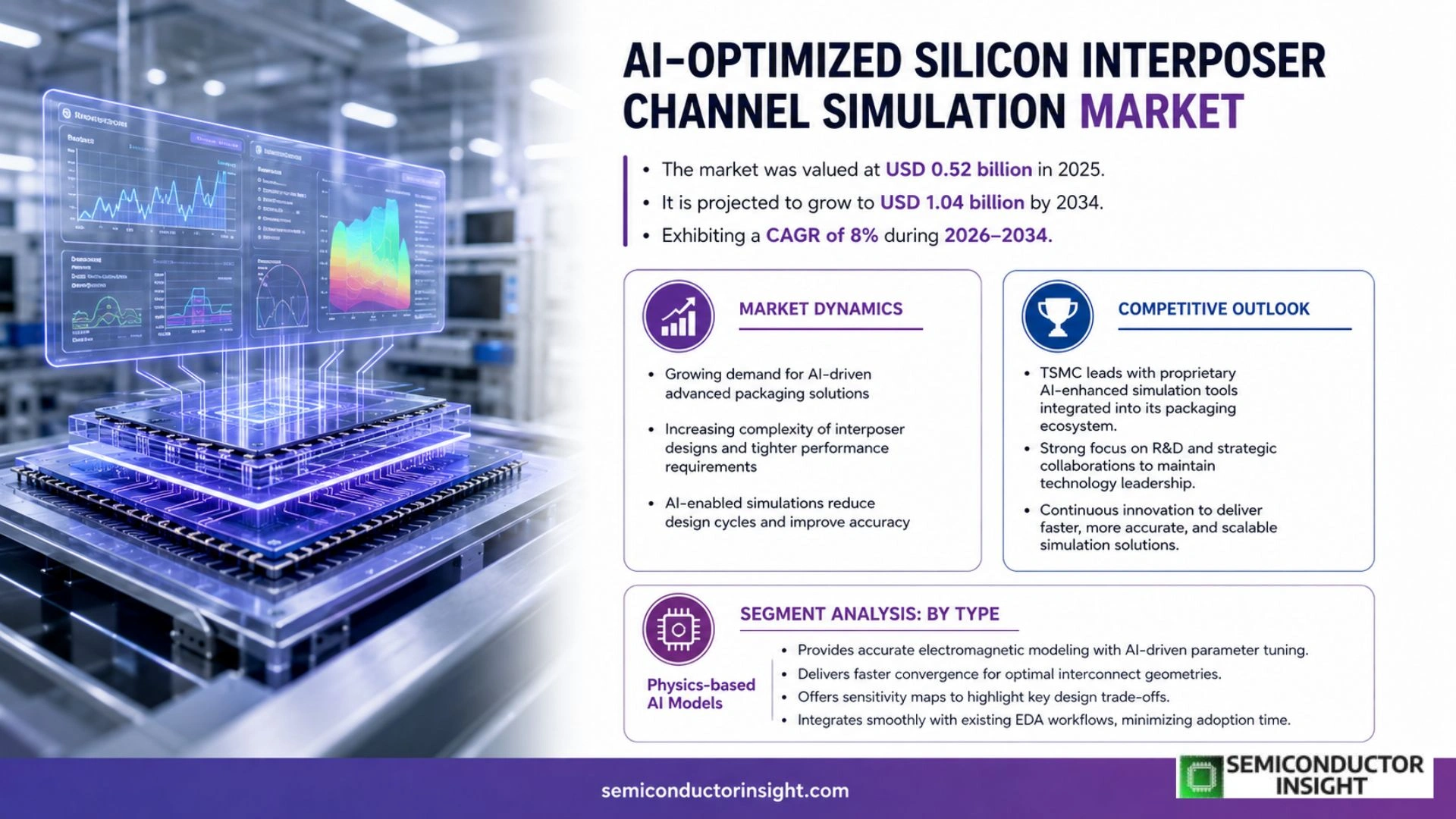
Global AI-Optimized Silicon Interposer Channel Simulation market size was valued at USD 0.52 billion in 2025. The market is projected to grow from USD 0.52 billion in 2025 to USD 1.04 billion by 2034, exhibiting a CAGR of 8 % during the forecast period.
This technology comprises AI‑driven computational models that predict signal integrity, power delivery and thermal performance across high‑density interconnects such as micro‑bumps and through‑silicon vias (TSVs). By leveraging machine‑learning algorithms on large datasets of silicon interposer designs, engineers can rapidly explore design alternatives, reduce prototype iterations and improve overall yield.
The market is experiencing rapid growth because semiconductor manufacturers are intensifying heterogeneous integration efforts to satisfy soaring AI workloads in data centers, while investments in advanced packaging,especially fan‑out wafer‑level packaging (FOWLP) and chiplet architectures,drive demand for precise channel simulation tools. Furthermore, strategic collaborations between leading EDA providers and AI specialists are expanding tool capabilities, and major players such as TSMC, Intel and Samsung are embedding AI‑optimized simulation suites into their design ecosystems.
MARKET DRIVERS
Rising Demand for High‑Performance Compute
The proliferation of AI workloads and data‑center scaling is compelling chip manufacturers to adopt silicon interposers that enable finer inter‑connect densities. AI‑Optimized Silicon Interposer Channel Simulation Market solutions provide predictive accuracy that shortens design cycles, allowing up to 30% faster time‑to‑market for next‑generation processors.
Advancements in AI‑Driven Modeling
Machine‑learning algorithms now automate electromagnetic analysis, reducing manual simulation effort by over 40%. This efficiency boost drives adoption across automotive, telecom, and high‑performance computing segments, where signal integrity is critical.
➤ Design teams report a 25‑35% reduction in prototype iterations when leveraging AI‑based channel simulation platforms.
Regulatory pressure for energy‑efficient electronics also spurs investment in AI‑enhanced simulation, as manufacturers aim to meet stringent power‑consumption targets while maintaining bandwidth.
MARKET CHALLENGES
Complexity of Multi‑Layer Interposer Designs
As interposer stacks exceed eight layers, the electromagnetic interactions become non‑linear, demanding higher computational resources. Even with AI assistance, simulation runtimes can extend beyond acceptable project windows, especially for early‑stage feasibility studies.
Other Challenges
Data Scarcity for Training Models
Accurate AI models rely on extensive measured datasets. Limited availability of high‑frequency test data hampers model generalization, forcing vendors to supplement with synthetic data that may introduce bias.
MARKET RESTRAINTS
High Capital Expenditure for Tool Integration
Implementing AI‑optimized simulation suites requires significant upfront investment in software licences, GPU clusters, and skilled personnel. Many mid‑size fabless companies cite budget constraints as a primary barrier to adopting these advanced solutions.
MARKET OPPORTUNITIES
Emergence of Cloud‑Based Simulation Services
Subscription‑model cloud platforms that deliver AI‑enhanced channel simulation on demand are lowering entry costs and expanding the addressable market. This trend is projected to capture over 15% market share within the next three years, especially among startups targeting niche AI accelerator designs.
AI-Optimized Silicon Interposer Channel Simulation Market Trends
Accelerated Adoption Driven by Heterogeneous Integration
AI-Optimized Silicon Interposer Channel Simulation market is witnessing a pronounced shift as semiconductor manufacturers intensify efforts to integrate heterogeneous components. AI‑driven computational models now predict signal integrity, power delivery, and thermal performance across high‑density interconnects such as micro‑bumps and TSVs with a level of speed and accuracy that was previously unattainable. By applying machine‑learning algorithms to extensive design datasets, engineers can explore multiple architecture variants in a single workflow, dramatically shortening the time required to validate interposer channels. The practical impact is a measurable reduction in prototype iterations, leading to higher first‑time‑right yields and lower overall development costs. This trend is reinforced by the growing demand for AI‑centric workloads in data‑center environments, which pressurizes designers to adopt more efficient, AI‑optimized simulation tools.
Other Trends
Design Cycle Efficiency
One of the most tangible benefits observed across the industry is the compression of the design cycle. Traditional simulation approaches often required repeated manual tuning and extensive physical testing. In contrast, AI‑optimized platforms leverage predictive analytics to highlight potential failure points early, allowing design teams to prioritize corrective actions before silicon fabrication. The net effect is a tighter feedback loop between simulation and layout, which aligns with the broader push toward rapid time‑to‑market for advanced packaging solutions such as fan‑out wafer‑level packaging (FOWLP) and chiplet‑based architectures.
Strategic Alliances Expanding Tool Capabilities
Collaboration has emerged as a secondary yet equally important driver. Leading EDA vendors are forging partnerships with AI specialists to embed deep‑learning modules directly into their simulation suites. These alliances are not merely contractual; they result in co‑developed features that improve model fidelity, automate data preprocessing, and introduce adaptive learning mechanisms that evolve with each new design project. Major foundries,including TSMC, Intel, and Samsung,have begun integrating these AI‑enhanced tools into their internal design ecosystems, effectively setting a new industry benchmark for simulation precision. As these strategic relationships mature, the market can expect a steady stream of capability upgrades that further streamline interposer development and reinforce the value proposition of AI‑optimized simulation.
COMPETITIVE LANDSCAPE
Key Industry Players
AI-Optimized Silicon Interposer Channel Simulation: Market Dynamics and Competitive Outlook
TSMC remains the dominant force in the AI‑optimized silicon interposer channel simulation market, leveraging its extensive foundry ecosystem and deep investment in AI‑enhanced design‑for‑manufacturing tools. By embedding proprietary machine‑learning models within its advanced packaging flows, TSMC offers customers a unified simulation environment that spans micro‑bump extraction, TSV impedance, and thermal diffusion analysis. Intel follows closely, integrating AI‑driven channel simulators into its silicon photonics and heterogeneous integration roadmaps, thereby delivering faster time‑to‑market for data‑center chiplets. Samsung’s EDA suite also capitalizes on AI to automate layout‑aware signal‑integrity assessments, positioning the company as a critical enabler for next‑generation high‑bandwidth memory stacks. Collectively, these tier‑one manufacturers shape a market structure where vertically integrated AI capabilities create high entry barriers, while collaborative partnerships with EDA vendors further concentrate value creation among a few global players.
Beyond the three incumbents, a cohort of niche specialists contributes differentiated expertise. Cadence Design Systems and Synopsys have extended their flagship simulation platforms with AI modules that target interposer routing optimization and power‑delivery network prediction. Ansys, through its HFSS and RedHawk portfolios, delivers physics‑accurate thermal‑electrical co‑simulation enhanced by deep‑learning surrogates. Mentor, now part of Siemens EDA, focuses on AI‑augmented verification for heterogeneous integration. Applied Materials and Lam Research supply AI‑powered metrology and etch‑process analytics that feed back into simulation loops, improving model fidelity. KLA Corp offers defect‑detection AI that indirectly refines channel reliability assessments. Emerging firms such as Altair (HyperWorks) and Keysight Technologies provide cloud‑based AI simulation services that lower adoption costs for mid‑size design houses. This diversified ecosystem of specialist vendors sustains competitive pressure and drives continuous innovation across the value chain.
List of Key AI-Optimized Silicon Interposer Channel Simulation Companies Profiled
- TSMC
- Intel
- Samsung
- GlobalFoundries
- Cadence Design Systems
- Synopsys
- Ansys
- Siemens EDA (Mentor Graphics)
- Applied Materials
- Lam Research
- KLA Corporation
- Altair Engineering
- Keysight Technologies
Segment Analysis:
| Segment Category | Sub-Segments | Key Insights |
| By Type |
|
Physics‑based AI Models are emerging as the foundational approach for channel simulation because they preserve rigorous electromagnetic theory while embedding AI‑driven parameter tuning. Key observations include:
|
| By Application |
|
Signal Integrity Simulation drives most investment because high‑density interposers demand precise eye‑diagram forecasts. Insights include:
|
| By End User |
|
Semiconductor Foundries are the dominant end‑users, leveraging AI‑optimized simulation to differentiate their advanced packaging services. Key points:
|
| By Integration Approach |
|
Chiplet Co‑Design is rapidly gaining traction as manufacturers adopt modular architectures. Observations include:
|
| By Tool Capability |
|
Full‑Stack Simulation Suite offers the most comprehensive capability set, integrating signal, power, thermal, and reliability analyses under a unified AI framework. Key insights:
|
Regional Analysis: AI-Optimized Silicon Interposer Channel Simulation Market
North America
The integration of machine learning models into layout automation tools has streamlined the creation of interposer channels, allowing designers to predict routing complexities and thermal profiles with higher confidence. This capability reduces iterative loops and accelerates the overall design workflow.
Universities and specialized training programs in the United States are producing engineers proficient in both AI techniques and high‑frequency interconnect design, ensuring a steady pipeline of expertise for the market.
Partnerships between leading EDA vendors and AI startups foster co‑development of simulation kernels, creating a collaborative environment that accelerates technology transfer and product readiness.
Government initiatives that fund advanced semiconductor research and provide tax incentives for AI integration help sustain investment momentum across the value chain.
Europe
European semiconductor hubs such as the German automotive cluster and the French microelectronics ecosystem are rapidly incorporating AI‑optimized simulation into their design processes. While the region lags behind North America in sheer volume, it compensates with strong standards‑driven collaboration and a focus on sustainable manufacturing practices. Companies are adopting AI to enhance electromagnetic compatibility analysis and to meet stringent EU regulations on energy efficiency. Collaborative research projects funded by the EU Horizon programmes are driving open‑source AI models that can be tailored for interposer channel challenges, fostering a more inclusive innovation landscape across member states.
Asia‑Pacific
The Asia‑Pacific market is characterized by aggressive scaling of fabrication capacities in Taiwan, South Korea, and China. AI‑optimized simulation tools are becoming essential for managing the complexity of advanced packaging technologies prevalent in this region. Manufacturers are leveraging AI to predict yield impacts and to fine‑tune signal integrity across densely packed interposer arrays. Although data privacy concerns occasionally hamper cross‑border AI model sharing, regional consortia are emerging to establish common frameworks that balance innovation with regulatory compliance.
South America
South America remains an emerging participant in the AI‑Optimized Silicon Interposer Channel Simulation Market. Brazil’s growing electronics design community is beginning to explore AI‑enhanced simulation as a way to leapfrog traditional design cycles. Limited local expertise is being addressed through partnerships with North American and European firms, bringing advanced methodologies to regional engineers. Investment in educational programs focused on AI and high‑frequency design is expected to gradually elevate the market’s maturity.
Middle East & Africa
In the Middle East and Africa, market activity is primarily driven by research institutions and niche design houses that are experimenting with AI‑based simulation for specialized applications such as aerospace and defense. While overall adoption is modest, strategic government funding in the United Arab Emirates and select African tech hubs is nurturing early‑stage talent. Collaborative initiatives with global technology providers are helping to introduce best practices and to lay the groundwork for broader market participation in the coming years.
Report Scope
This market research report provides a comprehensive analysis of the AI-Optimized Silicon Interposer Channel Simulation Market , covering the forecast period 2026–2034. It offers detailed insights into market dynamics, technological advancements, competitive landscape, and key trends shaping the industry.
Key focus areas of the report include:
- Market Overview: The report begins with an overview outlining its current market scenario, key growth indicators, and industry transformation drivers. It discusses macroeconomic factors, demand–supply balance, regulatory landscape, and the strategic role of semiconductors in powering advancements across industries such as automotive, telecommunications, consumer electronics, and industrial automation.
- Market Size & Forecast: Historical data and future projections for revenue, unit shipments, and market value across major regions and segments.
- Segmentation Analysis: Detailed breakdown by product type, technology, application, and end-user industry to identify high-growth segments and investment opportunities.
- Regional Insights: Insights into market performance across North America, Europe, Asia-Pacific, Latin America, and the Middle East & Africa, including country-level analysis where relevant.
- Competitive Landscape: Profiles of leading market participants, including their product offerings, R&D focus, manufacturing capacity, pricing strategies, and recent developments such as mergers, acquisitions, and partnerships.
- Technology Trends & Innovation: Assessment of emerging technologies, integration of AI/IoT, semiconductor design trends, fabrication techniques, and evolving industry standards.
- Market Drivers & Restraints: Evaluation of factors driving market growth along with challenges, supply chain constraints, regulatory issues, and market-entry barriers.
- Stakeholder Insights: Insights for component suppliers, OEMs, system integrators, investors, and policymakers regarding the evolving ecosystem and strategic opportunities.
Primary and secondary research methods are employed, including interviews with industry experts, data from verified sources, and real-time market intelligence to ensure the accuracy and reliability of the insights presented.
FREQUENTLY ASKED QUESTIONS:
What is the current market size of AI-Optimized Silicon Interposer Channel Simulation Market?
-> AI-Optimized Silicon Interposer Channel Simulation market is projected to grow from USD 0.52 billion in 2025 to USD 1.04 billion by 2034, exhibiting a CAGR of 8 % .
Which key companies operate in AI-Optimized Silicon Interposer Channel Simulation Market?
-> Key players include Axalta Coating Systems, AkzoNobel, BASF SE, PPG, Sherwin-Williams, and 3M, among others.
What are the key growth drivers?
-> Key growth drivers include railway infrastructure investments, urbanization, and demand for durable coatings.
Which region dominates the market?
-> Asia-Pacific is the fastest-growing region, while Europe remains a dominant market.
What are the emerging trends?
-> Emerging trends include bio-based coatings, smart coatings, and sustainable rail solutions.
Get Sample Report PDF for Exclusive Insights
Report Sample Includes
- Table of Contents
- List of Tables & Figures
- Charts, Research Methodology, and more...
 Download Sample Report PDF